Here Are The Latest Moves In Fiji
p. 17 · Read in the full issue
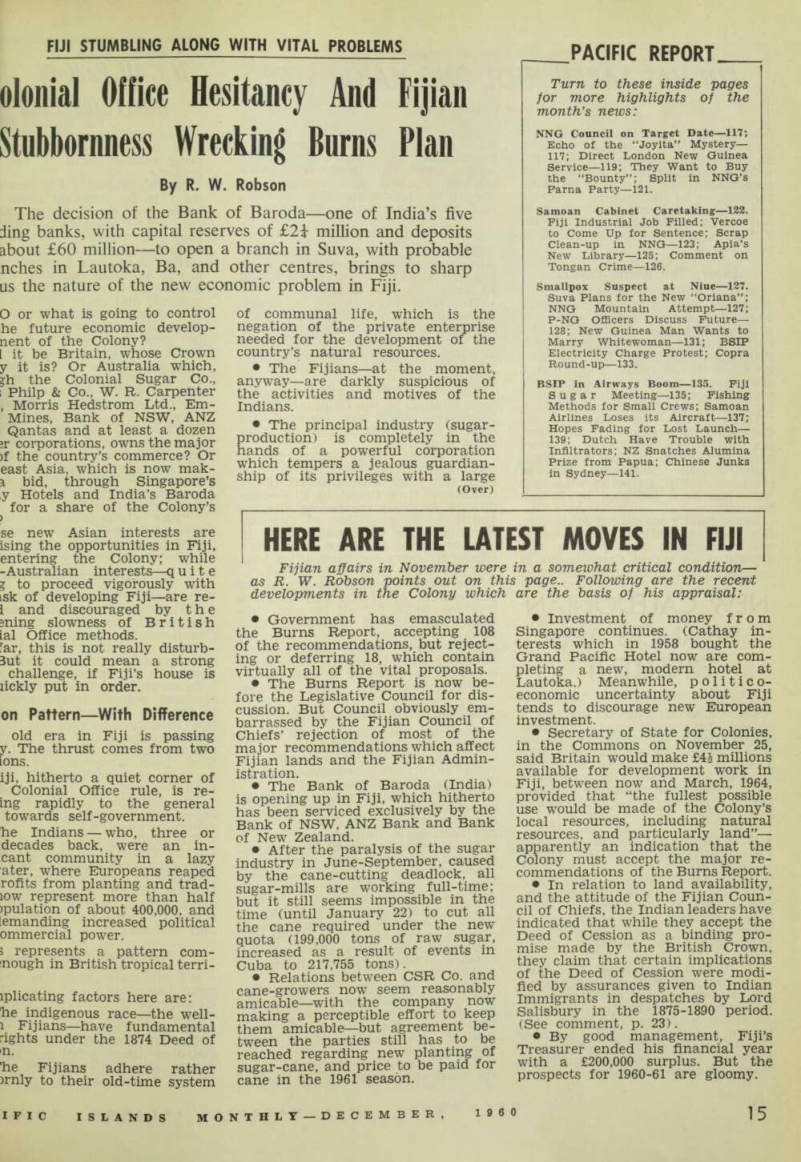
Fijian affairs in November were in a somewhat critical condition— as R. W. Robson points out on this page.. Following are the recent developments in the Colony which are the basis of his appraisal:
• Government has emasculated the Burns Report, accepting 108 of the recommendations, but rejecting or deferring 18, which contain virtually all of the vital proposals. • The Burns Report is now before the Legislative Council for discussion. But Council obviously embarrassed by the Fijian Council of Chiefs’ rejection of most of the major recommendations which affect Fijian lands and the Fijian Administration • The Bank of Baroda (India) is opening up in Fiji, which hitherto has been serviced exclusively by the Bank of NSW, ANZ Bank and Bank of New Zealand. • After the paralysis of the sugar industry in June-September, caused bv the cane-cutting deadlock, all sugar-mills are working full-time; but it still seems impossible in the time (until January 22) to cut all the cane required under the new quota (199,000 tons of raw sugar, increased as a result of events in Cuba to 217,755 tons). • Relations between CSR Co. and cane-growers now seem reasonably amicable—with the company now making a perceptible effort to keep them amicable—but agreement between the parties still has to be rparhed regarding new planting of sSar-canl Ind price to be paid for canf ifthe 1961 P P
• Investment of money from Singapore continues. (Cathay in terests which in 1958 bought the Grand Pacific Hotel now are com pleting a new, modern hotel at Lautoka.) Meanwhile, politico economic uncertainty about Fiji tends to discourage new European investment. • Secretary of State for Colonies, in the Commons on November 25, said Britain would make £4J millions available for development work in Fiji, between now and March, 1964, provided that “the fullest possible use would be made of the Colony’s local resources, including natural resources, and particularly land”— apparently an indication that the Colony must accept the major re commendations of the Bums Report, • In relation to land availability, and the attitude of the Fijian Coun cil of Chiefs the Indian leaders have indicated that while they accept the Deed of Cession as a binding pro mise made by the British Crown, they claim that certain implications of the Deed of Cession were modi fied by assurances given to Indian Immigrants in despatches by Lord Salisbury m the 1875-1890 period, (See comment, p. 23). ° By good management, Fiji s Treasurer ended his financial year with a £200,000 surplus. But the prospects for 1960-61 are gloomy.