The Month's New Reading
pp. 86-97 · Read in the full issue

With Judy Tudor
New Guinea's Got A Lot Of What It's Got
Papua-New Guinea has volcanoes, kuru (or laughing death disease), Cargo Cults, cannibalism, sorcery, tribal fighting and visits from UN Trusteeship Council delegations, but fortunately for the sanity of the District Commissioners concerned, they seldom occur in the same district, all at the same time. Except in Jon Cleary’s latest novel North from Thursday.
BUT don’t get us wrong; the novel as a story—even as a story about New Guinea —is good entertain ment value and might even end up where four of this author’s other books have ended—as movies.
Further, although purists amongst Territorians may consider that he gave himself a bit too much of a ball with the pestilences that over whelmed the tiny outpost of Kundavi (in the Eastern High lands), most will be prepared to admit that he had a keen eye for “the types”.
Jon Cleary first hit the literary jack-pot with a war novel about New Guinea (The Climate of Courage ) that won a Sydney Morning Herald award some years ago. As he served in New Guinea himself, presumably the story was based on his own experiences there.
But comparing his first New Guinea novel with the current model, his improvement in writing technique and characterisation are quite startling.
His Women are Better Even his female characters, who used to act like lay-models he borrowed from a department store, now draw near-enough to real breath although they are still apt to be products of man’s conception of woman rather than woman’s conception of the same thing.
In order to gather material for North from Thursday, Cleary spent some time in 1958 living at a New Guinea patrol-post. It is probably his desire that none of the real residents of the Territory will be regarded as the prototypes of his fictional characters, that caused him to give his Assistant District Officer and Patrol Officer Un- Australian names like Roy Narvo and Frank Rossi, although when you add to these a Czecho-Slovak doctor and his fiancee who sud denly turns up direct from Prague, and a Polish pilot, you have the basis of a small community that sounds more like a blown-away part of the international set rather than a NG patrol-post. Not that
New Australian doctors and pilots are novelties in the Territory, of course.
Kundavi is a small post on the outer fringe of what in P-NG official parlance would be designated “under influence” but not under full Administration control.
The Cast
The inhabitants, when our story opens, are: The ADO—an uninhibited Aus tralian who has never bothered to polish off the rough edges, and whose lack of finesse and diplomacy have managed to crush a lot of Very Important Toes, but whose devotion to his people and his job is deep-rooted and sincere; an authentic enough type, if we may say so.
His Patrol-Officer, Rossi, who is
20 and acts it some of the time A young Czech doctor, Pe Traxal, who escaped from the Co' munists but who, although he 1 fought against it, feels superior and dislikes Australians. Throd the impending visit of the 1 delegation he hopes secretly ] get on side again with his count and to go home.
Joan Duggan, an embitter! spinster, nursing sister.
Eric Macy, the European medi assistant, and his suburban-mine wife, Bernice (they call each otl “darl”), and their young son Hai Jack Bermingham, an j prospector who has gone native the extent of legally marrying native woman and begetting th: children (and old prospectors i not typical of patrol-posts on 1 edge of “under influence” areas And lastly, Father Mike ShaT a lovable American, who knew tl he was a failure as a missions and knew that his Bishop a knew, but whose deep friends] with the ADO had, until then, sai him from the worst consequen of the fact.
Into this pot-pourri, dr< Elizabeth Palyardi, right out of 1 skies in a Cessna aircraft, to ma; the doctor with whom she h parted when he had escaped fn Czecho-Slovakia five years befon Deaths from kuru, pay-b£ murders and excursions i n cannibalism—as well as Peter’s a Elizabeth’s rapidly cooling 1( affair—enliven the days before I scheduled visit of the UN tea which is looked forward to by one but the doctor, and is treat
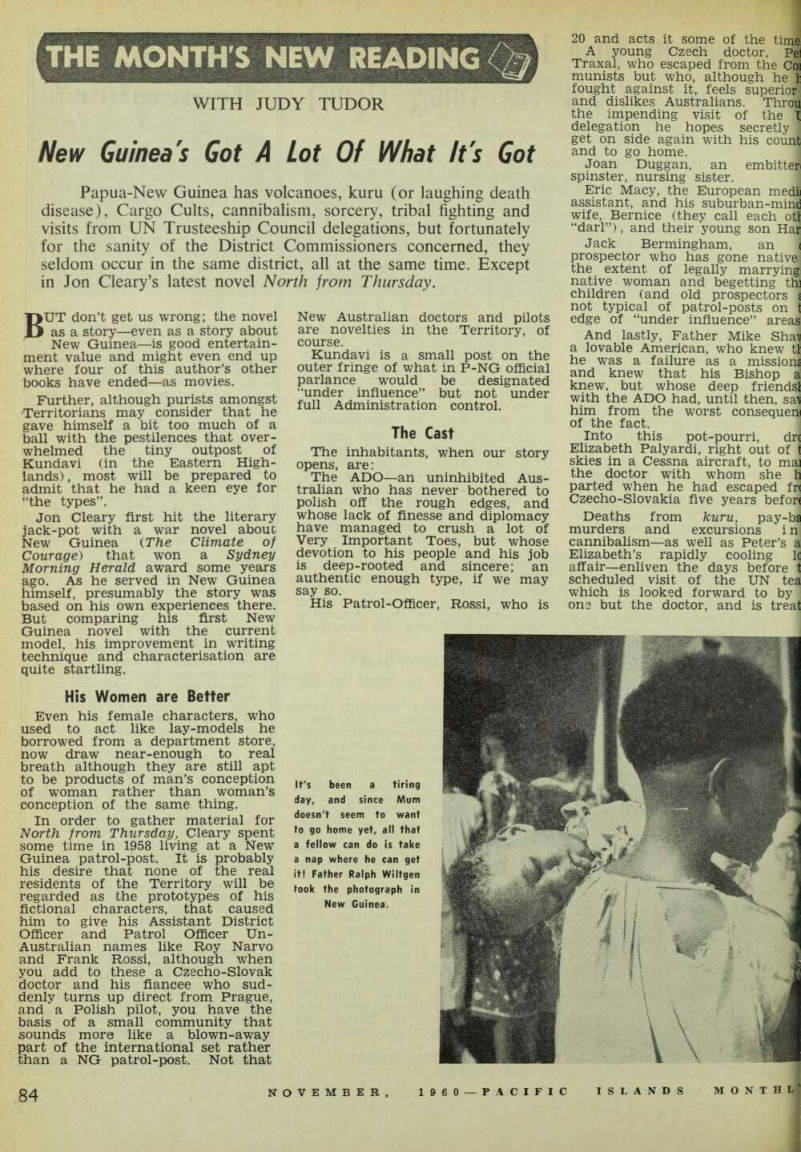
It's been a tiring day, and since Mum doesn't seem to want to go home yet, all that a fellow can do is take a nap where he can get it! Father Ralph Wiltgen took the photograph in New Guinea.
i the mixed contempt and ation that such visitations pro * in the Territory.
Saved by the Blast
; events turn out, the station pared the visit as the near-by ntain, after producing the usual s and portents, bursts out with iteral blast as Mt. Lamington ally did in Papua some years stripping a path for 50 miles killing all thereon. This event ddes a fitting climax to the ?1 as Narvo leads his small party Europeans and several thousand ves out through the valley of ;h to safety. (The airstrip went the tremors that accompanied eruption). eary has managed to produce novel without sentimental sense about the natives and al relations, or by making play Self-Government for the Terri —which would have been an ■ thing for him to do. e manages, too, to fuse into his f character the right blend of i-headedness and idealism for role he has to play. And, jrally, by his treatment of his ect, he might even be said to 3 done considerable good for the :itory by showing that New nea is still mainly a primitive itry, peopled by Stone Age Die who are as foreign to the listicated native minorities of coast as the Indians and sians and Latin Americans who lume to tell Australia how to its own business, he title of this novel simply ,ns “north from Thursday nd”, which while it conforms to current craze for “arresting” s, even if they don’t make much ;e in themselves ( Please Don’t the Daisies, The Summer of the enteenth Doll, etc.), is about as ' as they come, rhy the huge Territory of Papua -7 Guinea should be hitched to insignificant little island called irsday—even if it does happen to in the same general latitude — i matter which would need a ;ial-type publisher’s crystal to get the answer.
ORTH FROM THURSDAY. Published Wm. Collins, Ltd. Australian price, )
i'ou Would
io Sleep
IOSE! readers who may be tempted to read Anthony Powell’s Casanova’s Chinese taurant would be well advised ead first the article about same ;he September 26 issue of Time. he fortuitous stumbling on this your poor, bewildered reviewer, > was then struggling with this arently beginning-less and end
less piece of prose probably saved a nervous breakdown.
The clue to the mystery as supplied by Time is that this particular novel is just a fragment in the series The Music of Time. It is, in fact, the fifth novel, but Mr. Powell scorns the devices of lesser novelists who, from the creator of the Pollyanna series onwards, either produced stories with the same characters but “complete in themselves”; or gave the poor benighted reader some sort of inkling of what went on before.
To blunder into this fifth novel without prior tuition is like going into a dark movie theatre and trying to pick up the thread of a complicated melodrama three-parts way through the performance.
The business is not helped any by the writer’s style or his construetion of the so-called novel, which is, in fact, a prolonged conversation piece of only four chapters in 229 pages—a feat that leaves one metaphorically breathless.
The other novels that went before (A Question of Upbringing, A Buyer’s Market, The Acceptance World and At Lady Molly’s) apparently brought the narrator, Nick Jenkins, through school and university to the point where he is
melSTof
nVimpmn*mpmbpTof the TolKrd
Sl°^ooran^ e inM
"m hospital having a
m TOe r father of the brood. Lord Warminster, died in Kashmir while on a hunting trip; the dowager Lady Warminster lives at Hyde Park Gardens; and the young Lord Warminster is contemplating going
to Spain to throw his weight on. the side of the Republicans—the time of the current novel being around 1936-37.
But these things you learn only incidentally by following the con versations and flashbacks as our narrator meets, in pubs, at Lady Warminster s Sunday luncheons, in the corridors of the nursing home or elsewhere, a mass of characters whom he obviously knows well but the reader not at all. They waft in and out of the narrative like nebulous wraiths, the author apparently being under the im pression that that is how characters waft in real life — Bo why not in a , , , ... T* l ® whole background is terribly and U, and upper-class jMlv, participants are troubled at that period by the neuroses of their class. They dabble m the Arts and isms, and espouse such causes as the Republican side £ the Spanish civil war while at ffe same supporting such as Etpn and
Oxf P r ?J2S*
Jnst before World War II was a
Sappy
tnese P OOl nnnappy h nll£ni< , + iournaK
as mTSef
Spectator, New Statesman, etc., *£*■***.
Action * sev f al generations.
Reserving to myself the belief that the more erudite the reviewer, the more ready he is to pronounce the mcomprehensible brilliant I would not dare to contradict my
learned colleagues when I in so late to the party, any sensible comment could ade to this present fifth seg of the saga, a working know of the four other pieces that before is essential, vever, I will say that the drift uffocating cloud of words that >r Powell conjures up in the at instalment is the best ng potion I’ve discovered for g time.
Janova’S Chinese Restaurant.
ied by Heinemann. Australian price,
the Range
Into the Trees
NOVEL by a newcomer to le Australian writing frat mity, Gordon Robson, is with gimmick and cast in the ional form of pioneering story.
This Earth is, however, also on family history, Robson’s -grandfather having been the ir of a ship that transported loads of convicts to Van m’s Land. at-grandfather evidently i there later, as we find future ations of Robsons pushing off the Australian mainland, and ation by generation, getting as 3 Queensland.
Gordon of that ilk writes NSW in the years between J3o’s and 1840’s, when the eyes e first colonists—forced and -at Sydney Cove, turn west j vast plains that lie over the Mountains. ng Bob Murray and his wife join one of the first ex ons that travel over the range ittle, and through them we of the discomforts of the k wagons: experience the heat lust and storms of mountains plains; trouble with the ;ines; and the trials, joys and ations of the pioneer life, re is a wealth of subsidiary cters: Bob’s emancipist lawyer ather; Meg and her gang of ed convicts turned bush r; Kennedy, the handsome, uoyant leader of the bullock i train. Nonetheless, although agredients are all there, and ;ory is interesting enough and told, it somehow never quite js being superficial—perhaps se day to day encounters of personality with another are ;d to obscure what should be irger purpose of a community ig a piece out of the wilder for itself.
THIS EARTH. Published by Wm.
Ltd. Australian price, 20/-.)
i in Two-Levels
SIDERING who and what onald James McLean is, it ight have been expected that ould subscribe fully to the
?? e °ZiJ?r in today’s artistic circles in Australia that this continent of theslums Surrv HiUs and other non-bucolic subjects.
However, it is not so—in The Roaring Days, his third novel, the theme is mateship and the days when the bush was wide and open (except, of course, where there were gum trees).
Mr. McLean is a champion of progressive education; he’s President (Df the New Education Fellowship in Australia; editor of New Horizons m Education; Chief Lecturer in Child Welfare for the NSW department that deals with that subject; and has travelled
widely abroad and lectured there also, * But McLean was born in Western th f s W no a v n e ? abased to him by his father, and concern incidents around the turn of the century. Some of the yarns end on an anti-climatic note—which may be the author’s contribution to art in our times, but most of it can be regarded as good, typical Aus tralian story telling, with a slant of the author’s own.
In effect this is a sort of split level novel, in that it tells the yarns lan Stuart, the narrator, hears from his father about the old days in the outback, and at the same
; it tens lan Stuart’s own story, re is more of the former than latter for reasons McLean sets i early in the book, let rid of any notions about the of the outback being silent, ightful blokes who keep their ths shut,” he says. “That’s only flies. There may be quiet ricans, silent Slavs and ishmen given to understate t, but, given a listener, any ;ralian west of Nevertire will words as God meant them to ised—for life enhancement.” ; then goes on to prove his t with a bushman, squatting on leels, complete with map drawn le dirt, instructing the traveller to get from Broken Hill to oburra. n’s real story begins when he ands of his father, “Why ildn’t I kiss Mary”, and his er goes right back to Milparinka re World War I to show why houldn’t. The dual stories con -3 therefrom, taking lan through ol and college and overseas to bridge and service in the war- RAF (these two latter not be the usual lot of the typical ralian). uart, Senior, too, untypically of a heart attack on the night midget submarines raided ley Harbour in 1942, and from point where lan returns from war, the two stories merge, with outback of yesterday becoming outback of post-World War 11. fferent, of course, yet paradoxic similar and enduring, ith about 60 per cent, of Aus ans living in urban areas it can lly be said that the outback is typical. Yet that is still t marks the Australian story from others and Donald McLean devised a successful way of g it without the hayseeds or red dust showing.
IE ROARING DAYS. Published by Lilian and Co., Ltd. Australian price,
So Silent
Darien
E present-day Panamanian taxi iriver or tourist guide of Panama City tells you a dif it story about the exploits of :y Morgan than that in hren of the Coast, by P. K. p and Christopher Lloyd. Show pou some acres of obvious ruins w miles from the present city le Pacific entrance to the Canal, swear they were all the result [organ’s visit in 1671. nasty vicious type, your guide mfer, but doubtless what you i expect a country then on the jhold of its colonialism, to have uced. icy were probably correct about T—but according to our authors his account of the buccaneers, ig about his having deliberately
fired the town. There was, they say, nothing he could have desired less at that moment.
“Nevertheless, the city, built of cedar houses, was soon a flaming mass. As Morgan later reported: ‘Thus was consumed the famous and ancient city of Panama, which is the greatest resort for silver and gold in the whole world for its re ceives all the goods that come from Spain in the King’s great fleet and delivers all the gold and silver that comes from the mines of Peru and Potisi. Nothing remains today of Old Panama except the ruined tower that was once the largest cathedral in America.”
In order to attack Panama, Morgan and his men had to desert the Spanish Main for the nonce and walk across the Isthmus of Panama —where from a height, like “stout Cortez” is said to have done in the poem, they gazed at the Pacific for the first time. The last part of their journey into Panama was across a causeway and there at the end of it were drawn up 2,000 Spanish foot soldiers. 600 cavalry and a thousand wild bulls in charge of Indians. The bulls were by way of being the Spaniards’ secret weapon, but like Hannibal’s elephants in an earlier war, they turned out to be a mixed blessing.
The first volleys of the buccaneers scattered the bulls who turned and devastated the tight-packed Spanish lines. In two hours the battle for Panama had been won—by the buccaneers, who got out of hand and in the course of their pillaging accidently set the city on fire.
Brethren of the Coast is not, of course, only the story of Morgan; he has only a small part in this account of the wild men of the era when Spain had cornered the wealth of the New World and was fair game for all. Later, of course, these so-called buccaneers spilled out across the Pacific into the South Seas and in some cases inadvertently became discoverers and explorers.
The original buccaneers were not
as the modern usage of the term implies. They were French ad venturers, many of them escaped servants from French plantations, who began to settle on Tortuga, an island of what is modern Haiti.
They were, of necessity, hunters, and not sailors at all —attracted by the herds of boars and wild cattle that roamed the island. They dried the meat, which they cut in strips, by smoking it in dome-shaped huts called boucanes, and they sold the strips done up in bundles iviande boucanee ) to passing ships.
The men who produced this meat were called boucaniers, but gradu ally the name came to be corrupted to “buccaneers” ’and applied also to corsairs and privateers who roamed the Caribbean to loot, if they could, Spanish gold and riches.
The authors are well qualified to write a book of this sort. Kemp is a Lieutenant-Commander of the Royal Navy, now retired; and Pro fessor Christopher Lloyd has been on the staff of the Royal Navy College, Greenwich.
(The Brethren Of The Coast.
Published by Heinemann. Australian price, 26/-.)
In Orbit
With Emily
EMILY KIMBROUGH, the “other half” of Cornelia Otis Skinner with whom she wrote Our Hearts were Young and Gay, has squeezed more books out of travel in her own country than any six other writers.
Her current epic, however, is about that peculiar American social habit —the circulating lecturer — which is called appropriately enough, It Gives Me Great Pleasure.
As a book it isn’t particularly new, having been first published in the States about 16 years ago, while bits of it have graced the New Yorker, also. This is the first UK edition and while we are generally not fans of Miss Kimbrough this time her efforts do throw some light on what has always been a complete mystery the place of these perambulating lecturers in the American way of life.
Some people actually make a complete living by doing the lecture circuit dispensing enlightenment and amusement to mostly female audiences —members of some social club or other. The procession, ac cording to Kimbrough, can be politician, historian, economist, novelist, critic, musician, magician, dancer, interior decorator, fashion expert, or anyone else who has the material for one lecture. (One seems to be sufficient as the lecturer rarely if ever goes back over his tracks).
Recently a young woman ex journalist, who had somehow strayed from home and managed to break into the US lecture-circuit beat, gave some information on the phenomenon when she was inter
d on Sydney TV. It is a [singly lucrative business, ac ig to her, even allowing for the percentage that the agents as their rake-off. There are nain rules to the game—you be amusing (not just ha lve) ; and you must always your schedule even if you have *ak out your show-shoes and over the winter-bound es. This girl’s number-one e was a description of a bi trip around Australia; her i string, was about a walking into the territories between and Tibet. lecture tour business, as both nd Miss Kimbrough, explain, lighly organised one, and one ?e facet of it is that the can female’s thirst for know or entertainment of this sort ! only in the winter months, our Australian lass, even high expenses, seemed able to enough out of it in those is to be able to return home istralia to recuperate during f-season for culture. 3 Kimbrough’s story, of !, is an account of the odd to her) interesting things that n to her while in orbit but or nothing about what she ly lectures about.
Gives Me Great Pleasure,
ed by Heinemann. Australian price,
pope's Ordeal: One
is As One Weeps
of the most dramatic, but ast-known, incidents of the >uth Pacific War against the ese in 1942-45 was the seizure haul by the enemy; his osten s preparation of the port as sadquarters for the conquest istralia, New Caledonia, Fiji *ew Zealand; and—after his Lose scheme had failed—the i which he was neatly bottled Rabaul and contemptuously ssed by the American and ilian forces under General rthur. re was a period—about 1942ben the Japs, their south drive defeated, expected the to come and try to remove from Rabaul; and they pre accordingly. But the Allies r dropped bombs on them, they slowly degenerated from little military despots into led prisoners, living in holes ; ground on melons, kau-kau apioca. chroniclers saw all this, from inside namely Gordon as, editor of the Rabaul , who for some reason was n Rabaul as a freezer atten and Bishop Leo Scharmach, ■ Order of the Sacred Heart, isisted on remaining at Vuna with his missionaries as a elligerent, to care for the
Gordon Thomas told his story soon after the war.
Now, belated, but most welcome, comes Bishop Scharmach’s account of what he saw and experienced there, during the black-out, from the Jap invasion (January, 1942) to the arrival of the Australians in August, 1945—years of imprison ment, persecution and misery.
Right from the beginning, it was made clear that the Vunapope Mis sion would not be allowed to con tinue its work among the natives.
The Japs clearly wished to exter minate these Vunapope mission aries, just as they had systemati cally murdered or removed most of the Europeans they found in Rabaul.
The Bishop had a mixed com munity of about 330 Europeans and natives in the extensive Vunapope mission station; and he dedicated himself to the task of bringing them through the war alive.
To get the full account of how he employed wiles, stratagems, and courage to gain moral ascendancy over the bloody-minded enemy, to secure food and the even more vital medical supplies, to protect his men and women against intriguers, murderers and rapists, one must read the book.
The Bishop learned first-hand of massacres—of how 150 young Aus tralian men were systematically butchered at Tol Plantation, and 60 British officers were done away with at Matupi, for example—and he had direct evidence that the Japs were trying to “remove” his mission com munity, first by starvation and then by disease. So he knew what he had to meet; and the book tells dramatically how he met it.
In the latter part of the 3 h years, the Japanese ruefully acknowledged that they could not get rid of the Bishop’s party, and then they made a remark which meant “This Crowd Beats Us All”. The Bishop took this phrase as the title of his book.
Although it is a very grim and in places a horrible story, and is wholly a valuable contribution to the history of the South Pacific War, it also is excellent entertain ment.
This Bishop Scharmach is quite a man. Although formidable (as the Japs found) when he assumes the full role of Bishop and terrify ing when he really lets himself go in indignation and anger, he still is very tolerant of human weaknesses, and above all, he is a humorist. Even when he is de scribing very distressing things, his sense of humour peeps out. Thus it is a most readable and stimulating book.
One wonders how the Vunapope community came through such an experience with a comparatively small death-roll (Vunapope eventu ally was completely destroyed, and they were moved into Ramale Valley); but one can see how then morale was sustained bv this great natural leader. Even when they
starving on a restricted diet >ioca, they maintained dis and faith, tolerance and tumour. a remarkable story of how ised community can impro nd make do when cut off tely from normal supplies, ample, they provided them with soap, salt, tobacco, parts for machines, lighting il. Hungry for proteins, they happily on a tom-cat (fri -1 because he had developed Dnable habits). ly, the book confirms our impressions of the Japs we wartime in the South Paci- Jap we shall never forget; shop Scharmach met a few illy few! —who were merci d kind, and who gave him nal help. i ist in all libraries.—R.
Crowd Beats Us All. Pub
>y Catholic Press Ltd., Sydney, By Most Rev. Leo Scharmach, of Rabaul, and edited by John