His Wicked, Wicked Days
pp. 82-85 · Read in the full issue
Leaves from Errol Flynn's New Guinea Diary Selected by Stuart Inder
I amgoing and SpLlan like-ttfd t 0 rf° U ' d “ y life for me ‘
~ss tst ;SFr "
that man at wFi k busl " ess world which believes mat man at hard labour is the noblest work of God.
Leisure to use as I think fit!”
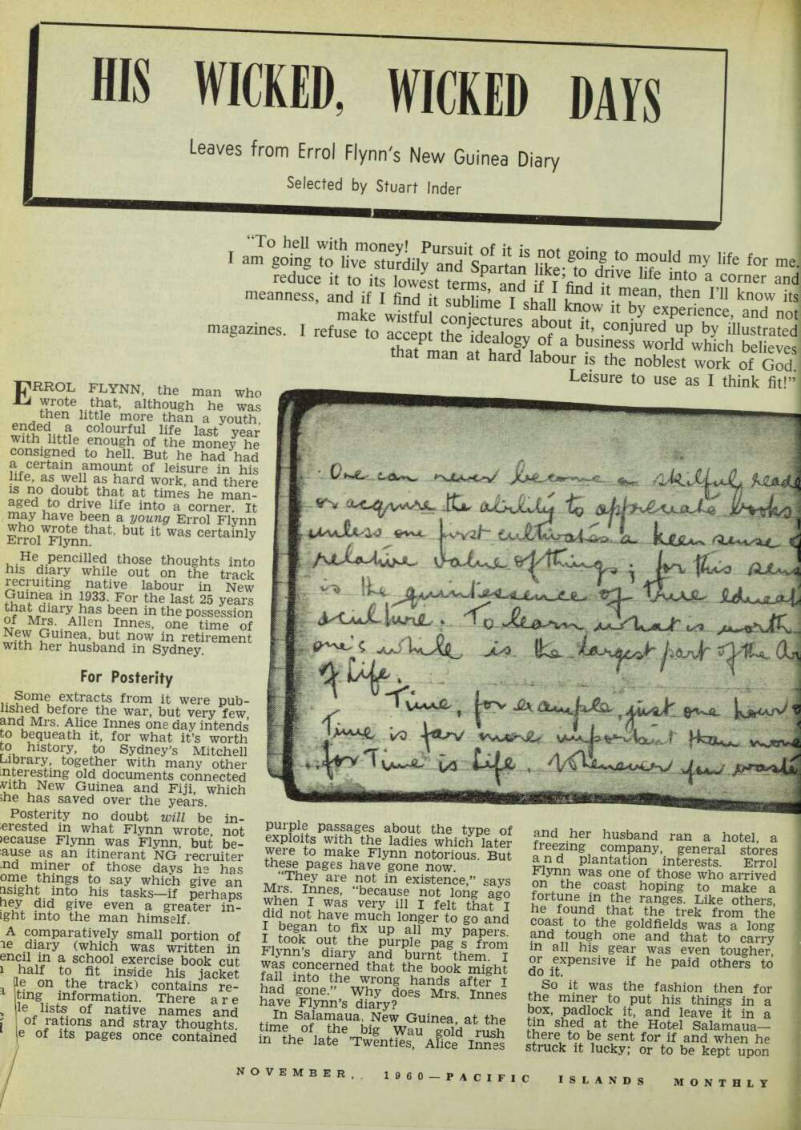
17RROL FLYNN, the man who !wrS at ' although he was then little more than a youth colourful life last year with little enough of the money he consigned to hell. But he had had a certain amount of leisure in his Me, as well as hard work, and there is no doubt that at times he man aged to drive life into a corner It may have been a young Errol Flvnn who wrote that, but it was certainly Errol Flynn. J He pencilled those thoughts into his diary while out on the track recruiting native labour in New Guinea in 1933. For the last 25 years a^/r^ as keen in the possession of Mrs. Allen Innes, one time of New Guinea, but now in retirement with her husband in Sydney.
For Posterity
Some extracts from it were pub lished before the war, but very few and Mrs. Alice Innes one day intends to bequeath it, for what it’s worth to history, to Sydney’s Mitchell Library, together with many other old documents connected vith New Guinea and Fiji, which me has saved over the years.
Posterity no doubt will be in erested in what Flynn wrote not >ecause Flynn was Flynn, but be cause as an itinerant NG recruiter md miner of those days he has ome things to say which give an asight into his tasks—if perhaps bey did give even a greater in ight into the man himself.
A comparatively small portion of ie diary (which was written in encil in a school exercise book cut i half to fit inside his jacket le on the track) contains re tmg mformation. There are , le lists; of native names and I of J a £ions and stray thoughts, e of its pages once contained
purple passages about the type of exploits with the ladies which later were to make Flynn notorious. But these pages have gone now.
They are not in existence,” says Mrs. Innes, “because not long ago when I was very ill I felt that I did not have much longer to go and I began to fix up all my papers I took out the purple pag s from flynns diary and burnt them I was concerned that the book might fall into the wrong hands after I had gone.” Why does Mrs. Innes have Flynn’s diary?
In Salamaua, New Guinea, at the of . £ he , bi S Wau gold rush m the late ’Twenties, Alice Innes
and her husband ran a hotel, a freezing company, general stores an d plantation interests. Errol Flynn was one of those who arrived on the coast hoping to make a fortune in the ranges. Like others, he found that the trek from the coast to the goldfields was a long and tough one and that to carry m all his 1 gear was even tougher, or expensive if he paid others to do it.
So it was the fashion then for the miner to put his things in a box, padlock it, and leave it in a tin shed at the Hotel Salamaua— there to be sent for if and when he struck it lucky; or to be kept upon
•eturn if he didn’t come out >p. nn was one of those who left x at Salamaua, It was still unclaimed in August, 1935, the Innes’ sold out. Flynn, no star then, had gone to Hong and he was not to come back ;w Guinea.
In the Box —Surprise!
3 Innes’ called in the District jr to officially take possession ose boxes for which no claim seemed to be now in the Terri- But when Flynn’s box was ;d there was a surprise for the Let Officer, and for the Innes’. contained few personal pos ms, and nothing of any value, box was filled with linen and s and sheets belonging to the Hotel Salamaua, all neatly id away by Flynn until the when he could have them sent
nto the ranges for his personal :ort! With the Innes’ sheets was Flynn diary. :s. Innes never destroyed it — iugh Flynn was a nobody then — use, she explains, “It wasn’t j to destroy and there were ; serious notes in it he may have bed to keep. He may have come . yy hen, years later, Flynn was a ywood somebody and Mrs. Innes
had more leisure of her own, she happened to take a holiday trip to America and took along the diary, too, with the object of returning it to him.
She expected he would remember her, and perhaps he did, but he wouldn’t see her. Thus the diary was returned to Sydney, where it has been ever since.
The diary of his recruiting trip in the Finschhafen area in 1933 was written in running form, but other parts of the book contain stray notes and comments, such as, “£1 returned from Gurung for dog”, and “Bill Stower and the egg trick on L. Bennet’s mary’s head”. Flynn alone knew what those meant, although by “mary” he means “meri”, or native woman. There is another one, “The time I passed Dusty Miller on a lorry in Madang with 11 boys for recruiting trip. He saw me when I waved, turned around and went into his house.”
[“Dusty” Miller, a well known old recruiter, died last year in Sydney.
L. Bennet presumably is Tiger Lil”, who much later married Dusty Miller.] Flynn’s spelling was frequently weak, although there was n °Ujing wrong with his construction, and he could express himself very well.
Here are some extracts from the diary:
Flynn On Seduction
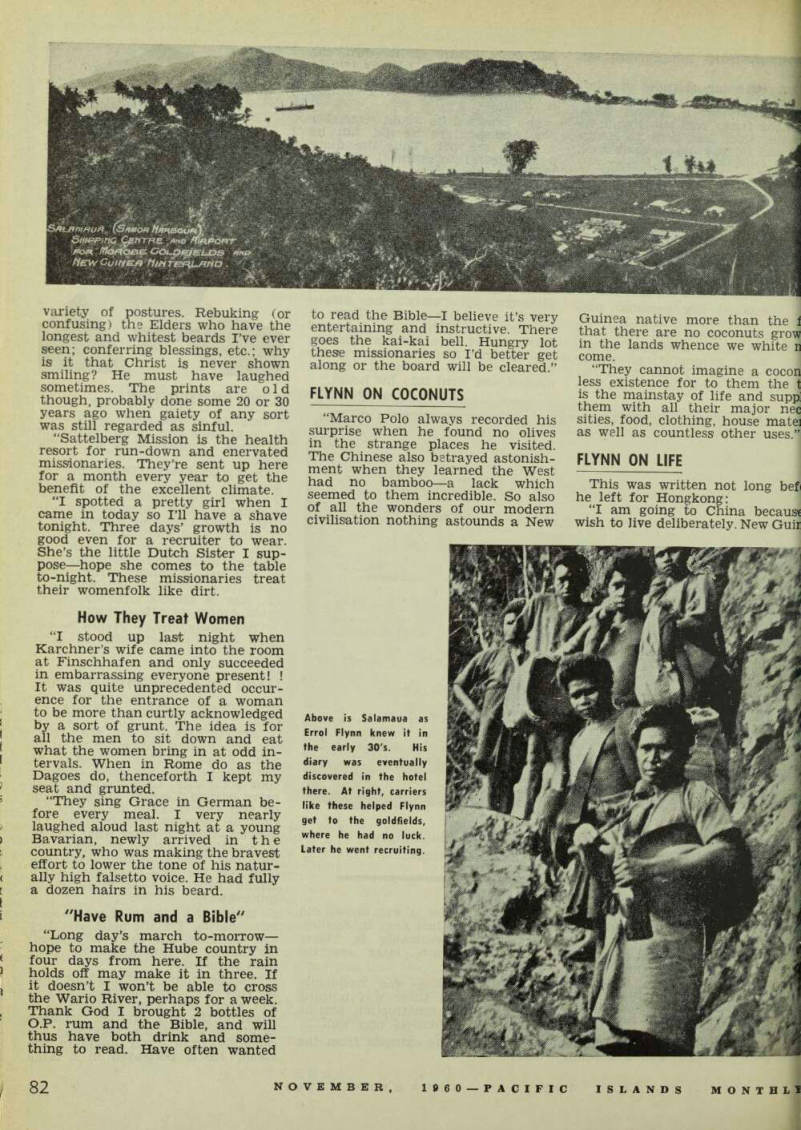
This is a notation, apparently made as some kind of an outline for an essay he intended to write. He says: “Essay on Several Don’ts in ‘The Art and Niceties of Seductipn’?
Compromising positions to avoid — avenues of escape must be arranged first. Avoid betraying astonishment at credulity of victim—even in the dark. Draw analogy between the mention of the word marriage and he who uses dynamite in exaspera tion after having failed with dry fly. Use of alcohol is to be depre cated except as a last resort”.
That essay, from Flynn, would have been a best-seller in later years.
Flynn On A Recruiting Patrol
Sattelberg Mission, January 13, 1933: “Arrived here at 5 p.m. after leav ing Finschhafen this morning at 10 a.m. Broke journey half-way at Yermen to give my boys time to cook some rice. Carriers would not carry beyond Yermen so paid them off and sent to Yehu for a new lot.
Cost of carrying very high in this district—they all know what money is. Sattelberg is 3,650 ft above sea level but commands wonderful out look over the sea—l can see Umboi Island from here—it must be 80 miles away.
“Queer lot these Lutheran missionaries. For the main part they are Germans but there is a small sprinkling of Australians of Ger man parentage.
“Father Holbig met me and gave me this room—very comfortable and Fm weary and a bit footsore as is usual on the first day out. Coloured prints of Christ are regarding me dolefully from every angle in the room. He is portrayed in a large
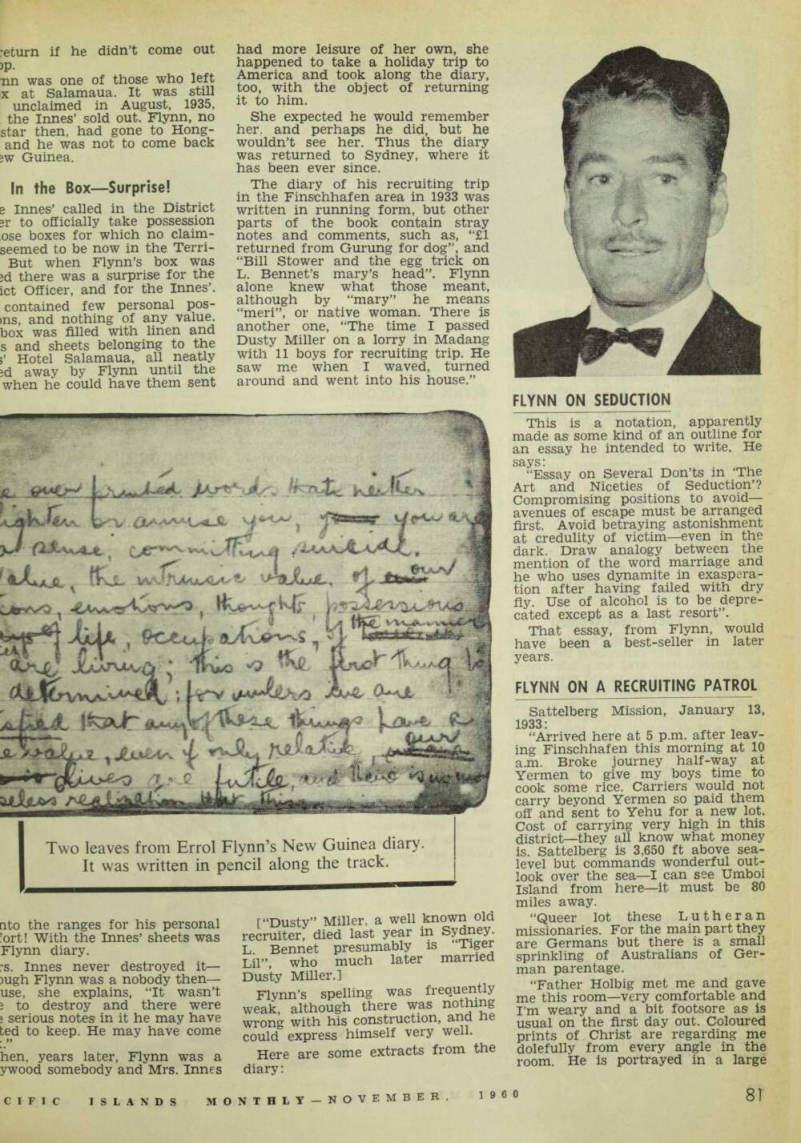
Two leaves from Errol Flynn’s New Guinea diary.
It was written in pencil along the track.
variety of postures. Rebuking (or confusing) the Elders who have the longest and whitest beards I’ve ever seen; conferring blessings, etc.; why is it that Christ is never shown smiling? He must have laughed sometimes. The prints are o 1 d though, probably done some 20 or 30 years ago when gaiety of any sort was still regarded as sinful.
“Sattelberg Mission is the health resort for run-down and enervated missionaries. They’re sent up here for a month every year to get the benefit of the excellent climate.
“I spotted a pretty girl when I came in today so I’ll have a shave tonight. Three days’ growth is no good even for a recruiter to wear.
She’s the little Dutch Sister I sup pose—hope she comes to the table to-night. These missionaries treat their womenfolk like dirt.
How They Treat Women “I stood up last night when Karchner’s wife came into the room at Finschhafen and only succeeded in embarrassing everyone present! !
It was quite unprecedented occur ence for the entrance of a woman to be more than curtly acknowledged by a sort of grunt. The idea is for all the men to sit down and eat what the women bring in at odd in tervals. When in Rome do as the Dagoes do, thenceforth I kept my seat and grunted.
“They sing Grace in German be fore every meal, I very nearly laughed aloud last night at a young Bavarian, newly arrived in the country, who was making the bravest effort to lower the tone of his natur ally high falsetto voice. He had fully a dozen hairs in his beard.
"Have Rum and a Bible"
“Long day’s march to-morrow hope to make the Hube country in four days from here. If the rain holds off may make it in three. If it doesn’t I won’t be able to cross the Wario River, perhaps for a week.
Thank God I brought 2 bottles of O.P, rum and the Bible, and will thus have both drink and some thing to read. Have often wanted
to read the Bible—l believe it’s very entertaining and instructive. There goes the kai-kai bell. Hungry lot these missionaries so I’d better get along or the board will be cleared.”
Flynn On Coconuts
“Marco Polo always recorded his surprise when he found no olives in the strange places he visited.
The Chinese also betrayed astonish ment when they learned the West had no bamboo—a lack which seemed to them incredible. So also of all the wonders of our modern civilisation nothing astounds a New
Guinea native more than the i that there are no coconuts grow in the lands whence we white n come.
“They cannot imagine a cocon less existence for to them the t is the mainstay of life and supp them with all their major nec sities, food, clothing, house mate] as well as countless other uses.”
Flynn On Life
This was written not long bef he left for Hongkong: “I am going to China because wish to live deliberately. New Guir
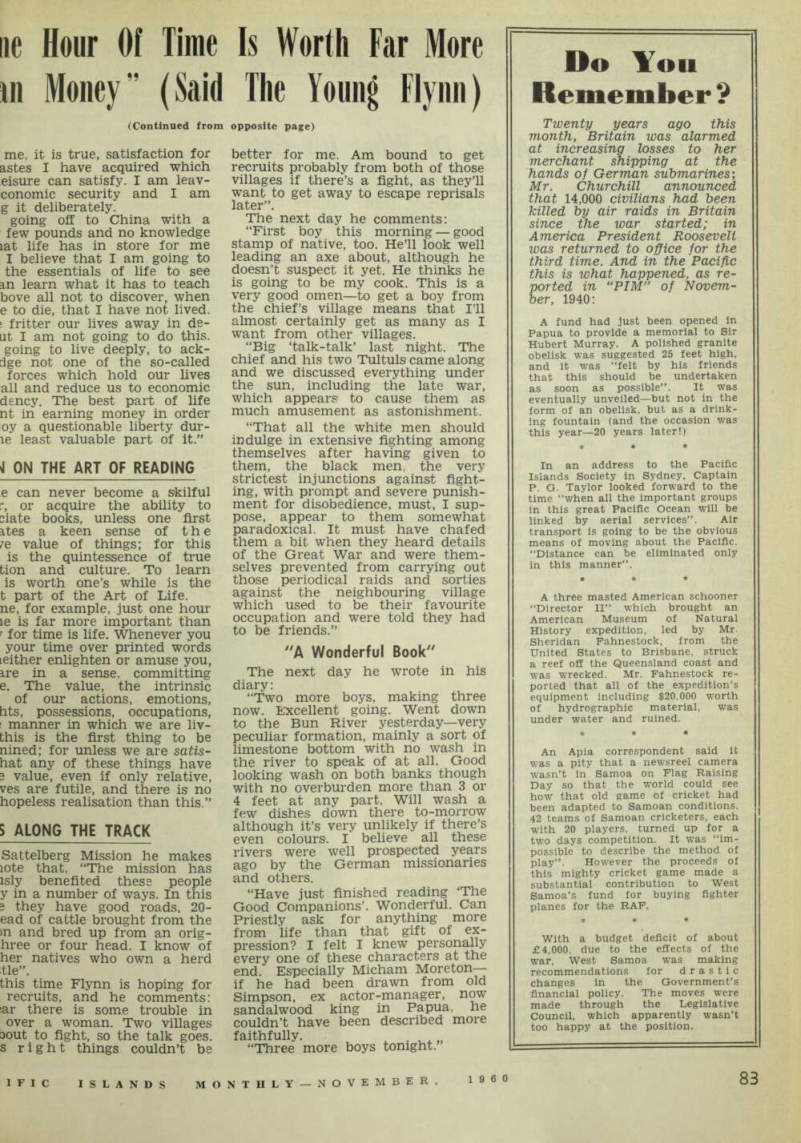
Above is Salamaua as Errol Flynn knew it in the early 30's. His diary was eventually discovered in the hotel there. At right, carriers like these helped Flynn get to the goldfields, where he had no luck.
Later he went recruiting.
Sala[?]Irur (Samor Harbour)
Shipping Centre And Airport
For Morobe Coldfielos And
New Guinea Minterland.
me, it is true, satisfaction for astes I have acquired which eisure can satisfy. I am leav conomic security and I am g it deliberately, going off to China with a few pounds and no knowledge lat life has in store for me I believe that I am going to the essentials of life to see an learn what it has to teach bove all not to discover, when e to die, that I have not lived. ! fritter our lives away in de nt I am not going to do this, going to live deeply, to ack dge not one of the so-called forces which hold our lives all and reduce us to economic dency. The best part of life nt in earning money in order oy a questionable liberty dur le least valuable part of it.”
A On The Art Of Reading
e can never become a skilful r, or acquire the ability to 2iate books, unless one first ites a keen sense of the re value of things; for this is the quintessence of true tion and culture. To learn is worth one’s while is the t part of the Art of Life, ne, for example, just one hour ie is far more important than r for time is life. Whenever you your time over printed words leither enlighten or amuse you, ire in a sense, committing e. The value, the intrinsic of our actions, emotions, hts, possessions, occupations, ! manner in which we are liv this is the first thing to be nined; for unless we are satis hat any of these things have 3 value, even if only relative, ves are futile, and there is no hopeless realisation than this.”
S Along The Track
Sattelberg Mission he makes lote that, “The mission has isly benefited these people y in a number of ways. In this 3 they have good roads, 20ead of cattle brought from the >n and bred up from an orig hree or four head. I know of her natives who own a herd tie”. this time Flynn is hoping for recruits, and he comments: iar there is some trouble in over a woman. Two villages 30Ut to fight, so the talk goes, s right things couldn’t be
better for me. Am bound to get recruits probably from both of those villages if there’s a fight, as they’ll want to get away to escape reprisals later”.
The next day he comments: “First boy this morning good stamp of native, too. He’ll look well leading an axe about, although he doesn’t suspect it yet. He thinks he is going to be my cook. This is a very good omen—to get a boy from the chief’s village means that I’ll almost certainly get as many as I want from other villages.
“Big ‘talk-talk’ last night. The chief and his two Tultuls came along and we discussed everything under the sun, including the late war, which appears to cause them as much amusement as astonishment.
“That all the white men should indulge in extensive fighting among themselves after having given to them, the black men, the very strictest injunctions against fight ing, with prompt and severe punish ment for disobedience, must, I sup pose, appear to them somewhat paradoxical. It must have chafed them a bit when they heard details of the Great War and were them selves prevented from carrying out those periodical raids and sorties against the neighbouring village which used to be their favourite occupation and were told they had to be friends.”
"A Wonderful Book"
The next day he wrote in his diary: “Two more boys, making three now. Excellent going. Went down to the Bun River yesterday—very peculiar formation, mainly a sort of limestone bottom with no wash in the river to speak of at all. Good looking wash on both banks though with no overburden more than 3 or 4 feet at any part. Will wash a few dishes down there to-morrow although it’s very unlikely if there’s even colours. I believe all these rivers were well prospected years ago by the German missionaries and others.
“Have just finished reading ‘The Good Companions’. Wonderful. Can Priestly ask for anything more from life than that gift of ex pression? I felt I knew personally every one of these characters at the end. Especially Micham Moreton — if he had been drawn from old Simpson, ex actor-manager, now sandalwood king in Papua, he couldn’t have been described more faithfully. . .
“Three more boys tonight.