Sydneysider Goes Walkabout
pp. 67-71 · Read in the full issue

The Legco Hits The Big Time
Port Moresby.
Port Moresby at present is dried out, brown, hot, horrible, rhe dust, in unpaved areas, swirls on the wind and covers every hing with a fine film of grit.
lIS is the end of the dry season, when leaves droop and fall and private gardens which five the benefit of the Territory’s y reticulated water scheme, stand like oases; and the sky is grey I black clouds build up around horizon with promise but never, ye t, quite come to anything. The y sky robs the harbour, and the f beyond, and the sea, of Port resby’s chief beauty—the vivid es and turquoise of its waters, [ere and there, a precocious nciana has burst into a canopy red and orange before its time; I a cascara is a pale-gold glory wisteria-like flowers; or a bou nvillea makes a splash of scarlet purple in the otherwise brown dscape.
Port Moresby They
II It “Spring”
’he pink and cream frangi inis bloom regardless of drought rocky ground—with leaves in ! private gardens—but without m in public places where there no garden-boy at the end of a ;e.
Iy hostess calls this “spring”, ere are other less picturesque nes for it; particularly, I ima e, if you happen to be a resident that ever-sprawling suburb that leard described the other day as e dust-bowl of Boroko”.
This is the Port Moresby that stralia’s Governor-General and lady, Viscount and Viscountess nrossil, saw on their first visit the Territory. And because of s visit, Port Moresby’s social ist —the female portion of it at y rate—was able to forget the 5t and the drought in a rash of v hats and dresses—to the in ite delight, I should think of the v establishments in this town it sell “models”.
The festivities that attended the Vice-Regal visit did a lot to re lieve the tedium of the dust and bareness of the End-of-the-Dry period; and no less so did the first appearance of the native elite, at evening occasions, in mess-jackets, cummerbunds and dress trousers.
This sort of thing has been going on elsewhere for a long time, but it is still new enough here to stop most Moresbyites in their tracks.
It may have been this that led a local scribe, in an excess of journalistic licence, to describe the evening garden-reception at Gov ernment House as “reminiscent of Old India”.
Pale hands I loved beside the Shalimar . . .
Where are you now? Where are you now . . . as the late Victorian poet or lyric writer had it.
Prophetic too, perhaps, in its last line, as according to some of the local quidnuncs there may be few pale hands left here in 10 years’ time.
This comparison of Papua-New
Guinea with India is not left en tirely to social-column writers; but the notion that the Territory may someday stand in relation to Aus tralia as India now stands in rela tion to the United Kingdom, is one of the many devices with which certain sections of the community are trying to reconcile the present with the unknown future.
I can’t, myself, see much consola tion in that comparison for the in dividual settler and small business man, although for the large cor porations there might be.
After the Vice-Regal party and the Parliamentary party from Can berra that attended the opening of the Legislative Council in its new home, had gone on its way (prob ably rejoicing), members of the Legislative Council—and others who have business with it during ses sions—took stock of their new abode.
The building itself is about 40
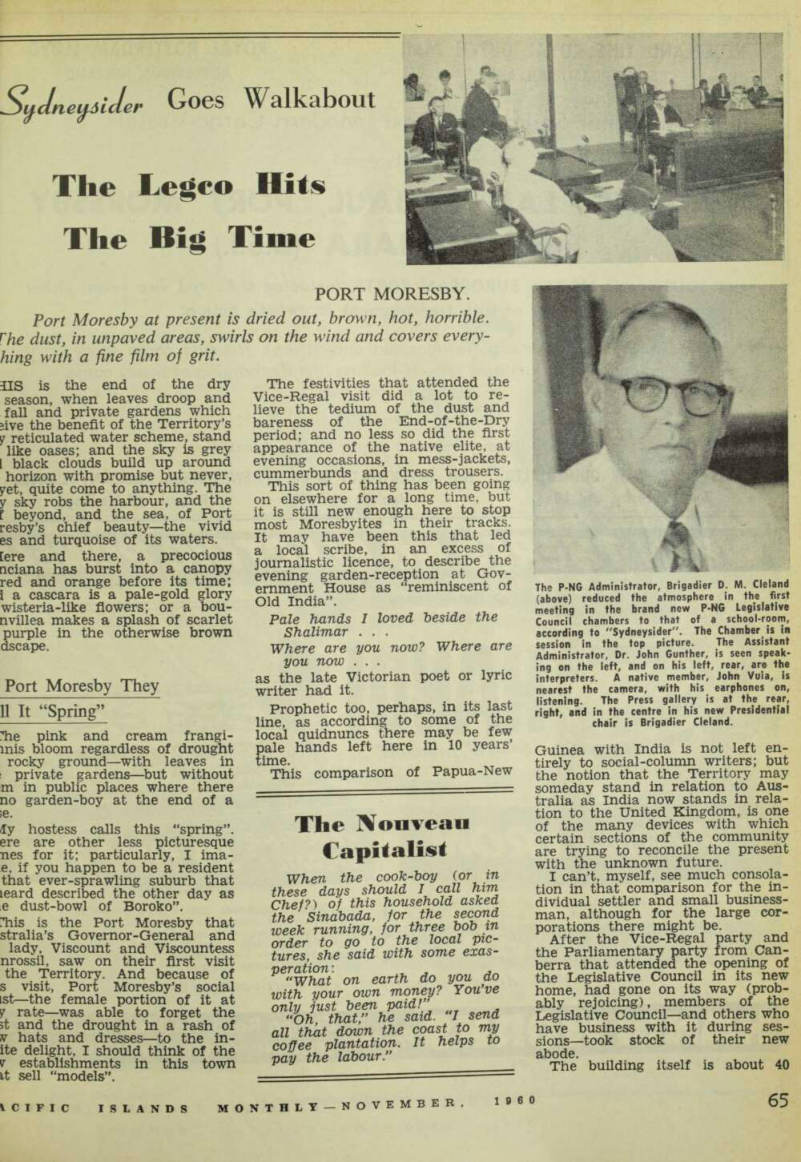
The P-NG Administrator, Brigadier D. M. Cleland (above) reduced the atmosphere in the first meeting in the brand new P-NG Legislative Council chambers to that of a school-room, according to "Sydneysider". The Chamber is in session in the top picture. The Assistant Administrator, Dr. John Gunther, is seen speak ing on the left, and on his left, rear, are the interpreters. A native member, John Vuia, is nearest the camera, with his earphones on, listening. The Press gallery is at the rear, right, and in the centre in his new Presidential chair is Brigadier Cleland.
rs old and was the old Euro n Hospital. However, by the ex iditure of about £56,000 it has i r been transformed inside; and side given a false front of lent blocks. The whole guts of old hospital have been torn and the arrangement now is huge Council Chamber in the itre, which is air-conditioned; I a series of outside rooms und that, that aren’t, a these outside rooms you can re or less be yourself; but the imber itself has suddenly be le a sort of sanctified ground— act that those who learned their iiamentary manners in the old ! Cross Hall at Ela Beach (which /ed as a Legislative Council imber for nine years) were slow appreciate. he President has proved more n equal to the task of educating m; and before the week was he had the whole thing re ed to the atmosphere of a very ct school-room. here was none of that unseemly laviour characteristic of the leral Parliament. Members did curse each other across the >r of the House, or slouch in ir seats, or leave in a body, ming; or curl up and snore.
They sat up straight, most decorously, and after the first day they wore their coats—not only because they were told to, be it said, but because these thinblooded Territorians found the airconditioning cold.
Father James Dwyer, whom we are used to seeing in an opennecked shirt with a small, gold cross on the collar, was hardly recognisable in dog-collar and black vest which occasionally found its way part way out of his coat as though seeking air.
During proceedings, apart from the voice of the individual speak-
ing—and, if you happened to be at the back of the Chamber, the low whispering of the interpreters into their mikes—the place had a church-like atmosphere, And, after Mr. Lloyd Hurrell, the member for NG Mainland, had been reprimanded for laughing out loud in derision at something the Assistant Administrator had said, I trembled for the fate of some members who stood up and spoke with their hands in their pockets; and particularly for Mr. Claude Champion who sat with his chair tilted back and his head on the wall. (Over)
Father James Dwyer.
Dr. John Gunther.
hroughout the proceedings I ected a roar from the Chair: up straight there, Claude. And 0 your head off that wall, if you ise—you’ll ruin the grey paint.” had my own brush with disaster ;n one morning I went through ide-door into the Chamber in d of through the back door into so-called Press gallery, to de r some papers to Mr. Hurrell. svas three-quarters of an hour >re proceedings were due to be there were only two people in place, and I thought I was 1 enough. ut, no. Don Barrett, member for Islands sighted me. “You’d er get out of here smartly,” he :. “If the Old Man sees you the floor of the Chamber he’ll e a piece of you.” prepared to exit through the r I’d come in. But that wasn’t j-t enough. “No, here,’ said Don, together like a couple escaping Gretna Green with the blood nds close behind, we stepped lot to the right over a piece of flex that trailed on the floor, so back onto unhallowed ground irved for people and peasants.
Director Adds a
te of Hilarity
he only time a dignified titter pt the Chamber was when the ictor of Agriculture, explaining operations of some of his traw , reported having dredged up Duple of “odd prawns”. Even in context in which it was said, vas not exactly killing, but in t gathering it was positively rious. liked this Director’s speeches. iy usually referred to providing rs for village pigs, or preserving ’s semen at 79 degrees below ), and brought an earthy atmo ere to proceedings that some es threatened to soar up into the itosphere of make-believe, here are many ways I could end
this report from Port Moresby. One by using the British Prime Minis ter’s phrase about the “winds of change”, which has been worn to shreds and trampled to death here in the past week. But sic transit gloria mundi, an even more ancient number, might suit old Territorians better.
They regret the passing of what they believe was the glory of the old way of life; and even if they are (as the Assistant Administrator has told them they are) fools and idiots, they find it difficult to ad just themselves to the new kind of thinking.
Some of these are taking the only way out—getting out. Whether this will be a good thing for the new
New Guinea (as the New Thinkers suppose) history will in due time record.
And out of it all comes only one self-evident truth: Blessed is he in these latter days who has no private capital in P-NG and who can, indeed, go when he listeth. t Chief Judge C. J. Stace, of the Cook Islands, who took up his ap pointment there earlier this year with the option of withdrawing after six months if he so decided, has resigned; but is to remain in office until he can be replaced. It was anticipated, however, that he would be returning to New Zealand by the end of the year.
Major Don Barrett.