Fitting Courtesy
pp. 59-62 · Read in the full issue
Director in Defence of Fiji Graduates They're Doctors As A Fitting Courtesy
When isn’t a doctor? A commentary on page 25 of the August “PIM”, discussing whether the title of doctor should be iven to graduates of the Central Medical School, Suva, has rought this spirited reply from Dr. P. W. Dill-Russell, Director f the Fiji Medical Services, who is also Inspector-General of ic South Pacific Health Service.
:E basis of PI M’s commentary was that the Central Medical School graduates were doing a gnificent job” but that they ,’t need any European handle doctor” to bolster their prestige.
Dill-Russell says that in most ts arguments the commentary “so far off the mark” that he impelled to provide the correct □nation in the hope that PIM find some way of repairing the age done to the reputation of graduates of the Central Medi- School”. ; continues:— le Medical School in Fiji was ded in the year 1886, it had its beginnings as early as 1883, it was in the latter year that jmatic three-year training was ;ed, and in 1888 the necessary lation was passed in Fiji to per those trained to practise medi-
To quote from the booklet of Dr.
Hoodless (principal of the school from 1930-1946) on the value of the scheme of training:—‘lf proof were needed of the success of the early type of medical training the record of NMP Sowane Puamau who qualified in 1899 would be sufficient.
After his training period he served for a short time in Fiji and was then transferred to the Gilbert Islands. There he was a complete success. Even the Europeans in the Islands regarded Sowane as their doctor, and his medical knowledge and his conscientious performance of duties endeared him to all races alike.’
It Blossomed Forth
In 1928, through the generosity of the Rockefeller Foundation, new buildings were erected and the School blossomed into a training centre for students from all the island territories in the South Paci fic, being designated the Central Medical School. In 1953 more spacious accommodation, with laboratories, dissecting rooms, lec ture rooms and students’ living quarters, were constructed and offi cially opened by the Queen.
As the basic education of students and the facilities for teaching im proved, so did the standard of training rise and the length of the medical course become extended.
As stated, the original course was one of three years, but in 1931 the length of the course became four years, and in 1951 it was increased to five years.
In addition, in many of the terri tories, particularly where there are possibilities of higher level train ing, the graduate remains as an intern of a major local hospital for a further year before official regis tration. (This requirement is writ ten into the law in Fiji).
The education qualifications re quired for entry to a medical school, the length of training and the methods of teaching medicine, vary considerably from one country to another and I would suggest that your correspondent might, with profit, consult the World-Directory of Medical Schools, in which there is a section devoted to the Central Medical School, Fiji, published by the World Health Organisation.
The legal requirements for the registration as a medical practi tioner also vary considerably from one country to another, but in point, of fact nearly all the island terri tories in the South Pacific have legislation under which the gradu ates of the Central Medical School,.
Fiji, may be registered to practise within the island territories area.
BMA Can't License I feel that I should point out that the British Medical Associa tion is, as its name makes clear, an Association, and has no powers to license or register medical prac titioners on a statutory basis. There is no compulsion on a medical prac titioner to join the British Medical Association, membership being en tirely voluntary.
Thus, any suggestion made by your correspondent that the British Medical Association does not recog nise graduates of the Central Medi cal School in Suva as eligible to join the Association is entirely irrelevant.
There are registering authorities in each territory, and, even within the Commonwealth, there are a number of universities, medical schools, and colleges the graduates from which are not eligible for registration as medical practitioners on a Commonwealth-wide basis.
Qualifications Vary
Further, the recognition of the medical qualifications granted in one country by the registering authorities in another is dependent entirely upon international agree ment and local legislation, and is not of necessity dependent upon the standard of the qualifications con cerned.
For example, British qualifica
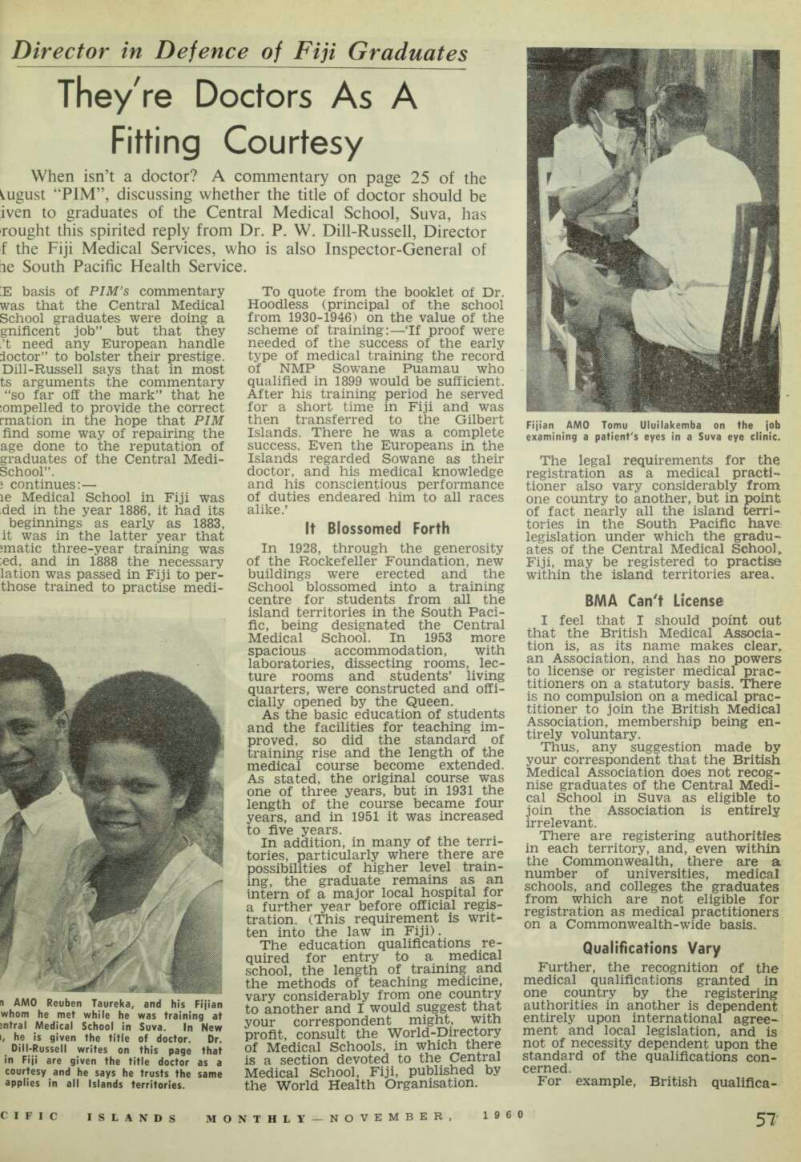
[?] AMO Reuben Taureka, and his Fijian whom he met while he was training at [?]entral Medical School in Suva. In New [?], he is given the title of doctor. Dr.
Dill-Russell writes on this page that in Fiji are given the title doctor as a courtesy and he says he trusts the same applies in all Islands territories.
Fijian AMO Tomu Uluilakemba on the job examining a patient's eyes in a Suva eye clinic.
is are not recognised for regis ,ion purposes in a number of itinental countries, and similarly qualifications granted in these atries on the Continent are not jgnised in Great Britain, rior to 1948, graduates of the 00l were known as Native lical Practitioners, a title which y described their activities; i.e., / were members of the in mous population trained in the and science of medical practise, he connotation of the word tive” changed, however, over years and the title was changed hat of AMP. iter, and contrary to your cor londent’s statement, without :e, the title was in 1957 again aged, at my request, to that of D as I felt that this was a more ng rank for these important ibers of the Government Medi- Servlces Rurally,' each administration been free to adopt that title :h they consider to be the most ropriate, but in all British ad istered territories that of AMO low used. our correspondent asks the ques “What is a Doctor?” and I Id suggest to him that, rather i look for the answer in the ing of an American humourist, would have been better advised consult the Oxford dictionary, i the concise version of this k he will find under the word ctor” a full definition which in [es the statement “especially ;or of Medicine, male or female 0 popular of any medical man, or not, especially in vocative)”.
Why Not "Doctor"? your correspondent can explain le why graduates of the Medical 001 should not be called doctor .11 be very glad to hear his argu its. bey are graduates of a medical )ol recognised by the World Ith Organisation, they undergo -six years’ training and they are stered as medical practitioners
under the legislation of the territories in which they serve.
Why your correspondent should consider that the title doctor is, to quote his own words, “a European handle to bolster their pres- “B®.» is beyond my comprehension.
The title is applied (in the local vernacular) in Africa, India, China, to name but three vast areas outside the European zone. The suggestion that the graduates of the School are being made into “imitation Europeans” is merely a further example of his ignorance.
Assistant Medical Officers in Fiji are given the title doctor as a fitting courtesy, and I trust that the same applies in all the islands territories -
No Aspersion on Central
Medical School
Judy Tudor replies :—Dr. Dill- Russell’s letter has caught up with me in Lae, New Guinea, while I am on my way to Rabaul—so com ment will be brief.
Let me say at once that the writer of the offending “Commen tary” is “she”, not “he”. Also, that I already have had several strips torn off me in the Department of Health, Port Moresby, on the same subject.
I still think that the points I made—or tried to make—in August PIM against the use of the title “Doctor” by Native Medical Prac titioners, are valid; although I am
prepared to agree that, like thos who think similarly, I an possibly amongst the people de scribed by the Assistant Adminis trator of P-NG, at the recent P-NC Legislative Council meeting in Por Moresby, as “fools and idiots” be cause they are not prepared t follow blindly the trends of th time.
Dr. Dill-Russell seems to be unde the impression that aspersions wer cast on the Central Medical Schoc of Fiji.
This was not so: to the contrarj With respect, I suggest the PIW interest in the CMS goes back fur ther than that of Dr. Dill-Russell about 30 years of issues of Pacifi, Islands Monthly and Year Boo i testify to that fact.
Although Dr. Dill-Russell state that it is customary in Fiji to refe to the CMS graduates as “doctor’
I imagine that he must mean tha this courtesy is extended to then inside hospital wards only. I hav never heard of AMD’s in Fiji re ferred to socially or in print a Doctor—and neither has anyone els to whom I have spoken on the sub ject. The only Fijian I have heart referred to as Doctor, is Dr. Doy (who for some time was a medica officer in BSIP) who took hi medical degree at a University out side Fiji.
What Moresby Said
My passage of arms with th( Health Department, Port Moresby took a slightly different angle. Th( arguments were warm, at times and a couple of points I remembei were (a) That the decision to cal Suva trainees “doctors” was taker partly because it was seen that ii was unlikely that there would b( any native Medical Practitioner produced by Australian medica! schools for at least ten years; (b) medical school qualifications varied from country to country—in Egypt one could become a “doctor” in If months; (c) the Suva NMP’s called “doctor” in New Guinea are about a year short of the standard of MB’s from Australian universities The point I was trying to make (badly, it appears) in August PIM is this: That, as P-NG is (for the nonce only) still Australian Terri tory, for heaven’s sake let the natives who aspire to be equal, in fact be equal, even to the point of passing the same exams.
I have discussed this question at all levels in the Territory—with Government officials, medical officers and plain Territorians —and, except in certain quarters in Port Moresby, this attempt to call native people by titles they have not earned is regarded as ridiculous. < The bestowing of doctorates upon CMS graduates is, however, only a symptom of the disease of wanting to make things easier for the native —a form of phobia that has Port Moresby well in its grip at the moment.
(See also Commentary, p. 25).