“Goodbye Old Ship
pp. 51-55 · Read in the full issue
Of Mine!"
From Cook Islands Correspondents The old Maui Pomare has finally gone. The Cooks bade her /ell on October 12 after 32 years of faithful operations between Zealand and her various Islands dependencies—lB of them on ?ooks run.
>PITE the fact that the locals ave been almost spell-bound fter seeing the “Pom-Pom’s” >ing replacement the new a Roa, which turned up on her m voyage a week before the re’s farewell, there were many ' hearts as their old and much d friend finally went off the
And when the time came it was almost as if the Pomare did not want to leave either. Her last call at Rarotonga lasted for more than five days, instead of her usual two or three. She had planned, before her departure, to circumnavigate the island of Rarotonga, but there was a mechanical failure of the windlass and this scheme had to be abandoned. Pomare has left her anchor and chain in 25 fathoms of water!
But the many guests from shore who were invited to a farewell function on Pomare the day the circumnavigation was supposed to have taken place, weren’t unhappy.
The sea was rough anyhow, and the crew of the old “Pom-Pom” treated them to a meal of delicacies which everybody agreed a luxury liner could not have surpassed. Chief Cook Ernie really meant to go out with top honours. .
There was a special cake, which was cut by Makea Teremoana Nui Ariki.
Sad Farewell
The speakers at that sometimes sad farewell function wandered back many times to the pleasant recollec tions that crowded in from the “Pom-Pom’s” 32 years on the Islands rU She was commissioned in 1928 —
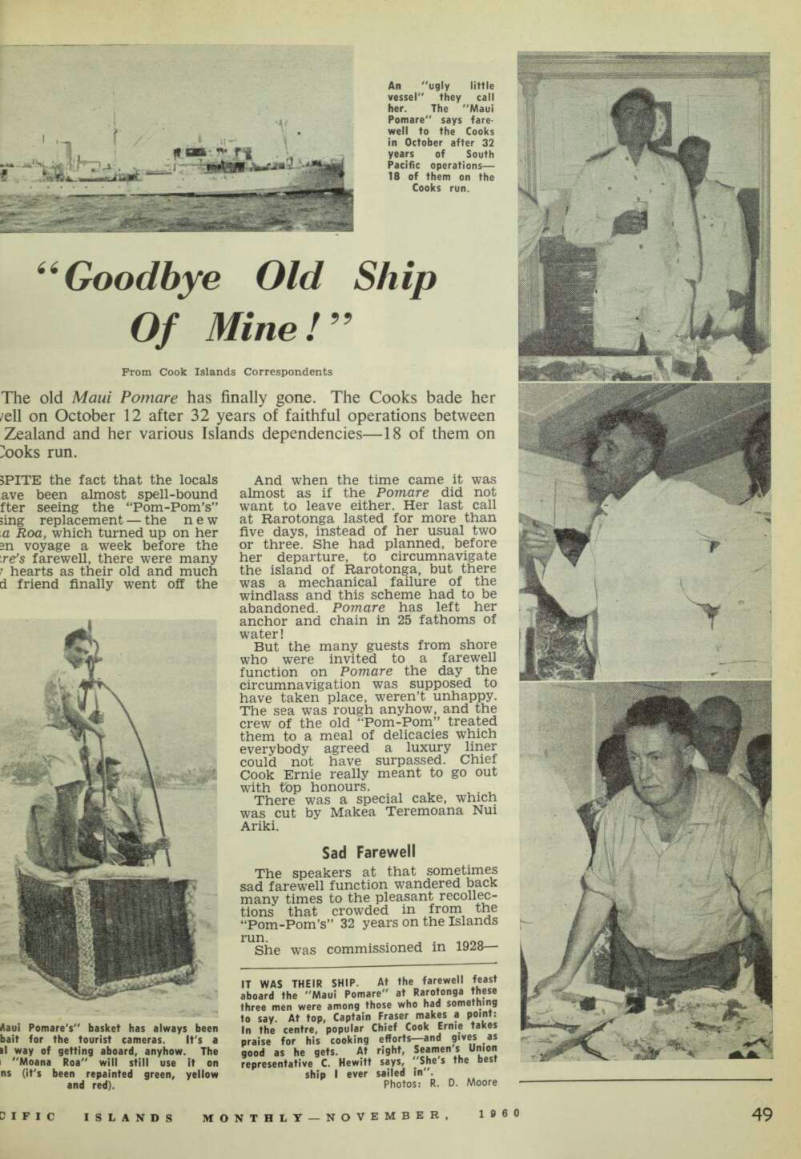
Aaui Pomace's" basket has always been bait for the tourist cameras. It's a [?]al way of getting aboard, anyhow. The [?] "Moana Roa" will still use it on [?]ns (it's been repainted green, yellow and red).
An "ugly little vessel" they call her. The "Maui Pomare" says fare well to the Cooks in October after 32 years of South Pacific operations— 18 of them on the Cooks run.
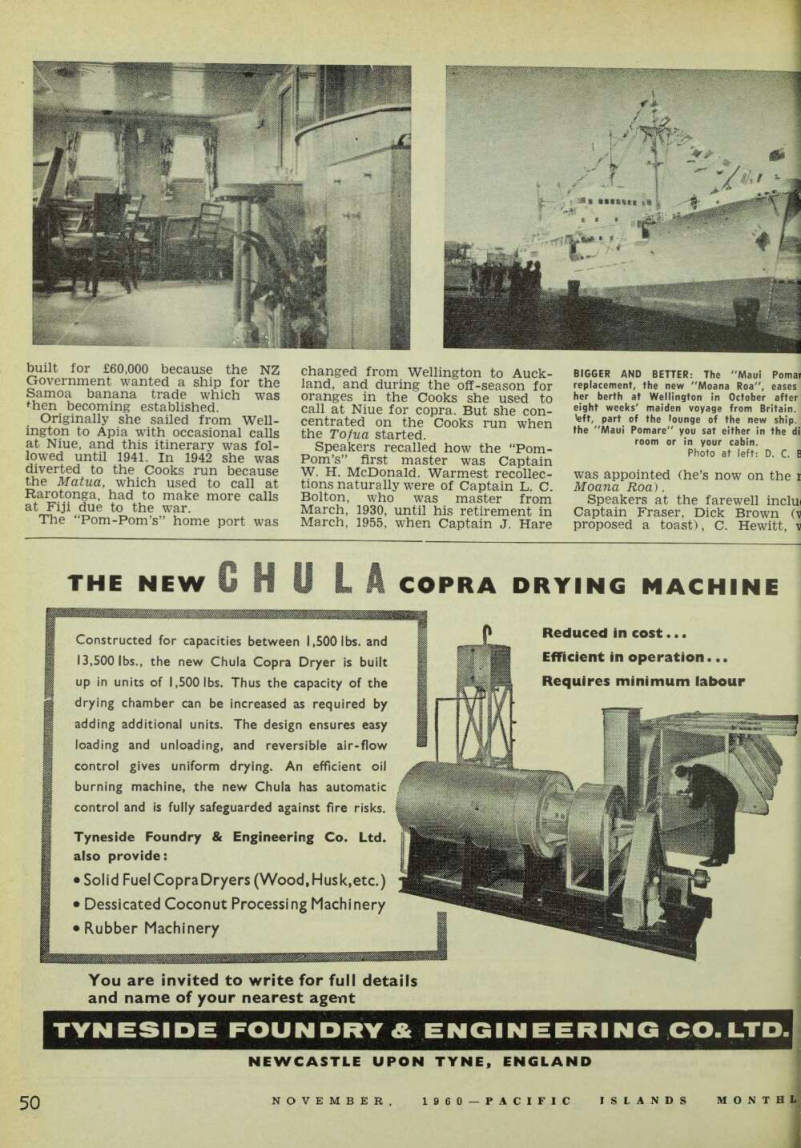
IT WAS THEIR SHIP. At the farewell feast aboard the "Maui Pomare" at Rarotonga these three men were among those who had something to say. At top, Captain Fraser makes a point: In the centre, popular Chief Cook Ernie takes praise for his cooking efforts —and gives as good as he gets. At right, Seamen's Union representative C. Hewitt says. "She's the best ship I ever sailed in".
Photos: R. D. Moore
built for £60,000 because the NZ Government wanted a ship for the Samoa banana trade which was *hen becoming established.
Originally she sailed from Well ington to Apia with occasional calls at Niue, and this itinerary was fol lowed until 1941. In 1942 she was diverted to the Cooks run because the Matua, which used to call at Rarotonga, had to make more calls at Fiji due to the war.
The “Pom-Pom’s” home port was
changed from Wellington to Auck land, and during the off-season for oranges in the Cooks she used to call at Niue for copra. But she con centrated on the Cooks run when the Tofua started.
Speakers recalled how the “Pom- Pom’s” first master was Captain W. H. McDonald. Warmest recollec tions naturally were of Captain L. C.
Bolton, who was master from March, 1930, until his retirement in March, 1955, when Captain J. Hare
was appointed (he’s now on the r Moana Roa ).
Speakers at the farewell inclin Captain Fraser, Dick Brown (v proposed a toast), C. Hewitt, v
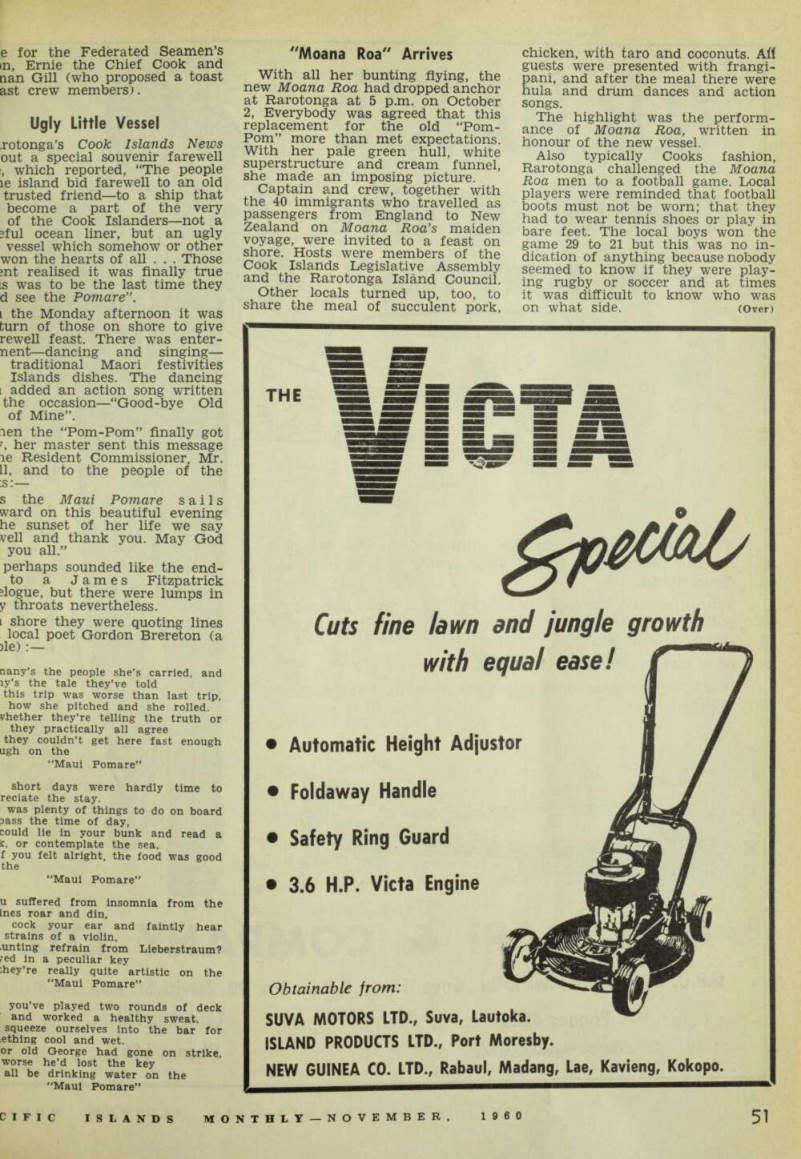
BIGGER AND BETTER: The "Maui Pomar replacement, the new "Moana Roa", eases her berth at Wellington in October after eight weeks' maiden voyage from Britain, 'eft, part of the lounge of the new ship, the "Maui Pomare" you sat either in the di[?] room or in your cabin.
Photo at left: D. C. B[?]
e for the Federated Seamen’s m, Ernie the Chief Cook and nan Gill (who proposed a toast ast crew members).
Ugly Little Vessel
Totonga’s Cook Islands News out a special souvenir farewell , which reported, “The people le island bid farewell to an old trusted friend—to a ship that become a part of the very of the Cook Islanders—not a sful ocean liner, but an ugly vessel which somehow or other won the hearts of all . . . Those ;nt realised it was finally true is was to be the last time they and see the Pomare”. l the Monday afternoon it was turn of those on shore to give rewell feast. There was enter nent—dancing and singing— traditional Maori festivities Islands dishes. The dancing i added an action song written the occasion—“ Good-bye Old of Mine”, len the “Pom-Pom” finally got r, her master sent this message
le Resident Commissioner, Mr.
11, and to the people of the ls : s the M aui Pomare sails ward on this beautiful evening he sunset of her life we say veil and thank you. May God you all.” perhaps sounded like the end to a James Fitzpatrick jlogue, but there were lumps in y throats nevertheless. l shore they were quoting lines local poet Gordon Brereton (a )le): nany’s the people she’s carried, and ly’s the tale they’ve told this trip was worse than last trip, how she pitched and she rolled, vhether they’re telling the truth or they practically all agree they couldn’t get here fast enough ugh on the “Maui Pomare” short days were hardly time to reciate the stay, was plenty of things to do on board pass the time of day, could He in your bunk and read a i, or contemplate the sea, f you felt alright, the food was good the “Maui Pomare” u suffered from insomnia from the Lnes roar and din, cock your ear and faintly hear strains of a violin, .unting refrain from Lieberstraum? red in a peculiar key ;hey’re really quite artistic on the “Maui Pomare” you’ve played two rounds of deck and worked a healthy sweat, squeeze ourselves into the bar for ething cool and wet. or old George had gone on strike, worse he’d lost the key all be drinking water on the “Maui Pomare”
"Moana Roa" Arrives
With all her bunting flying, the new Moana i2oa had dropped anchor at Rarotonga at 5 p.m. on October 2, Everybody was agreed that this replacement for the old “Pom
e£Pectations.
and cream funnel, • 6 an j lm P° sin S picture. ml?™ l?~e2„„ 1 ]? imi f rants J vl1 ? travelled 35 ® fr^n*S ng plS, and to ew ™vnt? and wp!p H% a ef den
owP’wnS? +S
SJJJJ* r ! f I 1 ? 6 b -i y and J“ he R ar otonga Island Council, Other locals turned up, too, to share the meal of succulent pork,
chicken, with taro and coconuts. Ait guests were presented with frangi pani, and after the meal there were hula and drum dances and action songs.
The hiahlisht was the Derform ance of g Moana Roa written honour of the new vessel, Also typically Cooks fashion, Rarotonga challenged the Moana Roa men to a football game. Local P la y ers were reminded that football boots must not be worn; that they had to wear tennis shoes or play in bare feet - The local b °ys won the game 29 to 21 but this was no in dication of anything because nobody seemed to know if they were play ing rugby or soccer and at times it was difficult to know who was on what side. (Over)
t the feast, Moana Roa’s master, tain Hare, said that the new i was in every way better than Maui Pomare. Yet as with all is she had still to earn her itation, and if she earned a itation such as the Maui Pomare had she would be a fine ship, icluded in the Moana Roa’s :o were 17 motor vehicles for the ks. le Moana Roa (her name means le sea”) was built at Grange ith on the river Forth, Scotland, is the first passenger ship built the NZ Government since before war. le is 2,750 tons, with a length 96 ft, beam 46 ft, and cost about ,000. le has a top speed of 14 knots ough she bettered this by a : during her trials. She can carry ) tons. 1 this means that the Moana is roughly three times as big he “Pom-Pom”, a third faster has almost twice the amount nsulated cargo space for vege es and fruit. Fruit is, of course, important cargo on the Cook ids run.
40 Passengers
ie can also carry 40 passengers more than the Maui Pomare. has 14 two-berth and three -berth passenger cabins, placed ;he boat and bridge decks, and is pleasantly decorated in pastel ars. ie decoration was done by Miss facKenzie Aikman, who is the ?hter of the managing director ie Grangemouth Dockyard Com f. Miss Aikman used South fie flora and fauna as a basis her designs. ■ints of paintings by famous >ts hang on the walls of the r ’s quarters. They include Van hs, Renoirs and a Gauguin or feature not seen in some much er cruising liners is the pro )n of yellow tinted fibreglass
awnings over some of the open spaces.
The winch operators have enclosed cabins on the main deck, resembling those seen on mobile cranes.
Visitors to the Moana Roa at Rarotonga noted that she had automatic steering, with the course set on a control unit and nobody to man the wheel except when changing course or manoeuvring.
There are watertight bulkhead doors throughout the ship which can be closed electrically from the bridge, and an automatic sprinkler system for fire.
There is a radio telephone service to shore, to link with ordinary telephone subscribers.
The Maui Pomare was notorious for the number of private radio aerials which appeared all over the
rigging with leads sneaking down ventilators to cabins below. But there won’t be anything like that on Moana Roa. The ship’s main aerial is connected with a large number of outlets to cabins. fo . ...
the^lo*
migrant? toNZmeant P tS?tThe be”
SJg? *nts to NZ me 3aiU that she be
■from EnslaiXfcfNZ* sink
the davs o? saflfne shins ® a * . sallmg shl P s - The tri P from England was not without incident. The ship struck a pier in the Panama Canal and dented some plates. There were a^so a number of minor accidents members. Moana Roa reached Wellington on October 12, after an ei e ht weeks’ maiden voyage, She was expected to start service on October 26.
Rip They'll Remember: Among The
ngers to NZ on the final trip of the [?]i Pomare" from Rarotonga in October were & Mrs. Roy Wills, and daughter Frances.
Wills is manager of A. B. Donald Ltd., rotonga, and they were going on leave.
Photo: R. D. Moore