How Can We Give the Natives
pp. 39-41 · Read in the full issue
What Lloyd Hurrell Told The Legco How Can We Give the Natives a Sense of Responsibility?"
“My efforts in this Council,” said Mr. Lloyd Hurrell, in ? P-NG Legislative Council budget session in October, “will directed largely towards curbing the headlong rush to super nal political and social development and in attempting to Uurb what I regard as the complacent and self-righteous itude of the governing bodies.”
;. HURRELL, Wau farmer and elected member for the NG Mainland, was making his sn speech (for how it was re i, see report on page 33). went on: lake it clear that I resent the -hand way income tax was in ced and the manner in which ecent advanced representation ie native people was ushered ider a cloud of fear and de created by the Prime Min and his Minister for External tories. . . ire has been an attitude created he Press, among southern nans, and amongst some Ad tration personnel that those oppose in any way the present , ill-considered developments nti-native and even exploiters, is most unfair. Most of the 3 in private enterprise in NG vith natives at their real worth without the power of the Gov 3nt at their elbows. Their de nent and that of the natives hand in hand. They are per nt inhabitants. . .
"Tragic Effect"
annot emphasise too greatly ragic effect the recent scare f-government had had on the al European population, enow of town and district ils, including their govern representatives, who refused this time to admit the natives ng capable of being more than bserver, who now, suddenly, the stimulus of fear, are pro ling theories of elected repre ;ives, universal franchise and )m to drink alcohol. It needs >ome crackpot to urge the un d supply of firearms and we e in trouble. the wake of all this, a crop fifare societies has emerged, )sed largely of missionaries vives of Administration per 1. I agree heartily with their *e work, but not their efforts some a political force. I trust administration evaluates care- Detween genuine work and airy actual exercises.
Legislation through the early years has to be discriminatory— but against the European, not the native. [And here Mr. Hurrell quoted examples —no need for miners’ rights, taxation privileges, etc., and went on to the question of labour and wages.] He continued: There seems to be dissatisfaction with present wages.
Well, I can assure the Administra tion that there is also, amongst em ployers, a great dissatisfaction with the standard of work and the ability of natives to take responsibility.
Even in Administration offices and work this is evident. . . It is not their ability that bars them, but their failure to accept responsibility.
I have had good natives on £5 a month, plus keep for themselves and families, leave me to work for £5 a month cash, and no food or issues, simply because domestic work in small households is easy.
The native should be shown that, so far, his efforts have been very small and that an all-out effort
must be made to develop crops and industries as well as professional and clerical classes.
On the other hand I believe that there is, in the Administration par ticularly, a resistance against giv ing responsible jobs to natives. . .
There are far too many natives do ing housework, cutting grass around buildings and loafing in road gangs for the healthy development of the people. . .
Natives Without Training
We are hastening forward to edu cate academically and politically a people that has no economic founda tion and no training to develop it.
Has anyone considered the impact of this mass education on the social structure of the villages? Economic distress and subsequent discontent must follow. [Earlier, he said that he hoped to see more agricultural and technical schools].
How does the Administration hope to employ the people when edu cated? For every new teacher em ployed there should be another agri cultural field man to train the people in agriculture and probably another Native Affairs man to sort out the troubles arising afterwards.
Fortunately, I believe that the people themselves will supply the restraint. I remember the schools at Rabaul before the war. There were some hundreds of young native students in government and mission schools. Where are (these natives) now?
In 30 years of earnest effort on education, the number attaining anything more than the intermedi ate certificate is negligible. It has taken the Catholic Mission 75 years to produce two priests. This is in
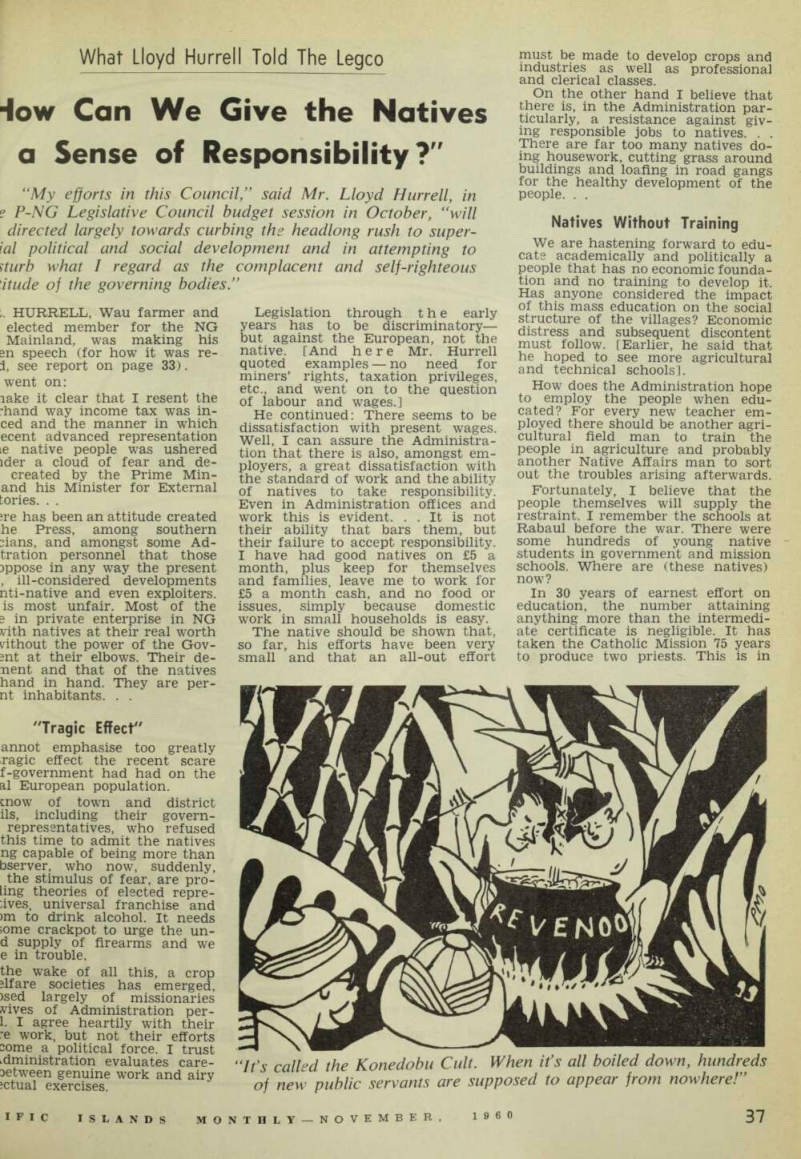
“It’s called the Konedobu Cult. When it’s all boiled down, hundreds of new public servants are supposed to appear from nowhere!”
mstances where skill of instruc and earnestness cannot be ted.
Must Have Incentive nehow, there must be given an itive to work, a desire to accept insibility, and this cannot be by calling boss-boys “fore prisoners “inmates of cor ye institutions”, medical as ats “doctors” and so on. the latter case, I think that ,11 field personnel who have i lustre to a name, it is the cal assistants; and why the frustration should feel any y at calling Fiji trained per el “medical assistants” I can >ee. . . uote Mr. Hasluck of August 23; New Guinea situation is ie and comparisons with :a and Asia are impossible.” is rot! There is a very good >arison. e people here are not ready self-government—there is no 3mic background to support the try. The country is divided, e New Britain area with its i and cocoa wealth would never to share their revenue the rest of New Guinea if ; were no (Australian) subsidy, heavily-populated Highlands would never subject themselves lie by Tolais and Papuans. It be more than a century before country is capable of settling i as an independent state. . . ; should cut our losses. Take New Guinea and Papua as a ith State without delay. I be that if a plebiscite were taken ajority of the P-NG indigenes Australian people would favour No normal thinking Australian regard Papua and New Guinea
as anything but Australian terri tory. Our blood, sweat and wealth have developed it. No other country has helped pay our way here. . .
If P-NG were taken over as a seventh State it would be a major help to industrial development. At the moment the White Australia Policy is a constant insult to the people of this country. How can natives and mixed-bloods have faith in a country that admits Chinese, but bars them? Papuan natives are Australian citizens and should have every right to go to Australia, buy property and seek employment. They don’t because of the immigration laws.
Appease White Australia
But by creating a seventh State the White Australian Policy is appeased. It would no longer bar
our actual inhabitants. I am sure that if our native people were sure of Australian citizenship which could give real equality, instead of (being given) the intellectual drivel they are so often fed on matters of schooling, clothing, drinking and other things relating to social standards, they would enter the struggle to reach higher standards with far more vigour.
What the natives must under stand is that most non-official people in NG, and most civil servants, want the NG people as part of Australia. It is the politician, and the dreamy idealist, who is pre pared to sacrifice them and their country on the outworn ideal of UN.
Is it that Mr. Hasluck and his followers are preparing the country to receive land-hungry Asiatic hordes who are waiting their oppor tunity? . . .
It is the Australian unions and Labour Party who are afraid to admit Papuans.
Australia next year wants 187,000 labourers for industry. It hopes to get them from immigration. Why not Papuans? Probably, not a lot would go, but what better education could there be, and what stronger link with our parent country?