The Budget Session
pp. 35-37 · Read in the full issue
Bombshell Or Two At The Budget Session
From Judy Tudor, in Port Moresby After commencing in a blaze of glory with a Ministerial lening of the Hew Legislative Council Chambers; a Vice-Regal iening address; and the presentation of a new President’s chair ; a delegation from the Australian Parliament, the Legislative ouncil of Papua-New Guinea, at its last meeting in its present rm, went on to churn out 28 new pieces of legislation.
a session that lasted six days id three nights, it approved e spending of £221 millions in urrent financial year, after the surer, Mr. H. H. Reeve, in a et speech had proved to his satisfaction —if not to private bers —that from a Territory of view, every prospect pleased, dealt also with a bill that sets tie machinery for the election selection of members of the new enlarged Legislative Council will come into being in the part of 1961. debates on this bill, members, official and unofficial, had derable difficulty in not wand from the mere election ures and trespassing on the idment to the Papua-New ea Act which sets up the new cil and which is purely a Com yealth Government measure, therefore verboten. was only on adjournment that te members were able to have iece of Territories Minister ick on the ground that his Legislative Council was, on : inspection, not what is seemed that there was, they said, un r to be an unofficial majority.
The "Catch"
the new Legislative Council will be 14 officers of Terri departments; 12 elected mem (six natives and six Euro -3) and 10 “appointed” members, the “appointed” members could te catch. It had been assumed, ’st, that these would take the of the old nominated mem who in the past have on vital 3 usually thrown in their lot the unofficial members.
M predicted in September (p. yhen it first foreshadowed the Council composition, that “the rnment could be expected to h for moderates to be nomin for the unofficial membership— it can depend on to be sympa : towards the Government’s of view”.] t by a cunning deletion of old e 32 of the Papua-New Guinea it is now possible for any c Service officer to be an )inted” member, der the Act the appointed
members shall include at least five natives. There will certainly be at least one Mission representative.
The remainder could be public servants who can be trusted to toe the official line.
With the realisation of what the new set-up could mean, bang went non-official members’ illusions; and they didn’t mince words in saying what they thought of “Ministerial duplicity”.
None objected to an official majority while the Commonwealth Government pours into this Terri tory the annual millions that have become accepted practice since the war. What they didn’t like, they said, was the manner in which it was presented. When the Min isterial announcement was made in September it appeared, at first glance, that the Government was giving away its power to call the tune.
Why was the camouflage thought necessary? asked Mr. B. Fairfax- Ross, of Papua.
It was Ministerial dishonesty, said
Mr. Lloyd Hurrell, of the NG Mainland.
The Minister had not been quite honest, said Mr. Don Barrett, of the New Guinea Islands, who was first to the attack.
Assistant Administrator Gunther, defending the Minister, said that members were being ridiculous, un generous and unfair; that the crux of the new Legislative Council was the 12 elected members and these “would have a sporting chance.”
Courage of Lloyd Hurrell
At this session also, three new members made their maiden speeches—C raig Kirke, Reuben Taureka and Lloyd Hurrell, in that order —although most of what the two former said was forgotten after
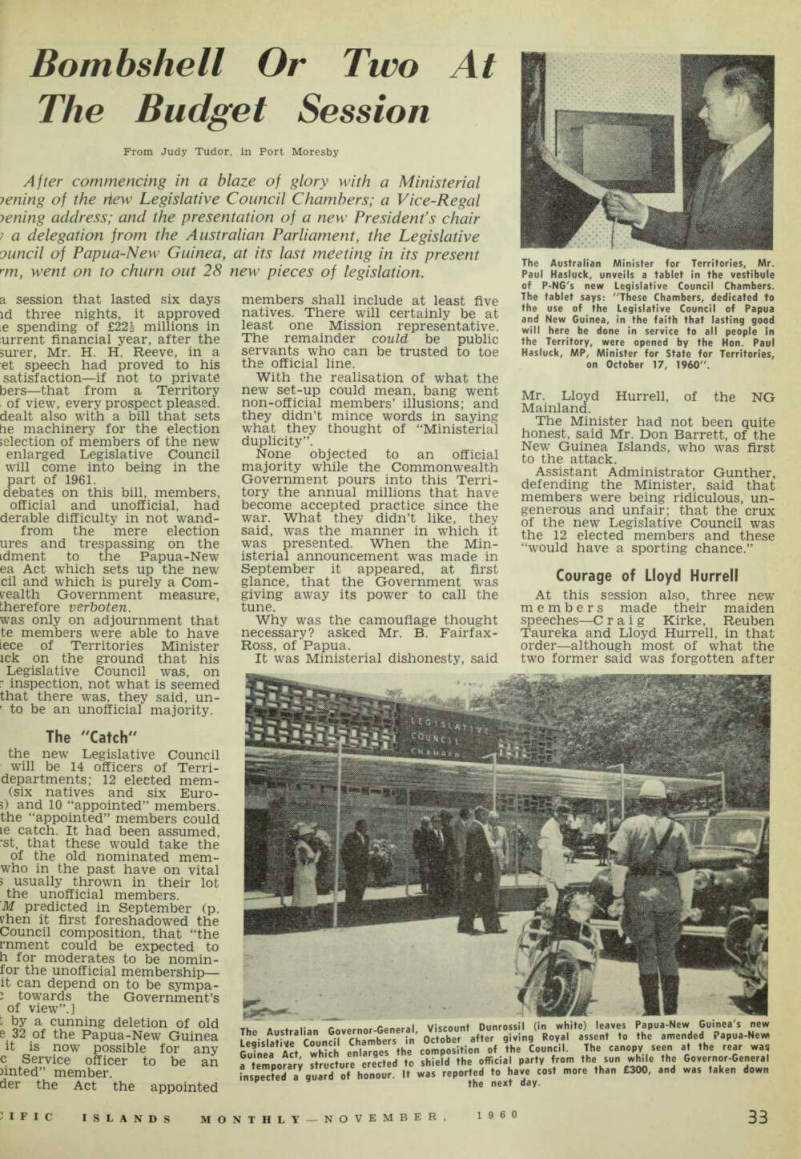
The Australian Minister for Territories, Mr.
Paul Hasluck, unveils a tablet in the vestibule of P-NG's new Legislative Council Chambers.
The tablet says: "These Chambers, dedicated to the use of the Legislative Council of Papua and New Guinea, in the faith that lasting good will here be done in service to all people in the Territory, were opened by the Hon. Paul Hasluck, MP, Minister for State for Territories, on October 17, 1960".
Tho Australian Governor-General, Viscount Dunrossil (in white) leaves Papua-New Guinea's new Chambers in October after giving Royal assent to the amended Papua-New Guinea Act which enlarges the composition of the Council. The canopy seen at the rear was a temporary struture erected to shield the of ficial party from the sun while the Governor-General insp eected a guard of honour It was reported to have cost more than £3OO, and was taken down the next day.
(omb-shell with which Mr. 1 shattered the gentlemanly dings in the Chamber, me could accuse Lloyd Hurrell diplomatic approach; and the rature of that air-conditioned fell a couple of points as he (See report of his speech, on 17). But it took real courage ak that piece in the current al climate of Port Moresby, yen more to take the cold dis ral of the day that followed, i some unofficial members aside their metaphorical and said “Really!” (according to Hurrell) very Hcial members spoke to him ; next day-and-a-half. (One R. Foldi, who is “a kind man w”, and another was H. L. vho, in the days when Hurrell n ADO, was his boss). ;ar ago there would have been ecessity for a speech like
Hurrell’s, and probably not much comment if it had been made, either.
But in the Port Moresby of the moment, when all spades are called “digging instruments” to describe them as “bloody shovels” just isn’t the done thing.
Lloyd Hurrell had a successful and distinguished career in the Ad ministrative service in the District which he now represents as an elected member, before he left the service some years ago to go farm ing at Wau. He has brought to this private enterprise the same energy and competence that he once gave to persuading the primitive Kuku kukus of Menyamya to go along the path of Administration rectitude.
But because he has deserted Ad ministration for private business, he now is treated as something of a renegade and the tendency is to make him the butt of official hand smacking—a role he has inherited from Mr, lan Downs, ex-MLC, who also deserted for agriculture.
Lloyd Hurrell says that he probably won’t stand at the election for the reconstituted Legislative Council —he can’t afford it.
This would be a pity. Papua-New Guinea still needs its Lloyd Hurrells to speak their minds, lest the whole Territory slide off prematurely into this mood of “sweet reasonableness at any p*ice” that seems to have Port Moresby in its grip at present.
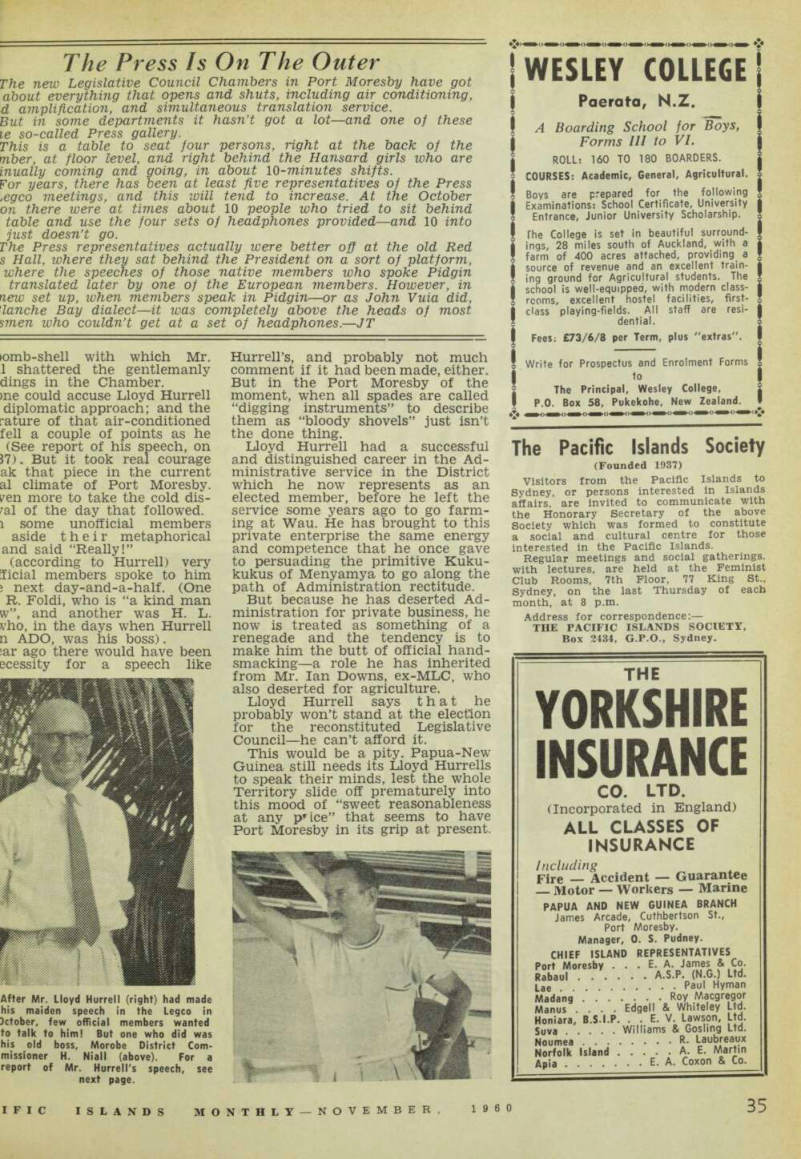
After Mr. Lloyd Hurrell (right) had made his maiden speech in the Legco in October, few official members wanted to talk to him! But one who did was his old boss, Morobe District Com missioner H. Niall (above). For a report of Mr. Murrell's speech, see next page.