Plain And Brutal Terms
pp. 31-32 · Read in the full issue
[?]He Fiji Outlook: Stated In
By a Staff Writer
An admirable summary of economic and political con dons in Fiji, and of the headaches with which the Govern ent is confronted, was provided in a series of three short tides by a Fiji businessman, Mr. A. J. Carfax Foster, of mtoka, published in the Fiji Times late in October.
is very difficult to effectively mmarise a summary; but some the outstanding points made :r. Forster can be set out here. . Foster sees difficulties im itely ahead —already created xovernmental failure to pro for over-population, and now worse by the recent dead in the sugar industry. He sees leant signs in growing numbers lemployed, more men seeking at reduced wages, cessation ork in a number of private prises.
Fiji, where we should be liv :ee from strain, racial discrim >n, intimidation, civil strife, irmed guards against disorder raised themselves.” ■e is another significant para i: the Fijians are to hold their n the world, if they really wish improved living conditions, tion, and all the appurtenances )dern living, then the Govern is and has been the worst y of the Fijian people. The > Report confirms this.” ing that, if the right men are itrol and the right things are the Fijian community need fear the increasingly active Jtition of Indian individualists, Foster deplores the lack of •ship seen in the Colony to ere is, so far as I can see after ars here, no body of people le of ruling Fiji either mically or socially.”
3rd Words for Europeans
Foster examines the com ies and lays the chief blame ie lack of leadership upon the eans. He says they “are ently interested only in the hat politically and economic they rule the Colony. They overlooked the basic reality Dy reason of their position in the lead should come from . . This stricture applies to European in the Colony, ent or permanent resident”.
Foster discusses “anti-Euro sm”. He says that this is the result of abuses of ige by Europeans who were etely in command in the past )ple have long memories for things”—and partly the feel
ing of jealousy by the “have nots” in relation to the “haves”.
Mr. Foster is very outspoken on the subject of the attitude of the Indians towards the future of the country—he apparently does not think that the young Indian leaders now emerging are thinking in terms of the future of all races in the Colony, but instead cling to narrow viewpoints.
“To persist in a policy of mak ing Fiji a ‘little India’ is fore doomed to failure. It is sheer in gratitude to the country which shelters them and in some cases has given them wealth.”
What Form of New Government?
Mr. Foster is certain that some form of constitutional reform must come soon to Fiji; and he urges that the Government, as protectors of the Fijian race, should take more active measures, in a planned way, to prepare the Fijians to share effectively in the government of their homeland.
Training in this regard, he argues, should apply not only to the Fijians but also to the Fiji-born Indians and especially the part- Europeans.
He apparently accepts the argu ment that an Assembly elected on
a common roll is impossible in the case of Fiji. But he does support the interesting suggestion that there should be some sort of gov erning council for the Colony, created on a basis of eight elected members of each race—eight Fijians, eight Indians, eight Europeans and part-Europeans,—plus a selected number of Government Department heads.
“As an immediate stop-gap to replace the present useless Legis lative Council it is worth a trial,” says Mr. Foster.
Mr. Foster sees no reason for complacency in the defeat of the Patel party and the resumption of cane-cutting. “There is more to come, so let us be prepared for it,” he says.
He quotes facts and figures to show that the cane-farmers are by no means the down-trodden serfs
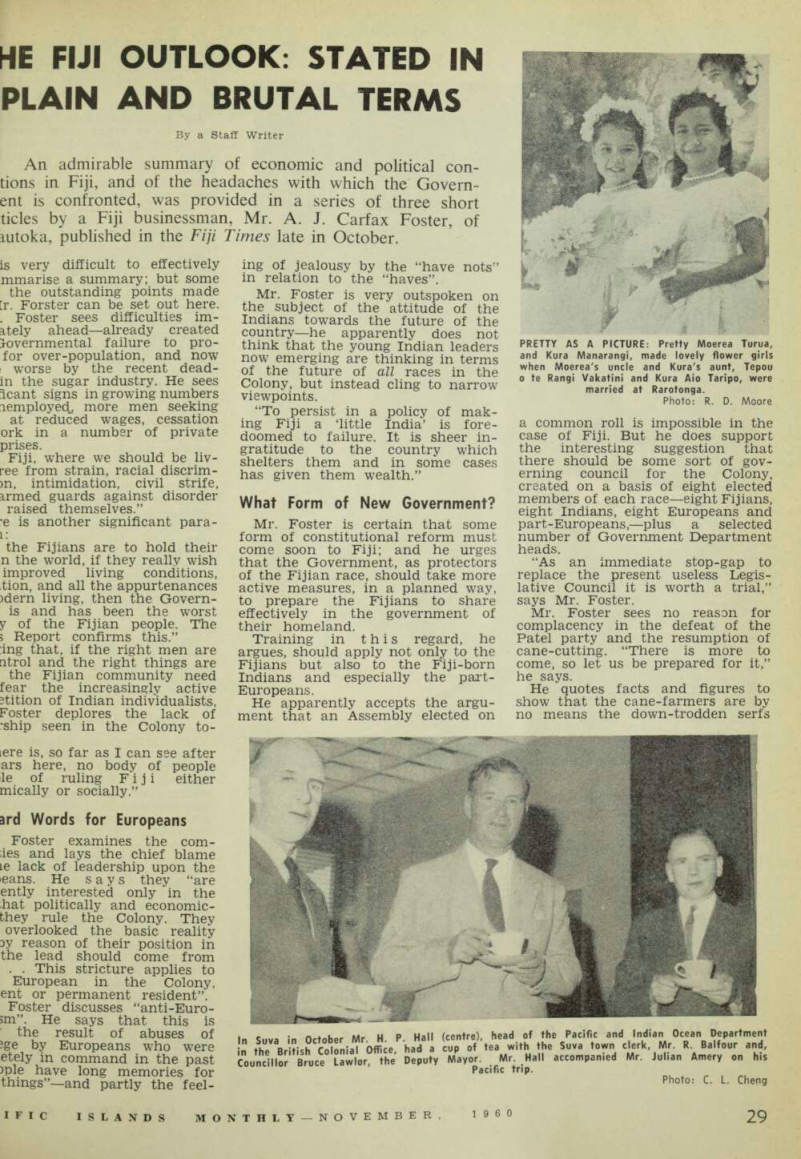
PRETTY AS A PICTURE: Pretty Moerea Turua, and Kura Manarangi, made lovely flower girls when Moerea's uncle and Kura's aunt, Tepou o te Rang! Vakatini and Kura Aio Taripo, were married at Rarotonga.
Photo: R. D. Moore
In Suva in October Mr. H. P. Hall (centre) head of the Pacific and Indian Ocean Department in the British Colonial Office, had a cup of tea with the Suva town clerk, Mr. R. Balfour and, Councillor Bruce lawlor the Deputy Mayor. Mr. Hall accompanied Mr. Julian Amery on his Pacific trip.
Photo: C. L. Cheng
so often described —on contrary, under modern conditu with the new kinds of cane, t live very well indeed on 12 a< of land and a working week about 26 hours.
He criticises them sharply 1 cause in so many cases they m no effort to grow their own fo stuffs on the land available them.
Mr. Foster is not a destruo critic only—he offers what apj to be sensible and practical s< tions to Fiji’s problems, most them somewhat along the lines the outspoken Burns Report.
While he insists that string economy is necessary in Gove ment departments he urges t without loss of time, steps taken to acquire funds for a road-building programme, gh employment to large numbers men, while creating a natie asset of incalculable value to Colony.
He wants immediately a reaching extension of farm trs ing for all races, with emphasis the growing of food for local c sumption first, followed by the velopment of crops to permit ports.
He would follow the Burns port line, in forcing the emp! ment by Government and prfi enterprise of local-trained pe< and discouraging the use of seas staff. He would extend
apprenticeship system.
He would take drastic measi to enforce the full usage of h while protecting Fijian land rig —a similar viewpoint and a sim conclusion to that set out in Burns Report.
He favours well-planned measi for the early establishment of dustries immediately secondary primary industries—fish cann fruit preserving, and so forth.
English Language For All
Mr. Foster is on very soi grounds when he urges that ; teaching of all languages, ex( English, in the Colony’s schc should be discouraged—“until language bar is lifted we shall ne make the progress in racial n tions that is necessary and e essential”.
Mr. Carfax Foster has done pu service in thus stating, in plain I emphatic language, the danj which confront this multi-ra country, and outlining the siir measures which can be taken avoid the looming troubles and sure for the Colony a secure futi It is a pity that more people in ] —men of all races—do not simik try to envisage the whole pict and seek the remedies.
Most community leaders in j today are completely sincere in tl eagerness to get on with necess reforms; but the great majoi seem unable to see the wood for' trees.