Nz Tells Samoa All
pp. 21-22 · Read in the full issue
The question of the ending of the UN Trusteeship of West Samoa will be discussed by the UN in November, when Samoan Prime Minister Fiame Mataafa will be present. Meanwhile, in Apia, the Samoans have been hearing more about their future.
IN October, Mr. F. J. Corner, Deputy Secretary of the NZ External Department, acting as special envoy of the NZ Government, addressed the Constitutional Convention on the future relationship between NZ and West Samoa after independence.
Mr. Corner’s address was of considerable importance, because for the first time the NZ Government was clearly defining its policy. Mr.
Corner made it clear that NZ would give every help to West Samoa in overcoming any initial difficulties. coin tvt-7 „rnnm bnvp Mr - nf for the of West Samoa for another 14 months, and although it was a serious step for her to give up the responsibility, she had made the decision only after being convinced that J' 116 of success in West Samoa were greater than the chances of failure. .
Political Maturity
... , . , , , Pohtical maturity and tolerance, of S a i 000 U embodying l per yef flexible social system, and above all an ability to combine the best of old and new customs—all these things had encouraged NZ in its decision.
Mr. Corner said no country was ever fullv prepared for independence. A start had to be made sometime People could not show their ability to govern themselves unless they were given the chance.
Cabinet Government, instituted in October, 1959, had worked well.
The Constitution adopted by the Convention was a wise document based on the rock of Samoan custom but incorporating the useful
experience of other countries. It was flexible enough to allow Samoa to meet the challenge which had to be faced with Samoa’s increasing population and the necessity to de velop the resources of the country, He said the Constitution would be that of the first independent Poly dnbf^di ° e f d wfthTbs^rbina^ bv the neonle outsfdp West by the P e °P le outside West , , .
He said steps had been taken by the Samoan Government to cope with such difficult problems as dual domestic status, land development and increase of agricultural produc tion the Samoan social cvstpm u r *** Must Have Contacts The problem of the relations of western Samoa with the outside WO rld remained to be solved. Samoa could not avoid contact with the rest of the people in the world. It had to accept the fact of inter dependence and welcome it.
Mr. Corner said his task was to l“ could lr a °r a rL g e e X d ter sS al as^ bring most benefit to the Samoan people at tne least cost, No firm arrangements could be made until Samoa was fully in dependent.
Samoa had full power as an in dependent State to determine policies on internal and external affairs, but Samoa should not be parted utterly from New Zealand and NZ should stand behind Samoa as a fnend * At present NZ was giving speci ally favoured treatment to Western Samoa over immigration; the banana trade and by technical assistance. Though NZ would be
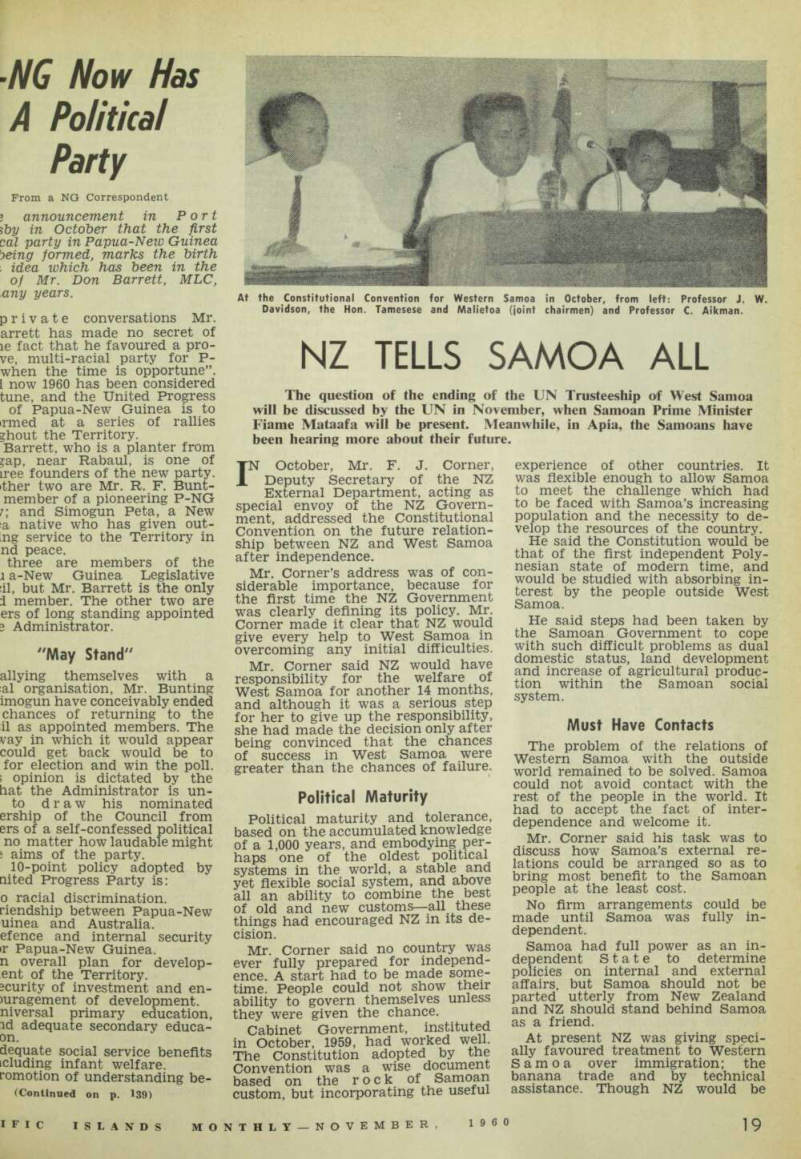
At the Constitutional Convention for Western Samoa in October, from left: Professor J. W.
Davidson, the Hon. Tamesese and Malietoa (joint chairmen) and Professor C. Aikman.
under no formal obligation to con tinue these special benefits after independence, NZ was fully prepared to continue the present policy sub ject to periodic agreement and negotiation.
If Western Samoa decided it needed help in some field and wished to look to NZ for such help, this would best be done by a Treaty, or Agreement, as is usual between sovereign and equal states, as Western Samoa and New Zealand would be. This would provide New Zealand with a basis for its policy.
Mr. Nash's Statement
Mr. Corner said the NZ Prime Minister, Mr. Nash, had expressed these feelings eloquently and ad mirably before the General As sembly of the United Nations in its recent meeting. The New Zealand delegation at the United Nations would during the present session propose that the Assembly take cer tain decisions to enable Western Samoa to effect an orderly transi tion from self-government to full sovereign independence, and to pro vide for a plebiscite to be held in Western Samoa to ascertain whether the people of the Territory wished their country to take this decisive step.
Mr. Nash had also stated that in response to the frequently expressed wishes of the Samoan leaders, NZ was prepared to afford substantial and continuing assistance to Western Samoa to enable it to establish it self in the early years of independ ence as a well-administered and self-reliant state.
He had made it unmistakably clear that this assistance New Zealand is ready to give both internally and in international affairs, would be pro vided with the fullest regard for Western Samoa’s independent status.
At a special meeting of the Con vention on October 21 Convention members asked Mr. Corner for de tails of NZ future relationship with West Samoa —in particular the policy of the NZ Government should at the November election a National Government replace the present Labour Government, Some Questions Answered Other questions raised were the matter of the continuation of the liberal immigration regulations which allow a large number of Samoans to find employment in NZ (a matter regarded with importance because of the large population in crease in Samoa); and also the pos sibility of support from NZ should West Samoa seek overseas loans.
Another matter raised was the question of West Samoa becoming a
member of the British Comm wealth.
Mr. Corner replied that the c tinuation of the present policy garding relations between NZ i West Samoa was a matter of hon with NZ and there were no dif ences of policy on Samoa betw the Labour and National Partie In his opinion continuity of present policy was certain.
All opportunities for immign coming to NZ for education technical training would be gr but apart from this, it would be duty of the Samoan Governrr after independence to make av able opportunities of employmen the Samoan people. He could give any definite guarantees immigration.
NZ would support indepenc Samoa’s applications for joining ternational organisations, and in contracting loans for econo development, such as the deep harbour scheme.
Member of Commonwealth?
He commented, however, tha was doubtful if it was necessarj feasible to seek a loan for the c struction of a large jet airport, wl would probably cost some £3,000, when there were modern air] facilities available to West Sai only 80 miles away at Tafi American Samoa.
On the matter of West Sam membership of the British C( monwealth after independence, Corner said it was entirely a ma for West Samoa to decide. If V Samoa decided to apply for meml ship, NZ would do everything i sible to support it.
He added that NZ had offeree undertake diplomatic represental of Western Samoa in oven countries.
Modern Hotels
For Lautoka
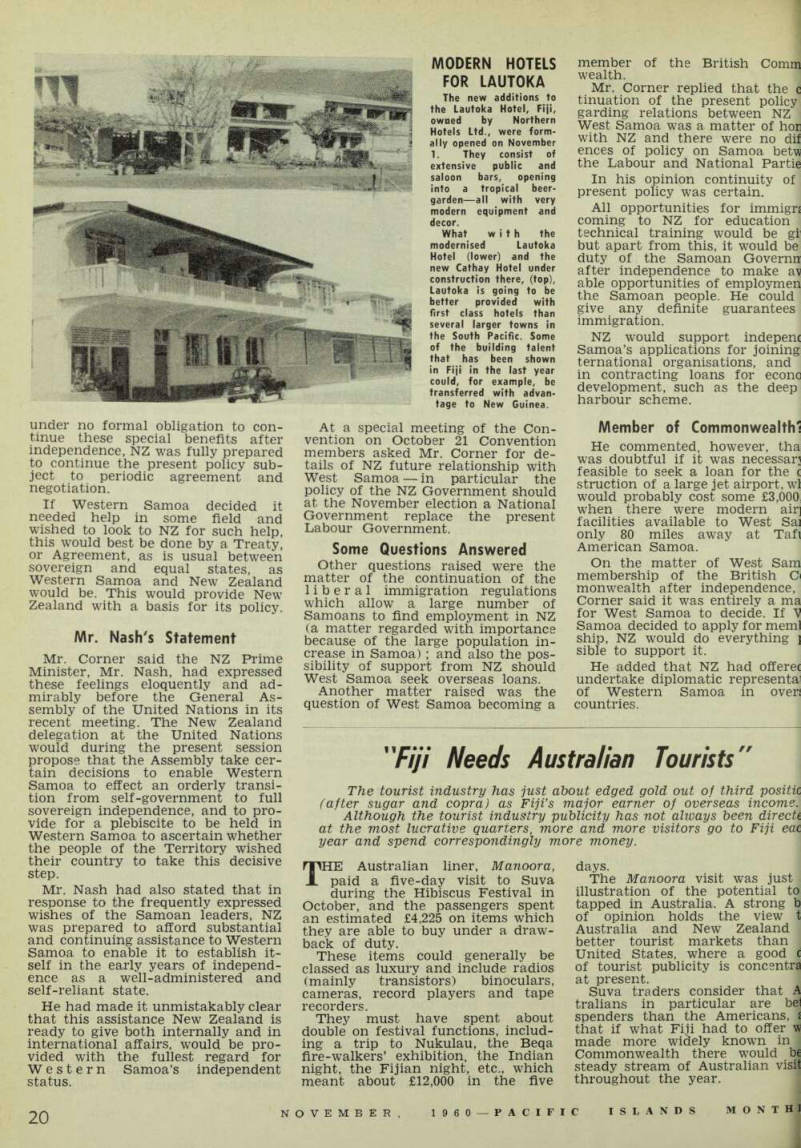
The new additions to the Lautoka Hotel, Fiji, owned by Northern Hotels Ltd., were form ally opened on November 1. They consist of extensive public and saloon bars, opening into a tropical beer garden—all with very modern equipment and decor.
What with the modernised Lautoka Hotel (lower) and the new Cathay Hotel under construction there, (top), Lautoka is going to be better provided with first class hotels than several larger towns in the South Pacific. Some of the building talent that has been shown in Fiji in the last year could, for example, be transferred with advan tage to New Guinea.