Whence Goes Australian
pp. 19-143 · Read in the full issue
Staff Writer Judy Tudor Examines Some
Strange, Sudden Trends
Whence Goes Australian New Guinea ?
Port Moresby, October 29 If they were to judge solely by the hot-air talked at the ? gislative Council meeting in Port Moresby this week, most ople not in direct Administration service would be well ad ied to pack up and give the country away.
But the further you travel from Port Moresby, the truer the perspective you get over Papua-New Guinea, as it stands the end of 1960. That’s not to say that God’s in His heaven, d all’s right with this particular world.
S is a New Guinea in which very second person is “going nish”, or plans to do so in er couple of years; a New ;a where large concerns are >wing small firms; where more lore plantations, no longer the 3ss of one man or one family, eing absorbed in public com s; from where most of the residents of the Between Wars I have departed.
he Basis of Uncertainty
these reasons alone, New a tends to follow the well path of other ex-colonial terri in Africa and Asia; and ly you can see—faintly yet oly—the ultimate pattern in the independent European anachronism. e, as in other places, it will ie big corporation that will ;o survive. category to which you belong aces your thinking. If you are I the swallowers, the prospect ill look bright. If you are the wed, you must feel that the k is gloomy. ou are a senior Public Servant, irrent order of things is likely ; long enough to see your term l fact that, perhaps, makes you o toe the new line. If, on the hand, you are a new Patrol r coming into the service, the jet of your ever filling a Dis- Commissioner’s shoes seems ndeed. if you are just a time-server, ie job or other, without roots, 'ty or much interest in the ory—and many Europeans into this category today—you be worrying about New a more than 21 months ahead, iy of this, no matter how often lenied from the top, adds up leral uncertainty; and this is ed most acutely amongst the settlers (or those who have
withstood the swallowing process) and have put their time, money and energy into individual agri cultural enterprises.
For those who want to make “a quick buck” and quit—even for the investor in big business enterprises of the Territory—P-NG is still wide open. For those who want to put down their roots and build for the
future, and perhaps for their chil dren’s future, the prospect is gener ally depressing. (Over)
And for this latter class there have been few official words of en couragement, and fewer guarantees of security.
During the recent meeting of the Legislative Council in Port Moresby, nominated member, Mr.
R. F. Bunting, left this particular bundle on Assistant Administrator Gunther’s doorstep. Dr. Gunther had inferred, he said, that if the European settlers weren’t good boys they would be thrown out.
Dr. Gunther's Defence Mr. Bunting suggested that the Assistant Administrator might have done more service for the Terri tory if he had sought the co operation of the European settlers in an effort to work out a solution that would be of benefit to all sections of the community.
Dr. Gunther denied on that occasion, and subsequently, that he had inferred anything of the sort; and read his usual “riot act” about people who talked of “insecurity.”
If you talked about insecurity long enough, he said, it would become a fact. There was no insecurity in the Territory at the moment.
But, other than denying that there is reason for fear, concrete reassurances were not forthcoming from Dr. Gunther, or from any one else.
Dr. Gunther seems to take some sort of sardonic pleasure in what he himself regards as a realistic attitude. During the session, he used words like “fool” and “danger ous” to describe people who couldn’t adjust themselves to the changes that are taking place—and, from certain aspects, no doubt he is right.
This Startling Change
But the change in the political climate here in the last few months has been so sudden and startling that few people have had a chance to adjust themselves to it; and those that have are apt to appear more opportunist than convincing.
Six months ago, P-NG was, for all practical purposes, still pursuing Sir Hubert Murray’s] “policy of gradualness”. Almost overnight the tempo changed. Suddenly it was “later than we thought”; time was “running out”; self-government was “right around the corner”.
It was a bloodless sort of revolu tion— but revolution it has been, nevertheless.
The change in the political out look between the last meeting of the P-NG Legislative Council in late May, and the recent one in mid- October, is so extraordinary as to be unbelievable, unless actually ex perienced.
Native's Warning to Europeans
Few Territorians of the old school —and not many of five years ago— expected to see the day when two Papuans would stand up in the Legislative Council and say, in so many words, that when the day for independence came those who were nice to the natives could stay, but those who were not could go.
But that is more or less what hap pened.
For want of any official assur ances on the future prospects of pre sent settlers in P-NG, Father Dwyer (nominated member) had asked the question point-blank of the present four native members.
He pointed out that the investing public must have a guarantee of confidence by the native people, and said that no new settlers would be forthcoming unless assured that the future would be secure. (His question could, of course, be regarded in the same light as that of a doubting wife who has asked her husband to tell her he “loves her, even if he doesn’t mean it”; because what the present native members of the Council could say, and what really will happen to “foreign” investments in this Terri tory when it does get independence,
is largely unrelated. Nonethe the native members did have i their power to allay current pi with a few words.) Simogun and John Vuia ign< the question altogether.
Marua Rarua Rarua did answer it directly; but in speal on the new legislation that up the machinery for the Legislative Council elections, said that the Council would native members from diffe: parts of Papua-New Guinea opportunity to exchange ideas the floor of the Chamber; and 1 it would also give native mem a chance to see whether the re\ sentatives of settlers and comm really wanted to help the nai or whether they were there ( to further their own affairs.
First native official meml Reuben Taureka, replied direi He said that the answer lay what the Australian settlers c< do for the New Guinea people; 1 it was unwise to predict what w( be done when self-governn came, but there would be no p for those who could not go al with current trends.
The future of Australian sett lay in their relationships with natives—and not just whether t played football with them or vited them into their homes, how they considered them human beings.
Any Future For The State?
Taureka couldn’t see much ful in the idea of P-NG as a seve State of Australia, either. Neit the Minister nor the Goverr General had mentioned anyth of the sort, he pointed out. And doubted whether the Austra] people wanted it. The only o who did want it were the A tralians who were in New Gui as settlers.
In almost 10 years of report Legislative Council meetings I h yet to see members who rep sent commerce and private enl prise urging legislation merely; the undoing of the native peq To the contrary.
(Continued on p. 141)
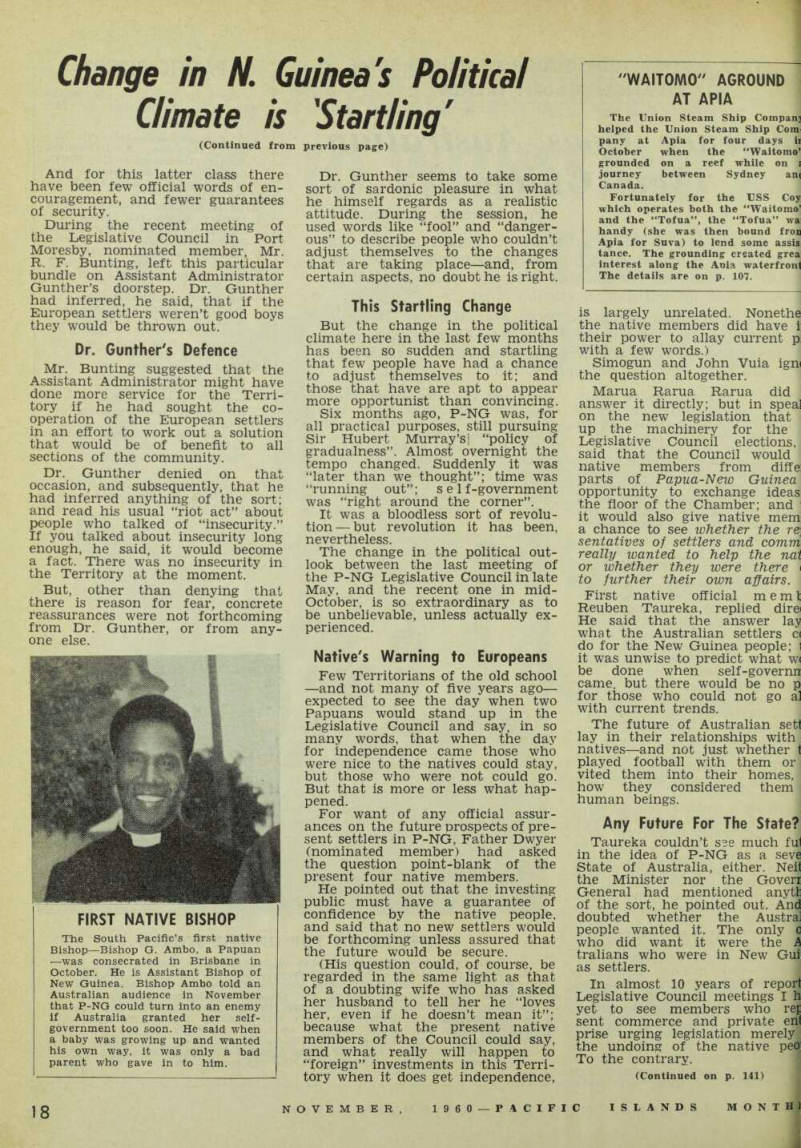
First Native Bishop
The South Pacific’s first native Bishop—Bishop G. Ambo, a Papuan —was consecrated in Brisbane in October. He is Assistant Bishop of New Guinea. Bishop Ambo told an Australian audience in November that P-NG could turn into an enemy if Australia granted her self government too soon. He said when a baby was growing up and wanted his own way, it was only a bad parent who gave in to him.
the other hand, Rarua Rarua a pretty naive idea of fully sentative government if he ines that the elected European bers of the future —if there nue to be any at all —won’t o protect the interests of their electorates. far as Taureka and his ideas t a seventh State are concerned, mid say that he is quite right s appraisal of Australian main ;rs’ wishes. New Guinea and its es and problems have curiosity to some Australians; but bing 2,000,000 natives perman into the Commonwealth would imething else again. ; idea that present settlers >e welcome to stay only accord -0 their social behaviour to the enous people shows a super knowledge of the background is country, and of the problems inning a new-fledged State. It ; about as much economic as an Australian Parlia ary back bencher telling ral Motors to get out of Aus -1 just because he happened 0 like Holden cars. e Rarua Raruas and Taurekas >n their way, politically. A few 1 ago they would have been detely impossible. But their ition has so far been gained is a background of Australian Administration benevolence,, to this extent they are politic and economically adolescent.
P-NG's Mixed-Up Kids t the poor mixed-up kids of the tory are not all natives. They, ast, still have the Administra te tell them where they are f. But the Europeans have to their own individual course; some of these begin to look in ting. an see the day fast approach ■if it isn’t in fact here—when i will be fierce competition as rho is nicest to the natives iest. e sort of thinking that is go
ing on in the Territory today has come gradually to most Pacific Territories; but here it is coming with demoralising and unhealthy suddenness. People who have per sistently regarded natives, for years as simple hewers of wood and drawers of water suddenly feel im pelled to include them in their activities.
They may have nothing in common, and like them no more than they ever did —but now it’s a matter of having to be in it to win it.
As a sign of the times, the local newspaper, reporting the forma tion of the Territory’s first political party, ran the three names of the founders (two Europeans and one native) one under the other, with Simogun Peta’s name on top.
As the story was told to me, it was the European two-thirds who conceived the idea and started the wheels moving. The order of listing of the names possibly shows that the editor knows where he’s going.
Most people would have been in clined to have a bit each way and put the native name in the middle, There has been, too, a lively newspaper controversy as to whether Port Moresby shows more racial discrimination than Rabaul.
The fight was on when Mr, Don Barrett, elected member for New Guinea Islands, said in the Legis lative Council that discrimination extended even to sport in Port Moresby—a situation that would not be tolerated in Rabaul. Port Moresby sprang hotly to the de fensive, whereupon no doubt, all the old-timers who have died in this country since 1884, turned hand springs in their graves.
The closer you are to Port Moresby, the more effort there is to impress everyone with this new found idea of equality.
The further you go out, onto the out-stations and the plantations where the true wealth of the country is produced, race relations remain pretty much the same, each with a healthy respect for the other, that goes deeper than this lip ser vice to a new line of thought.
For this reason, I can’t see “a Congo” in this country. I think the natives have far too much sense, even if some of their European tutors are lacking in this depart ment. . .. , I think that there is time enough left for everyone who is established here, at present, to see his life out here, if he wishes. But it would be a rash individual who could fore see as much for that mans chil dren.
I can’t see European settlers be ing “thrown out”, even if they aren't “good boys”. But there is nothing to show, either, that the political pattern of this Territory is going to be any different here than it has been in a dozen other former colonial territories since the end of World War 11. It probably will just take a while longer.