Pacific Report
pp. 119-148 · Read in the full issue
The month’s round-up of news and pictures of people and /ents, from PIM correspondents in the South Pacific.
:ial Visit to
Pacific War Graves
igadier A. E. Brown, Secretar ial and Director of the monwealth War Graves Com ion, visited Fiji and other d territories on an Ansett g-boat cruise in August, i said at Suva that he had 2d New Caledonia, Fiji, Tonga, ;em Samoa and Tahiti to in ti war graves. 1 Suva the war graves are in y good condition, largely be e of the personal care of Mr.
VI. Sellars”, Brigadier Brown *. Sellars acts as agent for the nission in Fiji. lere are 74 war graves at Suva, ily of New Zealanders, and 2 are some of United Kingdom cemen.
Bourail, New Caledonia, about miles from Noumea, there is a tiful war cemetery, Brigadier m said. ie cemetery is on the site the quarters of the 3rd New md Division used when pre ig for operations in the mons. ie graves of 343 New Zealanders i in that campaign are con rated at Bourail, and the orial contains the names of nen who have no known grave, so in the Bourail Cemetery are graves of two senior United :dom officers who were attached ie United States forces.
Western Samoa there are 23 ss of New Zealanders killed i the NZ forces took that island the Germans in 1914, or who during the subsequent occupa e New Zealand community in ;ern Samoa, led by Mr. stian, Director of Lands and eys, tends the graves.
Tonga there are three war 2S —two of New Zealanders and of an Australian, igadier Brown said there were var graves in Tahiti—five of ed Kingdom sailors, seven ralian sailors and seven New md soldiers and sailors. )se by the soldiers’ section of
the cemetery at Papeete are the graves of five British soldiers who died while resident in Tahiti early in the century.
The headquarters of the com mission is in London, but Brigadier Brown spends about seven months a year operating from Melbourne.
Coral Route Farewells
TEAL's Last Flying-Boat
There were farewell celebrations all along TEAL’s Coral Route in September as the company’s last flying-boat made its last Coral Route flight.
One of the passengers was Mr.
H. K. Ford, who was TEAL’s technical liaison officer stationed in the UK and who took delivery of the aircraft from the makers, Short Brothers, in 1948.
At Papeete the aircraft was farewelled by the Mayor, Mr. Alfred Poroi, on behalf of that city which
has been well served by TEAL in post-war years. Captain Joe Shephard was presented with a carved wooden spear.
At Aitutaki, TEAL’S fuelling and catering staff provided another send-off on the home run.
At Apia, the Samoan Minister of Civil Aviation, Mr. O. Nelson, entertained the crew at a cocktail party which was also attended by the High Commissioner, Mr. J. B, Wright, and by members of Parlia-
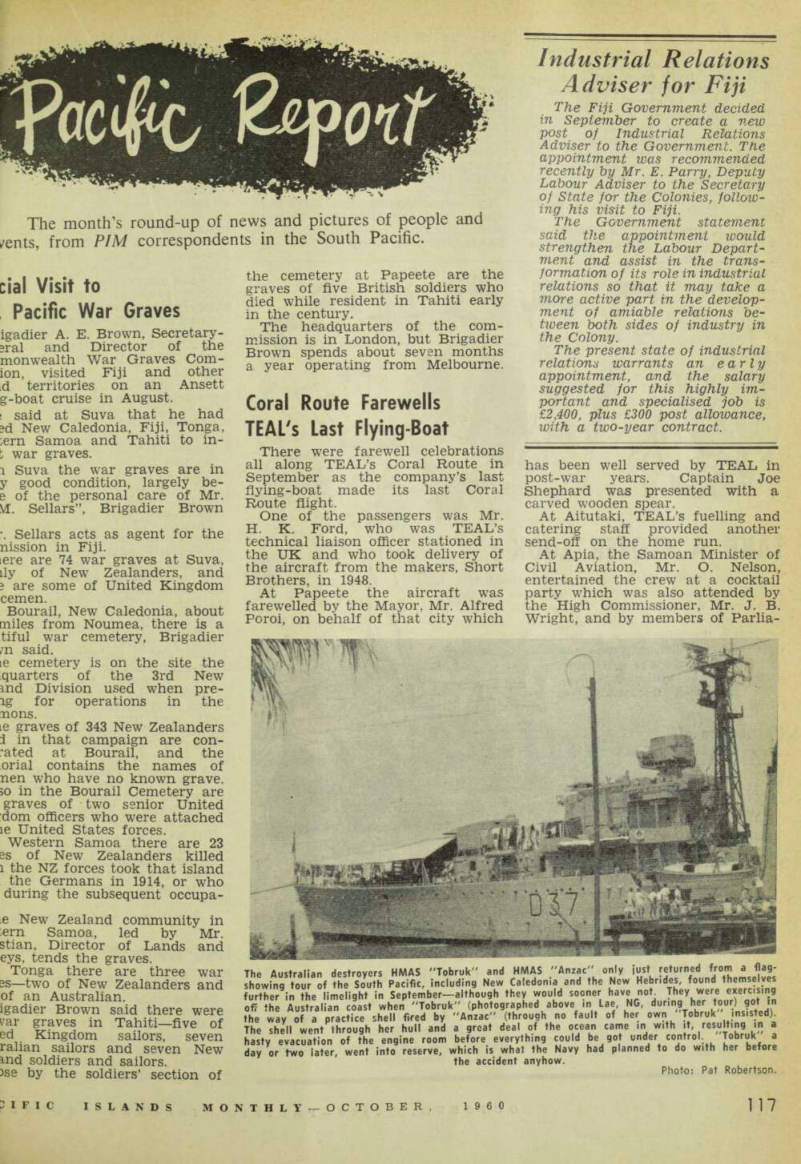
The Australian destroyers HMAS "Tobruk" and HMAS "Anzac" only just returned from a flag showing tour of the South Pacific, including New Caledonia and the New Hebrides, found themselves further in the limelight in September—although they would sooner have not They were exercising off the Australian coast when "Tobruk" (photographed above in m Lae NG, during her tour) got in the way of a practice shell fired by "Anzac" (through no fault of her own Tobruk insisted).
The shell went through her hull and a great deal of the ocean came in with it resulting in a hasty evacuation of the engine room before everything could be got under control. "Tobruk" a day or two later, went into reserve, which is what the Navy had planned to do with her before the accident anyhow.
Photo: Pat Robertson.
ment and business heads. Mrs.
Aggie Gray also arranged a farewell party at her hotel, where TEAL flight crews have been accommodated smce the service commenced.
The final departure from Suva ££ A £ UC^ nd -^ lth a full load of TEAL staff and members of their families—was delayed for two days beyond the scheduled date of September 12 due to bad weather at Auckland. For two mornings in succession people assembled at Laucala Bay to bid the aircraft
Go Ss' „ ,
When it finally left on September 14 its certificate of airworthiness
had just 24 hours to go before expiry.
Captain Shephard and his crew were escorted from the terminal building at Laucala Bay to the landing pontoon by the band of the RNZAF, playing Auld Lang Syne, followed by Poor Old Joe and Now is the Hour!
Suva’s Mayor, Cr. C. A. Stinson presented to Mr. Ford (for TEAL)’ a gift from the City of Suva—a writing set.
In acknowledging this, Mr Ford read a message from Sir Leonard Isitt, chairman of directors of TEAL, thanking the people of Suva
for the hospitality shown to tli airline’s flight crews during tli years that the flying-boats ha been based at Laucala Bay. Populs Captain Shephard also had some thing to say on behalf of the flyir staff.
For RNZAF, Pilot Oflicer G. i Danvers presented Captai Shephard with an 11 ft paying-o pennant which had been made t the RNZAF.
That job completed, Captai Shephard was then placed und« arrest by the RNZAF and parade before the Commanding Oflicer < the station, Group Captain A. A. I Breckon. He was charged with series of “offences”, found guilt and his aircraft was ordered to I forever banished from Fiji. Thei were, however, extenuating circum stances admitted—the good relatior that have always existed betwee the RNZAF and TEAL—who ha* used RNZAF facilities at Laucal Bay.
The aircraft, flying the specis paying-off pennant, and decorate with skull-and-crossbones an other decorations added by RNZA personnel, and escorted by RNZA launches, taxied out.
It took off at 8.40 a.m., made circuit of Suva before headin south. It landed in Auckland £ 3.55 p.m. after a couple of gran circuits over that city.
Though TEAL’s last flying-boe has gone, not all the flying-boats ii the South Pacific have disappeared By chance Aranui lay side by sid with an Ansett air-cruise flying boat from Sydney at Aitutaki dur ing her last Coral Route run.
At Tahiti RAI operates Bermuda flying-boat which wa formerly owned by Sir Gordon Taylor, and a Catalina, in its locs inter-island services.
Fiji Airways has a smalle amphibious Drover on regular locs routes, and there are other similaf craft operating in New Guinea Ansett still operates a regula* scheduled Sandringham service t: Lord Howe Island.
In the North Pacific, Trans Oceai Airways provides a schedule* Grumman Albatross service througl the American Trust Territory o Micronesia from Guam.
But the TEAL Coral Route flying: boat service was the only remaininp scheduled commercial Internationa; service operating between differen territories in the Pacific Island area. (See “End of an Era”, page 83)
NNG Wants A
DC3 Substitute, Too
Netherlands New Guinea is stil looking around for a replacement for the DCS work horse, and is haV-' ing no more success than its friend'l on the other side of the border.
“What we are looking for ifi really something in the nature oic
ive legged sheep,” explained r’s director of Transport and sr, Dr. N. W. Schregardus, just re leaving NNG in September • 10 years service there. . Schregardus said that the de Hand Caribou was an aircraft hie for short fields although squired a special take-off and ing technique. This technique, aid, involved a slight risk, but Civil Aviation authorities were ared to grant approval for its The Caribou would need to a smaller aircraft working in motion with it—and this would imably be the Beaver, . Schregardus said the Fokker rdship could have advantages the Caribou in regard to main nce, speed, and ceiling and at mt the pros and cons of the types were being weighed. He d that KLM intended to send expert to NNG, probably in ber, to discuss with the Gov lent local air transport needs, this visit should facilitate the tion of a substitute for the
:h Labour Wants
rnationalisation of NNG
e Dutch Government’s largest sition, the Labour Party, in ember called for the granting ndependence to Netherlands Guinea as soon as possible, advocated “internationalisation” he area under the United ms. a manifesto the Labour Party Dutch New Guinea was a heavy, less burden on HoHand.
It was not Holland’s job to the area as a bulwark against tnunism.
Holland was militarily incapable ffending the area.
Military security of West
New Guinea rested on an Indo nesian assurance to Australia and the United States that it would not attack New Guinea.
“Disregarding this assurance is not only an expression of distrust in Indonesia, but also an expression of distrust in Australia and the United States and this is politically stupid,” the manifesto said.
The manifesto contained a section on co-operation with Australia.
Australia had always viewed such co-operation (in New Guinea) as “a matter of extremely minor import ance, and rightly so from the Aus tralian viewpoint”, it said.
“Australia has refused to accept both the political and the military
consequences of co-operation with Holland, “Holland cannot let its policy be determined by Australian require ments either.
“Co-operation with Australia must be reserved for those—very limited and subsidiary—areas where it is possible.
“The great lines of Holland’s policy towards New Guinea must be de termined by Holland’s interests in Europe and in the world and by the interests of the Dutch New Guinea population.”
In the Australian Parliament on September 23, Mr. E. J. Ward, a former Labour Minister for the Territories, asked Prime Minister
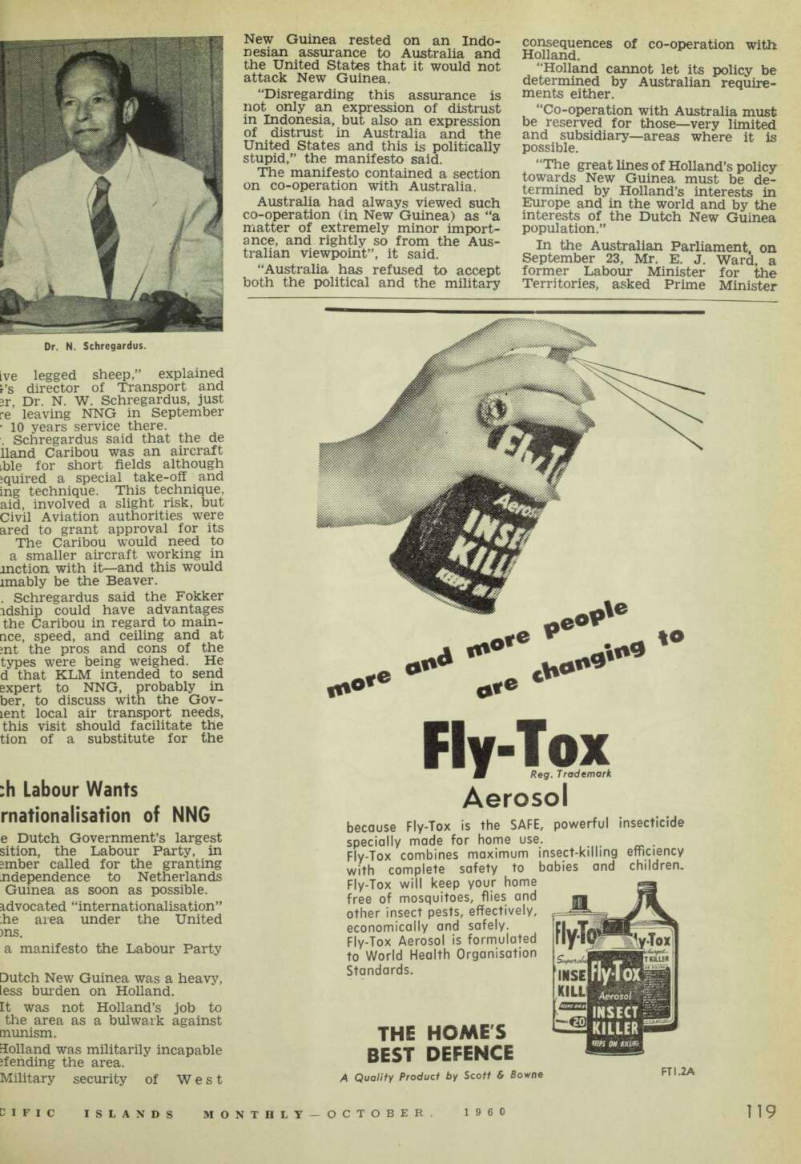
Dr. N. Schregardus.
Menzies a series of questions on Netherlands New Guinea.
The questions and answers were: Had the Government of Holland announced a target date when it proposed to end its occupation of West New Guinea and hand over control to the native inhabitants?— No.
Had the Australian Government declared itself in favour of the eventual decision as to the future political control of New Guinea be ing made by the residents of that country functioning as a single unit?—No.
Are you able to say whether the Indonesian Government has de clared its intention to occupy West New Guinea, by force if necessary?
—The Indonesian Government has stated to the Australian Govern ment that it does not intend to re sort to force.
If so, if Indonesia attempts to occupy West New Guinea following the Dutch withdrawal, and before the New Guinea people have, acting as a single unit, being afforded the opportunity of deci d in g that country’s political future, is the Commonwealth Government com mitted to oppose by force this occupation?—The Government of the day would have the re sponsibility of deciding what action it would take in accordance with international law, the principles of the United Nations charter and the best interests of the people of New Guinea.
Govt. Plans for Fiji's
Cocoa Are Strict
To encourage the planting o cocoa until production is sufficien to warrant the establishment o processing facilities, the Fiji Gov eminent is paying lid for each rip€ healthy pod produced, a Suva correi spondent reported in September.
These pods are being used as see( for further plantings and for tria fermentation to gather informatioi on the preparation of raw cocos under Fiji conditions. The Depart ment of Agriculture is sending samples of raw cocoa to varioui overseas manufacturers for com ment.
When production has reached th« level where fermentaries an warranted, these will be licensed anc numbered so that control can be kept on quality. All export cocoa will be identified with its fermentary.
The Government has undertaker to establish fermentaries in areas where a minimum of about 6,000 pods are being harvested, and these will handle the crop until growers have obtained the experience to dc the job properly. When that stage is reached growers will be able tc establish their own co-operative fermentaries.
Even then the Government will continue to handle the overseas marketing of the crop for some time and will buy wet cocoa beans from these fermentaries, the price being governed by the world price less costs.
Fiji Ginger Goes To
North America
The largest consignment of fresh ginger roots to leave Fiji for North America about 13 tons was shipped from Suva in mid- September in the Matson linen Mariposa.
The crates were shipped by Fiji
t Agency Limited. The man- Mr. Alex E. Muir, said that )mpany had been building up *ade over the past year against competition from Hawaii, asa (where production costs than counterbalanced the ir distance from the market) ’anama. Only the best quality r had a hope of competing— he company had proved that ould produce it if enough care taken in preparing and clean ;he roots and rejecting the sized. the ginger being exported from the vicinity of Suva— vua, Nasinu, and Sawani — bout one-third of the delivered : had to be rejected as under eptable ginger could only be l in this area in August, Sep ir and October. One of the problems was shipping con •ns during this seasonal I.
P & O and Orient Line has d about the only connection Vancouver, the best market.
September Matson voyage was bed as a flag-showing visit to ncouver know that these ships vailable on the trans-Pacific ’ inducement is offered, ile Fiji ginger enters Canada preferential tariff, there is a 'ate protective tariff against it i United States. A good quality ct, however, can still compete there. pment from Fiji is in standard ta crates which contain about of ginger.
itter Deal
fin Can Island
ga’s volcanic northwestern outlier, Niuafo’ou—Tin Can I —may soon have some public es restored, island was evacuated in 1946 result of a severe volcanic on, and the people were re i on Eua, south-east of itapu. A majority of them never very happy there r er, and wished to be allowed ;urn home. 5r 1950 the Tonga Govern permitted teams of copra
workers to spend periods at the island and the numbers pro gressively increased.
In 1958, in response to further requests, about 200 people were per mitted to return as family groups, but as the government was financ ing the Eua resettlement scheme the move was not looked on with any marked approval and it was made clear that the Niuafo’ou people would largely have to fend for themselves, in the matter of providing such services as radio communications, medical services, etc.
The Government has now agreed to provide such services on the basis that the Evacuation Committee aid to the Eua settlement will cease to apply.
The people at Niuafo’ou have now re-established settlements at the five former villages of ’Esia, Kolofo’ou, Sapa’ata, Angaha, and Fata’ulua, and have imported two tractors for the transport of copra and the construction of new access roads over the lava fields.
The Tonga Copra Board has agreed to establish a trade store and to erect a copra bulk store, and will look into the possibility of facilities at the island.
All in all, it now appears that — sparing another eruption—there are better times ahead for Niuafo’ou.
"No Holdups" at Pago Pago
Fish Cannery
The Van Camp tuna cannery at Pago Pago, American Samoa, is operating normally and has not experienced any difficulties in obtaining supplies of fish from Japanese vessels.
This was stated from Pago Pago in September, when rumours that the cannery had ceased operations and that Van Camps were pulling out were refuted.
A Pago Pago correspondent says that there was a period when supplies of fish were slow in com ing forward, but this was due to natural causes. The 400-odd em ployees—who draw about SUS4OO,OOO annually in wages—have been normally employed, and in mid- September four additional fishing vessels were on the way from Japan to join the fleet.
Drowning Tragedy
In Norfolk Tank
Barry Wayne Sanders, aged 1 year and 11 months, the son of Norfolk Island’s Mr. & Mrs. W.
Sanders, was accidentally drowned in an underground water tank on Norfolk Island in September. The cover of the tank had been damaged by a horse only two days before. At the inquest, the coroner, Mr. H. J. Powell, issued a warning to residents of the dangers of un covered wells and underground tanks on Norfolk. (Over)
Fiji's big ginger consignment ready to leave Suva in September.
ihiki Is Alright
Flying-Boats
3 Cook Islands northern atoll anihiki now has a flying-boat ing—a locally made one—and •ea of the lagoon marked out safe landing area for RNZAF srlands. ; survey was the result of the tion of the New Zealand *nment to make an experi il transfer of mother-of-pearl *s from Manihiki to one of the au atolls north of Samoa next May. no up-to-date chart of aiki lagoon exists it was sary for the RNZAF to send Dfficer from Fiji, Flight mant J. F. Harrison, to look ituation over before despatch fiying-boat. He was flown to iki at the end of May to ct with the local vessel Dobiri, I also had aboard the Cook is Fisheries Officer Mr. Ron 1, and a research team from Department of Scientific industrial Research, to make )rough survey of the lagoon rt of a programme of mother irl shell conservation.
August Flight Lieutenant son captained a Sunderland nihiki via Satapuala (Western a) and made history—so far known—by making the first -boat landing on this lagoon, ortunately the best landing is in the north corner of the i somewhat distant from the settlement of Tauhunu, but to the other village of Tukou, other islet. ire is not likely to be much -boat traffic into Manihiki but II be useful to know that a >le landing is available for :encies. i flying-boat remained on the for only about an hour and i up the DSIR party which completed a very full survey 3 oyster resources.
\i Has a British Consul—
Not in Tahiti
ce the British Consulate in ite was closed down last year— rederick Devenish was the last nt consul— PlM has made il inquiries to discover who >ents British interests in h Polynesia. now learn that in April this Mr. T. R. Cowell, of the South c Office of the Fiji Govern- Secretariat, was named to this -with office in Suva.
British Consul for French esia Mr. Cowell is responsible ly to the British Foreign . He will pay occasional visits ipeete, but up to the end of mber his credentials had still 3 officially accepted by the h Foreign Office in Paris, so
he has so far made no such visits.
Quite separate from this Consular position, Mr. Cowell is at present the United Kingdom Commissioner on the South Pacific Commission, and he represents the Governor of Fiji in the latter’s functions as Governor of the Pitcairn Islands Group, Chief Commissioner for the Kingdom of Tonga, Consul-General for the Western Pacific, and Consul- General for the islands under United States Sovereignty in the South Pacific.
Mr. Cowell was attached to the Western Pacific High Commission staff from 1941 to 1958 when he was seconded to the South Pacific Office of the Fiji Secretariat. Officially he is an Administrative Officer, Class I.
Education Director Doesn't
Like the Word 'Scandal'
Christian missions had made a “magnificent contribution” to native education in P-NG, the Director of Education, Mr. G. T. Roscoe, said in September. “If it had not been for the missions our education effort would have been much less than it is,” he said. “But I certainly would not use the word ‘scandal’.”
Mr. Roscoe was replying to the Anglican Bishop of Grafton, New South Wales, the Right Reverend K, J. Clements, who told the Seventeenth Synod of the diocese of Grafton that without the missions Australia’s education record in the Territory would be a “scandal”. (Over)
claimed that of the 200,000 e children receiving education lustralian Government provided ess than one-ninth. The rest educated solely by missions, his reply, Mr. Roscoe said that >t 20,000 native children were ig either primary, post primary :ondary education in Territory rnment schools. recognised and registered Dn schools the number was ly more than 55,000. )ther 110,000 children were be iducated in “exempt” mission Is—schools which the Admin ion did not consider good ;h to be given aid grants, my of the teachers in these ot schools are not trained and are not even literate,” Mr. ie said. “Sometimes the number pils per teacher is so great the en cannot possibly be taught ively. ie of the Administration’s ;ives in its universal education is to raise the standards of schools to the point where can receive Government aid.”
Pic Will See Luxury
s on First Voyage
h O-Orient Line’s two new iger liners, the 40,000-ton a and 45,000-ton Canberra, both ig completion in the UK, are uled to depart on their maiden es within six months of each and both will be seen in the c. Oriana, which will begin its in late October, will make her n voyage from Southampton Iney on December 3. will make a short cruise in ’acific before she sails again Sydney to NZ, Suva, Honolulu ie west coast of North America, ling via the same route, Canberra is expected to leave ampton for Sydney next June, j via NZ and the Pacific is for Canada and the USA, dng the same way. ma’s maiden voyage will last er 3 h months, and Canberra’s ike just under three months.
A Luxury New South
Pacific Vessel, Too
The new addition to the Aus tralia-West Pacific Line fleet, MV Samos, is due in Sydney on her maiden voyage about October 19,
but New Guinea residents will not be seeing her until December.
This very modern-looking 7,820 tons dw vessel was delivered from her builders in Denmark on August 16 and is beginning her Australia- SW Pacific-Far East service from the Australian end (departing Mel bourne, October 17).
Her first south-bound voyage out of Japan will commence on Novem ber 11, from Yokkaichi and there after other Japanese ports to Hongkong, Sandakan, Madang, Rabaul, Lae, Honiara, Vanikoro, Santo, Vila and Australian ports.
The latest navigational and cargo-handling aids have been fitted to the new ship which will carry general and refrigerated cargo.
There is luxury accommodation for 12 passengers in three double cabins and six single cabins, and a large dining saloon, smoking room, swimming pool, bar and Turkish bath. All accommodation is air conditioned.
A sister ship to Samos is cur rently being built in Japanese yards and was christened Tanos there on September 21 by Mrs. von Gelsing,
[?]s "Canberra", now being fitted out in readiness for her maiden voyage, when she will be seen in the Pacific.
Australia-West Pacific Line's new MV "Samos", to be seen in Sydney in late October on her maiden voyage. For the passengers there is every luxury, including a Turkish bath. Decor is modern, as this view of the lounge shows.
sister of Mr. Folke Hlllerst managing director and owner of company.
Tanos is expected to be delivt from the Japanese ship \ towards the end of January, I and then join Milos, Delos, A Citos and Samos on the reg Australia-West Pacific-Far ] service.
The addition of two new ves of this type to the company’s i indicates the firm faith of owners in the future of this ti route.
Increased tonnage available to Line has allowed them to introc a new service to New Gu ; shippers—that is, calls at cer ports on the northbound voyagi well as southbound.
Delos will start this new ser with her October departure f Australian ports by calling at and Rabaul as well as Manila the way to Hongkong and Japa
Gaol for Attacking
A NG Missionary
In Rabaul, NG, in Septembe: native was gaoled for nine moi for attacking a Roman Gath missionary with a grass sickle.
Mr. Justice Brennan dismissed native’s claim of provocat although he found the missior had hit the native first.
He said that in denying he “laid hand” on the native he lieved the missionary’s recoiled had been “faulty”.
The native, Aliengu, appeared fore Mr. Justice Brennan in Rat Supreme Court charged with ha\ caused grievous bodily harm Brother Theodore Koenig, of Vui pope Mission. Aliengu had plea not guilty.
Tonga Will Replace
Its Radio Equipment
Tonga is in the final stages; establishing a broadcasting stat at Nukualofa, and last month it ’ announced that certain new rs facilities were being established!
Tongatapu as aids to aviation. I there is an announcement that the equipment at the Nukual radio communications station, wh maintains inter-island, shippi: and overseas contacts is to be placed, making this station “one the finest of its type in the Sot Pacific”. Total cost of new equ ment is estimated at £48,000.
Unusual Hospital Ship
Crosses Pacific
One of the most unusual sh of her size ever to put to sea, privately owned hospital ship He of about 11,000 tons displacenMj left San Francisco on September! bound for Indonesia. Late in S>: tember it was not known wheti
lip would be calling at any Pacific ports en-route. ormer United States Govern hospital ship which had been balled” since World War 11, issel takes her new name from ogan: Health Opportunity for ; Everywhere. ipletely modernised for her ask of providing medical as ce and medical training in the -developed countries of Asia, ip is being financed by private is and organisations in the i States and is manned by an ly volunteer medical staff, has accommodation for 250 its, three operating rooms and ternity delivery room, dental is, a pharmacy, student teach ’acilities including a movie e and a supply of films on al and public health subjects, closed TV system making it le for large numbers of its in a lecture room to >s close-range views of surgical ions taking place in the ship’s ing theatres.
orms A
I Association
Fiji Naval Association was d in September at the in on of members of the former .oyal Naval Volunteer Reserve was disbanded by the Gov *it last year due to lack of e. Membership is offered to all ex-naval servicemen, eering committee consisting of s. N. McKenzie, Vil a m e na, A. Osborne, T. Morel, tie Qaranivalu, Saimone Isireli, >lin, and J. H. Gale was formed i member has offered a site le building of a clubhouse as as finances are available, while functions will be held in halls.
He'll Fight for Citizenship
°f NG's Euronesians
Visiting Australia in September was Mr. W. T. Thomas, prominent New Guinea planter, planning a new assault on the regulations which are preventing Australian naturalisation of any New Guinea halfcaste people.
Mr. Thomas hoped to arrange an interview with the Minister for Territories, Mr. Hasluck, on the chance that “on his home ground perhaps the Minister will give a frank appraisal of the situation”.
But whatever happens, Mr.
Thomas has the blessings of Kokopo Town Advisory Council and of the 300 or so self-styled Euronesians
XdTacl po p pu t iat l on abaul ' Kokopo
S' Mm
people, feel that the time has come when naturalisation should be available for mixed race people who meet the requirements of worth while citizens.
The Apex Club of Rabaul has also taken up the cause and has already held discussions with Mr. Hasluck.
New Guinea people who have dis cussed the matter with Mr. Hasluck feel that he is sympathetic to the suggestion, but is powerless to do much at present in the face of existing immigration laws.
Greatest attention recently has been focused on Mr. Harry Spanner, of Kokopo, a Roman
? ol tV^ 10 u n nsucc r esffuiiT°sintfe ! to obtain naturalisation. f the Euronesians do not get t their loyalty is requesting ■y. they may become embittered ver,” Spanner has warned ie Administrator of Papua-New nea Brigadier p M. Cleland sated recently that he was not happy about the individual light which the Spanner case been receiving. ’or goodness sake fight the case behalf of the people, not on ilf of one man,” he said. le of the main reasons, how- , which has triggered the offer Mr. Thomas to discuss the ect in Australia is a renewed sal to naturalise Harry Spanner. id Mr. Thomas: “This latest sal is not very satisfactory to me, and I want to do what el to help .
fpnrlpr fnr Amorlran
icimer lur Hmeritan
103 Governorship?
iptember Lember of the Hawaii State ature, would probably be a mder for the Governorship of rican Samoa “if the post falls it” as the result of the Preitial Election in November. A ler of Mr. Trask, Mr. “Barney” k, is living in Samoa at present,
No Second Nadi Hotel
An application for a licence to build an additional hotel at Nadi Airport, made by South Pacific Hostings Limited, was refused by the licensing authority in September.
Grounds for refusal were that the hotel plans, as submitted were deficient in' certain ™splcts. If these deflciences are corrected the application would again be considered.
South Pacific Hostings is the organisation provi d i n g catering facilities for the airlines and airport staff. They are at present also operating a licensed overnight accommodation house 21 miles from the airport and known as the Skylodge. This establishment was formerly the staff quarters for the personnel of the firm building the new airport.
The application for the permit to erect the proposed hotel was opposed by Mr. Barry Philp, * 3 ... , . •
Public Service Commission
Now For Fill
I Fiji now has a Public Service Commission, though with very limited functions and powers.
?t w°m e^fv en h state ‘ cerned within COn ‘ in respectpoststo the cmlkay vice have a Se nf more than £750 ner annumTwS not be advlS' in th e p««. nf m tne magistrates and Wher nSf in ih. a,.an higher
mSe The ps"ce F?rcf S
a P Servfce Commissfon of ™n commission of its The main purpose of setting up the Commission is to afford the Government independent and im- Partial advice on the selection and appointment of local candidates for Government employment, according to the statement. The Commission is not concerned with rates of pay or other conditions of service, though if these should make re cruitment difficult the Commission could invite the attention of the Governor to the fact, Qrder-in-Council governing
SefmayYl “tafoTv*
official or unofficial, may be a member T* l " member s named for immedi ate appointment are Mr. C. S. de D.
Reay, chairman; Mr. W. E. Donovan, Mr. J. B. Takala, and Dr. Dharam Singh.
me "Harbour"
provements at Pitcairn Is.
,lght from the day when Fletcher •istlan deliberately ran the .nty aground at Pitcairn Island, ling there has been difficult at last work is in hand make it a little less dangerous the islanders to land their ileboats at what they describe as “harbour” at Bounty Bay. tor Rex Cobbin, Seventh-day entist missionary, stationed on airn, wrote thus from there on ust 31: is expected that improvements under way in Bounty Bay will :e it safer for the island boats oad and unload their cargo, to ;e their way through the surf the entrance to the landing, prevent their receiving such :h treatment at low tide, when are continually bumped and ped on the rocky bottom. ) begin the operations, the ernment in Fiji sent over an osives expert, Mr. Bradnam, he, with the assistance of 17 le island men, is removing rocks lear the bottom and edges of harbour. Many of the rocks far too big for the men to lie, and these are being blasted of the way with dynamite. Mr.
Inam is also endeavouring to en the harbour by blasting ; of the rocky shelves on the )m. iis work has created so much ■est among the islanders that rder not to miss a single blast, y of them spend practically the e day at the edge of the cliffs hing the progress being made.
Imes the water and rocks have blown as high as the island, h is upwards of 1,000 feet, and action is worth seeing, e men working on the our avoid injury from the )sions by running up the cliff before the charges are due ) off. complete the improvements, Government plans later to 1 a breakwater near the ince,
a Looks Into
Future
e of Suva’s principal tourist failings is lack of a con nt bathing beach. That may be ually corrected under a plan before the Suva City Council itly. The plan covers the whole fronting Victoria Parade, from )ost office to the Grand Pacific I. and work is already going d at the post office end. e “bay” between the new post ‘ building at the rear of the
P° the Cable and Wireless building is being filled in.
A single-track roadway arcs into “7* Victoria Parade the fire sta u t I lon *9 rm ar6a capab l e taking
» “SS ■? ort Jj" bound
buses wfll use it. This bus bay was taking shape in early October.
To seaward of it will be a garden area, and beyond the Cable and Wireless building a civic centre will be developed, and from there on to the Grand Pacific Hotel past the old Boys’ Grammar School will be reserved as “general commercial” area, with provision for future luxury hotels. These would have to be set on reclaimed land leaving a broad area on the Victoria Parade
side for development as a future boulevard Beyond the GPH towards the en trance to Government HoSfe a further reclaimed area would be come a sports area, with tennis courts, bowling green, and football and cricket grounds, a possible artificially built beach —like many such beaches at over seas tourist resorts—would be de veloped to seaward of the Grand Pacific Hotel.
The proposed boulevard, 120 ft wide, would extend across the Nubukalou Creek near its entrance by the Harbour Master’s office to junction with Harris Road, the new road along the rear of the wharf area.
lohn Dutch's
well To New Hebrides
2 High Commissioner for the 3rn Pacific, Sir John Gutch, Lady Gutch, paid a farewell to the New Hebrides in >er, prior to Sir John s retire . (Mr. David Trench has been nted new HCWP.) John and Lady Gutch travelled le New Hebrides aboard the : Queen, which also took Mr. n Amery and his party to the Hebrides en route to Fiji. 3 High Commissioner was met Mr. J. S. Rennie, British [ent Commissioner in the New ides, who returned to Vila in smber after long leave in Eng . Rennie expected to accompany ohn Gutch to Noumea later in ier to attend the 21st session le South Pacific Commission.
ja's Deputy Premier
res After Long Service
;er 37 years unbroken service le Tongan Crown, the Hon. a Tuihaateiho has retired as a’s Deputy Premier, has been in poor health since eturned to Tonga early this from attending a course in amentary Practice and Pro :e at Westminster, London, and low live in his estate on Tonga e Hon. Havea Tuihaateiho first d the Tonga civil service in 1923 i assistant clerk in the Premier’s B.Later he was Governor of ,u and of Haapai. He was inted Minister of Lands in 1946, held the portfolio of Minister of j;s, together with that of Deputy lier, when he retired.
Latest On the NH
Volcanic Front
The flow of lava from New Hebrides’ Lopevi volcano, which erupted violently on July 10, re sulting in evacuation of the island, had ceased at the beginning of Sep tember when the British geologist, Dr. C. E. Williams, visited it. How ever, occasional puffs of steam came from some of the many craters.
Later in September Mt. Marum the large volcano on Ambrym be came more active, and there was some excitement when thick ash showers started, accompanied by earth tremors.
The last major eruption of Mt.
Marum occurred in 1951. There are two main craters and it is thought possible in Vila that a third crater may be developing as a result of the recent activity.
NNG On the Way In
Training Own Doctors
From 25 to 30 native doctors should be practising independently in Netherlands New Guinea by 1970, according to Dr. G. Hoekstra, NNG’s Director of Public Health, speaking in Hollandia.
He said many of these will be trained at a new medical centre shortly to be established in Hollandia.
The new centre will be financed by the European Economic Com munity Development Fund, and the main building will have three floors.
Others will probably receive training at a medical school to be established in Port Moresby.
New Caledonia Celebrates
With a Big Week
New Caledonia celebrated the 107th commemoration of France’s occupation of the island with more than usual gusto this year.
A new committee headed by Mr.
Numa Daly, Australian educated head of one of Noumea’s biggest import houses, was mainly respon sible for injecting the “gusto”.
Various fixtures extending over a week were held, terminating in a monster carnival on September 24, the commemoration day.
No French fete is complete with out a military review and this year
v. J. E. and Mrs. Owen left Vila, New [?]s, for Australia in September after six with the Presbyterian Church there. A [?]wd farewelled them. Before their de they saw the formal opening of Vila's [?]urch hall, named Owen Hall in apprecia their work in the community. The new [?]as erected in about four weeks on the [?] the former Raton Memorial Church, was wrecked in the 1959 hurricane. The [?]g was erected by Braybook Homes, of [?]e, who also supplied the pre-cut staff [?]s recently erected in Vila for the Condo [?]m Government and British Residency.
Photo: Reece Discombe.
Governor Pech o u x , Admiral Martinet and General Appert re viewed the island’s might in one of the main streets.
Whilst Lancasters flew overhead and jeeps and motorised artillery rushed by, General Appert decora ted some of the troops, one of them a New Caledonian, Yves Demene who was cited for gallant conduct in Algerian operations last year.
Demene was awarded the Croix de Valeur Militaire. He was wounded in the operation for which he was cited.
Some 6,000 people crowded into Noumea’s sports arena in the after noon to witness the huge carnival.
Heading the list of attractions was a troupe of Australian artists,
jugglers, acrobats and clowns.
The troupe was a huge success and seemingly enjoyed pleasing the crowd as much as the crowd en joyed watching.
Young native dancers and Wallisian men and women dancers also performed. Various sporting demonstrations were presented in cluding two “Go Karts”.
Young native collegians demon strated the throwing of the javelin, showing the inherited traits of their spear throwing ancestors. (With proper training New Caledonia might have some Olympic talent in that direction).
A concours d’elegance brought out some of Noumea’s finest cars, prettiest dresses and loveliest
women. The judges had ahj time of it and there was very lii difference between the winner a her rivals.
Some 12 lovely dames a demoiselles took part in 1 concours. The Japanese wife of engineer of the nickel smelt received great applause when j appeared in her kimono. The c of the group of contestants madt great impression on the tourists a one New Zealander confessed tc PIM correspondent that th could not be another island in 1 world which could boast so ma lovely women.
The carnival continued late u the night and was judged as be; Noumea’s greatest ever.
Has Tom Shot
The Rogue Croc.?
Professional shooter Tom Cole September trapped and killed a feet crocodile believed to have be responsible for four attacks natives in Marshall Lagoon, soi east of Port Moresby.
Cole trapped the rogue crococ near the grave of one of its victii A huge mesh net was set m the mouth of a small river flowi into the lagoon, after natives h seen a crocodile swimming ther The natives believed it was ti ing to reach the river bank grs of a native woman dragged fn a canoe by the crocodile in July.
Said Cole in Port Morest “It’s hard to say whether or r the croc, was the one I was afte “The last attack occurred t long ago for analysis of the cc tents of its stomach to show ar thing.
“However the natives of the an are convinced it was the o causing all the trouble.”
Cole, who now runs a smi nlantation at Banz in New Guine: Western Highlands, is regarded one of the territory’s foreme authorities on crocodiles. He is expert shot who has export thousands of hides to overse markets.
He was hired by the Administn tion to go to Marshall Lagoon aft a series of attacks on native wome At least two were killed and seriously injured.
Most were attacked aboard canc and all were believed victims the same beast.
The crocodile’s skin will 1 treated and presented to the Papui New Guinea Museum in Pc; Moresby.
What Mr. Menzies Told
UNO About P NG
The Australian Prime Minist© Mr. R. G. Menzies, addressed tL United Nations in New York 3 October. Among other thing he answered criticism by Ms Khrushchev of Australia’s role I
New Guinea. Mr. Khrushchev lied on Australia to give im e full independence and self ment to the Territory, is Mr. Menzies’ reply, taken le official text of his address: a piece of rhetoric LMr. ichev’s call] no doubt has its But it exhibits a disturbing )f knowledge of these terri and of the present stage of levelopment. ody who knows anything these territories and their ious people could doubt for lent that for us in Australia andon our responsibilities ith would be an almost il act. e is a country which not so ?o was to a real extent in a f savagery. It passed through ist gruesome experiences dur ; last war. It came out of it t organised administration i a sense, without hope. It is lation in the accepted term, people have no real structure aciation except through our stration. Its groups are i among mountains, forests, and swamps. It is estimated here are no less than 200 it languages. i work to be done to create ster a sense and organism of
community is therefore enormous.
But with a high sense of responsibility, Australia has attacked its human task in this almost unique area. Since the war some form of civilised order has been established over many thousands of square miles which were previously unexplored.
“We have built up an extensive admimstration service from nothing to a total of thousands of public servants, local members of the public service and administration indigenous employees.
“We have created five main ports
with modern equipment. We have built over 5,000 miles of road; con structed over 100 air-fields; estab lished and improved postal and tele-communications services. We built four large and modern base hospitals, 107 subsidiary hospitals and 12,000 aid posts and medical centres.
“There are in operation 778 in fant and welfare clinics. We have built from nothing, medical services that include 119 doctors, 347 trained nurses, 236 medical assistants, and thousands of native medical assist ants, medical orderlies and nurses.
“In a little more than a few yt we have established 4,100 set which are atended by 200,000 pui large stock stations have been es lished; and a great forestry indn founded. I could go on like
indefinitely.
“All this has been done in a years since the war. The achi ment has not been without cost, are a very strange colonial pc if I understand the sense in w that term is used. We have many more millions into Papua New Guinea than have ever c out or will ever come out. Like Netherlands, we regard ourselve having a duty to produce as sooi it is practicable an opportunity complete self-determination for people of Papua and New Guii; “We have established many J government Councils in ordei provide training in administra: and we have set up a Legist Council on which only the other we substantially increased the n ber of indigenous representatu “Mr. Khrushchev includes ui his diatribe against ‘foreign adr istrators who despise and loot local population’, I have shown exactly opposite to the truth th: in our case. His further extras anza about the ‘overseer’s lash’ the ‘executioner’s axe’ must re to areas with which he is n familiar than he is with 3 Guinea and Papua.
“I must say with complete cla that we do not need to be lecti on such matters by a man who no record whatever of ha 1 brought colonial people into free* and self-Government. We inc are proud to be in the Bn tradition of the 20th centurj tradition which has by sensible grees and enlightened adminisi tion brought the blessings of s Government and a seat in the Cc oils of the world to many for: colonies.” (See “Mr. Menzies at UNO”, page
Noumea Moves Towards
A Five-Day Week
Noumea is moving towards a f: day week. Most Governu services have already adopted it from September, together with I Caledonia’s only bank —the Ban!
Indo-China. Work starts ear: or finishes later to give ; Saturday free, and only a skele staff now operates the po: services on a Saturday.
Nevertheless Noumea’s five week poses a problem for pet; with children.
New Caledonian schools haw holiday on Thursday and work: the Saturday.
A correspondent reports that !
Australian system of a five school week has been under ( cussion, but this could meet w opposition from the church, Thursday is generally devoted 1 religious instruction of the childiJ
correspondent adds there is nee that a five-day week will the commercial section, will be hostile to closing on ays.
TNOTE : In late September decided that schools would en Saturday afternoons off, r ould work extra hours in ay afternoons to make up for st parents welcomed the new as it would enable them to earlier start in spending a nd in the country. Thursday a holiday.
‘acific Is
ig Together More
Pacific is getting smaller— ustralia knows it. Here are itest developments in her liaison.
RAAF Neptunes visited i in October for a fortnight’s
exercises with the US Navy. They flew via Fiji and Canton and will return via Samoa. 26 RAAF men, one RAF man and a RAN member made up the detachment which was the seventh RAAF reciprocal training exercise with the US Navy since 1957.
Two officers of the Indonesian army arrived in Australia in October to attend officer training courses in Australia. Their visit is part of a policy of making train ing facilities available to servicemen from neighbouring countries.
Australia’s Department of External Affairs announced in Sep tember that when Mrs. Kusuma Goonetilleke, of Ceylon, left Perth on September 8 on her way home to Ceylon she was the 3,000 th Colombo Plan trainee to have been helped by Australia.
The Royal New Zealand Navy cruiser Royalist will visit Australia for training exercises in November.
She will spend a fortnight off the Sydney-Jervis Bay areas. Royalist is under the command of a RAN officer, Captain H. D. Stevenson, who is on exchange duty with the
Rnzn.
Talks on Australian
Coastline Survey
A new five year plan for the charting of Australia’s coastline and sea routes will be discussed in Canberra in October at a con ference called by the Department of the Navy and attended by Aus tralian civil authorities.
The first five year starting pro gramme of the RAN ends next year, and plans have to be made to cover the most urgent tasks for the next five years. To conduct a thorough modern survey of the entire coast line would take 25 years. (Over)
[?]S NEW BUILDING. One of the most [?]uildings in the British Solomons —and the one with the best view of Honiara Geological Department's new building, [?]ge above the town. It is partly air [?]ed and contains among other things [?]ical museum. The Solomon Islanders [?]equipment lined up here are some of [?]rtment's staff who formed an honour [?]r the official opening of the building by the Western Pacific High Com missioner, Sir John Gutch.
New Hebrides Airways
Is Still Airborne
New Hebrides Airways, which September still had not b e authorised to run regular servi was nevertheless making it pretty busy and proving what evi body suspected—that there is r for a small internal airline wit the New Hebrides.
In late August the airline’s ( aircraft, a Rapide, made a lam for the first time on Aniwa Isk in the southern New Hebrides, a 600-yd grass strip made enti by local people. The airline has i made possible the opening of Qi Hill, which was built by the Am cans as a wartime bomber field is of compacted coral.
Tanna Planter Bob Paul, with fellow Australian Paul Bur is a director of New Hebrides i ways, has been visiting central i northern islands, to invests other possible airstrip sites. He also been supervising construe! of an airstrip on the island Tongoa, in the Shepherd Grouj In late September the Rai made a mercy flight to south Per cost to bring back to Vila a member of the crew of the Nika\
Norfolk Has a Big
New Hotel
Norfolk Island opened its ] Hotel Paradise in October. ' hotel, at Kingston, looking aa the golf links to the swimrr beach at Emily Bay, with Nep and Phillip Islands in the ba ground, has been described loc; as the “most important adva yet made in the development tourism on Norfolk”, The new hotel accommodates and all the bedrooms have an oo view. The hotel features a parq dance floor. More extensions planned.
S. Pacific Commission's
Twenty-First Session
The 1960 Session (the 21st) the South Pacific Commisss commenced at the headquarter the Commission, Anse Vata B: Noumea, on October 13.
Commissioners representing i six member nations—namely, Unii Kingdom, United States, Austraj New Zealand, France and T Netherlands sitting in aa; ciation with members of t Research Council, will devote tl weeks to consideration of ma matters affecting the soc i a economic and medical welfare the South Pacific Colonies a; Territories.
Australia’s Senor Commi sioner. Mr. Dudley McCarta (who is an Assistant Secretary J
epartment of Territories, a) was elected chairman.
McCarthy said the native had been meeting in their ‘acific Conferences with in : confidence and ability to themselves. The SPC was jsition to provide the help ific peoples needed and in ting decade would be found t and greatest chance to he Pacific future, ilia would play its part and ot be found wanting in pur ithusiasm or finance. The an Government realised •motion of the welfare of the •copies could only be realised r as the aims were identical lose of the people them
itives To Be
d as Officers
5 soldiers of the Pacific i s Regiment. Papua-New > military force, are to be for appointment as officers, ed native PIR members will a 12-month course at the Cadet School, Portsea, Yie ld will be commissioned as ieutenants. They will be the v Guinea natives to be com ;d as officers in the Aus- Army. jsent all officers of the PIR opean, although natives fill imissioned ranks, ilbourne, in September, the president of the Returned League, Sir George Holland,
and a former Chief of the Army General Staff, Sir Sidney Rowell, both agreed that the commission ing of New Guinea troops was a magnificent idea Sir Sidney said, “It had to happen sooner or later.”
Blood Study So Far Doesn't
Support Any Theories
Research into the blood groups of the various branches of the Polynesian family, carried out by the Auckland Medical Research Council, have not provided any con clusive evidence to support any par ticular theory of migra tion.
The research is still proceeding.
So far the blood of New Zealand Maoris, of Cook Islanders, and Tongans has been studied, and work is proceeding on the blood of Western Samoans.
The researchers have found a clear difference between Eastern and Western Polynesians, but these differences could be through chance, natural selection, or some other cause—such as different origins of the two peoples.
Anomalies Corrected In
Sugar Pay-Out System
Anomalies in the Government’s intended method of paying out cer tain Sugar Stabilisation Fund monies to Rewa Valley sugar cane
TOO. Netherlands New Guinea, too, putting up some fine new buildings.
Hollandia's new two-storey Telegraph ned in August. A new General Post earing completion on the site. Below branch building of the Nederlandsche atschappij bank, about six miles from Formerly it was an old shack, but uilding is of brick. The NHM is the in Hollandia with branches in other places.
! were corrected by the Fiji ;ive Council in October. v the original plan (Sept. . 121) the persons actually ession of the 750 farms on ier 10, 1959—the date that the fill ceased ive the money involved; it d £5B per farm, would have meant that who had only recently taken on would have received the jovernment now, although it agree to any system which I investigation of each farm ixtent of dividing the money b several farmers, will pay lers in possession, only if id was still bearing cane he new owner, and only if ae had been planted by the ier. wise the money goes to the ite predecessor who had been ig cane.
‘a's Query On
lam Strength
Noumean roneo news-sheet donien in September put in rumour prevalent in Noumea e last month or two. • the heading “We have the know” the paper asks if it that an expert from France Noumea to check on the ions of the Yate Dam which legedly, not as good as could ed. 1 correspondent reports that is been going on recently in /er part of the dam, but is extremely unlikely that g serious could be wrong the wall of the dam had strong test in last year’s r issues later Le Caledonien I that it had now been in that there was nothing vith the new dam and the i the site was quite normal.
Take More
Pacific Tuna
apanese Fishery Agency has the Taiyo Fishery Company o a quota increase of 3,000 ■ its tuna mothership opera the South Pacific this year, is stated by Mr. Nobuyoshi , business manager aboard tnpany’s mothership Koyo when that vessel called at >r bunkers and to transfer a, freezer vessel for despatch Dlulu and San Francisco in increased quota will mean s summer, for the first time, ership fleet will operate in uth Pacific right into the ae season. now the Taiyo Company has
not been in a position to operate a fleet later than November, as the vessels which are specially equipped as motherships, are required in the Antarctic as freezer vessels for the company’s whaling fleets. They load whale meat from the factory ships.
The whaling season extends from early January to mid-March, but it takes about a month to get to the Antarctic and to return.
This year, however, the Taiyo Company has launched a new 11,000ton freezer vessel, Sayo Maru, for Antarctic service. This will permit the mothership Tenyo Maru No. 3, which returned to Japan from the Fiji area at the end of August, to make a second tuna cruise. She will relieve Koya Maru in the Fiji area in mid-November and operate until some time in February, when it is expected that the additional 3,000ton quota will be reached.
Earlier it had been reported that another fishing company might be applying for a license to operate a mothership fleet in the South Pacific this year, but nothing eventuated.
The motherships last year had a combined total quota of 22,800 tons.
This year the figure will be 23,100 tons approximately.
Anglican Missionary Heads
In Conference
Activities of the Church of Eng land among the Islands of the South Pacific were under review in Springwood, NSW, on October 11-13, when the Bishops, and other leading men of the Dioceses of Melanesia, Polynesia, Honolulu, New Guinea and Carpentaria, held their triennial conference.
After many years of consideration, the Archbishop of Canterbury’s Ad visory Council on Missionary Strategy finally set up this “Con ference of the Church of the Pacific”, and its last session was in New Guinea, in 1957.
The President this year is the Bishop in Polynesia, the Right Reverend L. S. Kempthorne, of Suva. Among those attending were the new Assistant Bishop in New Guinea, Father George Ambo, who is a full Papuan; the new Bishop of Carpentaria, the Right Reverend S. J. Matthews, and a distinguished layman, Mr. Matthew Salato.
Board of Inquiry For
Fiji Sugar Industry
With the exception of one clause, the Fiji Legislative Council accepted a motion by the Indian Member for the North Western Division, Mr. B D. Lakshman. that a B9ard of Inquiry be set up to look into the sugar industry in the Colony.
The exact wording of the motion, as approved, was as follows: “That in view of the present crisis and past disputes in the sugar
industry and the possibility further disruption due to the peting claims of growers, mi and workers, the Govern should cause an inquiry to be : with terms of reference requ the persons conducting the in to: Examine, report, and m recommendations upon the ganisation, operation, economy prospects of the whole indi and: “Consider and report upon advisability of the establishmei a statutory sugar board chi with the responsibility of ensi that the proceeds of the sa! sugar and manufacturing i products are apportioned am participants in the industry 1 basis which is fair and equitabi The original motion had called upon the Governmen “bring the industry under legisl control” in addition to the abc According to a Government s ment made on October 2 afte: session had concluded, the Go 1 ment would deal with the resol as expeditiously as possible. 1 was no indication whether board would be set up during present cane season, however.
Gave Them the Works
But Beetles Increase
Insecticides, predatory inse parasitic wasps, and nems worms have all been introduced, Fiji since the anti-rhinoceros b campaign commenced some \ ago, and further investigations being constantly made oversea search of parasites which would be harmful to anything but rhinoceros beetle coconut pest.
So far, according to Mr. E O’Connor, senior entomologist, o; Fiji Agricultural Department, main objective of the programi the exclusion of the beetle ; the main copra producing ares the Colony—has been achievec far as is known. But in Viti the beetle population, though si is increasing gradually.
Since the programme comme: 71 years ago. 34,000 beetles . been collected, apart from imms grubs.
They Want the Memoriali
Where It Is
A suggestion that Aust: should move the memorial that o memorates the first all-Austrs military action in world history 1 with short shrift in New Gu recently.
Ex-Servicemen and the publi general shook their heads fi:i even when the tempting bait thrown out that the memorial c: be better maintained if it 3 shifted a mere five miles.
So the memorial will remain w.;
-but the voluntary labour of y property-holders will be 1 to keep it clean and stop the c New Guinea grass from ng it. memorial is between Bita and Kabakaul in the Gazelle sula area of New Britain. It i on the spot where five men aeir lives in the historic but lived battle which won New a from Germany in 1914. tralians, of course, had fought ge numbers in the Boer War than a decade earlier, but the near Bita Paka was the first cally all-Australian action in y. ras carried out by the Aus i Naval and Military Force Colonel William Holmes, who lecame the first Administrator ing the end of the German bodies of the men who died action and of men who died n the Second World War are five miles away in the Bita War Cemetery. The suggestion nade that if the memorial loved adjacent to the cemetery, Id be maintained by labour ble at the cemetery, the people have decided use, although there is general sfaction at the maintenance memorial. :by planters have said they epared to do the maintenance voluntary basis rather than ;he memorial lose its identity ng moved further along the
>lk Island Council
Continue in Office"
public meeting of Norfolk ers in September decided to the Norfolk Island Council to t the Norfolk Island Ordin and operate it as it is”. It a motion to this effect by 39, after an earlier motion >st calling on the Council to “to make way for councillors srould be prepared to accept awers offered by the Ordin- This earlier motion was de -39 to 32. 5 new Norfolk Island Council it elected members has chosen
[?]4 War Memorial which Rabaul decided [?]t be removed. But local planters have agreed to keep it tidy.
Photo: M. R. Hayes.
t in an advisory capacity, as entitled to do if it wants to, It can get the Commonwealth nment to give it more, includ mtrol of the local budget. It iting a decision on its applica from the Government, but irhile some islanders think the il should get on with its work ing under its present powers.] Council discussed the public ig”s decision in late September n the motion of Cr. W. S.
Id, “thanked all residents who ed the public meeting, and reference to the resolution I by 42 to 39, such a small ty cannot expect to impose will upon the Council whilst vays welcomes constructive m. Council states that it must ill continue in its duties to “lectors who put it into office, ncludes the island’s need for )st office, library and liquor to be brought to the centre 3 community. This Council out the active participation tical affairs of so large a pro i of civil servants”. >peaking to the motion, Cr.
Id described the Administra efforts as a “ghastly failure”’.
Lavinia Donkin moved an ment that the Council resign, e president refused to accept n earlier meeting, in moving ion of apology to the Aus- Minister for Civil Aviation, r Paltridge, for the Council’s to meet him at the airport •ival in August ( PIM . Sept. the Council said that the ance of a representative at port was due to the Council’s ' knowledge of the purpose of iator”s visit—holiday or other md not to any intentional :tesy.
is P-NG Departure
st Complete
>esn’t take long to forget, and shortly Qantas “may be a remembered name in parts MG,” says a correspondent, ig Qantas sign at the Lae al has been replaced by a ne; the DC3’s have been re i, and look smart with their rd” symbol. The buses sport AA insignia, and TAA and ANA flags fly everywhere. ember saw the biggest and the last of the Qantas per leave for Australia. More 10, including wives and chil boarded the aircraft. The al was crowded with friends ars were very close as TAA’s I gesture—the strains of “Now ; Hour” came nostalgically ie loudspeaker system. Qantas’ ure from P-NG internal ser has been a gradual process, is almost complete now.
Bougainville Promised
A Wharf—Later
Bougainville, New Guinea, has at last been promised a wharf suitable for overseas shipping.
The wharf will be built at Kieta and will take ships drawing up to 18 feet of water. It will be 60 ft by 20 ft, and there will be room behind it for two copra storage sheds.
The P-NG Administrator, Briga dier D. M. Cleland, made the announcement about the proposed wharf in October.
For more than six years Bougain
ville people have been appealing for major port facilities at Kieta, and the announcement follows an in spection which Brigadier Cleland made in the area in June this year.
The Bougainville Improvement Association and the New Guinea Planters Association have both been prominent in putting forward the case for a wharf at Kieta. They would like to see Bank Line vessels call there to lift copra.
Bougainville produces more copra than Papua does, but it has been badly neglected with things like wharves. It has not one overseas wharf.
Brigadier Cleland said plans for
the Kieta wharf would be included in the 1961-62 design list, and that “construction can start the follow ing year if funds are available”.
Papeete's New Airport
Is Now In Use
The long-awaited Faaa airport, near Papeete, was opened for air craft traffic in October. TAI was expected to land there first—on October 20, using giant DCS’s.
South Pacific Air Lines’ Super Constellation was expected to make its first direct flight between Hono lulu and Tahiti on October 21. The following day, October 22. TEAL’s jet-prop. Lockheed Electra was due
to land at Faaa after its initial direct flight from Nadi, Fiji.
Hitherto, both airlines have used Bora Bora airfield, Leeward Islands, 140 miles west of Tahiti; and con nection with Papeete has been by RAl’s Bermuda flying-boats. Faaa airport will be further extended in 1961 and, by next May. should be capable of taking the biggest full jet airliners now flying.
No Decision Yet On
Leahy Cattle Appeal
In early October, the High Court of Australia had still not announced its reserved decision on the appeal by the Administration of P-NG
against the verdict of that T( tory’s Supreme Court, under w Mr. Michael Leahy was awa £4,055 damages, and all legal c in respect of alleged mistreatr of his cattle on his large farn Zenag, in the Morobe District, case had been dragging on years and the High Court hea of the Crown appeal was hear Sydney on May 24. (See PIM, J p. 137.)
Tighter Laws On
Fiji Lotteries
The very lax laws on the ducting of certain types of lotto in Fiji have been tightened u regulations gazetted in Octob The new regulations will pre repeated postponement of dr provide a check on whether tickets actually go into a draw, reckless starting of lotteries w there is no reasonable prospec getting sufficient returns, and make it possible to trace whe winnings get into the hands of winners.