Pacific Shipping And Cruising Yachts
pp. 103-113 · Read in the full issue


The SS/P Government in August placed orders for two *hts to be installed as a memorial to the “Melanesian”, lost ith more than 60 aboard in 1958. One light will be on Rura alatoa, a small island near the Guadalcanal coast, and the her on Rura Suli, a half-mile west of Rura Sura. The lights ’tween them will give a complete coverage of the Rura Sura efs.
SUVA BY-PASSED: Shipping in Suva were looking forward sing over Scripps Institution of nography’s research vessel Argo ptember, but the call was can- L 10, ex ARS-27 of the US Navy, ;o call at Suva for bunkers en from Honolulu to Darwin and Indian Ocean, but apparently leaving Honolulu the ship put with engine trouble. To make le lost time she later sailed : for Darwin, where she was September 29. 0 is an identical type of ocean salvage tug to USS Current, 1 made an examination of a ; near Pago Pago wharf last then paid a visit to Suva. She 14-knot, twin-screw, diesel ic powered vessel with a total e horse-power of 3,000 and a cement tonnage of 1,360.
Iew Mission Ship: The
:an Melanesian Mission has 1 an order with S. W. White jtd., of Sydney, for the build
mg of a new vessel to replace the one which dragged onto a reef at Maravovo in the Solomons on March 31. To be built at Ballina, NSW, and to be delivered in about 18 months, the new ship will be 10 ft longer than her predecessor. She will probably be named Southern Cross IX. Dimensions are given as 85 ft o.a. by 25 ft beam. She will be a wooden metal-sheathed vessel powered by twin diesels and the contract price is given as £A85,000.
The previous vessel, somewhat smaller and built in 1958, cost approximately £A70,000. • ARTIST AFLOAT: Visitors to the cabin of Chief Officer A. J. Riks, of the Royal Interocsan Line’s chartered KPM vessel Van Neck may have to navigate their way round artist’s easels and drying canvases—for Mr. Riks is a com petent and busy spare-time artist in oils. A selection of his pleasing and colourful landscapes and scenes of Asiatic ports which his ship visits decorate his cabin. The ship is on the regular South Pacific trade from Hongkong. A Dutchman, artist Riks was born in Indonesia.
• More Cathodic Protec
TION: The GEIC Government vessel Moana Raoi came south to Suva in September to be fitted with cathodic hull protection. She was the second vessel to be so fitted in Suva—the first was the GEIC vessel Ninikoria earlier in the year.
Cathodic protection does not reduce marine growth on the hull but it
does prevent pitting and corrosion of plates where the paint has been scraped off.
Captain E. Ward, who took com mand of Moana Raoi when she was delivered from Hongkong in 1958, is still in command, with Mr. E.
Lancaster as chief engineer.
Captain Ward said in Suva in September that Mr. Willie Schutz, first Gilbert-born seaman to qualify for a foreign-going master’s cer tificate, was expected back from the UK via Hongkong in September and would take command of Nareau when her present master went on leave. Mr. Schutz sat his master’s examination at Southampton several months ago, after serving for some years in British tramp ships • DEATH TRAP; A year or so ago Scandinavian maritime author -
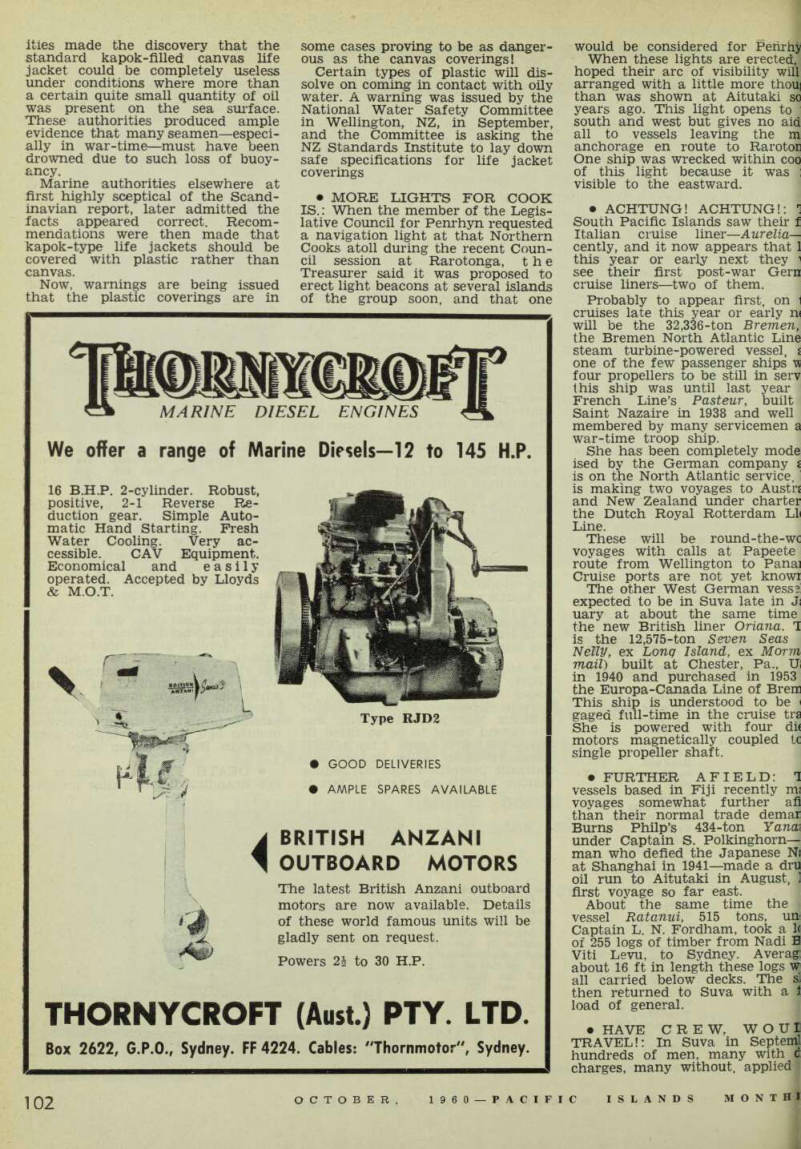
The well-rounded stern of HMNZS "Endeavour" caused some interest during an Islands cruise in September. The ex planation is that the vessel was originally built in the US as a naval net layer. See page 107.
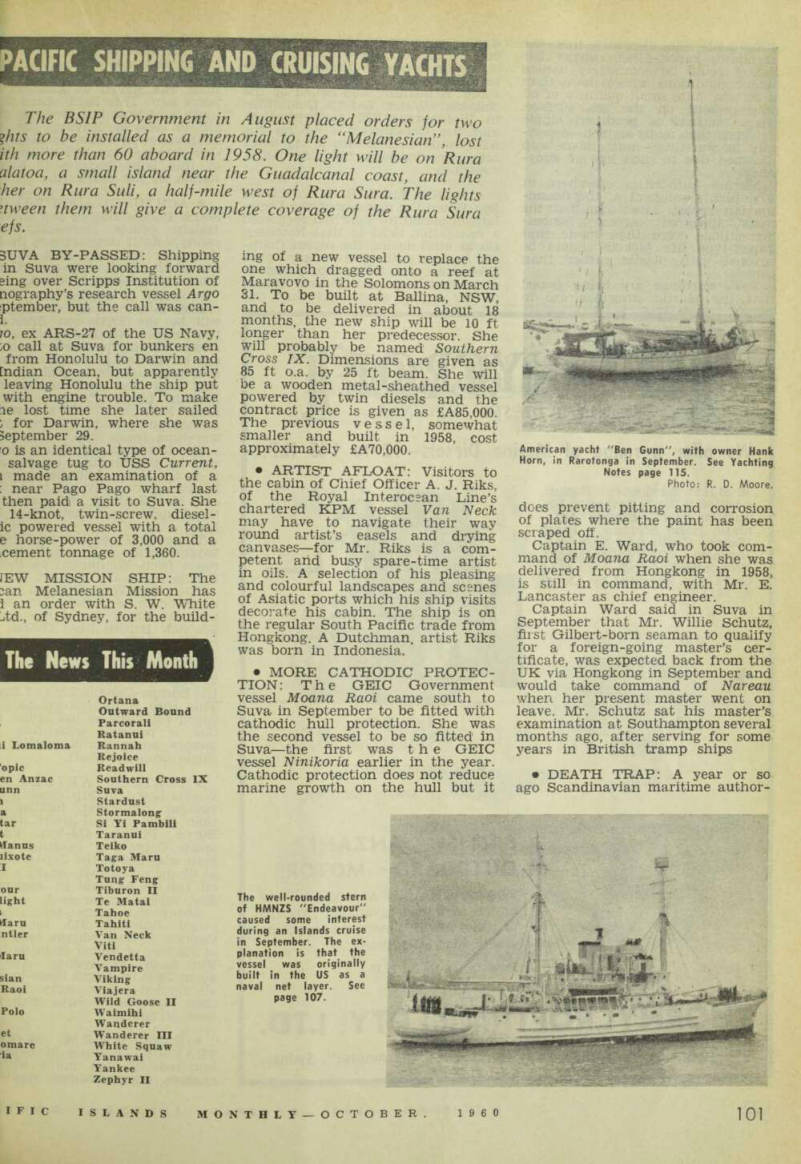
American yacht "Ben Gunn", with owner Hank Horn, in Rarotonga in September. See Yachting Notes page 115.
Photo: R. D. Moore.
ities made the discovery that the standard kapok-filled canvas life jacket could be completely useless under conditions where more than a certain quite small quantity of oil was present on the sea surface.
These authorities produced ample evidence that many seamen—especi ally in war-time—must have been drowned due to such loss of buoy ancy.
Marine authorities elsewhere at first highly sceptical of the Scand inavian report, later admitted the facts appeared correct. Recom mendations were then made that kapok-type life jackets should be covered with plastic rather than canvas.
Now, warnings are being issued that the plastic coverings are in
some cases proving to be as danger ous as the canvas coverings!
Certain types of plastic will dis solve on coming in contact with oily water. A warning was issued by the National Water Safety Committee in Wellington, NZ, in September, and the Committee is asking the NZ Standards Institute to lay down safe specifications for life jacket coverings
• More Lights For Cook
IS.: When the member of the Legis lative Council for Penrhyn requested a navigation light at that Northern Cooks atoll during the recent Coun cil session at Rarotonga, the Treasurer said it was proposed to erect light beacons at several islands of the group soon, and that one
would be considered for Perirhy When these lights are erected,, hoped their arc of visibility will arranged with a little more thoui than was shown at Aitutaki so years ago. This light opens to j south and west but gives no aid all to vessels leaving the m; anchorage en route to Raroton One ship was wrecked within coo of this light because it was : visible to the eastward.
• Achtung! Achtung!; 1
South Pacific Islands saw their f Italian cruise liner — Aurelia— cently, and it now appears that 1 this year or early next they i see their first post-war Gera cruise liners —two of them.
Probably to appear first, on 1 cruises late this year or early n< will be the 32,336-ton Bremen, the Bremen North Atlantic Line steam turbine-powered vessel, i one of the few passenger ships w four propellers to be still in serv: this ship was until last year 1 French Line’s Pasteur, built Saint Nazaire in 1938 and well membered by many servicemen a war-time troop ship.
She has been completely mode: ised by the German company t is on the North Atlantic service, 1 is making two voyages to Austrs and New Zealand under charter the Dutch Royal Rotterdam Ll( Line.
These will be round-the-wc voyages with calls at Papeete route from Wellington to Panai Cruise ports are not yet knowr The other West German vessel expected to be in Suva late in Jj uary at about the same time the new British liner Oriana. T is the 12,575-ton Seven Seas Nelly, ex Lonq Island, ex Morm mail ) built at Chester, Pa., Ul in 1940 and purchased in 1953 the Europa-Canada Line of Brem This ship is understood to be < gaged full-time in the cruise tra She is powered with four die motors magnetically coupled tc single propeller shaft.
• Further Afield: 1
vessels based in Fiji recently ms voyages somewhat further afi than their normal trade demar Burns Philp’s 434-ton Yana t under Captain S. Polkinghorn— man who defied the Japanese Ns at Shanghai in 1941 —made a dru oil rim to Aitutaki in August, I first voyage so far east.
About the same time the * vessel Ratanui, 515 tons, un Captain L. N. Fordham, took a 1c of 255 logs of timber from Nadi B Viti Levu, to Sydney. Averag; about 16 ft in length these logs w all carried below decks. The si then returned to Suva with a f load of general.
• Have Crew, Woue
TRAVEL!: In Suva in SeptemiJ hundreds of men, many with d: charges, many without, applied :
)bs offering in the Carpenter i-Pacific 4,873-ton steam cargo passenger vessel Suva of Suva try. About half the jobs were ndian stewards and galley staff the others went to Fijian le-room or deck hands. ?ry day of the week large num of able-bodied young unem d men are to be seen loitering : the Suva waterfront—which robably as pleasant and in ;ing a place to loiter as any you can’t find a job.
Fleet Addition: Eleven
Suva seamen drew a plum in in the form of the cargo vessel mi (ex Bingera) , purchased by i Pacific Shipping Company ICI and transferred to the register. The Fiji crew left by air on September 20 to man 54-ton steel, 25-year-old motor I at Sydney. itain James Ure, a shareholder iirector of the Suva-registered any, who had come to Fiji to se the take-over, accompanied len back to Sydney and was to command for the present. De of the intended trade were not diately available, but the any’s other ship. Bahinda, is y on the trans-Tasman run, occasional voyages as far afield e Gilberts with explosives. anui has recently been in Id’s alian coastal explosives trade.
•Till Drifting In: Those
s are still drifting in. Details teagre on this one except that s tossed into the sea by an irton, NZ, man—perhaps dur- Tasman crossing in a passenger -back in 1938, and was recently i up on a Fraser Island beach )uthem Queensland, where it »robably been for years,
’Or The Pigeon-Hole:
Early this year a NZ Marine De partment surveyor of ships was sent to the Cook Islands to look into “the unsatisfactory state of ships” in the group—as charged in a petition placed before Parliament in New Zealand last year.
The recommendations recently released suggest that the Cook Islands should introduce legislation to more adequately control safety measures. It was found, however, that while it was desirable to have certificated officers in these ships “it appeared impracticable at pre sent”.
It was also considered that the establishment of a slipway at Raro tonga—for the survey of local ships and to make it easier for them to
be maintained in better condition— was not warranted “in view of the presence of suoh facilities at Papeete”—7oo miles away.
• The Tong An Fleet: Strong
amd interesting coconut radio signals in September indicated that Prince Tungi of Tonga might soon leave for Holland to place an order for a cargo-and-passenger vessel of about 2,500 tons. The signals sug gested that the ship would be based at Suva and would operate to Aus tralia, New Zealand and Eastern ports.
There were also reports that a new 300-ton tuna longliner would also be ordered before very long to replace the 114-ton Teiko, lost
; March hurricane while set ut on her first fishing voyage. r as also learnt from Tonga in nber that the report on the gs of the official inquiry into ss of Teiko, delivered to the nment some months ago, is :pected to be released.
3Ngliners Move South:
vo Japanese tuna fishing fleets commenced operations west Gilbert and Ellice Islands in lave gradually moved south he albacore migrations in re lonths, and in mid-September val motherships, Koya Maru nyo Maru were located respec -260 miles and 400 miles south west of Suva.
Jva, Not Misaki: There
times in August-September a section of the Suva water night have been mistaken for ter of Misaki, Kesanuma, or r of Japan’s great tuna fish irts. As the 80-ton Misaki Taga Maru No. II lay wait r the use of the slipway to I a broken tailshaft, the time iployed in overhauling fishing one day hundreds of 10-ft i marker-flags were laid out wharf while they were being vith cord loops at their lower Fhese are for attachment to iss buoys which support the e. other days all hands were plicing new nets round the buoys, or making up new •aces with hooks attached. people, mainly seamen, who 3d these sturdy little peasant ien in their broad-brimmed, hats some hospitality during iree weeks in port, remarked r keen appreciation of friend own and on their quick sense lout. gh the average Japanese tan is a man of well under was therefore a child dur war years, he is in no doubt
that hates die slowly and that he must still pay for the sins of another generation.
Probably seamen more than any one else are prepared to take men as they find them, so it is natural that hospitality comes first from other foreign seamen. But those men, too, are well aware that 15 years after VJ Day it still takes courage for a young Japanese to walk the streets of some countries, including Fiji—though not for fear of actual violence.
• What Was That?: Radio
signals received in Suva in Sep tember indicated that a small American vessel, perhaps a yacht, named John Antler, and, according to the international radio call-sign list owned by Burke E. Bodwell, Jr. —no other details —was considered overdue between Samoa and Raro tonga for some days. The craft later turned up.
• Ships That Pass: One Of
the more interesting ships to call at Fiji recently was the four-year old, 9,943-ton Liberian-flag vessel Ante Topic (second word pronounced Topich ) which loaded over 13,000 tons of sugar at Labasa and Lau toka in September.
Apparently owned by Yugoslav in terests outside Yugoslavia, the ship was commanded by Captain B.
Kovacevic and manned mainly by Jugoslavs who had fled their Coru na un i s t-dominated homeland. A smart-looking vessel of modern type, Ante Topic was built at Osaka, Japan.
In the tramp trade, she has no real home port—and will probably never go near Monrovia—the port shown on her stern. She is the first Liberian vessel to call at Fiji since 1957.
Another one, under Banno Line charter Parcorali (ex Baron Napier ) was to call in October — after first calling at Port Moresby and Apia.
• Gone To Noumea; The New
Hebrides Condominium Government patrol vessel Don Quixote, a craft
The crew of Fiji men who flew to Sydney in September to man South Pacific Ship ping Co.'s latest ac quisition, "Taranui".
The group includes Temesia Lase, Silivo Vuetibau, Apimeleki Katonibau, Gavin Snow, Gabirieli Daulato, Luke Roko mokoti, Jovilisi Ma terisiga, Josefata Tailasa, Alisio Liga nivai, Viliame Baleikasavu, Wati soni Cabeta.
>out 70 ft overall and believed in Brisbane about 1950, has sold to a New Caledonia buyer, launch was delivered there in Her former skipper, Jack y, is now on leave in France his wife and son. s new British Administration I for the New Hebrides now ing at the Mill Kraft Boat- Bulimba, Brisbane ( PIM, p. 108) for which advertise -5 seeking a master have lately appearing is due for delivery next January. This is a 68t 18 i ft, 9-knot, twin-screw h.
Jhange Of Partners; The
based charter-cruise ketch r o —the former Tongan ketch m —now has a new partner in vnership. Mr. Norman Williams Did his share in Maroro Cruise Charter Service to Mr. Stan ss, effective October I. Mr. ms is joining the Fiji Broad g Commission as an announcer.
Burgess has lately been em l as a building foreman on the 3vu Beach Hotel extensions.
M TROUBLE: Two of Fiji’s traders were in trouble re . The first was the 22-ton n ui Lomaloma, not equipped radio, which had an engine lown soon after clearing Suva ladavu. Fortunately, she was d drifting by the overseas Van Neck. The information >assed to the Suva Harbour r and a launch sent out to ie derelict into port, where she r ery warmly welcomed by a >e merchant who had a par ■ interest in one of the deck igers—a bull. :, in mid-September BP’s 56ixiliary cutter Totoya, bound Lakeba to Kabara, went up tva Reef at night. The com- Zephyr II was diverted to Ie r assistance. Meanwhile gers and crew took to the md headed for Lakeba, where irrived safely. Some of the emained with the ship which uffered damage on her port ome days later work was still ding in patching her up and ing empty drums to float her towage to Suva, A shipwright Whippy’s boatyard was sent to supervise salvage.
Te We L L-R Ounded
'J: Probably a good many 1 e who inspected HMNZS your during the course of her iber Islands cruise speculated - extraordinary shape of her mnded stern. The explanation t the vessel was originally i the United States as a naval a vessel which handles ige steel anti-submarine nets jr port defence. The nets are >ut and hauled in over the which needs to be rounded ee of all angles to permit easy ng.
* Now Clearing Kavieng:
Svage P unit 6 wSch't Company 11 So 6 f*} as collected 11, 500 tons of scrap from sunken ships at Manus in the past 16 °V* ra io ™ to Kavieng Harbour, New Ireland, where a further 8,000 tons is expected to be salvaged from seven ?nh rhn e £r S ~,nH e me ™ h f ant shi Ps. a sub-chaser, and a destroyer.
Origmally it was expected that ennnr w P uld only recover about 5,000 tons of scrap from the Manus underwater wrecks.
• For New Zealand: Captain
G. W. Dunsford, representative of Pacific Islands Shipbuilding Company of Hongkong in Islands areas
east of New Guinea who was re- ? e i in Suva some other Islands ports, returned from Hong kong to Auckland in Sentember after placing an order for a 900-ton ship for thl Northern Steam Ship Company of Auckland—to be named Moanui. named Soon after his return he was en -BaSed to proceed to the assistance ol the 5.010-ton Norwegian tanker Anina as navigator in an Auckland owned Hongkong-built tue The tanker was brought safely to Auck land. Pacific Islands Shipbuilding
™^SLfi UP i? ft® Fiji Govern
ment vessel Degei 11. • ON THE JOB: Somewhere south-west of Fiji late in September
p’s barber removed the hair the head of a dead Japanese n before the body was com- [ to the sea. From the motherr oyo Maru went a radioed reto Suva authorities for pern to land the parcel of hair rmailing to the relatives in in, according to Japanese 1 The hair would be placed family shrine. If permission )i thooming the Parcel was to ded from the mothership when me to Suva early in October. ■t-ctt t~v/—v . «•, rrTT-i ■ -n i.
JELL DO, MATE.: Reports in September that 8,174-ton former passenger
pis
sxiG entered the tr3.nS“Pßcific mb trade in June, 1959, may ’urther add to her versatile * , , . ..
N Js? S Ss
State ?
»pp T i the v l ?7^i^'J 6gl « t ffi ed V F essel een p North T^ Q ™!Li P fvI li P P i? es ' • v,f It IS learned that She might
ndergo another name-chaSge
■yllambi and make a piljrrim oiF*? T l^ o r a^ nn ll da^ s 5,v 0 ?/T a m Slf Red £ ea 3ort for Mecca. The existing accommodation, tidied up a ls understood to be quite ible for .this trade. This be a special charter voyage, finch the ship would resume ik Y.9 ya £®?:. The shi P ha s a Fiji (Fijian and Indian)
Ti Research Cruise:
> from New Zealand that MV s being chartered by the New i Oceanographic Institute to out a research project in Polynesia waters were not .orrect—though the ship is tv. hunker at Papeete. institute reports now that
the vessel is carrying out an oceano graphic survey between New Zea land, the Kermadecs, the Cook Islands, Papeete, and back to New Zealand, the cruise taking just over four weeks with Papeete the only port of call.
Ocean temperatures and salinites a t various depths are being recorded, a s well as ocean depths. Samples of p i an kton and other sea life and sediments from the deep ocean floor were being taken. Some of this work W as also being carried out by HMNZS Endeavour , following a different route. The work is an extension of work carried out dur the jq Y . The departure date was not given jn the rpnnrt from thp Tn^titutp me report lrom tne Instltute
* Bank Line Extends: The
Bank Line, whose ships have been carrying Papua-NG copra to the UK since 1945, will be starting a monthly cargo service from Britain and the Continent to the Territory next January. The new service will operate a direct cargo lift to all rnaior Tprritorv r>nrt<s J Territory ports.
• Rope On The Way Out?:
Australian Fleet exercises off the east Australian coast in September may contribute to another victory for synthetic fibres. One of the de stroyers taking part in the exercises, HMAS Vendetta, has been stripped of most of its rope fittings. These have been replaced by a synthetic material. If the new synthetic ropes prove successful, they will replace natural fibre ropes on all Australian ships. During the exercises the new material was put through rigor ous tests, ranging from ship towing to berthing.
Navy Minister Senator Gorton said synthetic material was reputed to be stronger, easier to handle and to have longer life than rope.
He said a different variety of synthetic rope had been fitted in
the destroyer HMAS Vampire, now serving on the Strategic Reserve.
Analysis of the tests with the two types of synthetic fibres would de cide the future of rope in the Royal Australian Navy.
• New Wharf For Biak -
Work is shortly to start in Biak, Netherlands New Guinea, on a new 768 feet wharf to replace the pre sent dilapidated wooden landing stage. A new 46-ft pier for tankers up to 18,000 tons will also be built— the project to be carried out in three stages—all of them to be com pleted within two and a half years.
The new wharf will be put on the site of the present one, which means the wooden wharf will have to be taken down in sections as the new building proceeds.
• Lae Wharf Damaged:
Damage estimated at about £5,000 was caused at Lae’s wharf at the end of August, when the Tung Feng, on its first visit from the East, crashed into it when berthing. It was bad luck for Lae because the extension to the wharf had only re cently been completed—the wharf is still not large enough for Lae’s ever-increasing business. And it was bad luck for Captain W. W. Fish, the master of the vessel, who is 71 years of age and retired. This was the only crash in his whole career.
Captain Fish had been asked by the owners, Hang Fung Shipping and Trading Co., Hongkong, to take the ship on her first visit to Territory ports.
The ship received a gash in the bow, and a temporary plate was fixed above the waterline so she could continue her journey. The impact sheered away nearly 70 feet of wharf buffers and knocked out deep steel pylons valued at about £4OO each. Some of these were later recovered by a local diver.
• Ng Freights Up: Burns
Philp and the New Guinea-Australia Line announced in Lae in Septem ber that trunk line freight rates would be increased by about six per cent, between Australia and New Guinea and on inter-island
[?]Ke New
[?]Again
[?] faces and per [?]some gloom ac [?]lied a recent event in the [?]brides," was how put it in April, when the wooden "Aoba", which [?]en considered a [?]oss, sailed into [?] under her own photograph of was taken in [?]his August when [?]s on the slipway
by the local tuna fishing company, undergoing refit. "Aoba" originally belonged to the C.F.N.H. interests in the New Hebrides but late in 1958 she was wrecked on one of the Group of islands and the experts pronounced her a total loss. The owners or underwriters £5,000 for delivery of the vessel to Santo, and a Santo mechanic, Paul Coulon, who had [?]ndertaken salvage work before, decided he would give it a go. The experts smiled, but [?]w weeks later the "Aoba" was observed coming into port, after a voyage from where the [?]le up of 200 miles. Mr. Coufon collected his £5,000 but after the marine experts had the hull they said it would cost about £12,000 to make her really seaworthy again, and wooden ship was not considered worth it. She was put up for sale.
Tonga's new Fisheries Officer, Mr. Yatoka Sawa mura, with his wife and four-year-old daughter Yumiko, who flew from Tokyo to join "Aoniu" in Suva for the final section of the voyage to Nukualofa. (See story page III.)
0 from October 1. The exception id be refrigerated cargo rates, ih would remain unaltered.
New Fisheries Officer:
take over the position of eries Officer in Tonga following death of his predecessor in the longliner Teiko last March men were lost in the tragedy).
Yatoka Sawamura, of Tokyo, ed at Nukualofa in September, tvas accompanied by his wife four-year-old daughter. •. Sawamura, 33, is a graduate okyo Fisheries University and been with the Nippon Suisan pany—one of the two corn 's operating tuna mothership 1 in the South Pacific—for the nine years. He holds no
qualifications as a practical fishing master but he has a wide theoretical knowledge of all kinds of Jap fish ing methods.
Mr. Sawamura said in Suva that he was on a two-year contract with the Tongan Government. He has never been to the South Pacific Islands before—but he had made four voyages in whaling factory ships to the Antarctic.
• Hannah In The Way; The
owners of the Hannah, which lies on the reef near the approach to Avarua Harbour, Rarotonga, have relinquished all rights to it and the Cook Islands Administration has announced that, as it is a danger to shipping and “to nearby houses in the event of a hurricane”, it will
be destroyed. The Administration has now made the wreck available to the public for three months in the hope that the locals will do most of the disposal work for them, but very little seems to have changed on the three-year-old landmark, and the Administration will probably end up with the job, anyhow.
Some people, of course, feel that the wreck adds a bit of colour to the coastline, and one cruising yachtsman comments: “Any ship which gets anywhere near the Hannah will be in grave danger long before that!” Any houses it might endanger would probably be in trouble before that, too.
• Noumea Is “Lamentable”:
A Noumean newspaper in September described the port of Noumea as be ing in a “lamentable” condition, and daily becoming worse. It said leports made by succeeding harbour masters had never really been given attention. The wharf was in a bad state and much of it could not be used by large vessels, and little equipment was available to aid vessels. The port was gradually silt ing up because of the need for dredging, and the paper said this was losing Noumea important over seas traffic.
Meanwhile, an engineer of the NC Public Works Department has just put forward an argument ad vocating that Noumea’s port be shifted to the former prison island of Nou, now called Nouville, which before the war was a Pan American Airways base. There is plenty of space and water, and protection from the winds. The plan would mean bridging Noumea with Nouville and would be expensive, but this bridging is planned for the future anyhow. A correspondent says the matter may be raised shortly in the Territory Assembly.
• New Pilot Boat: A New
addition to the New Caledonian pilot-boat fleet is being built in Australia. She will be 45 ft long, with a speed of 11 knots, and will sail to Noumea under her own power. With the large number of ships entering New Caledonia over the last few years to lift ore, mem bers of the Maritime Pilots’ Associa tion of New Caledonia have been extremely busy.
The New Caledonian Government also announced in September that it would purchase for £AIO,OOO a unit of the local coastal fleet, Tiburon 11. This 50-ft vessel will be used by the French Navy for hydrographic work on the New Caledonia coasts.
According to a recent official re port, existing maps of New Caledonia contain some serious errors, and the navy wants to do a complete re-survey of the coastline.
The work will take about 10 years.
One of the first jobs to be under taken will be a survey of the west coast port of Nepoui, which is to be developed as a mineral shipping port.