of Noumea
pp. 88-89 · Read in the full issue
The Wonderful Sisters of Noumea
From Fred Dunn, in Noumea The month of August has seen the centenary of an orde of nursing sisters with a remarkable influence on the New Caledonian people and their way of life.
IT is the Roman Catholic Order of St. Joseph de Cluny, four sisters of which, on August 26, 1860, arrived to nurse in the new naval hospital at Noumea, then known as Port de France.
France had taken possession of Noumea only seven years before, and when the four sisters arrived in Tahiti aboard a French vessel they found that communications between Tahiti and New Caledonia were almost non-existent. The master of the British vessel Montfort agreed to give them a passage, but it was a frightening passage as a letter by one of the sisters, still in the Archives, tells.
It was a leaking ship and the master had never sailed the course to New Caledonia. The Montfort struck a reef in Tonga, and (accord ing to the writer) it was their sup plications to the Virgin Mary that finally got the ship off.
From Tonga the Montfort passed through a cyclone before finally
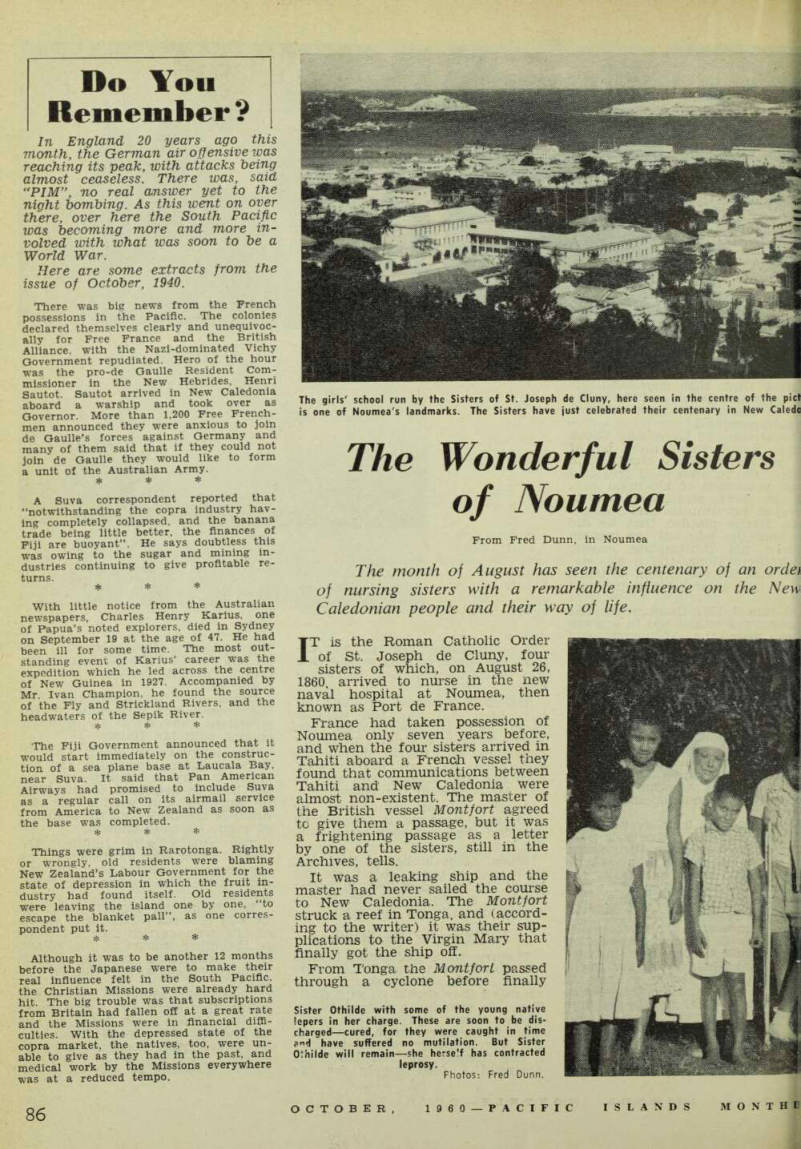
The girls' school run by the Sisters of St. Joseph de Cluny, here seen in the centre of the pic[?] is one of Noumea's landmarks. The Sisters have just celebrated their centenary in New Caledi[?]
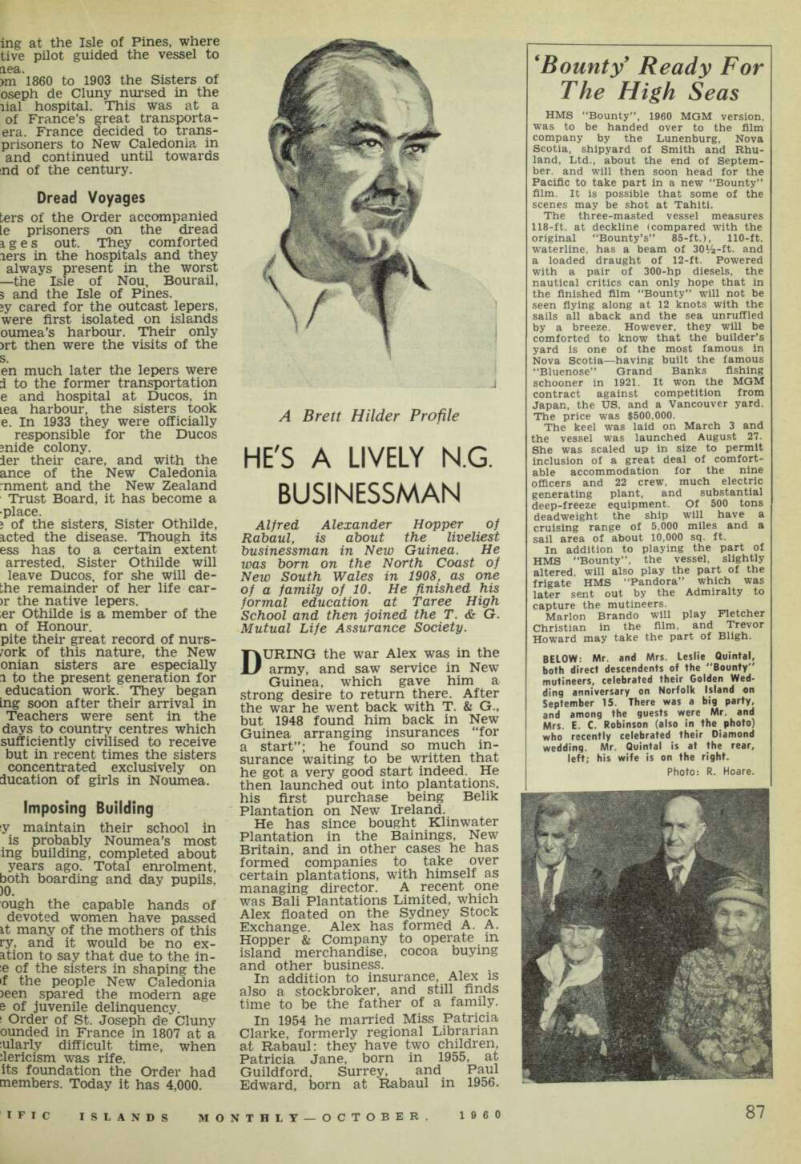
Sister Othilde with some of the young native lepers in her charge. These are soon to be dis charged—cured, for they were caught in time have suffered no mutilation. But Sister Othilde will remain—she herse'f has contracted leprosy.
Photos: Fred Dunn.
ing at the Isle of Pines, where tive pilot guided the vessel to aea. >m 1860 to 1903 the Sisters of oseph de Cluny nursed in the lial hospital. This was at a of France’s great transporta era. France decided to trans prisoners to New Caledonia in and continued until towards nd of the century.
Dread Voyages
ters of the Order accompanied Le prisoners on the dread ages out. They comforted lers in the hospitals and they always present in the worst —the Isle of Nou, Bourail, 5 and the Isle of Pines, jy cared for the outcast lepers, were first isolated on islands oumea’s harbour. Their only art then were the visits of the s. en much later the lepers were i to the former transportation e and hospital at Ducos, in lea harbour, the sisters took e. In 1933 they were officially responsible for the Ducos mide colony. ler their care, and with the ance of the New Caledonia rnment and the New Zealand Trust Board, it has become a ■place. j of the sisters. Sister Othilde, acted the disease. Though its ess has to a certain extent arrested, Sister Othilde will leave Ducos. for she will de the remainder of her life car >r the native lepers. ;er Othilde is a member of the n of Honour. pite their great record of nurs mrk of this nature, the New onian sisters are especially i to the present generation for education work. They began ing soon after their arrival in Teachers were sent in the days to country centres which sufficiently civilised to receive but in recent times the sisters concentrated exclusively on ducation of girls in Noumea.
Imposing Building
iy maintain their school in is probably Noumea’s most ing building, completed about years ago. Total enrolment, both boarding and day pupils, )0. ough the capable hands of devoted women have passed it many of the mothers of this ry, and it would be no ex ation to say that due to the in :e of the sisters in shaping the •f the people New Caledonia )een spared the modem age e of juvenile delinquency. ; Order of St. Joseph de Cluny ounded in France in 1807 at a :ularly difficult time, when dericism was rife, its foundation the Order had members. Today it has 4,000.