Tropicalities
pp. 83-84 · Read in the full issue
Pacific Islands Monthly
Magazine Section
Where the Bottles Go BERT M. NORRIS, of the Jniversity of California, wrote 0 the Cook Islands recently to k Tutai Teio and Resident t lan Robertson, of Atiu, for ig returned last year a bottle 1 had been set adrift by the ps Institution of Oceanography, s letter, Mr. Norris made some ssting comments about bottles beachcombing generally. wrote; seems certain that the coconut many other plants found on islands of the Pacific spread lly by means of currents which id nuts and seeds far and wide, lever a coconut is washed up shore with a favourable climate, likely to sprout and grow and urn to furnish still more mts for the restless currents, mts are sometimes found on inhospitable shores as Alaska Canada. beachcombing along the Cali i coast and on our offshore is. I have found large numbers ectric light bulbs! One would >se that these represent bulbs i have burned-cut aboard ships lave been discarded, ibtless this explains most of ght bulbs found on the beaches, have found some light bulbs i carried some surprising labels,
As: “For Street Railway
Only” Or “For Traffic
Al Use”.
nee collected about two dozen bulbs from one of our island ,es and took them home to see ;y were, by chance, still good, to my surprise, I found that half of the light bulbs worked, ss fish-net floats are among lore pleasing finds to a beach sr. On the west coast of North ica these are common. i capped or corked bottle dis d from a ship at sea can be ted to remain afloat for an ded period, although not in tely. After floating for several even a tightly corked bottle :ely to sink owing to the al accumulation of marine isms which attach themselves i glass. Bottles with metal caps pt to sink in a short time be the metal is quickly corroded e sea water, San Nicolas Island, off the of southern California, I once I a small bottle containing a
note from a merchant seaman who was looking for a wife!
The Scripps Institution of Oceano graphy in California has been re leasing drift bottles by the dozens from their ships operating off the west coast of North America, This programme has been in progress for more than ten years and is cairied out in an attempt to better under stand the current pattern along the Pacific shore of North America.
The bottles all contain a bright red postage-paid postal card with a printed message in both English and Spanish; many of the bottles are picked up in Mexico and Central American republics.
The records kept by the oceano graphers at Scripps Institution show that only about five per cent. . . one in 20 ... of the bottles are ever recovered.
Australia's Export Flour
Went Up With a Bang
IN Western Samoa where Whites can be Samoans and Samoans can be white, Peter Plowman told a PIM reporter in July of the whitest Samoans he’s seen to date.
In the course of a pleasant drive along that beautiful rugged coast line east of Apia towards Falefa, where the road takes a sharp bend onto a bridge, Host Plowman pointed up stream.
“That was where they shot the scenes for “A Pattern of Islands”, he said. “If you’ve read the book you’ll know that there was one amusing incident in connection
with an explosion—but the one in the book had nothing on this.
“I had the job of organising the film explosion, and the director took a lot of satisfying. We kept adding more sticks of gelignite to make each shot more spectacular, but he still wasn’t satisfied. Then he suggested we increase the charge by a few more sticks and add a few sacks of flour to improve the effect for the cameras—and up she went! The effect was rather better than anticipated. Every one of the Samoan chiefs and other spectators within half a mile was as white as a ghost when the smoke cleared— covered with finest Australian flour! ”
You Can't Always Win
A STORY we would like to have a little more of —as extracted in its entirety from the August 9 issue of the roneoed Government Cook Islands News:
Accident
The hospital ambulance was badly damaged when it ran into a coconut tree while coming down the hill from the Sanatorium. There were a number of casualties and a report from the hospital this morn ing says that all of them are fine and doing well.
Only The Dead Would
Lie There
NO use hopping into anything with your hob-nailed boots on.
Not these days. The scientific approach, psychiatry that’s the trick. And it applies equally well in New Guinea as anywhere else, so the experts tell us.
In Port Moresby recently, Mr. L.
M. Tomlison, a Cambridge gradu ate, told a Reuter correspondent how the Health Education Council has been set up—old Brown Brother to undeceive —and that nothing
Tourist
Attraction
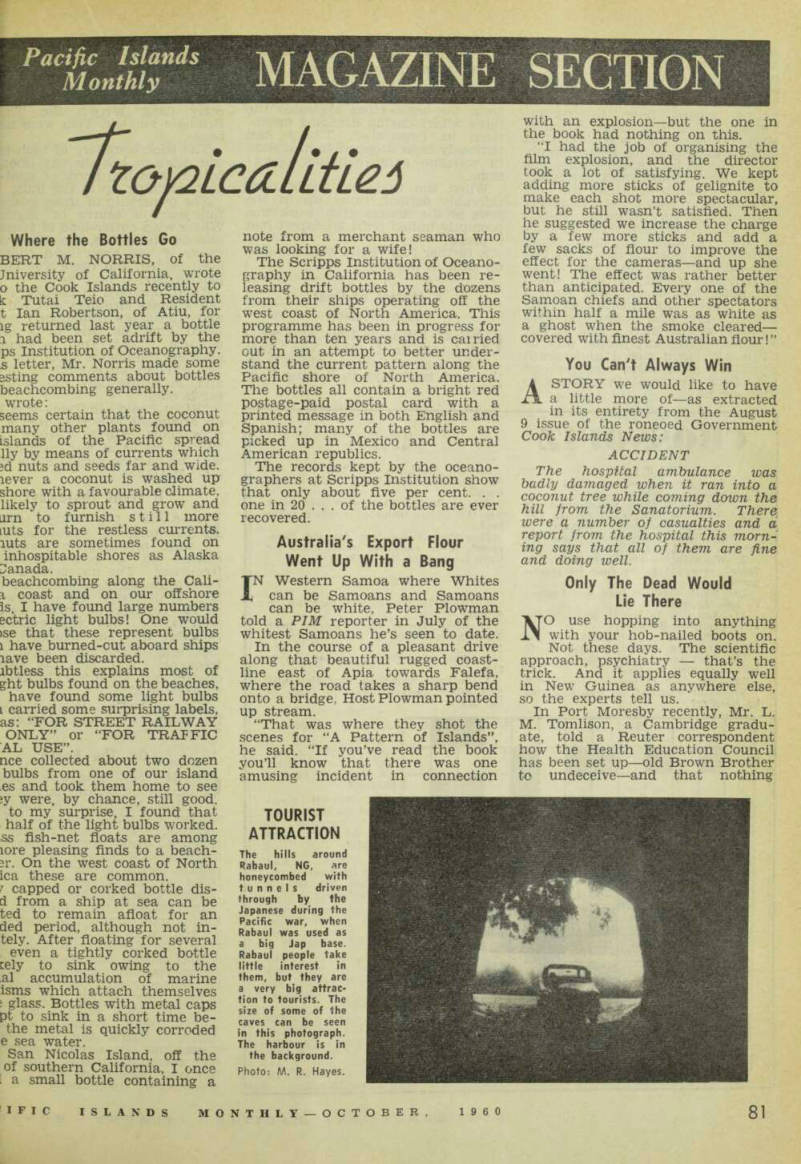
The hills around Rabaul, NG, are honeycombed with tunnels driven through by the Japanese during the Pacific war, when Rabaul was used as a big Jap base.
Rabaul people take little interest in them, but they are a very big attrac tion to tourists. The size of some of the caves can be seen in this photograph.
The harbour is in the background.
Photo: M. R. Hayes.
that the Trick-Cyclists have ever learnt from more sophisticated patients will go unturned. The first aim of the Council is to find out what the attitude of different native groups have to various aspects of health and sickness.
Many things that are taken as sensible and logical by us are simply left for dead by natives if they cut across local tamhus and customs.
As an example of where the best intentions can lead us, Mr. Tomlison told of the very splendid 40-bed ward that was added to an outstation hospital in the Sepik District. On opening day every bed was full, but 24 hours later every patient had got up and left. When the beds had been built, shelves were made underneath so the patient’s bits and pieces and food could be stored there. But in this community the only people who lie down with food stored underneath them are dead men, and no one was going to tempt Providence to that extent.
Careful Thev're Dynamite I ' Y [ U y na " l,Te ; QIX 3.7-mch anti-aircraft shells O with British markings and date marked 1941 were picked up from the sea-bottom alongside the Suva wharf during dredging opera tions in September. They had obviously been dropped from a sling in wartime cargo-handling opera tions.
When the first two shells, con siderably dented, came up in the jaws of the dredge grab, work was promptly halted until an expert had a probe!
A further four shells were brought up later in the day.
A -r A iviaiier or ooais Identification nIH tirnp wpll j| N K E , of ? ld time a d ™ ell " beloved hard cases was Tom Burness, of Caboni—which is on the roa d> nowadays, to Penang from Tavua.
It was years before I saw wti a lovely spot Caboni is, and cat face to face with old Tom, of who I had heard quite a few storii Perhaps the best one was of qui early days, when the Thom Brothers and old Tom were neig bours.
The back boundary of each esta was more or less the sky line; au both estates had herds of semi-w goats running up in the hills.
The ownership of those goats v? for years a source of argumei Whenever a cutter-load of goats vi sold by one estate, the other woi swear it was their herd that h been raided, and there was gene: hell to pay.
Then, one day, in Levuka, one the Thomas Brothers met old T« and after a few neighbourly squai faced gins, he said in a mell! moment: “Look, Tom, let’s cut c all these arguments about the goa We will cut an ear off all of oi and, in future, any goat with c ear is ours.”
“Right,” said old Tom—who lov an argument and visualised a p< sible court case in Levuka. “Tt will do me. And any flaming gc with no flaming ears at all is min
—C. Wager.
It Went Thataway!
BECAUSE of heavy overs« jamming, the Rarotonga shoi wave broadcasting station f shifted to a new transmits frequency. The instructions in t Rarotonga daily news sheet as how to locate it on its new si on the receiver dial made technii men wince, but the explanati probably met the situation.
It was given this way: “NI frequency 5050 kc/s — about quarter inch from the old frequer of 4965 kc/s”.
To the boffins, that’s someth! like saying it’s about an inch frr Sirius to Cygnus.
On The Beach
GOOD on Professor Morr author of Britain in the Pace ( PIM , August). For me he H settled a family argument of 1c standing. For years I have be taken to task by my high schi daughters whenever I used t phrase “beche de mer”. I pronoun it as we did 40 years ago in 1 islands “beach de mar”.
In stating the phrase is Portuguese origin, the Professor* backed up by no less an author] than the Eleventh Edition of t Encyclopaedia Britannica. Bich& Portuguese for slug, and what; beche de mer but a slug? Admitted among rude island men 40 yes ago the lowly animal was giv names more vividly descripti: Again I thank the Professor ; giving me the golden opportune of correcting my bluestockt family. “Beach de mar” now.
accepted by them,
W.B.