Airline Activities
pp. 65-68 · Read in the full issue
Sydneyiider At Home Base
Airline Activities Australian And Un-Australian
In this city of boom building and soaring glass and steel scrapers, something different in architecture is halting hustling neysiders in their stride just now.
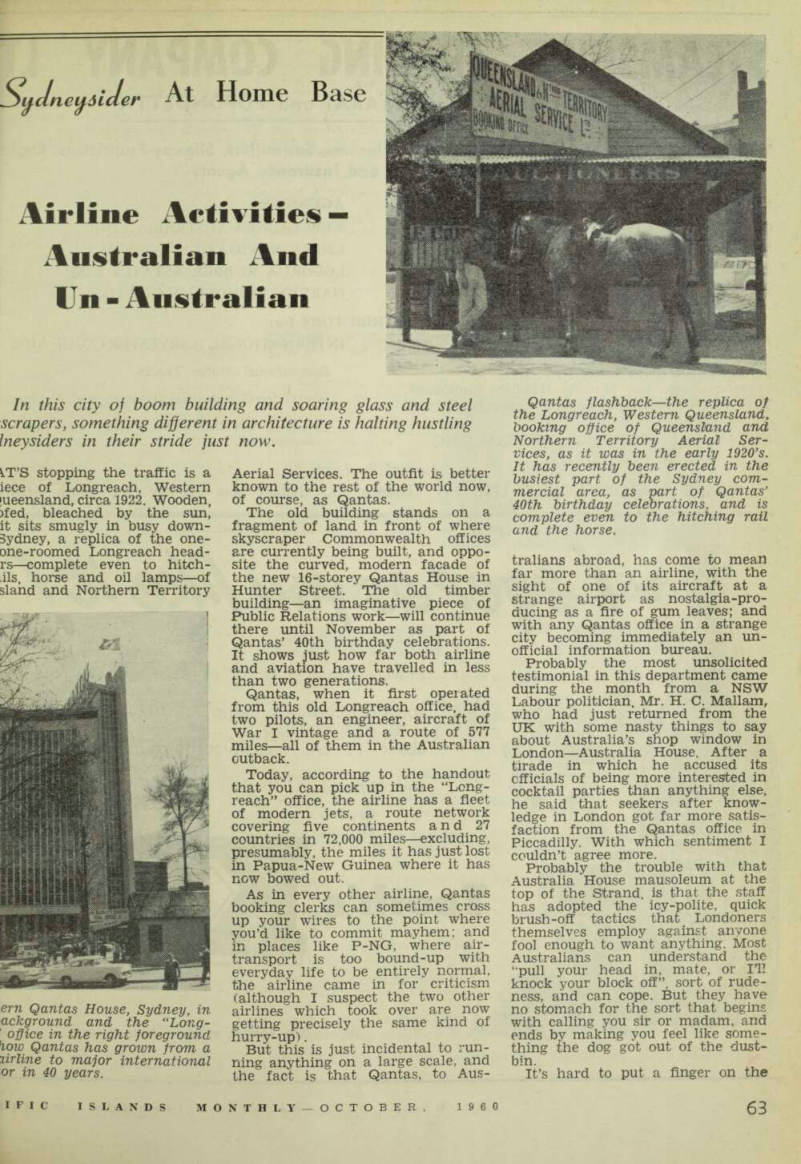
iiT’S stopping the traffic is a iece of Longreach, Western Queensland, circa 1922. Wooden, )fed, bleached by the sun, it sits smugly in busy down 3ydney, a replica of the one one-roomed Longreach head rs—complete even to hitch es, horse and oil lamps—of sland and Northern Territory
Aerial Services. The outfit is better known to the rest of the world now, of course, as Qantas.
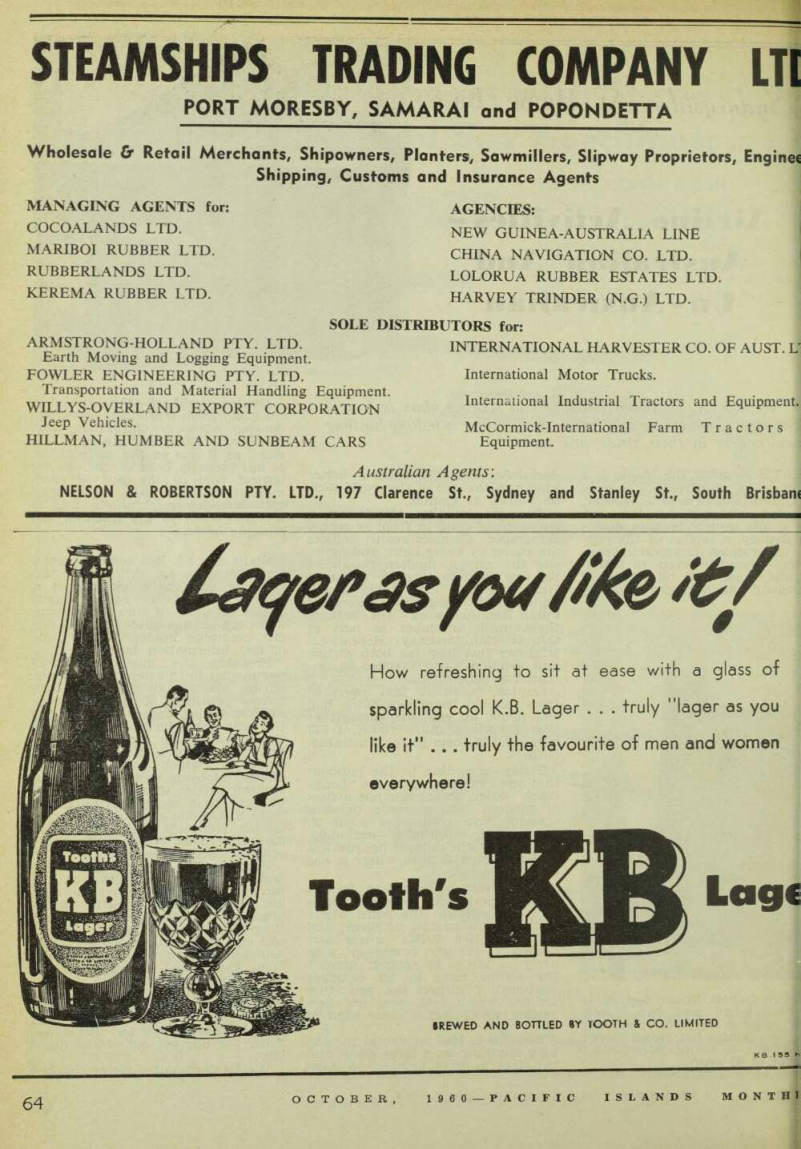
The old building stands on a fragment of land in front of where skyscraper Commonwealth offices are currently being built, and oppo site the curved, modern facade of the new 16-storey Qantas House in Hunter Street. The old timber building—an imaginative piece of Public Relations work —will continue there until November as part of Qantas’ 40th birthday celebrations.
It shows just how far both airline and aviation have travelled in less than two generations.
Qantas, when it first operated from this old Longreach office, had two pilots, an engineer, aircraft of War I vintage and a route of 577 miles —all of them in the Australian outback.
Today, according to the handout that you can pick up in the “Long reach” office, the airline has a fleet of modern jets, a route network covering five continents and 27 countries in 72,000 miles —excluding, presumably, the miles it has just lost in Papua-New Guinea where it has now bowed out.
As in every other airline, Qantas booking clerks can sometimes cross up your wires to the point where you’d like to commit mayhem; and in places like P-NG, where air transport is too bound-up with everyday life to be entirely normal, the airline came in for criticism (although I suspect the two other airlines which took over are now getting precisely the same kind of hurry-up).
But this is just incidental to run ning anything on a large scale, and the fact is that Qantas, to Aus-
tralians abroad, has come to mean far more than an airline, with the sight of one of its aircraft at a strange airport as nostalgia-pro ducing as a fire of gum leaves; and with any Qantas office in a strange city becoming immediately an un official information bureau.
Probably the most unsolicited testimonial in this department came during the month from a NSW Labour politician. Mr. H. C. Mallam, who had just returned from the UK with some nasty things to say about Australia’s shop window in London —Australia House. After a tirade in which he accused its officials of being more interested in cocktail parties than anything else, he said that seekers after know ledge in London got far more satis faction from the Qantas office in Piccadilly. With which sentiment I couldn’t agree more.
Probably the trouble with that Australia House mausoleum at the top of the Strand, is that the staff has adopted the icy-polite, quick brush-off tactics that Londoners themselves employ against anyone fool enough to want anything. Most Australians can understand the ‘•pull your head in, mate, or I’ll knock your block off”, sort of rude ness, and can cope. But they have no stomach for the sort that begins with calling you sir or madam, and ends by making you feel like some thing the dog got out of the dust bin.
It’s hard to put a finger on the
[?]ern Qantas House, Sydney, in [?]ackground and the “Long [?] office in the right foreground [?]how Qantas has grown from a [?]irline to major international [?]or in 40 years.
Qantas flashback —the replica of the Longreach, Western Queensland, booking office of Queensland and Northern Territory Aerial Ser vices, as it was in the early 1920’s.
It has recently been erected in the busiest part of the Sydney com mercial area, as part of Qantas ’ 40th birthday celebrations, and is complete even to the hitching rail and the horse.
ar charm of the people who in the modern Qantas office i corner of Bond Street and Lilly; possibly it’s a combina f off-handedness, friendliness he ability to work out most problems with the minimum s, even when they don’t con he airline at all. thought for a long time that ustralian Government might >re value for its money by sub g Qantas agents all over the than by appointing more tatic and trade represent- In my experience, anyhow, their direct representatives nt out from Australia to do for Australians or those want 'ormation about Australia, the i they give goes right beyond sre business of running an air- Greek Greek evening last April, when wait r a plane out of Athens to tii we ran into the usual e of trouble that seems to vhen Greek meets Greek. The terminal buzzed with the kind nzied noise that only Medi an people are able to pro but as the plane was running lours late we wanted to find lether we would have dinner ird or whether we should eat terminal restaurant, le waved their hands and d, or shrugged their shoulders oked depressed; ran back and vith files of papers or shoved o someone else. Finally they ed tickets that said we could e of “light refreshments with mpliments of the airline”— ot one could unravel the y as to whether we would go bo Karachi if we didn’t eat on ext. * we had retired to drink the refreshments”, a large young ippeared, said he was the ; representative and had been lat there were some angry lians making inquiries about out no one knew why. Were angry Australians? were. But the food problem rted out promptly and then hour, while we waited for me. we sat and chatted—and r part, learned more about it is like for an Australian to live in Greece than a of living in a tourist hotel have taught us. lly he escorted us out to the t and waved a cheery fare irith the absurd result that Athens is mentioned these it is not a parade of that t city’s undeniable archaeo delights that spring into my •but another Australian, whose [’ve forgotten, with whom we of Sydney and Johannesburg ew Guinea, and from whom
we learned that tea in Athens is the equivalent of 25/- per lb and New Zealand butter 17/-.
As this particular air terminal seethes and boils with movement, and can, at any given moment, con tain anyone from a Greek oil mag nate to a stoic posse of Bedouins go ing back to some arid oil well, my own dominant memory of Athens (“... the Qantas fellow who said ...) probably proves what I’ve always suspected: A traveller rarely escapes from his own environment, and even in the midst of the exotic, will return to it at the drop of a hat.
But to get back to where we came in: Airlines. Those who remember the arguments of a year or so ago (Comets versus Boeing 707’s), will probably be interested to know that Qantas actually does operate a ser vice with Comet jets—from London via Athens. Teheran, Karachi and Colombo to Singapore and return.
The reason is that the airports at Athens and Colombo are unable to take the 707’s.
For this particular week-end ser vice, Qantas charters the Comets from BOAC and pastes huge “QANTAS” labels over the normal “BOAC” fuselage markings. (Over)
Something Close
to Sabotage
Probably not even Mr. K.’s out bursts at the General Assembly have shocked Sydneysiders as much as the discovery that the Trans Aus tralia Airline terminal at Kings ford-Smith Airport is brewing its tea by that vilest of all methods of infusion —tea-bags!
I’d noticed it myself when I ordered a pot of tea out there about a month ago when waiting for a plane—the tell-tale string dangling out of the lid of the pot, and at the end of it, the sodden, waxed
paper type bag that is common everywhere north, east and west of Darwin, but not until now, south of that line.
But it took a Labour politician to crack the crime wide open—Mr.
F. M. Daly, who after being served TAA tea per medium of tea-bags, took his complaint direct to Parlia ment. Declaring that there was nothing more un-Australian than this method of brewing tea, he in voked the shades of long-dead Aus tralians like Banjo Patterson, Henry Lawson and others who had extolled the virtues of tea, made in a black billy-can for preference, outdoors over a fire of gum leaves and sticks;
or if one must be civilised, wil handful of tea direct into the pot.
Not only was Mr. Daly disgu at what he found at the bottor the TAA tea-pot, but, he said,, brew was weak and by the he’d waited half an hour for i strengthen up, it was cold —w as every true Aussie knows, is, : to tea bags, about the worst can happen to tea.
The catering contractor at ' fought right back: The tea-bag said, was the cleanest and quic method of making tea. And kindest cut of all), he doui whether Mr. Daly was a connoisi Well, we can tell the TAA cat that this is one time when he pull his head in, and that t; are about 10 million Austral right behind Mr. Daly and agg TAA’s un-Australian activities the sacred tea rite.
Tea, unbagged, is one of things that makes Australia to come home to; and one sure to pick Australians abroard i: sort out the morose indivic who sit at cafe tables, everyw from the Champs Elysees to Is bul, with tea-not lid removed solemnly dandling the strings ol sorted tea-bags in the tepid w 1 By the time this method has suited in the desired strength,, tea is—as Mr. Daly experienc; quite cold; more, it is permane Impregnated with the flavour waxed-plastic tea bag. —— Mr. Les Martin, a director ofl newly formed UNO Limited of £ said to be planning to pure: copra for export on behalf of!
Mitsui organisation of Japan, a short business visit to Japar September. Mr. Martin had no o ment to make on his return. I