Fiji’s Answer ?
pp. 59-63 · Read in the full issue


Are ‘Sub-standard' Houses Fiji’s Answer ?
From J. P. Shortall, in Suva
A great deal of publicity has been given in Fiji to the ousing Authority's housing projects, but very little has been dd outside the pages of a few Government reports concerning le magnitude of the situation.
CELLENT as the housing pro ects completed or in hand are, hey do not start to meet the tion. Nor, in my view, is i any prospect of a solution so as the existing regulations— vary in different areas—remain )rce. iere is a school of thought in which says the first considera is for the workers of Fiji to entrate on increasing produc- That way they will improve earnings and will be able then Eford better housing, ere is another school of thought h believes that the housing lem must be tackled first, and if it is not tackled on a massive ■ there will be increasing in rial unrest amongst the sands of low-income workers live under almost intolerable litions. le housing factor in relation to industrial unrest of the past has perhaps been underesti 3d.
There is also plenty of evidence that the housing situation is con tributing to the increased crime rate in Fiji, and that any government funds used to ease the problem would be partly or wholly recovered by savings in the police, judicial, penal and health departments, and in the field of education—as it is impossible for many children to do any study at home.
What is the Picture?
But what exactly is the housing situation in Fiji?
The 1956 census shows that (mly about 47 per cent, of all families in the Colony have their own sep arate accommodation. The figure rises to about 55 per cent, in country areas. The situation is worse in urban areas, especially near Suva.
A “sub-standard” house within the meaning of the law may be a com pletely adequate house within the circumstances of Fiji—the Housing Authority has proved that. But a
survey of the Suva area in 1957 found that there were 1,300 houses unfit for habitation, and that un authorised sub-standard houses were then being built at the rate of 250 a year.
The Local Authority decided to clean up the situation by ordering demolitions and preventing un authorised building. But they soon had to call a halt. Those ejected from one “unfit” house, unable to provide themselves with anything better, moved in with relatives or friends, often to an equally poor dwelling. This raised a further problem of congestion.
Last year a survey of Fijians liv ing in the Suva area showed that three-quarters of the families were living in accommodation averaging in size 10 ft by 12 ft, for which they paid over 15 per cent, of the family income. (Economists say about 121 per cent, of an income is a reasonable portion to be spent on housing).
An average of seven persons are sleeping in this average “dwelling”.
The dwelling may house two or more families, separated by a partition of sacking. Each family pays probably not less than £2/10/a week for its stake in one of these iron or wood-and-iron shanties, of which there are thousands in the Suva-Nausori area. Most of the rents are at a rate which pays off the cost of the shanty within about a year.
The 1957 survey found that 4,000 new dwellings would be required in
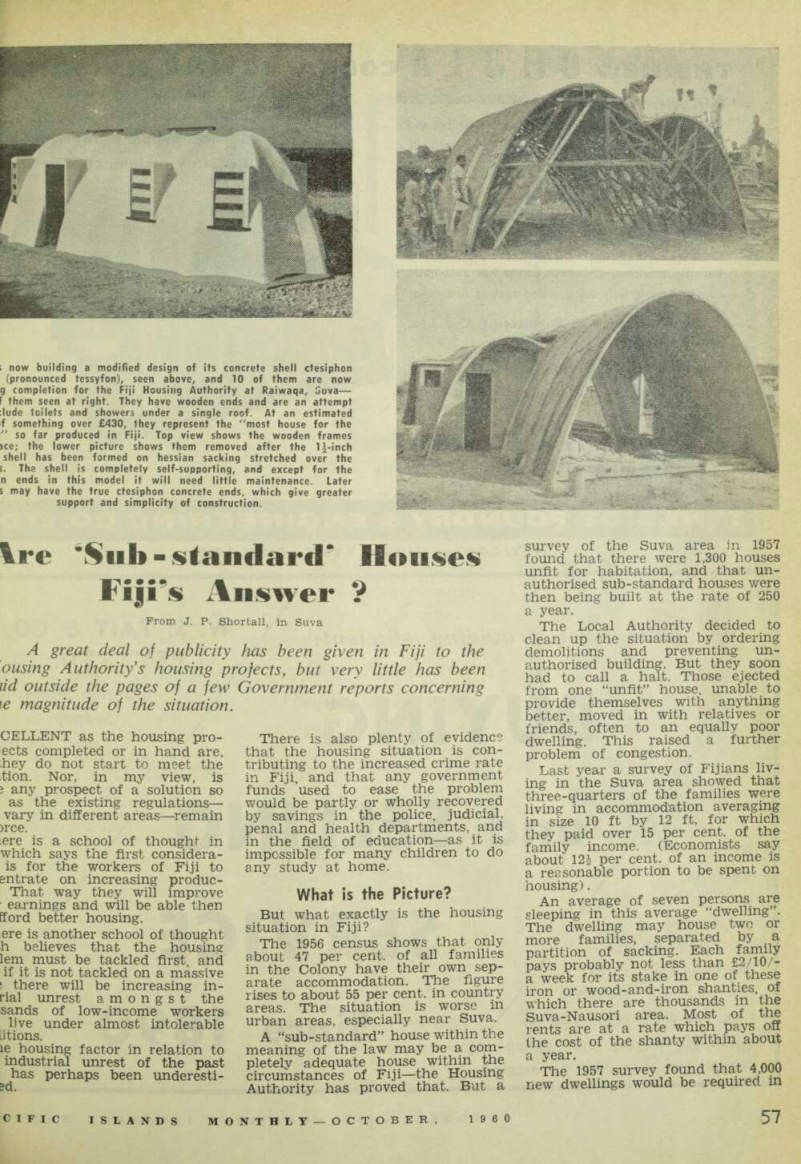
[?] now building a modified design of its concrete shell ctesiphon (pronounced tessyfon), seen above, and 10 of them are now [?]g completion for the Fiji Housing Authority at Raiwaqa, Suva [?] them seen at right. They have wooden ends and are an attempt [?]lude toilets and showers under a single roof. At an estimated [?]f something over £430, they represent the "most house for the " so far produced in Fiji. Top view shows the wooden frames [?]ce; the lower picture shows them removed after the shell has been formed on hessian sacking stretched over the [?] The shell is completely self-supporting, and except for the [?]n ends in this model it will need little maintenance. Later [?]s may have the true ctesiphon concrete ends, which give greater support and simplicity of construction.
Suva area alone over the next years, if building and health were to be complied with.
Idealistic Dream
is is an idealistic dream under ;nt circumstances. The existing are hindering a solution of primary problem—to provide i sort of housing for everyone, ilding blocks of an ideal size, ivided streets of an ideal width houses of a certain ideal ceiling it will never solve Fiji’s problem, is is now being realised, other major bottleneck is the Ivision of land. In a Native [ Trust Board subdivision of at Lami, near Suva, blocks been made available for those can afford to build on them a e of not less than 600 sq. ft. rent on these blocks varies be a £l7 and £2l a year, which is rently the lowest figure that be charged after allowing for costs of subdivision and ser . The rent on the block alone d be just within the means of under £5 wage earner, but he I not afford the additional e rent —even if he received the b as a gift!
Very Low Wages
r o-thirds of Fiji’s wage earners n the £3/5/- wage group, e cheapest orthodox type of rete block house so far produced le Housing Authority, with an of 412 square feet, has cost e first Housing Authority con shell ctesiphon houses, now ing completion in Fiji, with a area of 477 square feet, were lated to cost at least £430, ably more. Their rents will be )/- a month. e Housing Authority only has andate to provide houses for le who can pay them off (over riod of about 20 years) and has been able to do anything to ve the situation of the under roup up to now. ought to be remembered that figures given for Housing lority houses do not include site and that these prices have only
been achieved after the Local Authorities have relaxed the hous ing regulations as a special con cession, and by mass building Similar relaxation would be granted to other government or non government organisations establish ing housing settlements, but as the law stands at present, no concession would be granted a private citizen who might conceivably have a building site and the necessary finance to build one of these houses for himself on a loan scheme.
No person with an income below £8 per week could afford to build a house in the Suva area today under any loan scheme, to comply with the existing building laws, and from the economics of the thing no private builders would be in terested in providing housing schemes for the mass of low income workers.
The ctesiphon types which seem
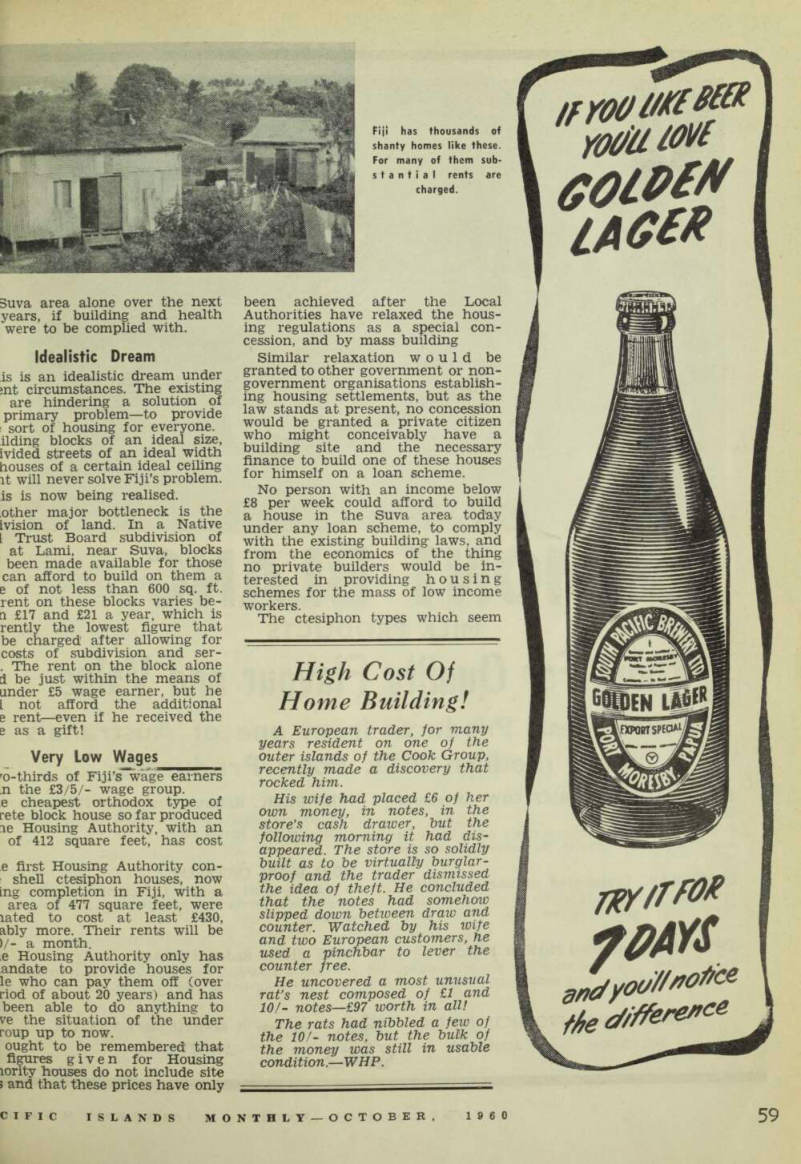
Fiji has thousands of
shanty homes like these.
For many of them sub stantial rents are charged.
bv such promise as one solu -0 Fiji’s housing problem, and e other orthodox types so far d by the Housing Authority, it comply with the law and t be erected by individuals r are all classed as sub ird.
A Solution?
only solution, assuming that land can somehow be made ble, would seem to be a re >n of building laws in specific to permit the public to build tandard” yet adequate, hous the cheapest type on smaller oubtedly many people could ve their situation if they were d to build a house within means. release of building materials 1 Government on a non-profit and the production of fittings as doors and windows for ird type houses would also recent registration in Fiji of idiary company to the Colonial >pment Corporation, and its e link with the Housing rity, seems to indicate that the t in which the CDC will first ipate will be in the field of ig, but there is no indication v large this project is to be. laps the factor which has de massive action in the field asing as much as the lack of
finance, is the lack of publicity which the situation has received.
This has resulted in an unaware ness by influential people of the seriousness of the matter. At pre sent, social workers are about the only people who are showing any real concern.
There appears to be some re luctance by the Government to ad mit the seriousness of the situation or disclose the facts. No publicity has been given, for example, to the results of the survey of Fijian hous ing in the Suva area made last year.
Noumea's Housing
Scheme Is A
"Big Success"
An experiment in native housing in Noumea has been so successful that the New Caledonian Govern ment is planning to extend it.
The experiment was begun two years ago with the construction of about 40 houses, to be rented to natives, in a good situation at Mon travel, on the main road to the north, about two miles from the centre of Noumea. The houses have three rooms plus a kitchen and bathroom, and are built of cement.
Montravel now presents a model suburb surrounded by attractive gardens and the Government has realised that the best way to help the natives is to give f hem an in terest in their home. It has decided to build another 38 houses immedi ately, and the French Government has advanced £A90,000 for the pur pose. A school is also to be built at Montravel, and householders, if they wish, will also be able to buy their rented houses.
Noumea's new Melanesian town, at [?]el. The long causeway in the centre [?]ccess to the Ducos Peninsular, the [?]lar space running off to its left being [?]d land for an oil company. The three [?]ildings at the right of the photograph, [?]he new houses, are old prison buildings.
Photo: Fred Dunn.