Fiji’s Sugar Debate
pp. 51-53 · Read in the full issue

Some Strong Words In Fiji’s Sugar Debate
From a Suva Correspondent Probably never before, in the history of the Fiji Legislative uncil, had such damning charges been made by Indian mem s against another Indian than in the September-October gar” session.
“other” Indian, specifically med, was Mr, A. D. Patel, e Lautoka lawyer who is ■-minding the opposition of a section of the Fiji Indian farmers to selling their cane i millers after a reasonable )mise had been reached, rding to Mr. B. D. Lakshman, elected member for the Western Division, this ;ion had a good deal more ,n it than the public had s appreciated.
Lakshman said Mr. A. D. and his brother, Mr. S. B.
Patel, had started this “sinister work” about 1939.
“In them converge the hopes and desires of that business community which is trying to keep the people in bondage,” said Mr. Lakshman.
They were interested in seeing that the farmers lost their money so that the farmers would become then vassals.
“This is the party which is creat ing syndicates and buying up land and keeping the farmers in bond age. This organisation is trying to put the farmers on the wrong track,” Mr. Lakshman charged.
“They are not only doing harm economically, but they are creating fights between brother and brother, between father and son, between friends and relatives—and they will keep on fighting for years to come.”
Mr. Lakshman said that just as Mr. A. D. Patel had in 1943 told the farmers to go ahead and cut their cane when “the mill was about to close and everybody had lost enough to become the vassals of his friends and others . . . this man is going to say the same thing in this strike”.
"Bondage"
In another debate Mr. Lakshman had more to say on the subject of bondage.
He said that when the farmers were led into the 1943 strike they got into the hands of money lenders and storekeepers.
“The banks did not help them, the CSR Company did not help them, the Government did not help them,” he said.
The farmer was forced to borrow the expenses of his farm and the money he needed to live, at any price, from those who would lend it. As a result he was so well tied down that by 1950 he could not get out of his bondage.
Mr. Lakshman showed that it was to the interest of these money lenders to keep the farmers in debt by acting as their “advisers”.
The farmers, he said, had met “obstacles of such a nature that they could not be called natural obstacles” when they had tried to set up their own co-operative busi ness schemes to circumvent the exploiters.
On this particular point Mr.
Lakshman was strongly supported by Ratu K. K. T. Mara, Second Fijian member, later in the debate.
"Face The Facts"
“I ask the government to give very careful consideration to the economic position of the Indian farmers which Mr. Lakshman gave us,” he said.
“We can spend days in con gratulating one another, but if we don’t face up to the facts that have
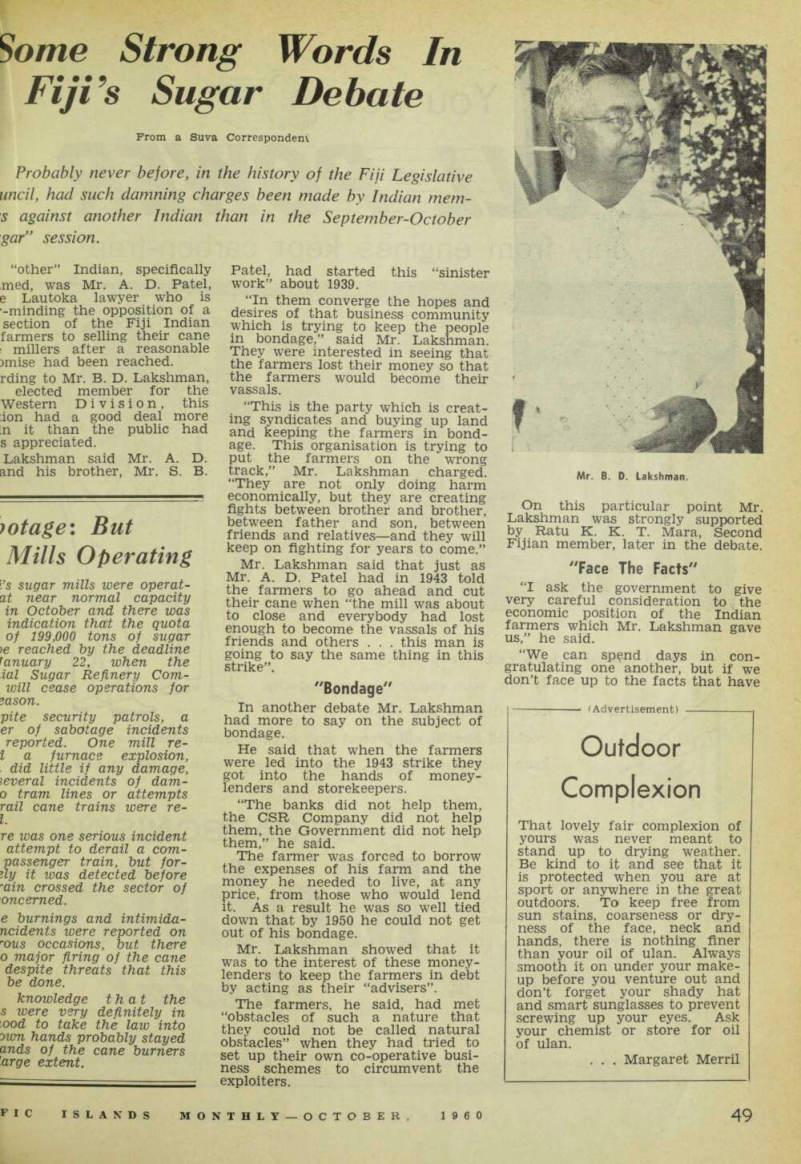
Mr. B. D. Lakshman.
laid before us and see what a do about them, we will have roblem over and over again,”
Mara said. e main problem ... is the pt of this group of people . . . r the farmers in the economic ge of the storekeeper. Several Dts have been made by isible Indian leaders to get out of their clutches. They or help to Big Business, the and the government in vain, is a challenge to all people ned. In failure to help the •s’ co-operative movement the iment has little to be proud j said. i Mara concluded: “If the co ive movement for the farmers een successful and they got from the clutches of the nepers, we would not have any /hile following of this group men who have been going intimidating and threatening, ) harvesting cane”.
Intense Feeling
Lakshman’s charges were supported by Mr. Vi jay Indian elected member for >tern Division. Other speakers Mr. A. D. Patel as the chief iot sole—engineer of the :ation of the holdup, and as an chiefly responsible for caused a very serious ration of racial relations in olony over the past few ama Vunivalu, Fifth Fijian r, mentioned the intense which existed at the recent 1 of Chiefs when the sugar was debated. He said that uncil “made no secret of its ; of certain so-called leaders sugar industry, and some aad suggested that these so leaders and their kind” be ck to where they came from stock, and barrel. d it be legally possible to do No one was very clear on )int; but Mr. J. A. Moore, an nominated member, said, ave certain powers in this
Colony and I feel that when the time is ripe they should be used”.
The time seemed more than ripe, if the powers existed.
Mr. H. B. Gibson, senior elected member, also expressed the hope tnat racial issues would not be brought in. Sugar, he said, was the lifeblood of the Colony, and he was annoyed that “twelve evil men have stabbed in the back this very great
industry”.
“But,” said Mr. Gibson. “I don’t want this to be considered as a question of Fijians versus Indians.
There are a lot of very sensible, very loyal Indian people who want to see Fiji prosper and see the sugar in dustry go ahead. We must take away from this problem the idea that it is all a question of the Indians.
P y° u . l*e. say some Indians want to get rid of the CSR Comnanv and * tak f th P place over - Bu^ mUSt n °‘ make this a racial issue ”
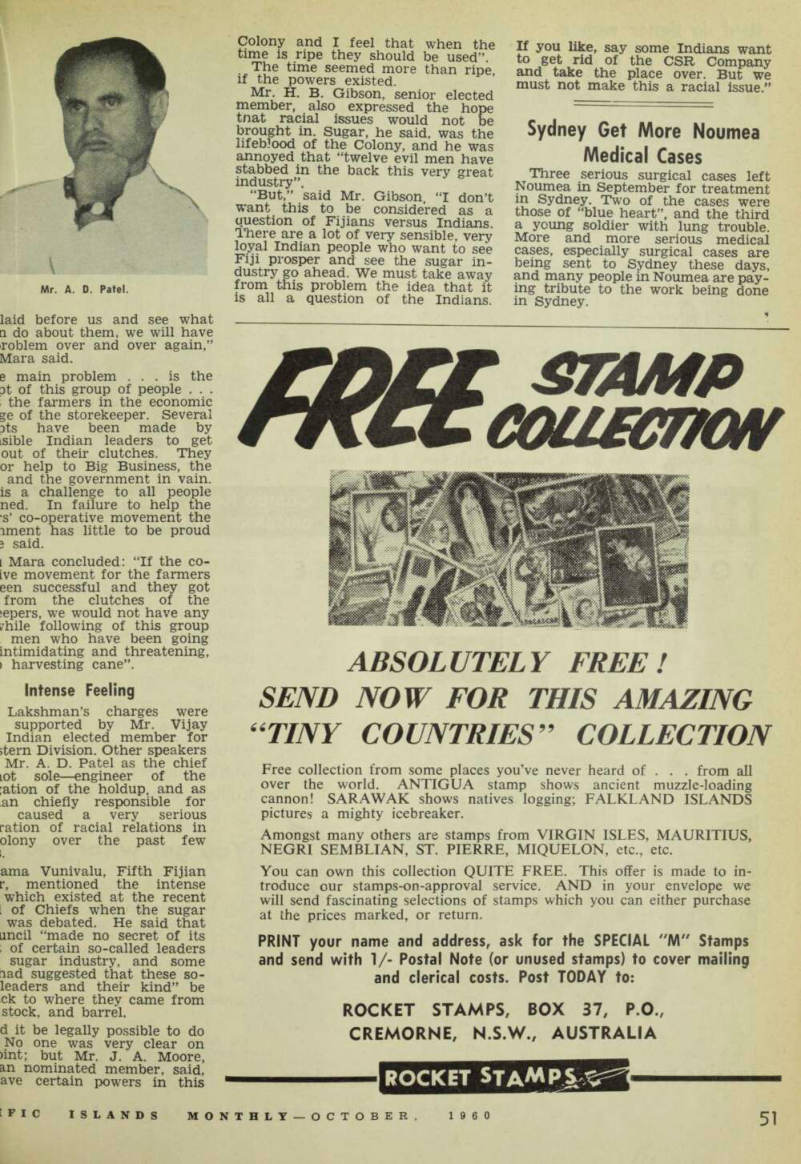
Mr. A. D. Patel.