Spirit Was
p. 45 · Read in the full issue
A War In The Offing
But Only The Spirit Was Willing
From a Rabaul Correspondent With an ancestral spirit (old
/le) to bring them luck, and
bottled spirit (new style) to
ing them courage, about 300 >lai natives came into Rabaul
September ready for a big
ht.
E ancestral spirit was a human arm bone tenderly hidden in a piece of rag, and the modern t was a banana juice home r even more tenderly hidden in >ven basket. i the more practical side, the is were armed with a bristling ction of pointed sticks, bayonets, bars and slings ready to fight i grudge with about 200 Chimbu res. The trouble started over a iffing debt. it the affair fizzled out before armed up when: The Chimbus, with a com iable sense of timing, chose the i day to disappear into the bush, The police, with a rapid series atrols, rounded up the Tolais confiscated their weapons. the light of what they have later, there seems little doubt the Tolais are as happy as any else that the affair did not ■ to a full-scale fight—but none iess they were ready. 265 Arrests! e police patrols arrested 265 es and collected a truckful of ons. e arm bone—not a fresh one ly means—was discovered when 5 were checking the weapons, bottle of home-brew was dis ed in an unattended basket i one of the natives put on ioor of the police station. When 5 called for the owner he came ird quite happily and admitted the basket and the home-brew his. e Rabaul Magistrate Mr. F. J.
Je, SM. took the men through itches of 25 to 50 at a time ise his court room was not big ?h to take the lot at once, e scoreboard at the end of the ■irgs was: Pleaded guilty to charges
fl having carried offensive
weapons, and fined £1 each 211 • Pleaded not guilty to charges of having carried offensive weapons, and dismissed 53 • Pleaded guilty to having been in possession of liquor, and gaoled for two months 1 Additional court attendants had to be called in to collect the fines and to keep the defendants apart from about 400 other Tolais who gathered around to see the fun.
Many of the onlookers were women and children who came to see how much Dad copped.
Police had their worries while they tried valiantly to balance the num ber of convicted natives with the pile of notes and silver which came in to pay the fines.
At one stage the books were short £3 and a few shillings, but a bit of back talking soon brought forward the defaulters and the books were squared.
With complete lack of sub judice tact, although doubtless well mean ing, the Administration came out with a lengthy explanation of what the natives had done and why they had done it.
The statement was made through the Department of Native Affairs at a time when no evidence had been given in court, and while the 53 natives who pleaded not guilty were actually on remand.
Today, about the only remaining evidence of the war that didn’t start is the human arm bone, which makes an interesting souvenir for the police station.
The home brew? It’s long since gone. “And it burnt with a clear blue flame”, the prosecution told the court.
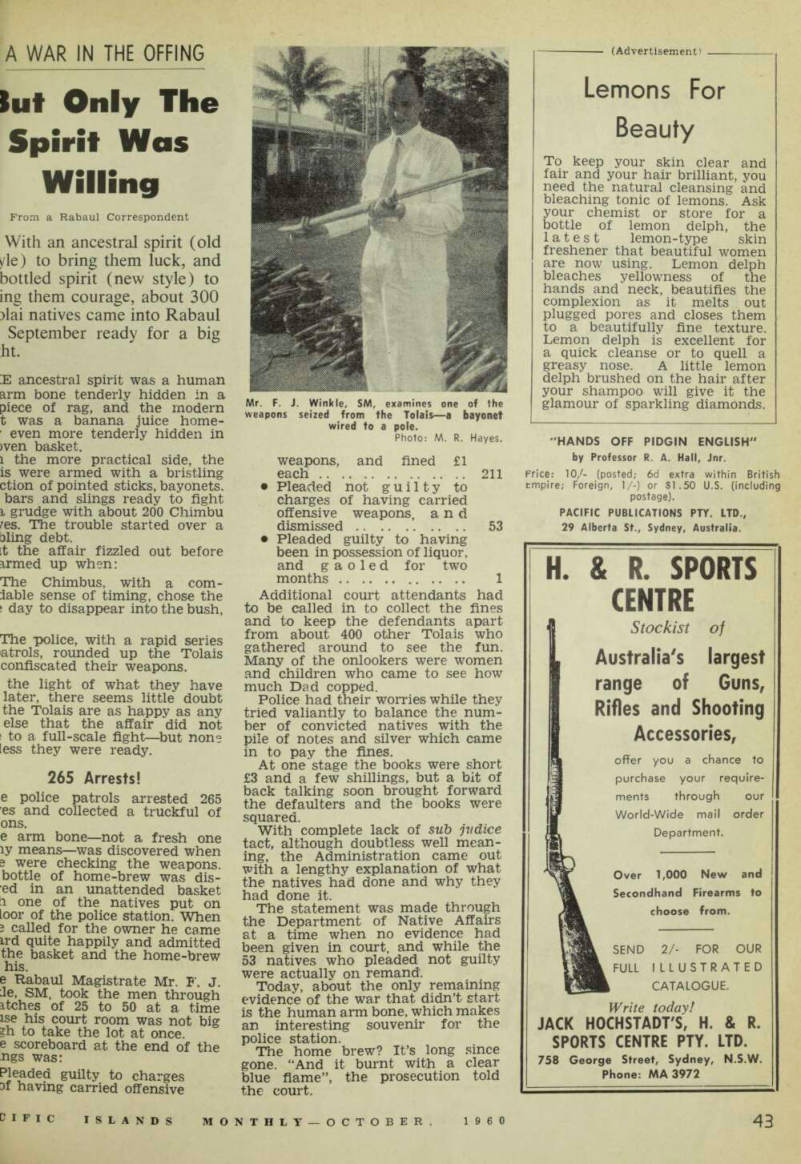
Mr. F. J. Winkle, SM, examines one of the weapons seized from the Tolais —a bayonet wired to a pole.
Photo: M. R. Hayes.