Commentary
pp. 27-28 · Read in the full issue
\G Drink Question
)verdue for Decision
lAPUA-NEW GUINEA cannot afford to delay much longer in making some clear-cut state ent on the question of drinking p native people, Fhe matter was brought up by two the native members at the May gislative Council meeting and tion promised “soon”. But noth l decisive has been done, rhe Administration is apparently xious to make a decisive move, d the delay so far can be laid the door of the Territories Min er, Mr. Hasluck. who appears to scared of the drink question. He storing up a lot of trouble for nself and everybody else.
Sere is the position as it stands; » Prohibition applies for all native people in Papua-New Guinea. » Some natives are clamouring for the right to drink although many others say they don’t want it. ► Public opinion on whether or not the native should drink is divided, with outspoken state ments on both sides. ► Five years ago the Admin istrator Brigadier D. M.
Cleland, promised a review of the situation this year, and he has since renewed his promise.
Jut while this position exists, gal drinking and illegal distilling increasing, and this fact can’t iously be ignored.
Recently the Council of Social vice of Papua recommended to gadier Cleland by 13 votes to six t what it called “the discrim tory liquor law” should be re ved. The council’s recommenda i was that native drinking uld be permitted, b created a storm of protest in )ua and in New Britain. Town isory councils, particularly the ncil at Kokopo in New Britain, »ngly attacked the recommenda ■ i. •ne of the most controversial ires to emerge from the situation the Rev. Percy Chatterton. of t Moresby, a missionary of the idon Missionary Society, who mrs drink for natives. His view hat the situations being caused prohibition are worse than those ch would be caused by legalised iking. ut Mr. R. H. Levi, chairman of :opo Town Advisory Council, ms that Mr. Chatterton’s atti e is “taking the line of least re ance”. mong Administration officers sonally there is strong support removing prohibition. Some
officers favour the brewing of a special “native people only” beer with a reduced alcohol content.
Others agree with the idea of mak ing a weaker beer, but say that all sections of the community would have to be content with it—other wise the naives would probably con sider they were still being discrim inated against.
Police have recently found more stills in the Gazelle Peninsula where the Tolais seem to lead all others in alcoholic inventiveness.
They brew potent draughts of firewater from bananas, pineapples and pawpaw; and despite strong measures to counteract black market sales of liquor to natives, there is evidence that a big trade continues.
Territories Minister Hasluck, of course, is aware of the situation. He has received many reports on it and senior Administration officers have pressed him for action.
For how much longer does he ex pect he can withold a decision? ☆ ☆
Mr. Menzies Doesn't
Tell The Whole Story
POOR Prime Minister Menzies wasn’t taking a trick in early October. While he was walking on some International toes at the United Nations, by making counter proposals to Mr. Nehru and party about getting Messrs. Khrushchev and Eisenhower closer together, he was also crushing a few lesser ones at home. How and why is set out in an article by G. W. L. Townsend on page 29 of this issue Mr. Townsend’s quarrel is not so much with the Prime Minister as with his advisers whom he feels did not provide Mr. Menzies with the right ammunition for “walloping”
Mr. Khrushchev and his attack on the New Guinea administration where it would do most good.
One of Mr. Khrushchev’s first proposals to the General Assembly was that all Colonial territories should immediately be “freed”’, and he extended this dispensation to cover New Guinea and the Trust Territories. Before he left Australia for his hurried visit to New York, Mr. Menzies said that he was going “to tell the UN the magnificent story of Papua-New Guinea”. Mr.
Townsend feels that Mr. Menzies, in fact, told only part of the story —the post-war story, and ignored the generations of hard work of the pre-war period that had brought some aid and enlightenment to a
Stone-Age people.
The campaign in New Guinea dur
mg the Pacific War, 1942-45 aid, in more ways than one, change the old Territory and it is undeniable that the popular conception now is that P-NG was discovered in 1942. This is galling to men who gave a life time of service to the Territory be fore that time—and Mr. Townsend expresses their irritation admirably.
Nonetheless as far as the outside world is concerned it matters little whether our Administration began there 15 years ago or 50. World opinion—with the new nations howl ing loudest—is not disposed towards listening to causes, or reasons, or of difficulties surmounted; they are interested only in effects, as of now. (Whether we should be un duly worried by all this is another matter).
Mr Menzies certainly is off the beam when he infers that we started from scratch in 1945, since the pattern of administration and its firm foundations had been set years before. But in the material sense it was a new beginning and figures show why.
Before the war the public services of Papua and New Guinea combined numbered only hundreds; now the PS numbers 4,000. Before the war, the New Guinea Mandated Terri tory got no financial aid from Aus tralia —it paid its own way, mostly from a royalty on gold; Papua got about £40,000. Since the war, the Australian grant to the combined Territory has run into millions each year—about £l4i millions this year, which, with internal revenue, gives the Administration over £2O million to spend. On the score of avail ability of funds alone, there would be something wrong with the P-NG Administration if it isn’t writing a more interesting story now than the pre-war Administrations were able to write.
In comparison with the almost hysterical interest that is taken in P-NG affairs today, there was little from the outside world before 1942, with the result that the most tangible forms of progress there then came from private enterprise trading and shipping companies, gold mines and plantations.
The Administrations had their policies and they kept to them, but their role—except in exploration— was restricted by funds available to keeping the status quo. Since the war, however, the roles have tended to be reversed, with the Adminis tration taking the initiative—and this trend seems bound to develop further.
The points Mr. Townsend makes at the end of his article are of more immediate concern than the point about who should be praised for the past. He stresses that while the Territory of Papua-New Guinea is run by the Territories Depart ment in Canberra, the Territory is represented before the United Nations and the outside world by the Department of External Affairs; and that the Administrator of New
Guinea, unlike the Governors and High Commissioners of other Trust Territories, has never represented P-NG before the United Nations, nor even been permitted to visit the organisation.
Mr. Townsend might have ex tended his criticism of Canberra’s fanatical insistence on watertight Ministerial departmentals to cover Canberra control of the Territory generally.
During the month, Sydney—and probably P-NG, too has been laughing at a letter that appeared in The Sydney Morning Herald signed by an Anne Howe, of Port Moresby, who said she was an “obscure and strictly non-careerist Civil Servant”. Most thought her to be a brave woman, but the truth may be “she” is fictitious. This is what she said (in part): “Minister Hasluck is commonly conceded to be almost fanatically sincere, and frightfully industrious.
But ... I have become equally convinced that Mr Hasluck’s’ petul ant doctrinairism, congenital pedantry, lack of psychological in sight, and intolerance of the advice of the men on the spot, constitute very serious obstacles to Australia’s efforts in these islands. Canberra pays most of the Territory’s bills, and this provides the pretext for Canberra control over Territory affairs to extend down to adminis trative minutiae. Talk of the Admin istrator’s autonomy is regarded here as a poor joke, and every depart mental head is alleged to have a shadowy counterpart wielding power without responsibility.”
It isn’t as bad as that, of course, but it’s bad enough. V
Hint of Rich, New
Goldfield in Fiji
mHE Fiji Government’s announce- X ment that recent investigations indicate the existence of a valuable goldfield in the Waimanu River region, about 15 miles directly north-west of Suva, brought a gleam of sunshine into an economic picture that, for many months, has been consistently gloomy.
The Tavua goldfield, on which the town of Vatukoula now is based, has brought many millions of good money into Fiji. There have been minor goldfields elsewhere in Viti Levu, and in Vanua Levu. Beyond doubt, there still is much gold in the Colony, just waiting to be dis covered.
This Waimanu River goldfield is not new—in fact, its existence was reported decades before Bill Borth wick’s discovery at Tavua. Adam Boyd, an old-fashioned prospector and miner, who fossicked for years in the Waimanu area, always in sisted that there was rich gold there.
But every effort at large-scale survey and development hitherto has been defeated by the extreme roughness of the terrain. There is no road of any kind —only native tracks, over which Fijians carry packs of 50 or 60 pounds. There is no place in the precipitous gorges for an airfield.
“I know this gorge,” said Mr. W, G. Johnson, managing director of the Carpenter companies in Fiji, who was in Sydney the day the news came through. “I myself have washed out lumps of alluvial gold there. Old Boyd was right—there is a goldfield there. And it could be rich.
“But it is terrible country to get into—a very tough, difficult walk.
It lies around to the northwestward of Joske’s Thumb (the curiously shaped mountain peak seen from Suva). We used to go out to the Navua, and then up the Waindina River to the headwaters of the Waimanu (which is a large tributary of the Rewa River).
“There is no flat land at all, but it is beautiful country—streams and wild, broken gorges. No Fijians live there. There is much fog there— as anyone can see who flies be tween Nadi and Nausori. It could be made accessible by helicopter, perhaps.
“I have myself recovered gold there in small lumps, and I have grub-staked prospectors but we always were defeated by the difficult terrain.
“John Millett and some of his friends were interested in the Waimanu some 30 or 40 years ago —but no one has made an effort at development in recent times.”
The Fiji Government said there was a probability of proving 34 million cubic yards, with values running from one to 16 grains per cubic yard. Government geologists are continuing investigations.
P-NG Reform Ends
A Long Battle
IT’S taken a great number of years to get a plan for Papua-New Guinea Legislative reform out of the Minister for Territories, Mr.
Hasluck. Hundreds of thousands of words on the subject have been written and spoken in that time.
We will probably never know why he never announced a plan, even in general terms, much earlier than September 22. Probably the final decision on an announcement, if not earlier ones, had something to do with picking the most oppor tune time for the news to rebound around the halls of UNO.
But now the plan is finally announced, nobody could fairly find an argument against it. It’s a good scheme. It’s a praiseworthy scheme.
It should give every chance for the
Territory to grow in the rigl direction politically. The plan cor tains some important safeguards fc the Government, yet at the sarr time it gives rein to the opinioi of the Papua-New Guinea public a public that has for so long bee neglected, despite the strength has developed since 1951, when tU present Council was inaugurated.
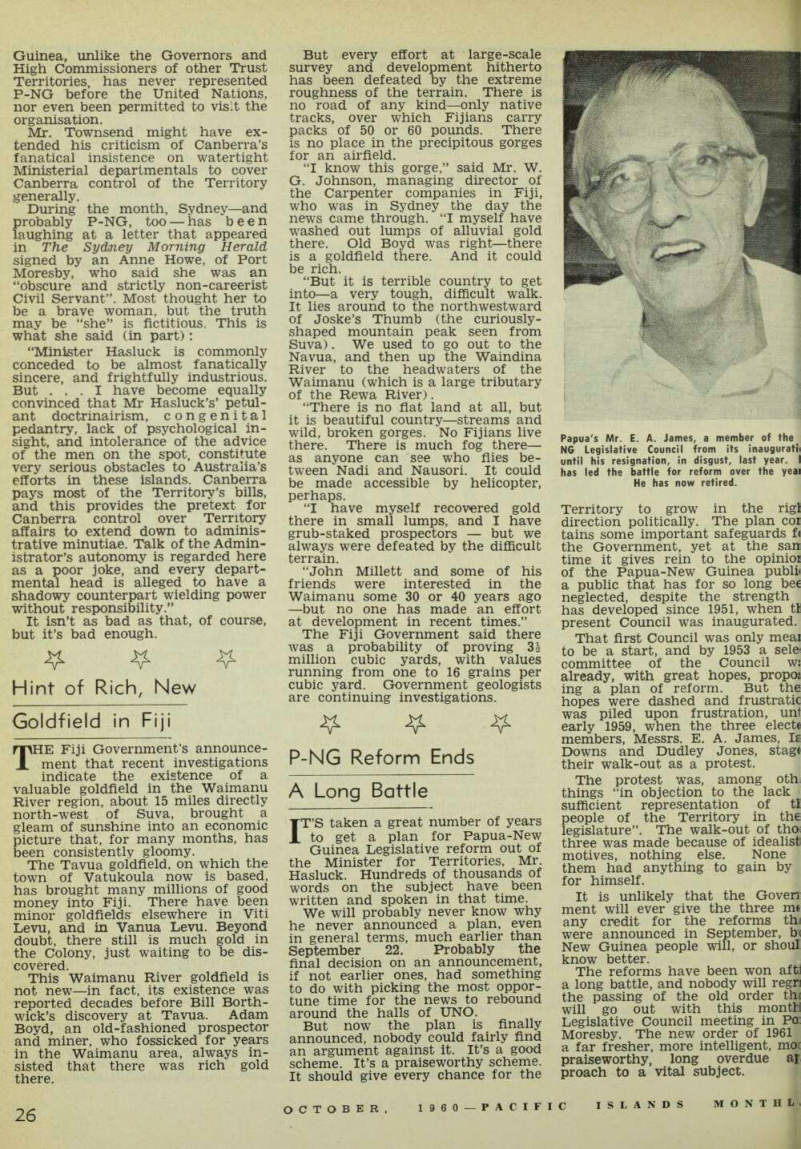
That first Council was only meai to be a start, and by 1953 a sele< committee of the Council ws already, with great hopes, propos ing a plan of reform. But the hopes were dashed and frustratic was piled upon frustration, unt early 1959, when the three electe members, Messrs. E. A. James, Is Downs and Dudley Jones, stage their walk-out as a protest.
The protest was, among othj things “in objection to the lack ■ sufficient representation of tl people of the Territory in the legislature”. The walk-out of tho; three was made because of idealist motives, nothing else. None them had anything to gain by for himself.
It is unlikely that the Goverr ment will ever give the three me any credit for the reforms thi were announced in September, b< New Guinea people will, or shoul know better.
The reforms have been won aftJ a long battle, and nobody will regn the passing of the old order tin will go out with this month Legislative Council meeting in Po] Moresby. The new order of 1961 a far fresher, more intelligent, moc praiseworthy, long overdue a] proach to a vital subject.
Papua's Mr. E. A. James, a member of NG Legislative Council from its inaugurati[?] until his resignation, in disgust, last year. I[?] has led the battle for reform over the yeas He has now retired.