Know Where Ws Going?
pp. 21-151 · Read in the full issue
Does The New Hebrides Know Where Ws Going?
By Stuart Inder
After almost 60 years, the Anglo-French Condominium of the New Hebrides has reached the stage where it has to decide where it is going. There are real difficulties ahead for the New Hebrides unless the two Governments plan the future for these islands which are neither British nor French and whose native inhabitants have no national status of their own.
EIE trouble will not be caused by the British or the French, but by the New Hebrideans, I there need be nothing sur ging in that. While big develop tits are occurring on all sides of New Hebrides, the winds of nge may be expected to pass r those islands, too. his month’s news, for instance, 3 of the race towards autonomy Netherlands New Guinea, of (ht new legislative reform in lua-New Guinea, of a brand new islative Council about to be in urated in the Solomons, of [plicated problems in Fiji and quickening pace towards inde dence in West Samoa. The New Tidean is becoming aware of n all. r hen the British and French - entered into the Condominium 906 nobody held out much hope '• it would last as a system of eminent. Nobody has held out hope in the intervening 60 ’s, yet by some amazing circum-
stance, the Condominium has managed to stagger along with all its faults.
A Success in a Way
In one remarkable fashion it has been a success. It has been a success in international relations on the personal level. While national jealousies in the higher political arenas still are no better than any body has come to expect, the French and British who live in the New Hebrides, who have their planta tions, businesses and their jobs there, get on very well by and large.
In 60 years both have come to learn that there are good French men and bad, good Anglo-Saxons and bad, and that the personality counts, not the nationality.
Over a long period all these people have in fact developed such skill at living within the framework of the “Pandemonium” system that they would be unhappy with a New Hebrides that wasn’t a Condo minium.
As one British businessman told me when I visited the New Heb rides recently: “Don’t let anybody take the Condominium away. The more the two Governments stand on their national dignities up there at the top, the more they argue with themselves about what should be done and what shouldn’t (and finally come to a stalemate), the better we like it. While they argue about the finer points they are not worrying us, and we can get on with the job.” A French companion who heard that, grinned and nodded.
Alice in Wonderland
This Alice in Wonderland exis tence need not be any worry to anybody if the New Hebrides existed in a vacuum within the South Paci fic. But the future of the New Heb rides belongs to the New Hebridean, and he is fast entering a new stage of development.
He is beginning to be aware of his future inheritance, and in a few years he will be developing at a faster rate than the natives of these northern islands who today are getting the lion’s share of pub licity.
The New Hebrides now has an
Advisory Council (it began only in 1957) which includes native mem bership. Some New Hebrideans now are saying of some of those native members, “They don’t really rep resent us. They are stooges.”
Whether they are or not doesn’t matter —the point is that the New Hebridean is thinking politically.
He is also taking an interest in money and trade, and the death warrant of the small European trader has been signed. New Heb ridean natives produce more than half of the Condominium copra (with their share growing quickly) and they see no point in trading to a small middleman when they can get a better price by trading direct with the shippers.
Some individual New Hebrideans are now wealthly fellows, and they are not stupid. They are learning very well, in fact, how to play one Government off against the other for their own benefit.
They Need Education
They are very much aware that what they need is education, for their children if not for themselves.
The greatest need in the New Heb rides today is for schools and teachers, and more important, for a properly planned education pro gramme.
(Continued on page 149)
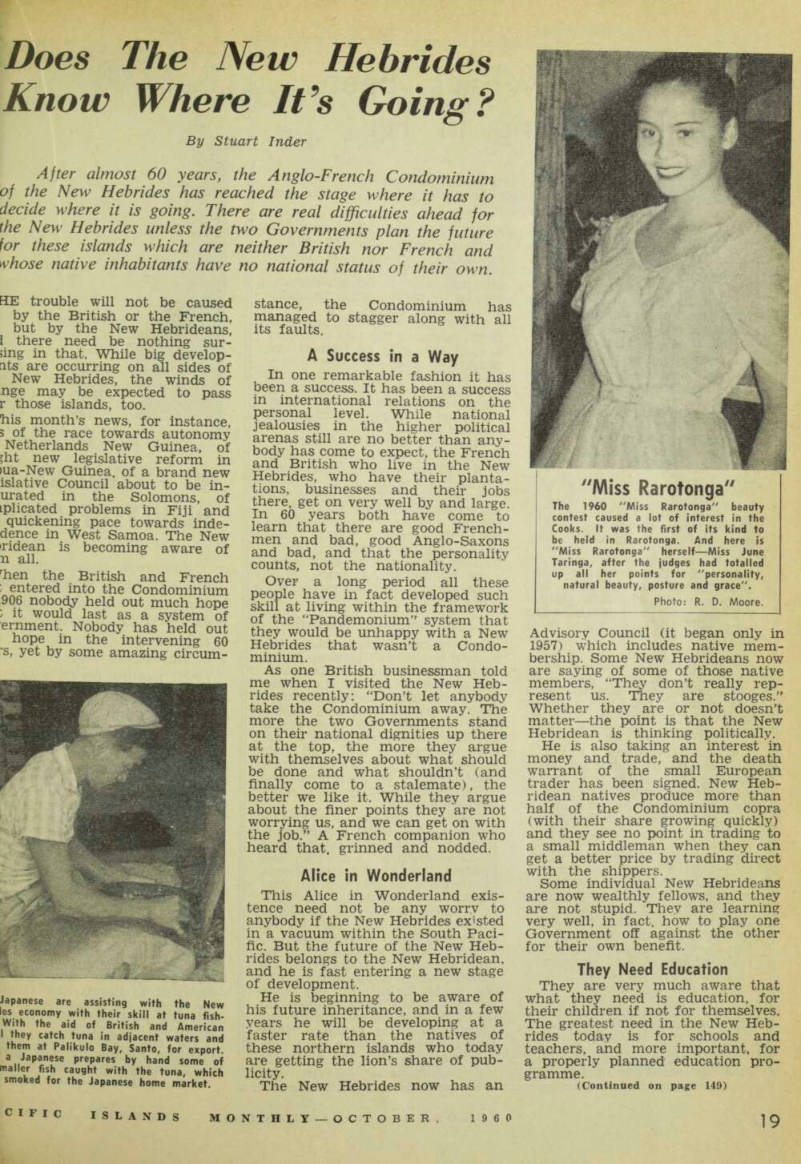
Japanese are assisting with the New [?]es economy with their skill at tuna fish- With the aid of British and American [?] they catch tuna in adjacent waters and them at Palikulo Bay, Santo, for export, a Japanese prepares by hand some of maller fish caught with the tuna, which smoked for the Japanese home market.
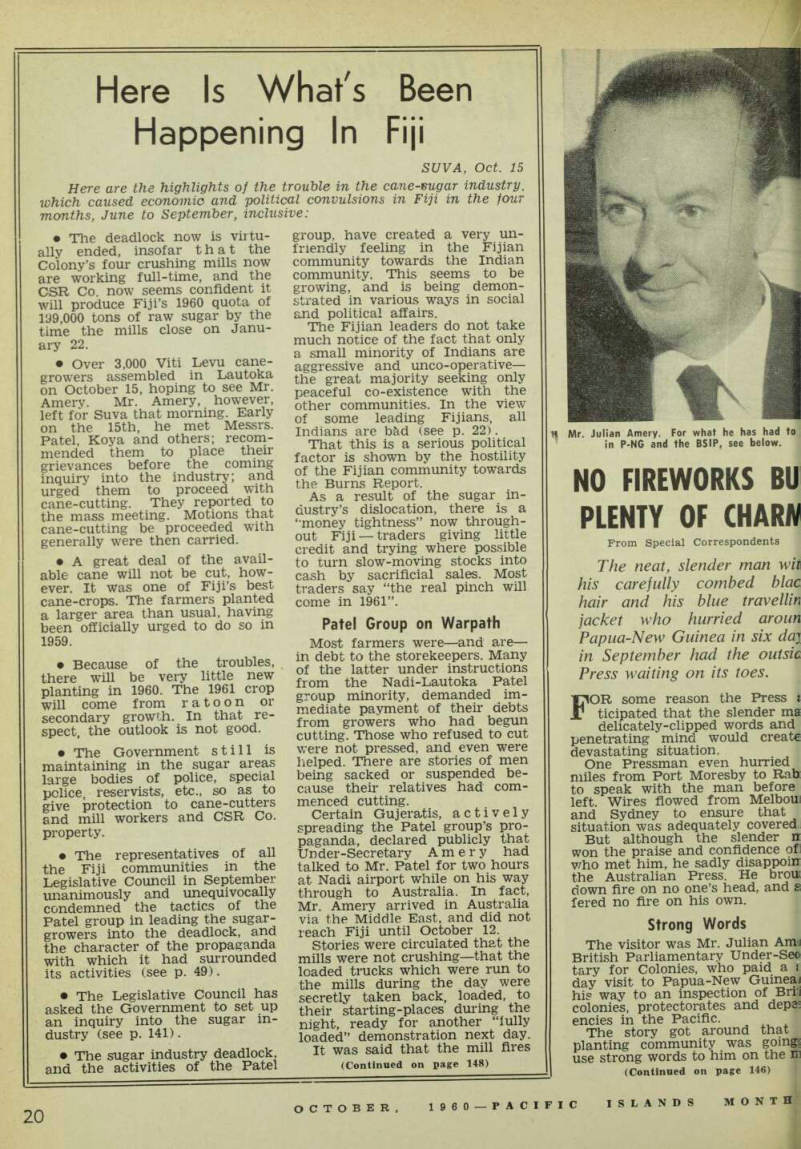
"Miss Rarotonga"
The 1960 "Miss Rarotonga" beauty contest caused a lot of interest in the Cooks. It was the first of its kind to be held in Rarotonga. And here is "Miss Rarotonga" herself—Miss June Taringa, after the judges had totalled up all her points for "personality, natural beauty, posture and grace".
Photo: R. D. Moore.
, . . , There is no Condominium educanon department. There is no coordmation. Education is largely handled by the separate Governments, with the missions, as almost everywhere in the South Pacific, acceling the brunt of the responsibilities. Only recently, with the appomtment of a go-ahead education officer, have the British begun to gather up their many loose ends, but an integrated pattern for the Condominium is still in the future, For how long will the New Hebrideans continue to let the Condominium adopt the peculiar standards it has set in so many things (or, more accurately, the peculiar standards that have developed because the two Governments can’t agree to set any standards) ?
What course is the New Hebrides following in education and in everything else? What does the Condominium want to achieve politically?
Have the two Governments the same end in sight—the handing
over of the New Hebrides intact to the New Hebridean? What form will this take; what is the machin ery; what are the stages to be reached and passed on the route?
If the Condominium system is the only system that can be agreed on for the two Governments to achieve a common end then some realism has to be injected into the system for the sake of the New Hebrideans. If there is another sys tem, what is it?
What Is Her Future?
The New Hebridean has to be told what his future is. The race for his soul —the present apparent race to attract the New Hebridean into either the British orbit or the French orbit before “the other side” does is a needless waste of energy.
The future of the New Hebrides (and also the Solomons) has been discussed in London and Canberra and Wellington recently. Britain would like to see Australia take a greater interest in these areas— and it is natural that Australia should, considering her early relations with the New Hebrides, and her present trade interest there. The Commonwealth owns 25,000 acres of land in the New Hebrides, and the future of some of this is now being discussed at a high level.
Britain would like to see Aus tralia take a closer interest through the granting of scholarships, par ticularly to teachers, and even to help in a crash teacher project, and through other forms of aid.
Australia can do a lot, working through the present framework of the Condominium system. The South Pacific Commission can, and will, also be a means of assistance within the Condominium frame work.
But. important as all these moves can be for the emerging New Heb ridean, the wider problem has still to be discussed by Britain and France at the top level.
That is, can they agree on where the New Hebrides is headed before the time comes when the New Heb ridean himself will take the matter into his own hands? They will have to move soon.