Road To Autonomy
pp. 19-151 · Read in the full issue
The Natives Will Soon Have a Vote Papua-New Guinea On The Road To Autonomy
From New Guinea and Canberra Correspondents There were two major reactions when Papua-New Guinea eople received the long-awaited details in September of how ustralia planned to recompose membership of the P-NG egislative Council.
E first reaction was one of satisfaction that elected rep representation was to be in sed. le second was amazement at the irent loss of the official Admin tion majority in the House, i paper, the elected and ap ted membership, drawn from public, will have sufficient igth to out-vote the official ibership drawn from senior Ad stration officers, iwever, Australia still has con over legislation through the la-New Guinea Act and through imber of other processes, le composition of the Council announced in Federal Parlia t by the Minister for Terri-
tories, Mr. Hasluck, on September 22. The details basically are those foreshadowed by PlM’s Canberra correspondent in the September issue (p, 17), The Government hopes to hold elections next Feb ruary or March, and the new Legco will begin operating soon after.
Total of 37 The new Council will have a total membership of 37, with the official membership in the minority by seven; compared with a total of 29 members in the old Council, with official membership in the majority by five.
Natives are to be elected for the first time—through a system of electoral conferences in each elec torate—this method to be used only during a transitional period.
Mr. Hasluck said the Government intended to establish a common roll and preferred to see a change direct from the electoral college method to a common roll, rather than a change to another inter mediate stage in which there would be two rolls for the two races, even for a brief period.
When native nominations are re ceived. an electoral officer in each electorate will summon a confer ence in which Local Government Councils will send delegates. Dis cussion will be held at these con ferences, candidates will be invited to make addresses and then a vote of the delegates will be taken by secret ballot—delegates voting indi vidually. In some cases groups ether than Local Government will be able to send delegates.
The details of these conferences and voting will be set down in regu lations yet to be made.
The present three P-NG elector ates are to be doubled and the new
divisions will be (as reported in PIM in September) East and West Papua, the Highlands, the New Guinea Mainland, New Britain and the New Guinea Islands.
The table on this page gives the new Council compared with the old.
Need Support
Apart from the elected members it will not be known until the names are announced how many of the new Council will be natives. The Govern ment has announced that all the ap pointed membership, whether official or non-official, will be open to natives as well as non-natives. There is a stipulated minimum of 11 native members—six elected and five ap pointed—but this is merely a mini mum. It is, for instance, likely that at least one of the official members will be a native in next year’s Coun cil, Dr. Reuben Taureka, a civil servant. Dr. Taureka was in Septem ber appointed to the present Council.
Mr. Hasluck told Parliament that because of the loss of the official majority the Government would have to obtain the support of some of the elected or nominated mem bers in order to have a majority in the Council.
As PIM reported in September, this will mean that the Govern ment will be searching for moder-
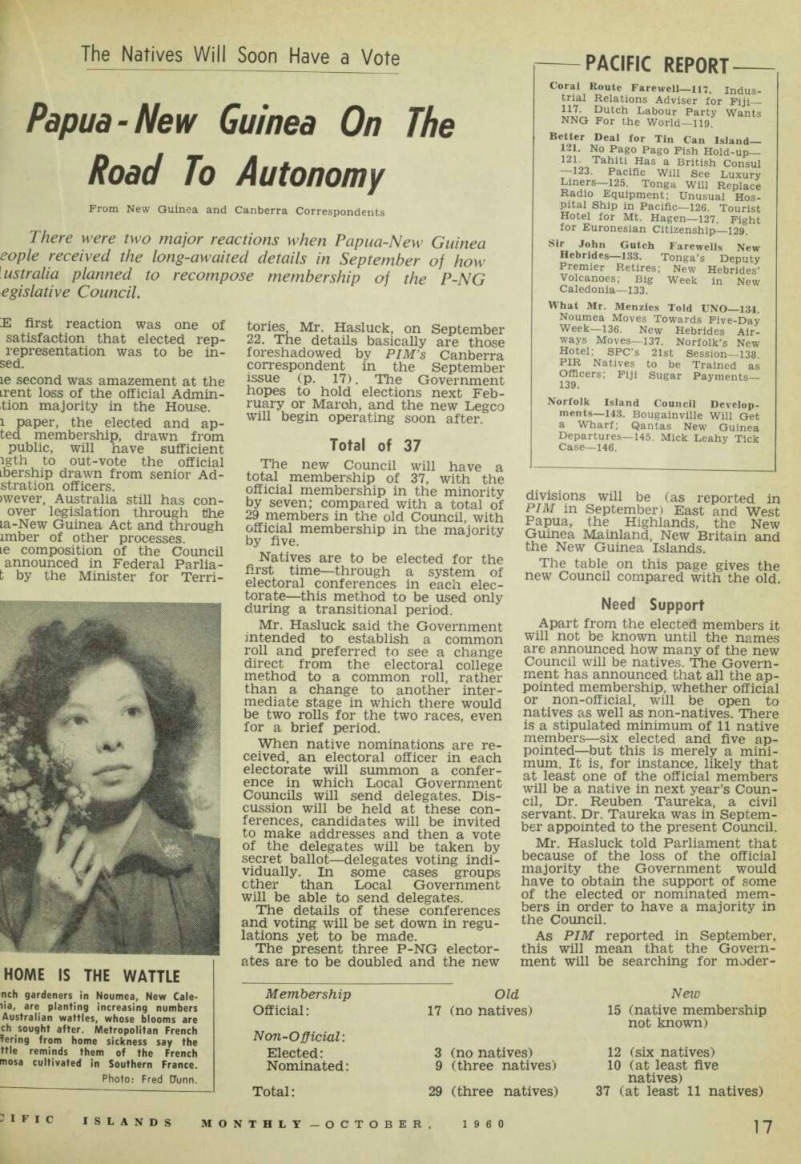
Home Is The Wattle
[?]nch gardeners in Noumea, New Cale [?]ia, are planting increasing numbers Australian wattles, whose blooms are ch sought after. Metropolitan French [?]ering from home sickness say the ttle reminds them of the French [?]mosa cultivated in Southern France.
Photo: Fred Dunn.
Membership Old New Official: 17 (no natives) 15 (native membership not known) Non-Official: Elected: 3 (no natives) 12 (six natives) Nominated: 9 (three natives) 10 (at least five natives) Total; 29 (three natives) 37 (at least 11 natives)
ates to be nominated to the un official membership, and also that important legislation will probably be foreshadowed, with members given plenty of notice, and their opinions canvassed. If it is obvious that the proposed new legislation had no chance of being passed, the legislation would not be submitted or be amended. However, the Gov ernment will also have the protec tion of its power of veto in Can berra. Assent may be withheld from ordinances.
Since the announcement, a strong body of Papua-New Guinea opinion has felt that a big proportion of the membership could be drawn from the ranks of the public ser vants. and the Government could get it’s majority support that way.
It is being pointed out in New Guinea that there is nothing to preclude senior Administration officers from providing some of the appointed membership. The new alterations to the Papua and New Guinea Act merely allow the Gov ernor-General, at the nomination of the Administrator, to appoint 10 members, not less than five of them to be resident in New Guinea end not less than five of them native members. The Act does not say that appointed members have to be non-Administration.
Natives To Be Appointed Mr. Hasluck himself probably gave currency to this belief when he said in Parliament that because native public servants were barred from election, and because some of the most outstanding and best edu cated of the P-NG natives were
at present in Government service, it was intended to see that some of these made up the appointed mem bership of the new Council.
Mr. Hasluck said the next step forward would be a further increase in the number of elected members at the expense of appointed mem bers, and the Government did not want to encourage any section of the community—the missions, com merce, or anybody else in the belief that it had a right to be appointed to the Council.
Another major change announced in September was the abolition of the Executive Council (which at present has an all-Administration membership) and creation of a new body called the Administrator’s Council.
This will consist of the Adminis trator, three official members of Legco and three other non-official members of Legco—at least two of them elected members. The Ad ministrator’s Council will “advise the Administrator on any matter referred to the Council by the Ad ministrator . . . and also, by an ordinance of the Territory, certain functions can be confided to the Administrator’s Council”.
What these functions are will be revealed by legislation to be passed in the Territory.
At least one member of the Ad ministrator’s Council will be a na tive.
Both Houses of the Common wealth Parliament passed the new Council bill and assent was granted on October 17. The Labour opposition moved unsuccessfully to have a common roll of natives and
(Continued on page 149)
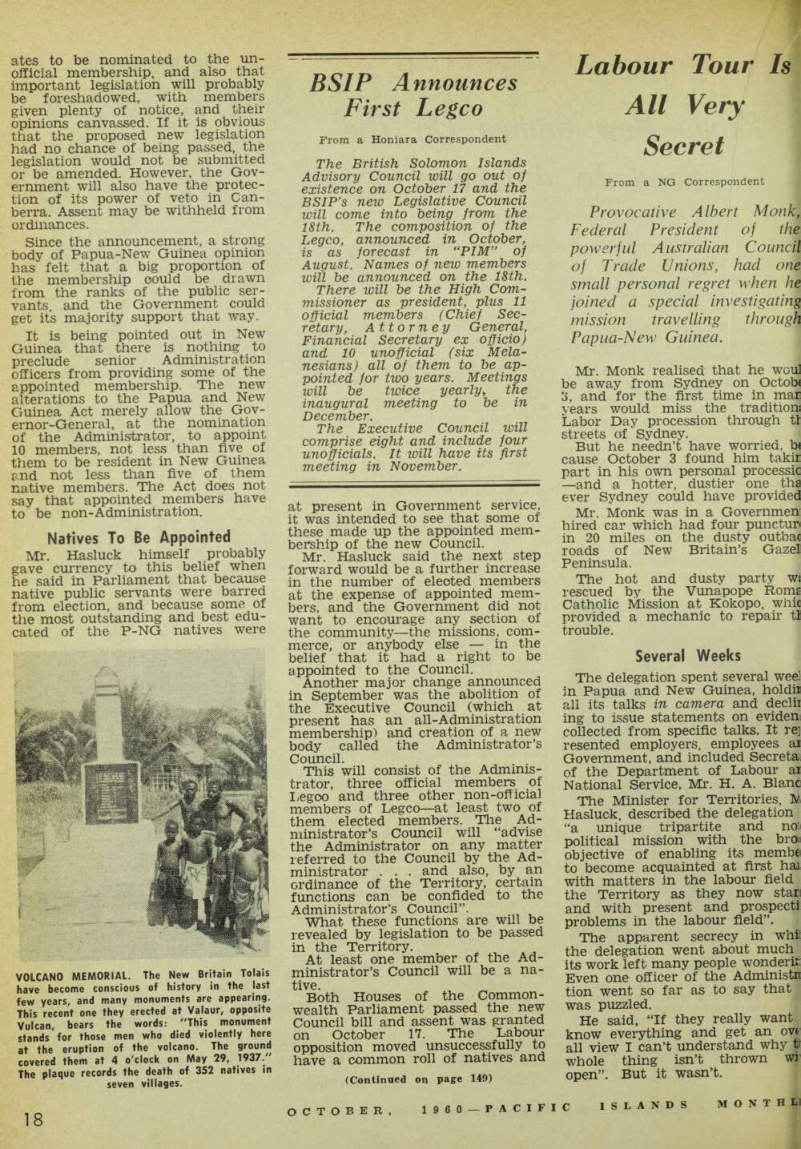
VOLCANO MEMORIAL. The New Britain Tolais have become conscious of history in the last few years, and many monuments are appearing.
This recent one they erected at Valaur, opposite Vulcan, bears the words: “This monument stands for those men who died violently here at the eruption of the volcano. The ground covered them at 4 o'clock on May 29, 1937.
The plaque records the death of 352 natives in seven villages.
eans brought in immediately. . Hasluck told Parliament luring his recent tour in the ory he asked all European itions about their opinions on imon roll and all had recog that a common roll was ap ate and they had raised no ion to it. The only doubts concerned the problems set literacy, and the question, er, if the native people were on a common roll too soon, rates might be won too easily orer types of candidates.') oughout Papua-New Guinea ative and native leaders y praised the proposals for position of the Council, rs in Port Moresby, Lae and il particularly praised provi for elected native representa- Rabaul particularly, and in centres to a lesser extent, was a feeling of complete ment at the provisions which the official Administration th in the minority. former elected member for Guinea Islands, Mr, Dudley flatly refused to believe the >n until he received confirma- He suggested that the first received in Rabaul setting out nembership of the Council 3ly contained a telegraphic Mr. Jones 7 Statement Jones eventually issued a lent in which he described ituation as “a sweeping re and a long step towards self iment longer than antici -9 Jones made four points, how which he said demonstrated he Legislative Council would heless remain “very much a iinate legislature”. The four were; ustralia’s wide powers under apua-New Guinea Act. he fact that only the Admini )n could initiate certain im it types of legislation, he fact that some legislation reserved for the Govemor al, he all-pervading provision very bill passed by the council to receive Assent before it te law. e Australian Government ap tly considers the'se controls ate to ensure that it can ment its policy in the Terri - Mr. Jones said, baps one of the strongest g comments also came from ew Guinea Islands region. It nade by one of the nominated >ers in the existing Council,
the Rev. Father James Dwyer, of Rabaul.
Father Dwyer said: “The oppor tunity has been given to the native people for political advancement to outstrip educational and economic advancement. Herein lies the bold ness and the danger of the change”.
Father Dwyer also described the proposals as forming “a bold stroke and a calculated risk that could pay off with an extraordinarily rapid political advancement of the people”.
He believed the new composition would form a danger if not properly handled.
But whatever happens, Papua- New Guinea’s view is that the Terri tory has achieved on paper what can be described as a big slice of self-government.