More Shipping Links
pp. 115-143 · Read in the full issue
Pacific Report
The month’s round-up of news and pictures of people and events, from PIM correspondents in the South Pacific.
: or Papua-New Guinea
Transport in the South Pacific las a habit of being available either is a feast or a famine. New ship ping arrangements affecting Dutch uterests and Papua-New Guinea in the feast class —and nobody n the Territory is likely to com plain about it.
The Dutch KPM Line has recently naugurated services involving two hips, the Arfak and Korossa, be ween NNG and P-NG ports, and n December two major Dutch ship ping companies, the Netherland anes and Royal Rotterdam Lloyd, nnounced that about February they rould operate alternating services rom Holland to P-NG.
The KPM Line arrangements have Iready started (see PIM, Shipping lection, Dec.). Recently a repre entative of the line, Mr. Th. Hut, Isited P-NG to get things under ray.
In Lae, Mr. Hut told a PIM cor espondent that the first idea of , shipping link between the two rerritories followed the Canberra Difference on co-operation in Oc ober, 1958. It had originally been uggested that one service from each territory should alternate; however £PM had offered to start a service n a monthly basis for a six month’s rial.
“KPM feels that with the lifting f import restrictions in P-NG there hould be a bigger flow of cargo rom Europe to the Territory,” said ilr Hut. “Also, until now, cargo rom the UK to Territory ports has tad to be transhipped from Hong :ong—taking four months—although lollandia gets a ship every three reeks.
Thus cargo transhipped at lollandia will take a much shorter ime, and there will be a lower reight rate. For example, textiles hipped from Europe to Madang at iresent cost 547/- a ton. Shipped la Hollandia they will cost 457/i ton.”
The motor ship Arfak, which can oad 100 tons of cargo, will ply be ween Hollandia, Wewak, Madang ,nd Lae, and the 2,000-ton motor
ship Karossa will run from Merauke to Port Moresby, Sorong, Timordilly, Singapore, and back to Port Moresby. The latter accommodates 20 first-class passengers, 30 second class, and has room for third-class and deck passengers as well as cargo.
The Arfak does the round trip from Hollandia and back in a fort night, sailing from Hollandia on the fifth of each month. The com pany has taken Arfak on charter from the Dutch Government. Apart from carrying cargo ex Europe to New Guinea ports, the company will also canvass for cargo from New Guinea to Hollandia. No cargo will be carried between inter-Territory ports.
The Karossa will carry cargo ex Europe to Port Moresby after transhipment at Singapore, The Port Moresby-Singapore ser vice should appeal to Territorians with long leave as it offers two alternatives. They can either do the round trip, which allows 12 days in Singapore, or disembark at Singapore and make trips to Rangoon, India Hongkong, and Bangkok—spending approximately 40 days—and then catch the next steamer to Sorong,
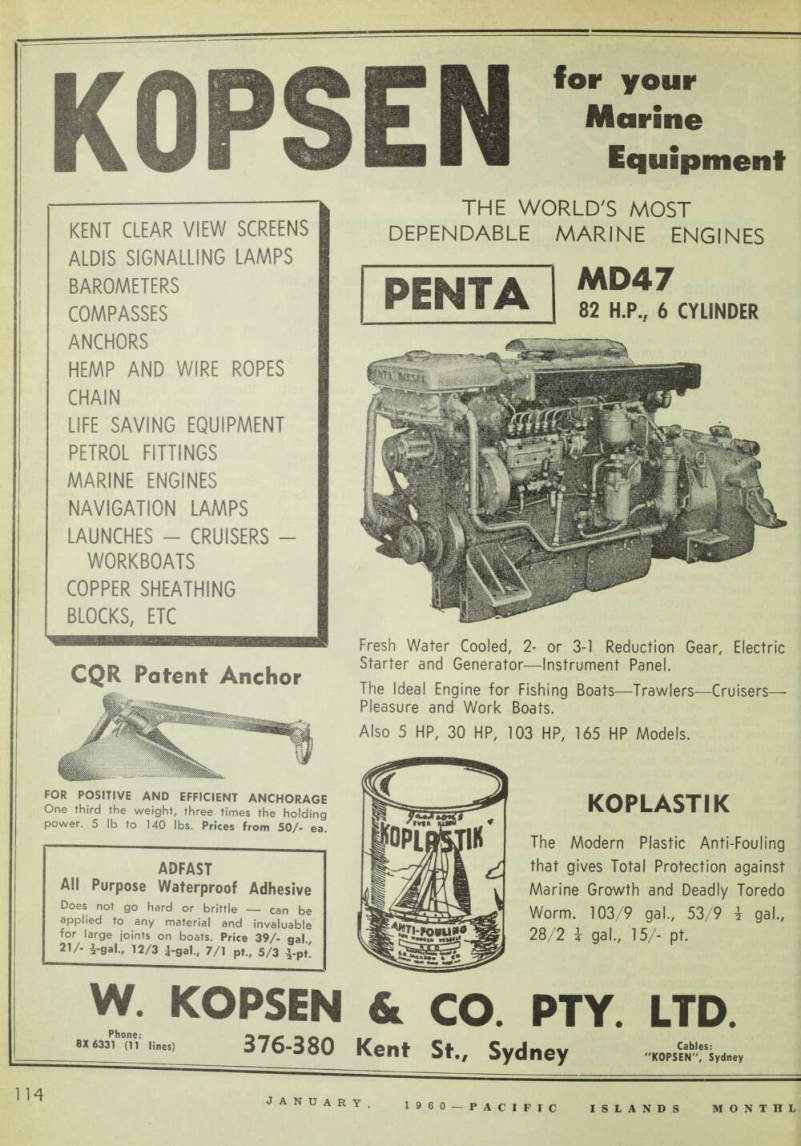
According to the cap tion that came from Pago Pago, this photo graph shows "Dr. Jones, TB specialist with the Samoan Medical Services, barefooted, joining in a siva with one of his nurses during a social evening at the nurses' quarters". That is all very well but "PIM" believes that everyone named Jones should have initials —and we wrote away for the good doc tor's initials some time ago. We still haven't got them. But we can brook no further delay in publishing this de lightful photograph, so Dr. Jones is now minus both initials and shoes. —Pan American Prints.
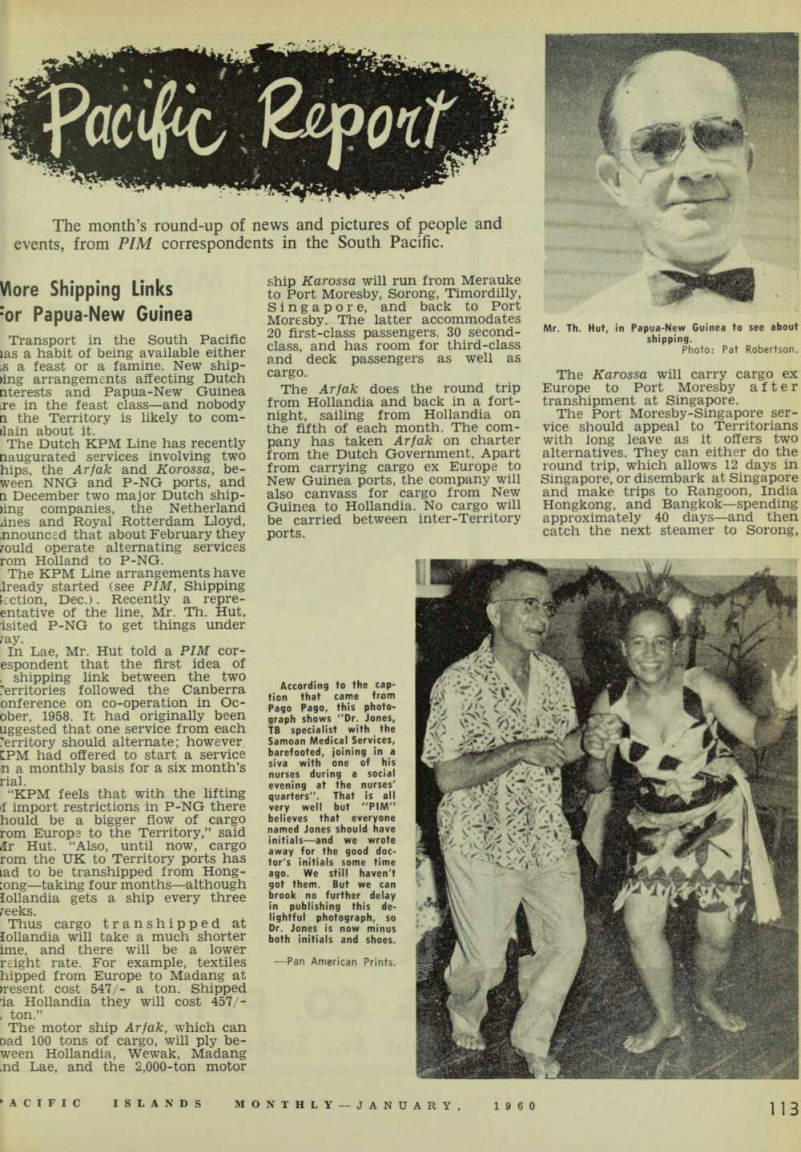
Mr. Th. Hut, in Papua-New Guinea to see about shipping.
Photo: Pat Robertson.
Dutch New Guinea, picking up urossa there. The same facilities >e offered passengers from Port loresby to Europe and return by urossa, that are already offered issengers via Hollandia, i.e., single ire with reduction of 30 per cent.
Mr. Hut, who has been with the :-mpany since 1939, pointed out at KPM ships were not strangers old-time Territorians, who would call that before the war a number them called regularly at Port oresby from Singapore these ;re the Maetsuycker and Van Rees.
The company, which operated in idonesia prior to 1957, owned the 31l known ocean liners Nieuw olland and Nieuw Zeeland, now ms Johan von Oldenbarnevelt, illem Ruys, and Oranje, a tanker jet, and has interest in a line inning between Europe and the madian Lakes.
It was Mr. Hut’s first visit to the jrritory.
The official announcement in De mber on the other services said: “Starting early next year, two ajor Dutch shipping companies, e Netherland Lines and the Royal Dtterdam Lloyd, will operate an ternating service from Europe he Netherlands) to P-NG.
“It will be a nine-weekly service, id from Europe the ships will call Hollandia before going to Rabaul, le and Port Moresby. The call at adang will be optional.
“From the Territory, ships will it return to Hollandia but will ,ss on, alternatively, via the lilippines and Indonesia, to trope.
“The ships will be 10,000 tonners, id will have air-conditioned commodation for 12 passengers, le first sailing date from Holland scheduled for February, 1960. No ;ures are yet available for freight sts and passenger fares.”
Z Warning to
lands Firms
Islands firms who advertise in ;w Zealand newspapers are likely be doing less business in future.
In recent months the NZ Customs jpartment has issued two warn gs to people in New Zealand who irchase transistor radios and nilar items from Western Samoa, ji, and other Islands areas.
The Customs Regulations allow private individual to import for s own personal and private use ods not exceeding £lO in value, parcel post, but only where the ndors of those goods have not licited for business in New Zea ad.
If it can be shown that the vendors ive advertised such goods in New ialand, or sought business in any her way, the goods can be seized Dods associated with any business,
for example, parts for machinery, are also not permitted. The regulation is intended only to permit the duty-free entry of bona fide gifts. A person wishing to import other goods must apply to the Customs Department for an import licence — and at present he has very little chance of obtaining one for nonessential goods.
Several hundred transistor radios seized by the Customs under these restrictions and in other circumstances were sold by auction in Auckland in December at prices ranging from about £lO to £l6. The police were called to control the huge crowd that attended the auction.
SnrnP Npw Hpbridps
JOme licW neunutJb
PhnorhatP Snnn
rHOSpnaie 300 H
Definite progress is being made towards the exploitation of phos phate deposits on the east coast of Efate Island, New Hebrides, at Forari.
The big Compagnie Francaise des Phosphates de I’Oceanie, which operates the workings on Makatea Island, French Polynesia, has been showing an active interest in the Forari deposit for some years past, Recently the managing director of that company, Mr. Lamotte dTncamps, visited the area. He said that a contract had now been
awarded to Compagnie Industrie! de Travaux (CITRA) for the coi struction of a loading jetty, ar that work on it would commence : December. Equipment and materia arrived on the site in Octobe Certain negotiations regarding tl company’s exploitation of the d posit were completed satisfactori by Mr. d’lncamps with the Britk and French Resident Commissione across the island at the capita Vila.
Progress In All
Directions in Cl's
Things are happening in all dire< tions in the Cooks. Gone now a the days when a client at the movi in Rarotonga might be asked by tl happy vahine in the next seat ■ hold onto a set of wet naps for minute while she fits out the bat in a new set. They’ve just broug] in a law barring children und< three from entering. It’s believe that young children often pick i infections in movie houses.
Progress towards self-governmei is also bringing some surprises : new taxes. The Island Council, no responsible for certain public work has to raise funds somehow. IS longer is all of it coming from Ne Zealand. A tax of £1 has just bee placed on every new bicycle sold and there are many bicycles c Rarotonga’s flat perimeter roa That has been followed by a ne road improvement tax of 10/- pi annum per head on all males b( tween the ages of 18 and 60.
Now on the stocks is a licensir scheme for traders. Up to now, you wanted to go into business yc hung out your sign. Soon it will I necessary to apply to a committe which, if it grants a licence, wi extract an annual fee.
Between passing or considerir these new means of gathering taxe the councillors found time in Nc vember to raise their pay from £‘ per annum to £5O, and to arrang that they also receive £1 each tin they had to attend a meeting ( any special committee set up 1 look into any particular problem
First Shots In The
Fares War
Duncan Sandys, British Ministf of Aviation, told the House c Commons, in December, that tb Government had given its approvi of BOAC’s policy of cutting ai fares.
He said that new aircraft on orde by BOAC and BEA would carr about 50 per cent, more passenger; and being faster would be able t accomplish more flights in quicke time. To make economic use of thes aircraft, a larger increase in ai traffic was essential.
“I am convinced that the only ay to do this is by boldly cutting >wn fares. Experience has shown lat a reduction in fares quickly tracts new passengers,” said Mr. indys.
What Mr. Sandys had to say will ive an impact on the South Pacific r entually. He was opening an air le fare war.
The last lATA traffic conference ; Honolulu concluded without aching agreement on fares on a insiderable number of the world’s r routes. This was largely due to OAC”s’ insistence on the introduc on of economy fares, a measure hich did not meet with general jproval.
“After carefully considering this hole matter I have decided to uthorise BOAC to introduce :onomy fares on the cabotage >utes to West Indies, Africa and ie Far East. These fares will vary jtween 10 per cent, and 20 per >nt. below existing tourist fares,” lid Mr. Sandys.
Because of BOAC’s stand at onolulu the fares to be charged on number of international routes aring the new year beginning pril 1, have yet to be fixed. lATA ad decided that the traffic confer ice—which alone can agree on ires—would not meet again until lere was a reasonable chance of yreement.
Now BOAC may be able to modify s demands since it has got its ay on cabotage (overseas pos jssions and dependencies) routes.
[?] NGAN HONOUR. Mr. T. Mather, of Auckland, [?] o has had much to do with Tongan visitors New Zealand in the last 10 years, recently [?] de a six months visit to the Kingdom him self and came away loud in his praise of its [?] spitality and friendship. "A lovely Queen, [?] ely people and lovely islands," he said. He [?] o came away with this taovala, and a Tongan title name of "Mauo".
Perhaps lATA will convene anotl traffic conference in order to res agreement on the internatio] routes which have been the subi of dispute.
BOAC is a leading protagonist lower fares on these routes and, the News Chronicle said in a rec( leading article, “it is not throu want of trying that only now, a only on a few routes to Colon territories, BOAC is to be alloy; to cut its fares. There is ho however, that this is the thin ed of the wedge. . .
“The routes on which the cuts s to be made do not come within t jurisdiction of lATA. But this bo could do well to take the hi: Britain’s principal airlines are qu powerful enough to go it alone cuts continue to be resisted. So s those of several other countri The rest would be wise to gi ground.”
Are The Peasants Sifting
On £2O Notes?
To prevent hoarding the F Government intends to call in i £2O notes over the next two yea The Financial Secretary, Mr.
R. Bevington, speaking during t Budget session of the Legislati Council, recently, outlined 11 situation.
Mr. Bevington said that the were about a £1 million worth £2O notes hoarded away somewhe —the total circulation of the notes amounted to £1,730,000, b the number in possession of ban on a recent check amounted value to only £494,000.
A great proportion of tho hoarded were believed to be in t] possession of peasant farmers possibly to the value of £1,200,00( All £2O notes now coming in banks will be withdrawn and £ notes issued to replace them, people want them.
In a year’s time it should 1 possible to see how many we actually being hoarded. If : million was being so hoarde £25,000 a year was being lost the owners in interest at savini bank rates.
Depending upon the number ( notes received during the ne: year, the Government may the announce that £2O notes are to I formally withdrawn and that the cease to be legal tender after tt end of 1961. Before then a publicil campaign will be launched 1 encourage the hoarders to put the: money to work or in the safety e banks.
“I hope all members will do a in their power to ensure ths farmers and others do not thin that Government is going to tak or nullify their savings,” said M: Bevington, “The reverse is the casi We are trying to safeguard an increase their savings.”
ladi "Will Not
e Overshadowed"
Nadi Airport has a tremendous iture and there was absolutely no istification for pessimism in some uarters that some other airport light take its place as the aerial rossroads of the Pacific, said Mr. . R. Rae, chairman of the South acific Air Transport Council in is address to the Council at its sth annual conference in New ealand in December.
Mr. Rae did not say so but it lay by assumed that he was herring to suggestions that Tafuna .irport, still being built in Ameri an Samoa, might steal Nadi’s aunder, or alternatively that 'ahiti’s new international airport light make inroads on Nadi rans-Pacific traffic.
Quake Damage, Skull Houses
)n Solomons Expedition
After completing three months in ae Western Solomon Islands as jader of an expedition to explore tie virtually unknown interiors of ae large islands in the New Georgia Iroup, Dr. Dick Stanton, of the Iniversity of New England, Armi ale, returned to Sydney recently.
He was assisted in the expedition y Dr. David Bell, a newly appointed
geologist in the Solomons, and about 30 islanders, some of whom had been with Dr. Stanton in the course of his two previous expeditions to the Solomons, in 1951 and 1956.
Working on the small launch Noula, much ground was covered, but it is understood that further work is needed to complete the undertaking. Towards the end of his work the old Miena (the ship on the 6d Solomon Islands stamp) was also brought into service. This work is to be continued by Dr. Bell.
The party had some interesting moments in the field, experiencing minor aftershocks of the August earthquake, and at one stage negotiating on foot from south to north the island of Vella Lavella, whose centre had been shattered
and vast areas of the jungle canopy thrown down into the gorges from the mountain tops.
Dr. Stanton described dangerous landslides of 1,500 feet and more, which it was necessary for them to climb.
He said that he had never seen anything like the shattered rock core of the central mountain Tu’umbuo. The surface effects' there had been very great, but the area was quite unpopulated, and there were no casualties.
The rivers must have been blocked for a while by a confused mass of shattered timber, rock and soil, but they had quickly cut their way through and were still depositing large quantities of sediment in the sea, which was stained brown for
[?]OWING THEIR OWN. How's that for a bunch [?]bananas! Perhaps not quite up to Islands [?]ndard, but these are growing in the garden the Ellis family in Auckland. Ron and Esther [?]rand-children of Mr. Bertie Leyden of Vavau) [?]ep a close eye on progress. Mr. Les Ellis, [?]rmerly of Tonga, brought some plants back [?]m Tahiti and planted them in March, 1957.
"PIM's" roundsman in December helped to eat [?]me sizeable and fully ripe fruit from the palms!
If a mile offshore near Parasa, on 2 north coast of Vella Lavella. rhe Islanders reported that the ck mudflows which followed the lin earthquakes smothered all uarine life.
Dn another occasion, while the rty was nosing into the mangrove amps of western New Georgia, jy came across partly sunken panese ships and barges almost rered by vegetation.
Vlany other relics of the war were icovered. The most conspicuous re piles of beer cans and Coca la bottles. rhe expedition was enlivened ten members of the party tripped er somnolent crocodiles, on one
occasion killing a 12-ft long monster with improvised spears and stones, in a mild scramble that lasted half an hour.
The central parts of these islands are rarely penetrated by Europeans, and the party were surprised by the number of places sacred to the heathen that they discovered. It is probable that these places have never before been seen by Europeans.
Skull houses, ancient graves con taining shell money, old walls, terraces and village sites were located in many places, particularly on Vella Lavella, Vangunu and Simbo.
Interesting material awaits the study of archaeologists.
Prince Tungi on
Extensive Tour
Tonga’s Prime Minister, Prince Tungi, is at present on an extensive business tour. He is expected back at Nukualofa late in January.
Prince Tungi left Nukualofa on November 23, travelling per Hifofua to Pago Pago. From there he flew to Honolulu by Trans Ocean Air lines to represent Tonga at Hawaii’s Admission Day celebrations which extended from November 26 to No vember 29 and marked the occasion of Hawaii becoming the 50th State of the United States.
From Honolulu, Prince Tungi was to fly to Manila via Wake and Guam, and after a week at Manila he was to fly on to Bangkok and Colombo. His schedule called for six days at Colombo.
He was then to leave by Comet jet airliner for Kuala Lumpur and Singapore, thence to Hongkong, where he was to spend Christmas.
Prince Tungi was to leave there on December 27 for Tokyo and from there would proceed to Ise on the Inland Sea to inspect progress on the new tuna longliner Teiko, which was launched in mid-November and is now fitting out.
From Japan, Prince Tungi will again fly to Honolulu and then to Nadi and Suva, from where he will return to Nukualofa.
Prince Tungi is believed to be discussing various agricultural, pro duce marketing, and purchasing matters along the route, and there are rumours that he is also making inquiries regarding the construction of another larger ship for the Tonga overseas trade.
[?]SENTATION. In Suva in December the captain the "Arcadia" Capt. G. A. Wild, received [?]n Lady Liku, a tanoa (carved kava bowl) [?]ch Lady Liku presented to the ship to mark [?]appreciation and that of the Fijian people the care given to her husband, Ratu Sir [?] Sukuna just before his death in the [?]cadia" while on his way to England in 1958. [?]M. W. Leivers and Sister P. L. Bissell, the [?]eon and nursing sister who attended him [?]le he was ill, watch the presentation. The [?]around Lady Liku's waist is known as a [?]ala, symbol of mourning to the Lauan people of Fiji. —Rob Wright.
>w High Chieftainess
>r Aitutaki
In day-long ceremonies, chants, il d celebrations in November, mrukura Tungarangi Ariki was wated to the rank of High deftainess of Aitutaki Island, in e Cooks.
Fhe coronation ceremony, in the cient native rite, was performed Taunga Monga, senior native test. Later a Christian service was nducted by Pastor Samuela of the IS Church.
as It Another
>st Explosion?
k sudden and complete radio le-out was recorded at Rarotonga 7.10 a.m., on November 30 (1840 tfT, November 30) and lasted for out half an hour.
Recalling the complete and pro iged radio fade-out experienced the Cook Islands when the aericans carried out their high ;itude nuclear bomb tests on igust 1 and August 11, 1958, near hnston Island, radio men at Raro iga were speculating whether other test shot had been fired or tether the fade-out was the re- It of a sun spot or solar flare. ie short duration of the fade t this time suggested it might ve been a natural cause.
ir the Card Collectors—
lother D-Xpedition
American radio “hams” in De tnber were planning another of eir DX (that means “long stance” in radio lingo) expedi n to far-away places. This time e target area is New Zealand’s ikelau atolls, where no indigen s “ham” exists. identifying letters are allocated to ery country in the world by the ternational Telecommunications ireau in Switzerland with the reement of the member countries, ie “ham’s” constant aim is to ike contact with as many of these untries as possible, and to obtain and display on the wall a rification card for every one of e separate prefix-letter areas, hen even two “hams” make con ct for the first time they ex ange cards.
In recent years American “hams” ive financed expeditions to many lall, isolated territories where ere are no “hams”.
There, with the permission of the sal authorities, the expedition embers set up shop with portable uipment for a few hours, days, or seks, and make contact with as any overseas stations as possible,
and especially the stations which have helped with their dollars to finance the expedition.
Eventually cards are printed bearing the call-sign allocated to the station by the local administration, and those cards are sent out to all who were lucky enough to make contact.
Apparently, however, the New Zealand authorities insisted that a British “ham” would have to be included, and that the license would actually be in his name. This was OK by the Americans, but the problem was to find a British “ham” nearby who could spare the time Finally, Mr. Peter Alexander, of Vatukoula, Fiji, arranged to make the trip. He and Mrs. Alexander,
together with Dr H W. Meredith and his wife, sailed from Suva for the Tokelaus on December 29 by the chartered Maroro. It will be a busy week for them, after they set up their radio gear—they plan to make contact with about 10,000 “hams” throughput the world dur inS that short time. 7 , , Early last year a New Zealand “ham” did a DXpedition to Tonga for the benefit of the card collectors,
New School At
Palmerston Is.
A new school was completed at Palmerston Island in late November, the labour being provided by the local people from materials sup-
iied by the Cook Islands Admin tration and delivered by the onald schooner Tiare Taporo.
Most of the Island’s older build igs of European type were con ructed from, lumber washed up on le atoll from past shipwrecks, and om the timbers of such ships lemselves.
Much of the Island’s furniture has distinctive 19th century nautical avour about it,
ig Trimming of Fiji
Government Expenditure
Savings in many Government de artments are recommended by an conomies Committee which looked ito staffing and methods recently.
Under the scheme there would be substantial reduction of Public rorks Department manpower—from bout 3,400 to about 2,000 direct nployees.
This would be achieved by letting 11 major Government works to out de contractors, who would pre imably absorb a good deal if not 11 of the staff which would be pro ressively eased out of Government jrvice over a period of five years r more.
The PWD would continue to Derate certain Government services
like water supplies, and would do maintenance work on its own mechanical equipment, but by reducing its functions there would be a major reduction in stores held in reserve and in the staff necessary to onerate that section There will be a good deal of doubling up of jobs or down grading of certain jobs in other Goveminent departments, especially the medical department in the administrative and field sections.
Certain vacancies in the Establishment will not be re-filled, and certain salary scales will be reduced as ttie existing office holders retire or are transferred. There will be
some “streamlining” to make up for reductions in staff Female employees jjm not be happy to learn that it is rfttom mended that unmarried females should work the same hours as males, and that eventually the con cession to married females whereby they start half an hour late in the mornings, should also be withdrawn, . There will be no general increase in working hours- it was pointed out that th e i"e could be a reduction in staff if office hours for Government employees were ex tended by half an hour The pos sibility of staggering the lunch hour will be considered. (Over)
[?]ME SAVING. This refinement for sun louvres [?]uld be of value in the South Pacific. It has [?]en successfully developed in South Australia [?]Wunderlich Ltd. The louvres in the photo graph are in Adelaide's new satellite town of [?]zabeth, installed along the whole 161-ft. front the General Motors-Holden plant, and they [?]ver need adjusting. A photo-electric cell [?]erates the louvres in shutting out the sun's [?]ys right throughout the day. The whole [?]ocess is automatic, but a pushbutton control [?]can be used to over-ride the electric brain.
A suggestion that undoubte< will appeal to the females is tl the telephone be used more obviate the time wasted in writi unnecessary letters.
All recommendations have yet be approved by the Legislature.
GEIC Labour For
Santo Fishery?
Some Gilbertese may be employ the South Pacific Fishing < (N®) ktd. tuna fishing b£ at Palekula, Espiritu Santo folia mg a recent visit of inspection a a similar British-Japanese tu fishing company might later established in the Gilberts.
Tebati Teeta, of Kuria Islai and Kalwanati Tebano, of Aroi Island journeyed to Palekula in t fishing company’s refrigerat cargo vessel Santo Maru to vi the working conditions there.
There has been no stateme from the GEIC Government but is understood that the idea Gilberts labour going to Palekr is to train them for similar dut back home, in the event of sat factory arrangements being reach regarding the financing of a tu fishing base in the GEIC . p ago Pago has shown that the is no doubt that such a base cor be a valuable money earner through taxation—for a territory restricted resources like the GEI
Fiji Banana Legislation
To Be Re-Written
A . bill to establish a Banai Marketing Board in Fiji, which w to be presented at the Decemb session of Legco, is being wit] drawn and re-written.
A Government statement sa that 15 amendments had bei agreed upon and it would thereto be simpler now to re-write the bi The bill did not come into fori on January 1, as originally planne After the bill has been passe the Board members will have be selected. They will then probab have a number of meetings • decide on regulations to be mat under the new ordinance. The will then be submitted to tl Governor for his approval, afb which the Board will invite applies tions from persons who wish i become licensed suppliers—the sa overseas will be entirely in i\ hands of the Board.
All this is expected to take mar months.
Changes to the original bi (reviewed in PIM, September, ] 63), include a new definition of “supplier”. A grower may no longt necessarily be a supplier. Only th person delivering directly to th Board will come under th; definition.
Some of the powers of search c inspectors have also been reduce(
hey will no longer be allowed to ivade private residences in the ;ad of night in search of sub andard bananas or packing cases, heir activities will be confined to icking sheds.
Another important alteration is lat where suppliers were, under le original bill, to receive full lyment upon shipment, they will jw receive only a down payment itil all the shipping costs are ilculated —presumably a week or
yo after shipment.
olonial Development Fund
ssistance for Cathay
A remark by the Governor, Sir enneth Maddocks, in his opening idress to the Fiji Legislative ssembly in November to the effect lat the Colonial Development orporation was already participa on with Cathay Hotels (Fiji) Ltd. i the development of additional otels in the Colony was the cause : some surprise.
This appears to have been the rst news of any such participa on.
Sir Percy McNeice, Cathay’s lairman of directors in Fiji con rmed to the Fiji Times that Ivice had been received in October lat the company’s application for nancial aid had been accepted on le basis of a loan with the option f acquiring shares in Cathay iter.
Sir Percy did not reveal the mount of the loan.
Other interests in Fiji also in vested in building new hotels jem to have been taken by surprise rat such funds might have been vailable to them. From comment lade later in the Legislative buncil debates it appeared the orporation would be unlikely to stend similar financial assistance ) other hotel companies at this incture, as they will be operating d some extent in competition with iathay in which it has now com litted funds.
Emergency Voyage
To Chatham IS.
The officers and men of NZ Island Territories Department’s MV Maui Pomare sacrificed most of their normal Christmas-New Year leave in Auckland this year to make a special school children’s voyage to the Chatham Islands.
Because a RNZAF Sunderland flying-boat struck an uncharted reef in the only sheltered landing area in the Chathams in November, and because constant bad weather had prevented a re-s urvey of the
Waitangi lagoon by a party since Sent out, a flight with 20 children due to return home from schools in New Zealand had to be cancelled.
The land airstrip was considered unserviceable.
Maui Pomare, which arrived in Auckland from the Cook Islands on December 22 was the only suitable vessel available for the job. She was hastily discharged and was despatched on December 26, the children being sent by rail from south to join her.
The children thus missed their Christmas at home, but would have most of the school holidays there.
[?]REWELL. Popular Lae couple Mr. and Mrs. [?]J. Coolhaas are back in Sydney again—"gone [?]ish" after four years in the Territory, where [?]. Coolhaas was Regional Hydrographer with [?] Commonwealth Department of Works, Lae. [?]s. Coolhaas was well known for the interest she took in local kindergarten work.
etrol Caused a
iji Explosion
“Sorry, no petrol,” the signs said ; most of Suva’s petrol bowsers on ecember 9. The reason was a strike 300 petrol workers in the Colony a strike which touched off the ggest civil explosion in Fiji’s story. Here is the log of events: October 24. Wholesale and Re -11 General Workers’ Union opened jgotiations for increase of basic ly rate from £3/0/6 to £4/15/-, and r proportionate increases of other ,tes, payment of overtime, and rtain other improvements in con tions, retrospective to October 24. ibour Department was advised of jgotiations, which continued •©radically into December.
Final offer from oil company em oyers was for increase of basic ,te to £3/10/- as from January 1, 60, and for negotiation of other aims in February.
December 7. Negotiations broke >wn.
Some 250-300 oil company em oyees at Suva, Nadi and Vuda Dint come out on strike. Union jcretary James Anthony addresses rikers and other workers at Walu ay industrial area. Bus drivers id some taxi drivers strike in mpathy.
December 8. Government state ent condemns strikers for failure make full use of negotiating achinery. Rush on petrol bowsers t private motorists, remaining ,xis.
December 9. Oil companies’ tankers, corted by police, deliver petrol to tree Suva bowser stations. Some inor incidents in intimidation by rikers.
In afternoon, Secretary Anthony prevented by the police from idressing strikers and big crowd
of public unable to obtain bus trans port home from work. Police throw smoke bombs into crowd after it fails to quickly disperse. Some re taliate with stones.
Vandals join in wanton destruc tion of windows. Stone throwers continue activities through night, aided in eluding police squads by destruction of street lights 1 .
Official union statement rejects Government statement charges.
Some 300 casual workers at Millers and BP’s, in Lautoka, strike in sympathy, but no violence there.
December 10. Fiji Legislative Council, which had been in session, met and adjourned, voting sub stantially for no discussion of the strike or riots at this time. More stone-throwing and damage to the main Suva business houses in the morning, as Legco dispersed. Gov ernor announces Safety Regulations, including 7 p.m.-5 a.m. curfew at Suva-Lautoka-Nadi. Outdoor gather ings of more than three persons liable to be dispersed. Army Terri torials and police reserves called up.
In the afternoon, Mr. B. D.
Lakshman, MLC, at a public meet ing at Albert Park prior to the im position of the Safety Regulations, extracts a promise for the continu ance of essential services and for restraint from further violence from a crowd of about 3,000.
December 11. Worker buses resume skeleton service by union agreement.
Some biscuit company men come out on sympathy strike, but factory was already idle. Some further minor damage, apparently by vandals not connected with strike. Court hearings of arrested persons com mence, first at Suva gaol as a matter of convenience.
December 12. Fijian chiefs —members of Legco—address Fijians at open-air meeting, calling for re straint and condemning destruction by Fijians.
December 15. Interim strike settle ment announced.
December 18. Windows smashed in Millers store, at Lautoka, when union secretary Anthony is refused permission by police to address unionists at an open-air meeting.
Curfew, which had been eased slightly, was reimposed at Lautoka.
Governor announces total damage in the Colony assessed at about £20,000. Private estimate is about £14,000.
December 20. Curfew totally lifted throughout Colony.
December 21. Hotel bars reopened for normal 10 a.m. to 10 p.m. hours.
December 24. Governor announces appointment of Commission of In quiry into riots at Suva, to com mence its work late January fol lowing completion of arbitration proceedings between union and em ployers.
—Rob Wright.
Fiji Had Seen Nothing
Like It Before
The reasons for the Suva riots— and there are many of them—will be argued for a long time yet, but the actual occurrences of the three days from December 9 are the events which will remain in the minds of Suva residents of all races. Fiji had seen nothing like it before since Cakobau ceded the islands to Queen Victoria in 1874 Events had moved slowly early in the day of December 9—th|e third day of the oil workers’ strike.
The Government that day de cided to deliver petrol from the depots to the petrol bowsers, under armed guard.
First reaction was a lighting strike by taxi drivers. They then went to the Suva bus station in Rodwell Rd., pulled the bus drivers out on strike by devious means — threats, cajoling and appeals to “workers’ loyalty”.
With the transport system now suddenly paralysed, thousands of Suva workers moved towards the bus station after knocking-off time.
The police earlier had sent out a riot squad to that area. Mobile police patrolled Rodwell Rd. for its full length.
The riot squad was soon in action. It broke up a procession of placard-carrying strikers (mainly taxi drivers) at the corner of Prince’s and Margaret Streets.
Large crowds watched this brief episode.
With no means of getting home, stranded workers moved from the bus station to a vacant allotment at the end of Rodwell Rd., just opposite the Phoenix Theatre, where Mr. James Anthony, secretary of the Retail and Wholesale General Workers’ Union was to address the striking oil workers.
As a big crowd gathered, and spilled on to Rodwell Rd., mobile and riot squad police took up posi tions nearby. Mr. Anthony’s arrival caused a stir.
The police, a few minutes earlier, had announced twice over a loud speaker from a Landrover that there would be no meeting. They gave an indication there would be trouble when they asked all women and children to leave. They then refused Mr. Anthony permission to address his meeting.
The riot squad, with perfect dis cipline, under Assistant Superin tendent L. W. Allen-MeUph, and armed with batons as big as pick handles, carrying wrist shields, and wearing; steel helmets, stood in Rodwell Rd. facing the crowd All wore respirators. The crowd had now grown to something like 5 000 or 6,000.
A policeman now hurled a smoke gas bomb into the crowd. There was
Members of the po[?] riot squad, with s[?] helmets, shields [?] batons, await m[?] trouble in a Suva m[?] street. Shop at re[?] Stinsons, owned by Mayor of Suva, [?] badly damaged [?] looted in the rioting.
With petrol rationed and hundreds of cars queueing up, police (right) take over some Suva petrol pumps. Be low, crowds watch cars queue at a service station in Rodwell Road, markets and bus ter minus of Suva, and main trouble spot during the riots. —Rob Wright.
;lld scatter as they tried to avoid smarting smoke. ■unning in all directions, they a melted away to a safe distance. en-Mersh, at the head of his :ad, and with a rearguard of six ijmen, marched along Rodwell lome of the crowd, angry at nt had happened, began to throw les at the police, who carried on liinchingly. llen-Mersh halted hi s squad i or three times during the rch and stood facing the crowd, st of whom were still apparently dldered by what had happened, opposite the bus station the ad came to its final halt, where Indian MLC made an appeal calm, and said that an Indian ncillor would arrange trans t for them. .t odd intervals people in the wd continued to throw stones at police, and one of them, istant Superintendent Eric Smith
[?]n leader Ratu G. T. Cakobau, after the main [?]ng, addresses a crowd gathered in Albert to listen to a union leader. He and other [?]n chiefs who spoke asked the crowd to re member Fiji's good name.
Crowds above flee
from police during
the first day's dis turbance in Rodwell Road. Suva stores soon barricaded their windows (right) against stone throw ing. The size of the stones can be seen along the kerb at left.
Top photo: D. L.
Low, others Rob Wright.
10 was in plain clothes and tak photographs) was hit on the j of the head. inally, exasperated by the stones, police threw more smoke bombs I again the crowd withdrew idly to a safe distance.
Tie crowd jeered some passing torists and stoned a petrol ker (which should never have n allowed into the area). The wd also jeered and booed the ice.
Tie big crowd slowly came to iler again, mainly in the bus fcion. ncidents were now occurring ularly. Several of the riot squad ised a man into a lorry park, and en he surrendered and was lost surrounded another riot ad policeman charged into him full gallop. ’he crowd was by this time be riing incensed, and the hail of nes became thicker. The police tin retaliated with their smoke nbs, although what they were empting was not apparent. /Ir. Anthony drove past during quiet moment and the crowd, ►tting him, followed his taxi to i vacant lot where he had planned speak. The riot squad police piled 0 a special bus and followed.
This time the police wasted no le. They broadcast a quick warn : to the crowd to disperse and in began to heave their smoke nbs again, in all directions, even bystanders on high ground, who re not interfering.
There was no escape from the oke, which was cruel to the eyes d harsh on the throat.
The crowd, now thoroughly roused, )lied with stones from a safe tance. The riot squad was ever ick to form up, and now ready go into action with their batons, ich they had not used up till m.
IThe hooligan element in the >wd then started on its trail of itruction.
With most police at one end of dwell Rd. they raced into Robert -1 Rd., between the new Car iter Building and Burns Philp.
Grabbing any ammunition they could they began throwing it at all exposed glass.
Carpenter’s had earlier taken the precaution of battening all plate glass windows on the ground floor, but the upper storey windows were exposed to the mob’s fury. It was a mystery where the stones came from, for the area all round the two buildings is paved. In fact the appearance of stones during the two days was a mystery, unless the crowd picked them up in the un paved portion of land between Rod well Rd. and Harris St.
Several people, wise after the event, claimed they had heard stories that taxis had been taking
them to the area earlier that day.
The hooligan element continued its destruction around Rod well Rd. after dark, having smashed all street lights to make it easier.
That night the Government did nothing to prepare for possible future violence. On Thursday morn ing groups of hooligans—arrogant and noisy—walked exultantly along the streets, with not a policeman in sight.
The Government had not arranged to meet until noon to approve emergency regulations, although it was apparent to many people in Suva that the urgent need was to break up the small groups early.
By noon there had been real trouble, with more window smash ing, with European cars, and Euro peans stoned.
One photographic store which had its window smashed had all its photographic equipment dragged out and broken up on the pave ment. The main stone throwers and looters were little boys and girls, principally Fijian, but some Indian —with Indian adults and some Fijians shouting in approval.
“The scar of those few hours,” said one man later, “will take a lot of healing.”
News got around that Mr.
Anthony would talk in Albert Park in the afternoon, and the mob began to stream down to the waterfront, throwing stones at windows as they Went. (Over)
Late in the afternoon the emer ency were announc but at the public meeting Mr. B. : Lakshman, Indian MLC, spoke. I said that all the violence had stop.
“And they did it,” reported i onlooker. “They walked home aga like lambs”
The main part of Suva w like a ghost town that night. The was peace, if little sleep.
Next day the same little grou began to form and some people we worried. A popular view was that the police had had their men the streets jollying the crowd alon London Bobby style, keeping the moving, better control would ha been had. But the police appear* to operate as a kind of mobi force directed from headquarters trouble spots.
But despite the small grou* events remained fairly quiet in tl streets. During the morning, M Anthony decided to let the bus run in the mornings and evenings Mr. Lakshman tried to introdui a motion into the Legislative Com cil, asking for an inquiry into tl police action in throwing smol bombs on the first day. The Go-' ernment closed the session on gag motion —a move that won it r friends.
Said a correspondent, “The Goi ernment showed no sense of urgent at any time during the rioting an came out of it badly. The polit were both active and well discipline but they appeared to adopt an ai titude of war rather than of keej ing the peace”.
Ixtensive Aid"
omised N. Caledonia
Extensive aid has been promised New Caledonia in various forms, e French High Commissioner for b Pacific, Mr. Pechoux, said in lumea in December, on his return )m a visit to Paris, where he had conference with Mr. Jacques ustelle, Minister in Charge of r erseas Territories.
Vtr. Pechoux said the Vietnamese estion had nearly been resolved, d he was confident that word iuld arrive soon that would settle Fhis statement was received with eat satisfaction in New Caledonia iere people for years have been itating to have the Vietnamese patriated to their homeland.
r. Hasluck In P-NG:
Friendly Ending
kfter a touchy beginning peppered th strong public criticism, the jcember tour of Papua-New linea by the Australian Minister : Territories, Mr. Paul Hasluck, ded on a fairly friendly footing.
Public leaders (including some onymous ones in the Adminis ati o n itself) criticised Mr. isluck’s early conduct of the tour, t later admitted that “some ing appeared to have been hieved”.
The tour lasted a fortnight, and vered Rabaul, Port Moresby, Lae, ivieng, Madang, Popondetta, and e Highlands. It was for “fact iding”, and to meet as many ople as possible.
But things got off to a bad start len Mr. Hasluck accused reporters persecution tactics at interviews Port Moresby and Rabaul. In e latter interview he showed a swspaper reporter to the door on e grounds that the reporter’s
;tions were cheeky and imper nt. :ie questions (without the vers, which were never given) later published. General ic opinion was that the itions were in the most part ./ant, and should have rated at :b some sort of answer, lis incident added fuel to the .ngs of some people in Rabaul Port Moresby that Mr. Hasluck side-stepping issues of impor ;e to the Territory, and that he doing too much listening with enough answering. /en before he had left Rabaul ral days later, however, there a swing in feeling. Much of swing was attributed to a ight from the shoulder talk 2h Mr. Hasluck gave to members Rabaul Chamber of Commerce, r. J. K. Dowling said after the ting: “This was the third major itation to Mr. Hasluck with Dh I have been associated in past three days.
Ve were disappointed with the . two, but this one was a beauty, came straight out and told us e of the real problems which and his administration are ng.
Vhen he does something like and we can see some of the ters from his point of view we in a much better position to erstand the whole picture.
Ve only wish he would come and talk this way more often id more publicly, if possible.” iter, on the New Guinea Main l Mr. Hasluck followed a very ely-organised itinerary which : him into contact with Ad istration and private people ■ a wide area. bst people said that they had id their talks with Mr. Hasluck rful, and that he had offered issist in a number of matters, ne of the most hectic meetings the tour was at Minj, in the igi Valley, a pioneer district re the residents are mainly iters, most of whom are vocal ments of Canberra policy, peakers at that meeting didn’t ler to mince words and for vhile it was heated, but it stened down when the Minister 3 as good as he got. Some ikers said they wanted real •esentation in the Legislative ncil not “the comic opera” slature they had. There was bund insecurity, and private iative, either by native or Euro 1, was regarded as an chronism. t. Hasluck made it quite clear : he is willing to listen to any ig reasonable, but he wanted s and figures and not abuse, bst people left Mr. Hasluck’s tilands meetings satisfied that 7 had heard something, but a hlands correspondent later re :ed: “There has been a reaction
here. People seem to have decided that the Minister’s policy was, ‘I am going to let you complain, and now that you have complained and I’ve heard it, you can shut up in future’. Time will tell. Perhaps the trouble is that there is not enough of these official visits—not enough opportunities to complain to the people who matter”.
The correspondent added that Highlands people who heard Mr.
Hasluck gave him full credit for his insistence on facts and figures, chapter and verse. Generalities didn’t matter to him.
Mr. Hasluck wound up his tour in Port Moresby—from where he had started—and the results of his visit were generally well received there.
Matters discussed throughout the Territory tour covered all possible subjects. Among the most prominent were roac j programmes, taxation, parallel development of all racial communities, primary production problems and requirements, travel facilities, education, radio broad casting policy, hospital develop ment, naturalisation of mixed race people, opening of new land for
rural development, financial ass tance for rural or indust]
development, shipping facilities
cargo, public service proble: constitution of Territory Gove ment.
Generally speaking Mr. Hash made no direct answer to i request put to him, but he t< details of circumstances and formation for later inquiry.
Some of the most significant marks he made during the b were: • As long as the Austral Government continues to prov two-thirds of the Territo] finance, the Commonwealth Par] ment will not relinquish the rij to have final voice in the Territc • Let there be no mistake ab the fact that the Legislative Coui of the Territory is specifics constituted to give a majority vc to the official government memb Precedence for this type of legis tive arrangement has been est! lished in British systems, and being retained because of necessity in a territory of the t; of Papua-New Guinea. • People at Port Moresby £ Rabaul can have local munici government if they really want If a sufficiently strong mass me ing asks for it, the government i be glad to sit down and talk over. • As Minister for Territories, ] Hasluck personally takes full £ final responsibility for administ tion of the Territory, but he is ] prepared to enter into pul inquisitions concerning pe o p responsible to him for that s ministration. • The Commonwealth Gove: ment has made a specific rep and decision regarding natural! tion of mixed race people, 1 details of the decision cannot disclosed as they are at presi before the Australian Departrm of Immigration which is the fi: authority in a matter of t nature. • If at any time a resident the Territory feels that he is g ting less than justice he is entit to write direct to Mr. Hasluck, approach him personally, and case will receive consideration.
An overall summary of the o come of the tour and the questk
icussed was given by Mr. Hasluck a broadcast speech shortly before returned to Australia. The tin points he made were: • The people of Australia as a pulation provided the guarantee security in New Guinea rather an did the Government. • The taxation system was not changeable or fixed, but was oject to adjustment as needs and iditions warranted. • In any case, the tax question d not loomed as large during the ir as might have been expected. » It was important that the >ple and the Administration Duld establish confidence between 3h other. Good government re ired an efficient, public service, t it also required co-operation by 3 citizen. » The white man’s future in w Guinea lies in the attitude it the native takes in 20, 30, or more years ahead. Therefore 3 white man’s relations with the tive today will in effect determine ; place in the future.
ought Still
rious In N. Caledonia
'Tew Caledonia’s drought re dned unbroken at the end of cember. The east coast had icived some good rains but the st coast, centre of the cattle tions, was still badly in need of battle in the north were dying i rivers drying up. >ome old identities said the mght was the worst they had Dwn. rhe once beautiful Yate Lake, med by the construction of the te Dam, is now more than half pty, and once submerged vege ion and dead trees make a iful spectacle. bridge, which was submerged ;h the filling of the lake and ,de necessary the construction of miles of deviation road, has v come to light again.
ocodile Shooter
ows Them How
n the first case of its kind iching the Territory of New inea, the High Court of Australia
in December upheld the appeal of a man who had been charged and convicted of having entered the Territory illegally.
In addition to upholding the appeal, the court quashed the conviction and awarded all costs against the Crown.
The man is 40-year-old New Zealand crocodile shooter Hewton (Ossie) Amess whose legal victory created a wave of interest throughout the Territory and capped one of the strangest stories the Territory has known in recent years. (PIM June, p. 143).
The story goes back to March, 1959, when Amess arrived in the Territory at Buin in his small motor vessel Vega, and with a native crew of one.
He carried a passport which was
stamped at Buin, after which he came on to Rabaul. Following a series of official investigations and messages between the administra tions of the British Solomons and New Guinea, Amess was charged with having illegally entered the Territory.
He appeared without legal repre sentation in Rabaul District Court and admitted that he did not have an entry permit. The court sentenced him to two months gaol on the charge, Amess decided to appeal on the grounds that as master of his own vessel he did not require an entry permit so long as his passport and other papers were in order, Meanwhile a wave of public support swung out to Amess who was confined to Rabaul Harbour
pending the hearing of his appeal and was thus unabll to earn money by shooting crocodiles.
Several private citizens and the RSL distress fund at Rabaul gave him financial help, and Mr. Dudley Jones of Rabaul, took the brief for Amess.
The appeal was heard before the High Court of Papua-New Guinea and was dismissed. Amess decided to take the case further, and it was listed for the High Court of Australia sitting in Sydney.
While waiting for the outcome of the second appeal, Amess arranged for his wife Suzanne to come from Brisbane to Rabaul, but at the last moment immigration officials prevented her coming. Later she was
able to arrange a ten-day temporary permit to visit her husband, and she went to Rabaul in November. . ..
Shortly before Christmas the High Court unanimously upheld the appeal, quashed the conviction, and took the unusual course of ordering all costs in both appeals against the Crown, It was a happy day for Amess— but he was not the first to learn of his victory because neither his barrister Mr. Jones nor the RSL which had helped him could find him for some hours, The news was finally brought to Amess by PI M’s representative at Rabaul.
Amess threw his hands in the air
and said: “This is the grea thing I have heard in nine mont In the bar of the Retui Servicemen’s Club a notice scrawled on a blackboard: “C Amess wins his appeal backed your local sub-branch. All c against Crown”.
Amess who drinks mai: lemonade—was in later to th the members of the club and : branch for what they had d The president of the sub-bra: Mr. L. M. Henry, asked him h to Christmas dinner, but Ar said he had been a tie on community too long.
He said: “I can’t thank you enough for what you have d The best thing I can do nov get out and earn some money guess I will spend Christmas a the crocodiles”.
And he did, too. Four days be Christmas, MV Vega clej Rabaul Harbour with Amess at wheel—and with a local na crew.
“I don’t know when I will back,” Amess said, “But it wil] when I am carrying as many si as possible. It might take a weeks, it might take longer, bu will be some day.”
Hotel Encouragement
Plan In Tahiti
Tahiti’s Assembly has just ] posed a plan to exempt from tj for a period of 10 years all hotel construction with a minin of 50 rooms. This is to encoui French and foreign capital.
Also being studied is a plar grade hotels, from the deluxe d< to the fourth class. At prei tariffs are high in Tahiti, and standard of comfort not good.
They Swallowed Up
Their Old Building
On December 23, 1949, a grou] ex-servicemen with the Pacific only four years behind them ope a Returned Servicemen’s Club ir old tin shed (ex-army) at Rab And on December 23, 1959years later to the day — the sj club officially opened the J section of its big new premises the same site as the old build The first building, which shipped from New Ireland, di( cost much (“but we can’t remi ber the actual figure off hand’ committee member said), but new building has already cost ir than £lO,OO0 —and there is a more to come.
And perhaps one of the stranj parts of the whole story is t the old building is already sta ing—inside the new one.
The old building will eventu be dismantled piece by piece “i whipped out the back door of new one”, as one member put neatly.
At present it is being allowed to ind undisturbed in a yet-to-be 'eloped section of the new build , but the billiard table inside it •still in use.
The new building is of pre dicated steel. Sections already med include the main bar and • lounge, a kitchen, store, and vice sections. Later additions 1 bring in a general lounge, liard room, main hall, and ac nmodation facilities.
The opening ceremony was a big :asion attended by nearly 500 mbers, associate members, wives d guests. Members assembled the bar in the old building and *n filed into the new bar lounge, . by the president of the club, Stan Weston, and the presi lt of the Rabaul RSL sub inch, Mr. L. M. Henry, rhe opening was performed by a uor member of both organisa ns, Major E. V. (Wally) Smythe, .0 has also turned the first sod earth for the new building, dr. Smythe spoke of the history the club and the way in which had developed.
Phe first drinks over the new r were served by three founda n members of the club, Mr. M.
Foley, Mr. W. Dupe, and Mr.
Flynn.
Tribute was paid to the members the committee for the big ume of voluntary work which d resulted in the building of the v club, and also to the club mager, Mr. Jeff Stone, who had rked outside his normal duties bring the project to success.
AL Electras
Dm February 1
TEAL’s new Electra turbine ipellor aircraft were to replace ; old DC6 aircraft on the ckland-Nadi and trans-Tasman vices from February 1. As eady announced, the Electras I take over from the Solent ing-boat on the Coral Route to hiti in the middle of the year.
The DC6’s will be stored at lenuapai, Auckland, pending ;ir disposal.
i's Biggest Land
lal Completed
The transfer of Colonial Sugar fining Company land in the wa Valley of Fiji to the Fiji ivernment in exchange for other id elsewhere in Viti Levu became ective on January 1. Some 77 >cks of land of from five to seven res have now been leased by the ji Government to ex-CSR iployees at £1 per acre per annum, rhe land transfer was the result the CSR decision not to replace s old Nausori cane mill, first CSR II to be established in Fiji, which s reached the end of its useful e, and to concentrate its sugar
production in the drier areas where the sugar content of the cane is higher.
Pacific Unaffected by
France's New Franc
On January 4, 1960, the new French “heavy” franc became fully official in France—bank notes now circulating bear in red the overprint of their value in the new francs.
For example, a 5,000 franc note now is marked “50 new francs”.
However, French Pacific Terri tories will not be affected by the change. Their currency is the Pacific franc (called the CPF) and the same notes and coins will con tinue to circulate in New Caledonia,
New Hebrides, and Fr. Polynesia as heretofore. No changes in the price of merchandise coming from France are expected.
The CPF franc, 18 of which hitherto equalled 100 Metropolitan francs, will keep its parity; for con version purposes now, the value of the CPF franc will be 0.055 heavy francs.
Cathay Hotel for Lautoka
Cathay Hotels (Fiji) Ltd., owners of the GPH, Suva, were given a con ditional licence for their proposed £lOO,OOO hotel at Lautoka, on De cember 24. Northern Hotels Ltd., owners of the present Lautoka Hotel, were refused a licence for a second hotel there in November.