The Month's New Reading
pp. 86-97 · Read in the full issue
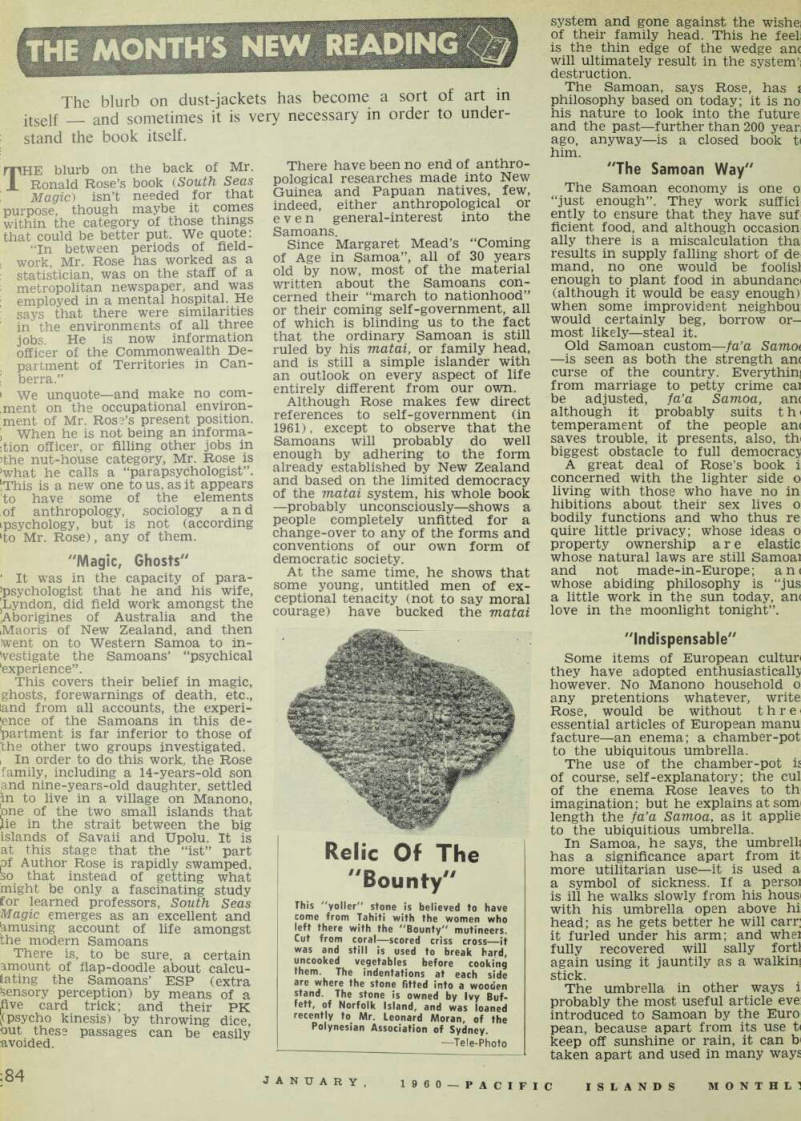
The blurb on dust-jackets has become a sort of art in itself and sometimes it is very necessary in order to under stand the book itself.
THE blurb on the back of Mr.
Ronald Rose’s book ( South Seas Magic) isn’t needed for that purpose, though maybe it comes within the category of those things that could be better put. We quote: "In between periods of field work, Mr. Rose has worked as a statistician, was on the staff of a metropolitan newspaper, and was employed in a mental hospital. He says that there were similarities in the environments of all three jobs. He is now information officer of the Commonwealth De partment of Territories in Can
? berra.”
i We unquote—and make no com .ment on the occupational environ ment of Mr. Ross’s present position. ; When he is not being an informa tion officer, or filling other jobs in the nut-house category, Mr. Rose is >what he calls a “parapsychologist”. ‘This is a new one to us, as it appears to have some of the elements of anthropology, sociology and [psychology, but is not (according ‘to Mr. Rose), any of them.
"Magic, Ghosts"
' It was in the capacity of para psychologist that he and his wife, 'Lyndon, did field work amongst the Aborigines of Australia and the Maoris of New Zealand, and then Went on to Western Samoa to in vestigate the Samoans’ “psychical 'experience”.
This covers their belief in magic, ghosts, forewarnings of death, etc., land from all accounts, the experi ence of the Samoans in this de partment is far inferior to those of the other two groups investigated. , In order to do this work, the Rose family, including a 14-years-old son and nine-years-old daughter, settled in to live in a village on Manono, 'one of the two small islands that lie in the strait between the big islands of Savaii and Upolu. It is at this stage that the “ist” part pf Author Rose is rapidly swamped, so that instead of getting what might be only a fascinating study for learned professors, South Seas Magic emerges as an excellent and kmusing account of life amongst the modern Samoans There is, to be sure, a certain amount of flap-doodle about calcu lating the Samoans’ ESP (extra sensory perception) by means of a pve card trick; and their PK Ipsycho kinesis) by throwing dice, but these passages can be easily avoided.
There have been no end of anthro pological researches made into New Guinea and Papuan natives, few, indeed, either anthropological or even general-interest Into the Samoans.
Since Margaret Mead’s “Coming of Age in Samoa”, all of 30 years old by now, most of the material written about the Samoans con cerned their “march to nationhood” or their coming self-government, all of which is blinding us to the fact that the ordinary Samoan is still ruled by his matai, or family head, and is still a simple islander with an outlook on every aspect of life entirely different from our own.
Although Rose makes few direct references to self-government (in 1961), except to observe that the Samoans will probably do well enough by adhering to the form already established by New Zealand and based on the limited democracy of the matai system, his whole book —probably unconsciously—shows a people completely unfitted for a change-over to any of the forms and conventions of our own form of democratic society.
At the same time, he shows that some young, untitled men of ex ceptional tenacity (not to say moral courage) have bucked the matai
system and gone against the wishe; of their family head. This he feeli is the thin edge of the wedge anc will ultimately result in the system’; destruction.
The Samoan, says Rose, has j philosophy based on today; it is no his nature to look into the future and the past—further than 200 year; ago, anyway—is a closed book t( him.
"The Samoan Way"
The Samoan economy is one o: “just enough”. They work suffici ently to ensure that they have suf ficient food, and although occasion ally there is a miscalculation tha results in supply falling short of de mand, no one would be foolisl enough to plant food in abundanci (although it would be easy enough) when some improvident neighbou; would certainly beg, borrow or most likely—steal it.
Old Samoan custom — fa’a Samoi —is seen as both the strength anc curse of the country. Everythin! from marriage to petty crime cai be adjusted, fa’a Samoa, anc although it probably suits th < temperament of the people anc saves trouble, it presents, also, th< biggest obstacle to full democracy A great deal of Rose’s book i concerned with the lighter side o living with those who have no in hibitions about their sex lives o bodily functions and who thus re quire little privacy; whose ideas o property ownership are elastic whose natural laws are still Samoai and not made-in-Europe; anc whose abiding philosophy is “jus a little work in the sun today, anc love in the moonlight tonight”.
"Indispensable"
Some items of European culture they have adopted enthusiastically however. No Manono household o any pretentions whatever, write Rose, would be without thre essential articles of European manu facture —an enema; a chamber-pot to the übiquitous umbrella.
The use of the chamber-pot is of course, self-explanatory; the cul of the enema Rose leaves to th imagination; but he explains at sonr length the fa’a Samoa, as it applie to the übiquitious umbrella.
In Samoa, he says, the umbrelk has a significance apart from it more utilitarian use—it is used a a symbol of sickness. If a persoi is ill he walks slowly from his housi with his umbrella open above hi head; as he gets better he will carr; it furled under his arm; and whei fully recovered will sally fortl again using it jauntily as a walkin* stick The umbrella in other ways i probably the most useful article eve: introduced to Samoan by the Euro pean, because apart from its use t< keep off sunshine or rain, it can b< taken apart and used in many ways
The cloth with the centre cut out used by women as a loose blouse sat can be easily tossed aside for ieedom of movement —umbrella nuses are still frequently seen on lanono, and others are deliberately it to the same pattern. The stick the umbrella can be used by defs and orators to indicate their iportance; and the ribs can be ounted on a suitable pole and to ; used as a fish spear. If the uropean has given the Samoan othing else, it has provided him ith a whole department store in le shape of one brolly.
The Rose family spent six months i Manoro where no other Euro
;an had lived permanently
>r 60 years. Few anthro-
Dlogical (or parapsychological) ex
3ditions include a whole family nit, and it can be imagined that lis one was not without its trials nd its shocks, but out of the gold sh bowl existence that they led, lere has emerged an engaging ;udy of a semi-sophisticated native eople. (SOUTH SEAS MAGIC. Published by ,obert Hale, Ltd. Our copy from Hicks, mith and Sons, Sydney. Australian price, 2/6.)
rish Journey, With
lenty of B and G
rJSH novelist and playwright Walter Macken explains the reasons for his latest book Seek he Fair Land thus: “In a period of the lives of my wn people, I saw a time in the eventeenth century when the rish were living the history of all teoples. This was the dark night >f the Irish soul, and it was to ast a long time as Cromwellian ►rutality, persecution and the well mown satellites and camp ollowers of conquerors, famine, lisease and pestilence, fell upon he Irish. These were not really mportant. What was important vas that the ordinary people, some (f them, managed to survive them ill and pass on their own ndomitable courage, hope, and aith to their children, who would n turn dig in their heels and urvive until the sun shone again md the waves of terror had ibbed.”
Well and good, but the message icems to have been lost among the )lood and guts.
Seek the Fair Land tells the story )f how one family escapes from the nassacre of Drogheda and flees icross Ireland to an uneasy peace n Connacht. The journey takes some years and there are many ;rials and tribulations on the way, md even when the party arrives ,n the fair land there are more ;rials and tribulations ahead.
Along the way, the English bash )ut the brains of babies against ioorposts, rape and mutilate every female within cooee, pack the
children off as slaves to the cane fields, draw-and-quarter odd bods here and there, strangle a few others, and burn one leading character at the stake after dragging him behind a horse. (You get the details in technicolour).
All this rather indicates that the English of the day were baddies, which is quite right. But where Mr. Macken seems to get off the beam is that he makes out that all the poor Irish and their hunted priests were just too good for this sort of persecution. He gives them twentieth century minds in a seventeenth century slice of history.
But since he still leaves the English with the witchburning outlook which was common to all in the seventeenth century, his history
of the Irish working classes comes out a little lop-sided. The reader, ends with the impression that Mr.
Macken is still personally a little bit mad at the English.
If you overlook this and read the novel as an adventure story it’s good stuff —providing, of course, you have the right kind of stomach. (SEEK THE FAIR LAND. Published by Macmillan. Australian price, 20/-.)
he Know-How—But Not The
,ang —Of The Surf
THERE are no better surfing beaches anywhere in the Pacific than those along the 12,000-mile •astline of Australia, and there is ) sport in Australia that has more stive participants than that of irfing.
Along the hundreds of sandy »aches that line the east coast of le continent (the zone which sup irts the greatest part of Aus alia’s 10 million population) surf ig is probably even more than a >ort. It is a regular habit, like go ig to church or to school, or buy ig the groceries. Whole families ike to the surf.
Every year a number of surfers rown nearly always at quiet caches not patrolled by some of le 17,000 young men who now make p the voluntary membership of le Surf Life Saving Association of ustralia. But the patrols have sscued 110,000 others from the surf nee they have been operating.
This popularity of surfing in Aus ■alia is a comparatively modern evelopment. For many years after le coming of the white man, the caches near Sydney—which to ly are the greatest mecca of the irfers—were used only as tracks ► the north and south of the settle lent.
Gradually, men began to explore le joys of sea bathing, until the rudery of the Victorian era pro uced edicts to prevent them. No srson, said one ordinance, could ithe in waters exposed to public ew from 6 a.m. to 8 p.m. Hardy mis who still persisted in their anton excesses were thus compelled > rise with the birds.
Despite the lack of official en mragement, swimmers not only mtinued to surf but to try their ;rength and skill. Tommy Tanna, South Sea islander employed as a ardener’s boy at Manly, near ydney, was first to amaze onlookers y his habit of throwing himself a a wave, and then hurtling >wards the beach with it. Local irfers were quick to acquire this bility to “body shoot”, and soon it as being practised by other illegal vimmers on other beaches —illegal ecause the surfers were now surf ig outside the prescribed hours.
Gradually the restricting ordin nce became difficult to police, and s end came with a memorable act f defiance. On September 1, 1902, le editor of a Manly newspaper, 7. H. Gocher, announced in his ewspaper that he intended to a the publicly outside the permitted ours.
The following Sunday, at noon, he athed at Manly’s now famous cean beach. No official action was iken —despite the wide public in erest in the case.
Gocher continued to bathe un molested again and again on Sun days, and others quickly realised that the freedom of the beaches was ensured —as it was from then on.
John Bloomfield, a former Aus tralian surf champion who is now a sports master at Maitland High School, NSW, takes a closer look at the Australian surf in Know-how In The Surf, which is described as being the “first book in history to combine an ABC for the surfing be ginner and an invaluable aid for the expert”.
This it might well be—we can’t recall any other book with the con tents of this one, nor can we recall more than one other book on the Australian surf, despite the popu larity of the sport. It is likely for this reason to be a very useful book.
It is not, unfortunately, going to be a book that will live in the minds of men for itself alone. A book on Australian surfing could, we think, be written as some experts can write books on the best of the French wines—books that say a lot more than merely how the wine is produced; books that bring out the very bouquet of the wine; books that
conjure up scenes of the vineyards themselves.
Know-how In The Surf has none of the froth and foam and the salt tang of the Australian beaches. It is an adequate, if pedestrian, account of the technique of identi fying and catching body waves—and of avoiding dumpers; of the tech nique of using boards and skis; of the mechanics of the surf carnival and how best to train yourself to take part in one, or how best to train others.
The book has some excellent photographs and drawings.
(Know-How In The Surf. Angus And
Robertson. Australian price, 25/-.)
When "Cyclone Jack"
Scratched for Tin
THE tally of Australian author lon L. Idriess’ books is now push ing the 40 mark —he has ranged Australia from the inland, the out back and the pearl seas of the north-west to Torres Strait, the Coral Sea and even Papua-New Guinea. In his latest one, The Tin Scratchers, he goes further north from the locale of his last one.
Back O’Cairns, and uses Cooktown and Cape York, the Big Peninsula, as his background of his own per sonal story.
In his early 20’s, Idriess journeyed to Cooktown, lured by gold, but gold was in the jungle country and the aborigines were wild and plentiful—they hadn’t yet met up with the Spanish influenza that all but wiped them out in the Pen insula—so he turned instead to tin mining.
Idriess was writing even in those days, almost half a century ago, and his eagerness to scan through packages of the Sydney Bulletin when they arrived on mail-day cost him his first job on Rossville field.
You couldn’t hunt through the “Red Terror” for your published pars and tend to your windlass and buckets at the same time —leastwise, not while the boss was around.
They nicknamed the dreamy, slow-w ork i n g scribbler “Cyclone Jack”, in biting irony; but, going it alone, he got on to a patch of “flood tin” and won enough from it to get a stake to venture out and discover for himself all he could about the tin-mining business, from fossicking to sluicing.
Idriess spent 11 years up North and his experiences make enter taining reading. Now 69, his memory of the old-timers’ tales still is sharp and his pen has lost little of its cunning, as he reels off endless anecdotes of those now-vanished times and the rugged characters who put colour and vitality into the frontier days of Cooktown’s tin mining area.
But The Tin Scratchers is not only about mining. The great gold
ish of the Palmer River and i e toiling Chinese pack-gangs, niggling the 100 miles of ambush Dm Cooktown base; the North leensland sandalwood trade and i King, Hughie Giblet; the luggers id links with New Guinea (such Jimmy the Larrikin, who found t. Hartley tin field but left it for 3w Guinea’s gold—only to be abbed, cooked and eaten by NG vages)—all are fascinatingly re eated. (THE TIN SCRATCHERS. Published by igus and Robertson, Ltd. Australian Ice, 22/6.)
tercule Poirot After
he Pigeons
[THERE must be as many different L ways of writing detective stories as there are people writing stective stories, yet one method is robably most satisfying to the 3al connoisseur of crime fiction, hat’s the method which goes to re trouble of putting all the clues i the text, so that the crime lover ither (a) beats the author to the >lution by a page-and-a-half (b) icks himself for not having done D.
Agatha Christie, referred to by er publishers as The Queen of rime (after 61 detective novels le is entitled to be called some ling) is not one of the writers )r connoisseurs—despite her huge Dllowing, and despite the uproar lat statement will no doubt touch [f in some of the more ignorant uarters of the globe.
To put it bluntly, Miss Christie heats. She does not always cheat, ut she cheats enough to deserve greater reputation than she’s got Dr that particular crime.
Nothing can be more galling than d have read happily through a hristie crime, to find on the jcond last page that the murder as committed by somebody the sader has never heard of, in cir iimstances which he could never ave been aware of, since Miss hristie only thought of them her slf at the last moment so she could nish off the book and begin lunch, hat is the impression the crime annoisseur occasionally gets, any ow.
All this is by way of saying that liss Christie’s new murder book, 'at Among the Pigeons, mercifully oes not cheat. Not all the clues are lere, to be sure, and it is doubtful : deduction alone will win the eaders their trophies but at least liss Christie appears to have ifficiently planned her work so as > convince most readers that they aven’t been diddled.
There is some nice characterisa :on, too, particularly of Miss lulstrode, the school teacher who uilds up her school from nothing i its position as one of England’s fading colleges for young ladies.
Murder among the mistresses is
the basis of the book, and Hercule Poirot gets involved in it at the later stages.
(Cat Among The Pigeons. Published
by Collins. Australian price, 15/6.)
The Grand Tour
Brought Up To Date
WHEN Colin Simpson wrote Adam in Ochre and Angus and Robertson Ltd. published it in 1951, they combined to introduce a new standard in Australian book publishing that has continued through Simpson’s other Adam books and is climaxed in his Wake Up In Europe, issued last month.
Lavishly illustrated with 30
colour-plates and over 80 photo graphically perfect black and white pictures, it delights the eye and titillates the travel sense of even the dullest stay-at-home. The author’s wife, Claire Simpson, too, has expertly handled the book’s decorations.
Wake Up In Europe is a five months’ record of the Continent and Britain seen through the perceptive eye of an Australian who has a particularly apt gift for describing places and people exactly as the average Down Under or Islands tourist would see them for the first time.
Simpson travelled by KLM route to Europe, as a Cook’s lIT (In dividual Inclusive Traveller) and he
makes no bones about his frank ad miration for the Man from Cooks and the lIT plan that allows stop overs for as long as you like at any place along the way that takes your fancy. Thus, before he woke up in Europe, he sharpened his pencil on word-pictures by sampling Bangkok (Thailand) and Beirut (Lebanon).
His continental tour took him first to Holland, which the Dutch have unaccountably managed to keep as a picture-postcard country for foreign tourists and at the same time make it modern and progressive (Rotterdam has the largest com mercial building in Europe). Then into Western Germany and down the Rhine, Bavaria and Austria, and on into Italy, via the Brenner No little part of the charm of Simpson’s book is his flair for meet ing up with “interesting” people.
Beginning with Helen, a American chemist, with whom he watched the Rhine castles on the river trip, he glides along the Grand Canal with Peggy Guggenheim, art-collector (and millionairess), who lives in Venice; obligingly turns over his private-bathroom to Janet and Beth, two hitch-hiking Australians, for their first hot soak in three weeks; and lets Geraldine, “in scarlet pants and chartreuse sweater, with a bun cf blonded hair and a figure that can wear a bikini”, show him the rock and roll haunts of Capri. Not to mention half a dozen other as sorted travel-companions who seem to bob up at just the right time.
Italy and Rome get lengthy but interesting treatment, for the book in part is angled to go into the travelling-bag of a large slice of the expected 70,000 Aussies and New Zealanders who will trip off to the 1960 Olympic Games in Rome and then wander for a time in Europe until the budget dries up.
Switzerland (with capital Berne nominated by Simpson as the best kept city on the continent), France and Paris in the spring, Monte Carlo and Nice, fleetingly in Spain—all add their quota. Maybe, it’s to give the red-blooded he-men readers their money’s worth that an all-in de scription of the nudity of the Folies Bergere and the Lido is included.
Incidentally, Simpson isn’t coy about describing the less ritzy areas of the cities he visits there usually is mention, brief or in detail, of the Ladies of the Night and their estab lishments. Maybe his observations have shown him what the after d a r k tourist-on-the-loose is in terested in, at that.
A chapter on Britain covers more than most of what the average traveller has time to take in. Some 2,500 miles of motoring through England, Scotland, and the edge of Wales allowed Simpson to visit and describe with feeling and insight a host of places that remain forever only names in literature and
history to the great majority of Antipodeans.
Flying home, he set down in the two Berlins, and found that going behind the Iron Curtain wasn’t as hard as he’d been led to expect, His chapter comparing bright East Berlin with Big Brother’s West Berlin in both enlightening and thought-provoking, (wake up in Europe. Published by Angus and Robertson Ltd. Australian price, 37/6.)
Netherlands Neighbours
T>lM, in December (p. 20), pubr lished a brief extract from a small book, Our Neighbours In Netherlands New Guinea, by G. T.
Roscoe, which had just been published in Brisbane.
The author is the Papua-New Guinea Director of Education and the book gives an account of a recent trip Mr. Roscoe made to Netherlands New Guinea as part of the exchange of personnel and ideas between the two Territories.
The book gives a direct and clear account of what Mr. Roscoe saw on the other side of the border.
It deals with such matters as health, education, and the native people, and finally it has something very brief to say about the road to self and in respect to some other matters, one feels that perhaps Mr. Roscoe has reserved his comments and opinions more than he should. It would have been interesting to know more of what he felt on the things that he saw.
No doubt, of course, he was conscious of his present position with the P-NG Administration and might not have felt that this was the occasion to speak his mind too freely.
Despite the book’s slim size, and despite this lack of comment, the book is most readable, and anyhow would be worth having for no other reason than that it is the latest authoritative record on the Dutch Territory to have been produced in English by an outside observer. It should be read by anybody interested in New Guinea affairs.
[ (Our Neighbours In Netherlands
NEW GUINEA. Published by Jacaranda Press. Brisbane. Australian price, 8/6.)