In Education
pp. 67-71 · Read in the full issue


The Missions’ Role In Education
I was appointed Director of Education on September 1, 1958, and two weeks later the Minister discussed educational policy with me.
I outlined a plan, already discussed with the Administra tor, for Universal Primary Education and Universal Literacy in English. This was accepted in principle by the Minister.
Later, it was worked out in detail and received his approval in January, 1959.
HE plan recognises the need, as an indispensable condition of “social, economic and political irelopment” for every child of 1001 age to have a school to go rurthermore, if the people of this intry are ever to be united, they ist have a common language; and it cannot be Motu, Kote, Pidgin, lanua, Dobuan, or anything but world language, which means vracy in English.
S. survey of our resources shows it it is quite out of the question establish universal primary acation through Government lools alone. Under the most rourable circumstances circum nces more favourable than we are ely to have —at the end of 10,15 or years we might have 100,000 ildren in Government schools; but ‘ estimated potential school pulation is 400,000—and, thanks the Department of Health, this mber is likely to increase rapidly.
Che only practicable way of pro iing schooling for all is by an ;ension and improvement of ssion schools. fhere are in this country, at the ?sent time, 285 Administration lools and between 600 and 700 gistered or Recognised mission lools. A Registered school is one ich has been approved by a de rtmental inspector as satisfying r requirements of efficiency. A cognised school is one in which effort is being made to reach the ndards desired. itive Teachers—How and Where? 1 part from these Registered and cognised schools there are thous ds of Exempt mission schools, impt from the provisions of the iinance and receiving no Govern nt aid because their teachers are qualified and not competent to ich English even at the lowest el. tfany of th c se Exempt schools are worthy of the name and it is ex mely easy for a patrol officer, or * Area Education Officer, to write >orts about them in scathing ms. rhe essence of my plan is that j Department, instead of wash
ing its hands of the Exempt schools, should endeavour to raise them to an acceptable standard. Thus, un qualified teachers who are not com pletely hopeless, may be given short courses of training which qualify them, not for a Teacher’s Certificate, but for a Permit to Teach. This will not entitle them to receive a financial grant-in-aid, but it will entitle the school to receive an issue of school material.
To enable the Department to organise the in-service training of native teachers, both mission and Administration, and to make pos sible the annual inspection of all Primary schools, the organisation of the Department has been changed.
The Divisions of Native and Non- Native Education have been re placed with the Divisions of Primary and Secondary Education.
The establishment of inspectors and District Education Officers has been increased: and numbers of Area Education Officers have been posted who are not responsible for the management of a single school, but for the in-service training of teachers in a group of schools.
The key to the whole problem is teacher training.
There has been a remarkable im provement in mission schools since the basis of payment of grant-in aid was altered from school enrol ment to staff qualifications.
Since mission candidates have been permitted to sit for depart mental examinations for the award of a Teacher’s Certificate, some 1,200 native teachers have qualified, and are receiving grants-in-aid.
Payments to the missions this financial year are at the rate of £5O
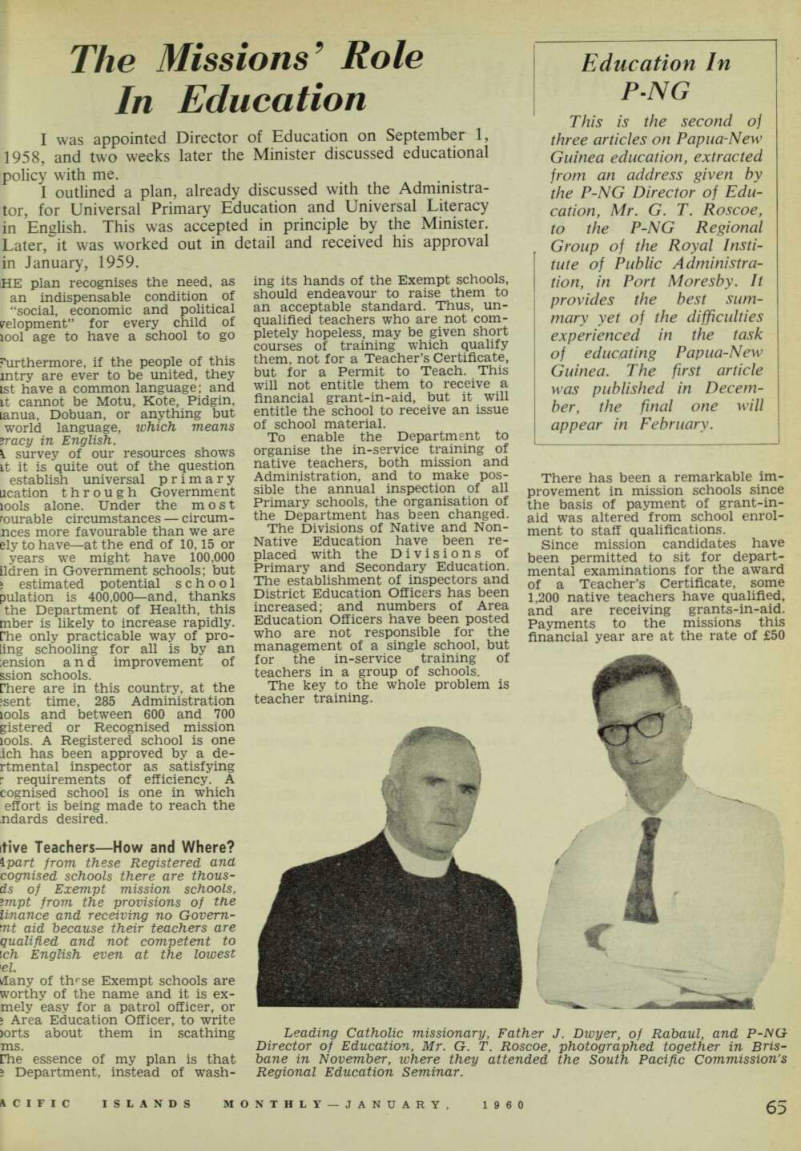
Leading Catholic missionary, Father J. Dwyer, of Rabaul, and P-NG Director of Education, Mr. G. T. Roscoe, photographed together in Bris bane in November, where they attended the South Pacific Commission’s Regional Education Seminar.
r each “A” certificated teacher, £7O r a “B” certificated teacher, and for a “C” certificated teacher, le missions are expected to pay is sum to a teacher as a living owance. While native teacher linees are in residence at teachers’ lieges the mission receives a ant of £3O per annum for their lintenance. rhis year, for the first time, a lintenance grant of £2O per num will be paid in respect of w admissions to Mission Inter jdiate schools. This is in recogni n of the fact that it is from e Intermediate schools the ichers’ colleges obtain candidates : teacher training. [Editor’s Note; There have been terations in some of these figures ice this address was given].
ome Teacher Training Problems
Last year there was a very big jrease in the number of qualified tive teachers; 300 candidates from ssion teachers’ colleges obtained sir Teachers’ Certificates. This ar the number will be consider ly less. [ had hoped to see a progressive pansion of teacher training on b part of the missions—knowing ite well that for every new teacher ailable for posting, 30 more pupils aid be admitted to school. How- Br, I am advised by mission rep sentatives that there are serious ficulties in the way of any great pansion of teacher training, rhere is great wastage at the yer levels. In the poorer mission lools, pupils reach adolescence thout passing beyond Standard 11. the majority of Primary schools, th Administration and mission, my pupils leave at Standard IV, d even of those who reach andard VI, and wish to continue eir education, not many can do so, cause there is only limited accom odation at Intermediate schools.
Boarding schools are costly to ild and the maintenance of the pils cannot be done entirely by e efforts of the pupils themselves.
All boarding schools have food gardens; but if the children grow enough food to feed themselves, their school-work is neglected. If departmental requirements are to be met so far as efficient teaching is concerned, garden produce must be supplemented with bought rations — and this costs money.
The intake to mission teachers’ colleges is limited by the output of Primary and Intermediate schools; but there are additional difficulties in providing suitable buildings for teachers’ colleges, in providing qualified European staff, and in maintaining the trainees. A teacher in training must be fully maintained, and I am assured that this cannot be done for less than £5O per year.
One of the reproaches levelled at the Department of Education by its critics is that native pupils are be ing prepared for white-collar jobs and that few such jobs will be available, ~, , Jobs tor educated Natives This criticism is quit© unfair. The Department does recognise the need for balanced development, and knows quite well that extension of Primary education would be useless if it were not accompanied by com munity development and economic progress.
Prior to 1956, community develop ment was a function of the Depart ment of Education; but in that year it was recognised that the provision of formal schooling for all the
children of this Territory is a big enough responsibility for any iirector. The tasks of community development and economic advance nent were in that year transferred X) the Department of Native Affairs.
Dbviously close liaison must still be naintained with the Department of Education.
The Department of Education nust accept responsibility for vocational training, but the business if vocational placement and the de velopment of industries are jobs vith which the school-master should not be expected to cope.
Something has been achieved in the field of technical education. In deed, we have three fine Technical schools at Idubada, Lae and Mala ;una, which provide vocational training for apprentices and native tradesmen; but this form of tech nical education is not enough. It provides tradesmen to work with,
and for, Europeans, but it takes the trainees away fom their village communities to which they are not likely to return.
Something is needed for primary pupils who do not advance beyond Standard IV before attaining the age of adolescence.
We have started, at Kundiawa (in the Chimbu Sub-district) a Local Government Technical School, in which boys will be trained, not with modern machinery, but in the use of simple hand tools which are likely to be available in the native community. It is hoped that they will not crowd to the townships but will stay among their own people and improve the standard of hous ing, furniture and general comfort.
I would like to see this country covered with a network of such Local Government Technical schools, completing the work of the Native Local Government Primary schools.
I would also like to see a low level course of agricultural training provided in association with the technical training—all this for boys who are not likely to make progress beyond Standard IV, or at any rate Standard VI.
It must be made clear that this Department has no intention what ever of invading the fields of agri cultural extension. Having some ex perience of project clubs in Queens land schools, I know quite well that you cannot improve the agricultural practices of parents by teaching agriculture to the pupils. You can, however, predispose the pupils to favourable reception of agricultural extension work when they them selves are adults.
I have, in fact, submitted to the Minister through the Administrator, a plan for agricultural training in schools; but quite obviously we can not divert much of our attention to this special branch until we are get ting somewhere with Universal literacy in English.
A new Youth Club—the first—has been formed at Aitutaki Island to encourage the performance of traditional songs and dances, aid charities, and to generally bring the young people together. The chair man is Mrs. Maria Henderson, and the secretary Teremoana Tangaroa.
Lae Intermediate School
A sample of what is being done in the field of native education in Papua-New Guinea is this new Intermediate school for native students at Lae, finishing touching to which were being made by workmen in December. The top photo graph shows a dormitory; below it, painters work on a classroom; the third photograph shows a view of the mess hall; and the building at the bottom is part of the teachers' quarters.
There will be about 75 native students when the school opens early this year, but later it will be enlarged.
Photos: Pat Robertson.