They’re Harnessing
pp. 51-53 · Read in the full issue


Underground Steam
A recent announcement that Papua-New Guinea is in vestigating geothermal steam near Rabaul to see if it will be an economic method of supplying electricity, focuses attention on the successful work in that sphere now being done in New Zealand.
UNIQUE generating scheme is L in operation at Wairakei, in the central North Island of NZ, lich will shortly produce 69 000 lowatts from natural steam. This only the first stage of the pro it, and work on a second stage is jll under way to increase output 150,000 kw. A third stage will obably bring output to 250,000 kw, a total cost for the three stages £NZ2I million.
Only One of Kind
Furthermore, the Wairakei steam ild is only one of the areas in e North Island from which ©thermal steam is produced, and has been suggested that there ight eventually be one million lowatts to be tapped. Nobody lows for sure.
The NZ scheme is the only one its kind in the British Common jalth and only the second in the
world on such a large scale. The Italians have already had a half century’s experience in the use of geothermal resources at Larderello, in Tuscany.
Some of the Italian experience is being relied on, but in other ways the NZ undertaking is unique and is developing its own techniques which are likely to be of value else where. Besides providing direct steam power, Wairakei will probably provide the first example of natur ally produced pressurised hot water being put to work to provide steam for generating equipment.
Rabaul Visitors It’s not surprising then that New Zealand’s co-operation was enlisted for the investigation at Rabaul, which was undertaken at the re quest of the Commonwealth De partment of Works.
The two New Zealanders who
visited Rabaul (they were there in the last week in November and re turned to NZ early in December) are widely experienced in this kind of power supply.
They are Mr. A. C. L. Fooks, of the NZ Ministry of Works, Wairakei, and Mr. F. E. Studt, of the NZ De partment of Scientific and In dustrial Research.
Mr. Fooks has had extensive prac tical experience at Wairakei since 1952, when work began in earnest on the task of winning geothermal steam. He has been project engineer there.
Mr. Studt has been intimately as-
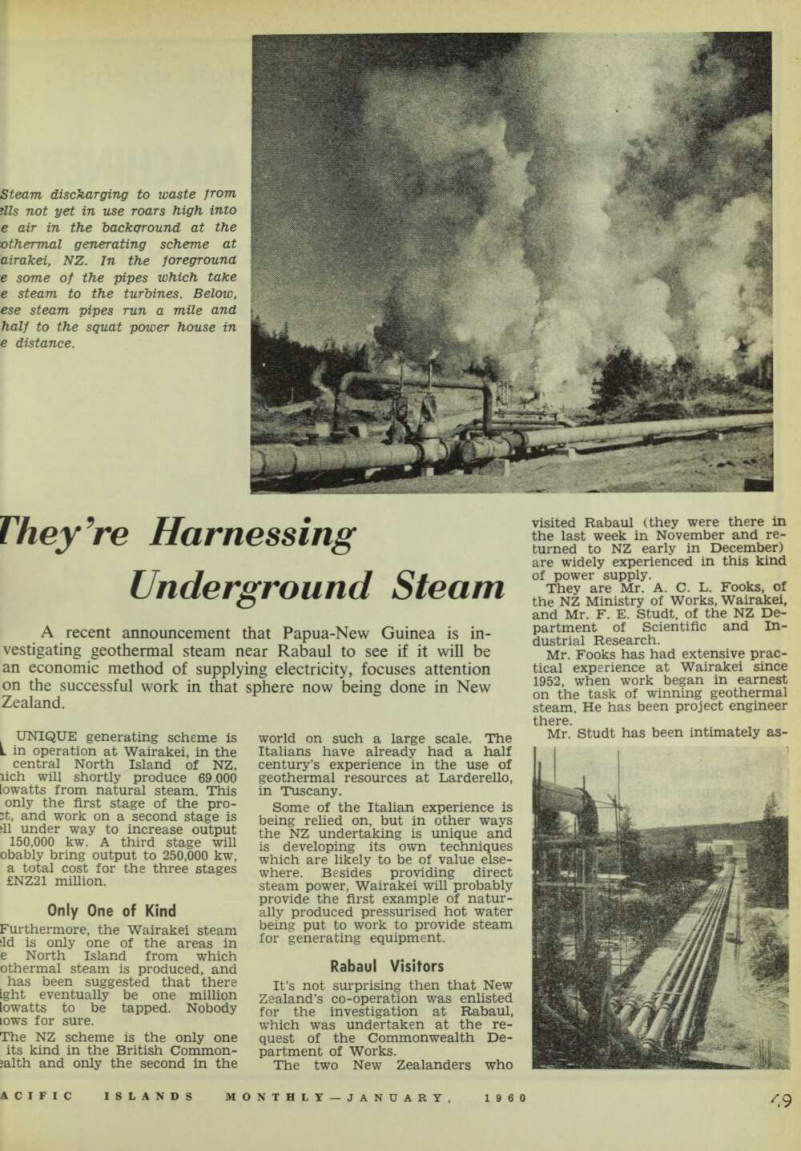
Steam discharging to waste from [?] lls not yet in use roars high into [?] e air in the background at the [?] othermal generating scheme at [?]airakei, NZ. In the foreground [?] e some of the pipes which take [?] e steam to the turbines. Below, [?] ese steam pipes run a mile and [?] half to the squat power house in [?] e distance.
Ir. F. E. Studt and Mr. A. C. L. )ks, who recently visited Rabaul, to investigate the possibilities geothermal steam in that area. iated with successful investiga i work in the Rotorua-Taupo a. He has worked on the Wairakei im fields, and on that field being eloped at Kawerau by the Tas n Pulp and Paper Company.
Tie steam that provides the per at Wairakei is drilled for. lling methods and equipment very much like those used for drilling. Diameter of the pro ;tion casing is usually about eight hes. o far at Wairakei about 70 bores r e been drilled, about 50 of them iable for production. They vary depth from 560 to 4,000 feet, but average is about 2,000 feet.
Loud Noises
’he work could be dangerous hout proper control, but at irakei there have been no fatal s or major injury. When the im or water is tapped there is se of a high intensity, but ncers have been developed to ig this down to bearable levels, Vairakei steam contains about 80 cent, of water with a small con t of chemicals, chiefly sodium oride, silica, potassium salts and taboric acid. lie steam itself is now being put use, but the use of the hot water a’t begin until stage two comes d operation. By stage three, >ut 35 per cent, of the total elec ;ity available will be generated m the steam flashed from this ter. lie water will be separated from steam at the wellhead and piped the powerhouse. ?he dry steam at the present ge comes into the powerhouse ng five main lines of 20-inch mless, insulated steel tubes. The am is admitted to the turbines ect. [lie Wairakei planners are proud their powerhouse, which is more ractive than a conventional verhouse. The building has no okestacks or cooling towers, no ler equipment, fuel or water rification plant.
It’s a square steel building, finished in aluminium and glass, and there has been a lavish use of colour in side and out.
It is also, for obvious reasons in that kind of country, earthquake proof.
The Palmerston Islanders caught 15 turtles during the October- November egg-laying season —and 11 of them were captured by one man, Joseph Dick, according to news from that Cook Islands out post.
They were taken on or near Cook’s Islet on the south side of the atoll.
They Won't Guarantee You
Income tax guarantees are “out” in future, according to a Cook Islands Inland Revenue announce ment. Just what is behind it all is not quite clear.
In the past, provided you could get some one to guarantee your in come tax bill, it was not necessary to pay up on departure from the Group for an overseas trip. Pay ment could be made at the end of the taxation year in the normal way.
In future, every person departing overseas will have to pay right up to date. No guarantees will be accepted.