The Deeper Issues Of
pp. 31-145 · Read in the full issue
Mob Rule Was Only a Minor Part The Deeper Issues Of The Fiji Rioting
From L. G. USHER, Editor and Publisher of “The Fiji Times”
The Suva riots of December were spectacular, but they sprang from deeper causes than any of the surface incidents.
Because they were spectacular, they made headlines in many xmntries.
3 put the disturbances, as such, into proper perspective it is well to remember that Fiji events d to gather about themselves an talanced importance if they occur Suva. ’here may be a hurricane, and ps and houses may be destroyed, if all this takes place in the er islands of the group, in places h names which people outside i have never heard of, the 'ld’s Press does not become iuly agitated. But let Suva be ched, and banner headlines in yspapers and scare superlatives
in news broadcasts mark the occasion.
So it is wise to recall that while gangster mobs were making Suva streets unsafe and destroying Suva property, the rest of Fiji was very little affected. There were strikes at Lautoka and Vuda Point, parallel to that among the oil workers at Suva, and road and inter-island transport was generally upset, but the violence that developed at Suva was not repeated elsewhere.
The mobs that caused the im mediate destruction were of the type that large towns breed, the “dead end kids’’, the slum conditioned youths without roots or civilised standards who are the enemies of the police and the peaceful and more stable sections of the com munity.
It says little for the Government or people of Fiji that such an element has been allowed to grow to such proportions in the Colony’s towns, and especially at Suva, ready to be made use of by unscrupulous people who are no friends of Fiji.
"Deep Concern"
The riots have caused everybody concerned with the future to think earnestly about the reason for this growth, about the conditions under which the gangs have flourished and have taken on a criminal tinge, and about the origins of the racial antagonism that showed on the second day of the rioting.
These are fundamental matters, but there are related questions, concerned with the actual disturb ances of the two days.
The first is—to what extent was the violence planned in advance, and its form organised, either over seas, or in Fiji, or both?
The second, round which the most heated local difference of opinion has arisen, is—was the official action taken prompt, wise, and adequate?
There is nothing unfamiliar about the things you come slap up against when you begin to look at the root causes of the growth of the de linquent gangs. They have been talked about often enough, and a
lot more talk will follow the pub lication of the report of the Burns Commission in a few weeks’ time.
It all comes down in the end to a population that is growing too fast for the number of jobs available, and growing in racial imbalance, to the need for better use of the Colony’s land so as to increase pro duction, and to the urgent need for more capital investment, so that more jobs will be available.
The tragic stupidity of things like the riots is that they could have the effect of discouraging that very investment which is the Colony’s main hope.
On the social side, there are too many people in Suva with not enough to do. They are crowded into tenements for which they have to pay exorbitant rentals, and there is neither discipline nor graciousness in their lives.
No Sense of Belonging The Fijians among them have lost the sense of belonging to a community, and the social discipline (satisfactions) of village life, and nothing has replaced these things.
The central Government and the Fijian administration have failed to recognise, or anyhow to meet, a new situation. There is need —now become urgent—for an organised social and political set-up for Fijians living at Suva, based on the traditional village system, but adapted to the circumstances of crowded urban life.
Much was made in some overseas newspapers about the racial element in the riots.
It is well to get this into per spective, too. On the second morn ing, the stone-throwing and the abuse were undoubtedly directed against Europeans.
Placards and slogans on some — but only some—motor-cars carried
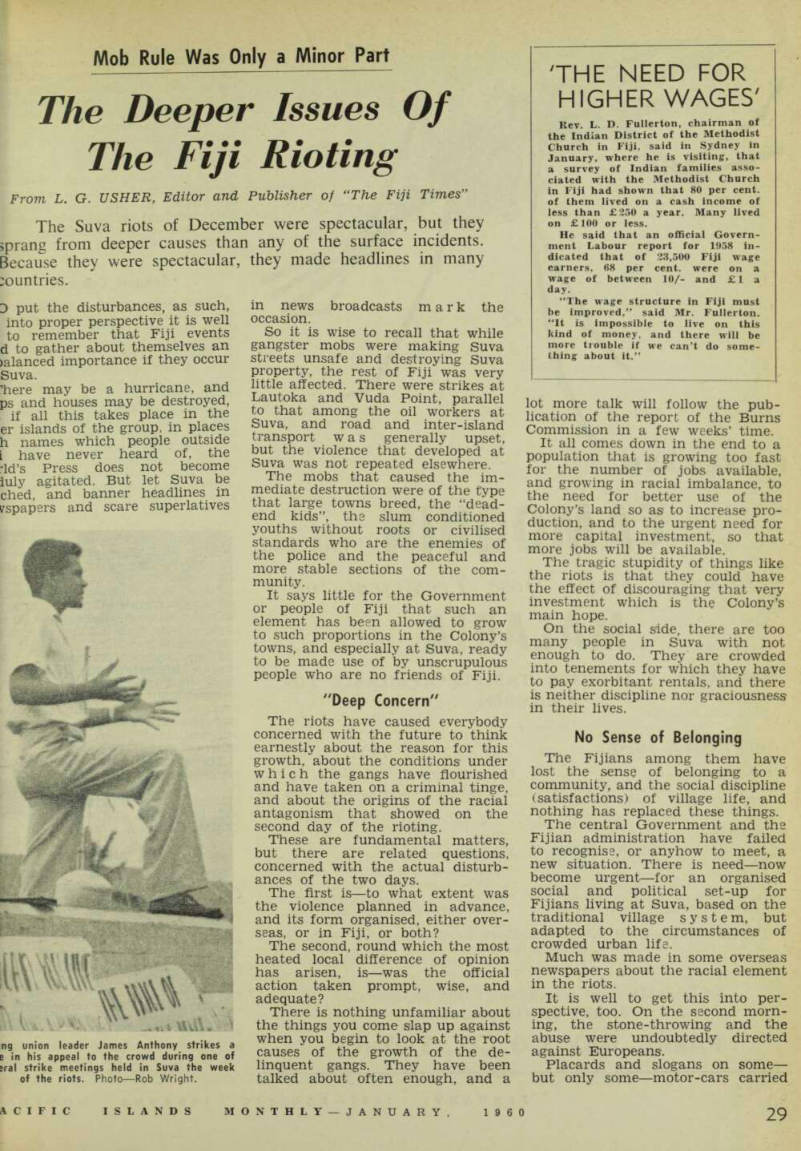
[?] ng union leader James Anthony strikes a [?] e in his appeal to the crowd during one of [?]eral strike meetings held in Suva the week of the riots. Photo —Rob Wright.
crude variations on the “Kill t] white man” theme. Stones we brought in cars from suburbs roads and left in convenient pil or passed out to excited boys ai girls who threw them at the window of European-owned shops, ai laughed with unhealthy joy at t] sound of breaking glass.
But this was during the heig: of the riot, while the mob ruled, ai the spirit that rules in any me anywhere, in any age prevaile Evil men, and evil motives come in their own on such occasions But consider the other side the picture.
Genuine Concern
ITiere were many non-Europea: who offered to drive the cars their European friends through tl danger area, to lessen the possibili of stoning. There were warning born of genuine concern, not to g into the streets where the mob h£ taken over.
Fijian and Indian workers walk( many miles to work each day aft( the bus and taxi drivers—for who no sympathy need be felt < excuses entertained—had sudden taken away public transport.
Christmas Eve and the New Ye* period, which in recent years ha) been marked at Suva by nois drunkenness, and by fighting ar aggressive ill-manners, this yes passed off with peaceful goo humour—a few short weeks aft* the riots.
There is in Fiji, as in all mult: racial communities, a measure ( ill-will between individuals an groups, but it is a long way froi being universal.
There are, unfortunately, in a races, ill-mannered, patronisinj arrogant people. But there are als a great many men and women c good-will, who condemn arroganc and ignorant rudeness wherever ; appears, in their own race or i others.
There is now special need for sue! condemnation, and for a bit c honest self-examination about racia attitudes on the part of all thos who live in Fiji and want to see he prosper in peace and good humoui
Evil Influences
There is a large element of per sonal friendship between the peopl of the various races in Fiji, buil on mutual respect and liking. Tha is the core round which to buil< a good future, and people are say ing so. It is the only way in whicl such a future can be built and Fij is better without anyone who feel otherwise.
What of outside interference?
There seems little doubt that be fore and during the trouble perioc evil influences were at work, making use not only of the criminal gangs
(Continued on page 143)
•se violence produced the head s, but also of personally em ered or ambitious elements in vents followed too closely the :ern made familiar overseas, and •e were too many hints in ad ce that there was “going to trouble” to leave any real doubt t that trouble was engineered encouraged, either from over ; or within Fiji, his is one of the matters which Chief Justice will have to try assess in his inquiries into circumstances surrounding the s. his applies also to the part red by the police, here will be controversy for a I time over the throwing of the i smoke bombs. Whether it was sssary at that stage is at least btful, but the inquiry will give police the chance to state the * from their point of view. here were unnecessarily sensa ial reports in some overseas spapers, but printed comment , in general, fair. The London tes leader on the riots did little
to enhance its reputation for in formed comment.
The point where most overseas journals went astray was in assum ing that this was another example of the demand for political in dependence showing itself in violence born of frustration.
Unreal Interpretation
To put any such interpretation on the Suva disturbances is fan tastically unreal. It is greatly to be hoped that no precipitate “reforms” will be forced on Fiji as a result of pressure—however well-meaning, and whether it comes from official sources or otherwise —from people or groups who do not understand the Fiji situation.
A major failure during the brief crisis was the present administra tion of Fiji. At no stage was there any sense of urgency and the people generally were left with the melancholy feeling, which has been brewing for a long time, that policy makers are out of touch with reality and that from an ivory tower of complacency can be expected neither leadership nor drive.
The Pacific Islands Monthly can well say, “I told you so”, but Fiji would be a much more contented 1 place if editorial predictions had not proved to be so unhappily accurate.