Commentary
pp. 27-28 · Read in the full issue
ositive Action
leeded in Fiji
S Sir Alan Burns indicates in L his London interview with R. W. Robson (p. 17), the Suva its of December are not important themselves, but as a symptom of disease.
The disturbances were the inevit ile outcome of an economy that is it of gear. Fiji has too many people r its resources. This has caused Lemployment, poverty—and with it, scontent.
It is, as another authority in cates elsewhere in this issue, a se of the haves and the have its.
The vital question, of course, is lat should be done to remove the uses of unrest?
Action will need to be quick and isitive.
There can be no more of the illy-shallying that has marked e Fiji Government’s outlook in e last few years—its do-nothing iss despite the warnings of many ople that the situation was get ig worse, and that the Colony «ded to change both pace and rection.
Fhe Burns Commission could have en got working several years ago, len an inquiry was first asked for. was in 1952 that Mr. Maurice :ott moved in the Fiji Legislative mncil that such a commission be ►pointed “forthwith”, to advise as what steps should be taken to isure that Fiji would not suffer Dm over population, “to the detri ent of the standard of living of all ces in the Colony”. That resolu >n was adopted six years before the irns Commission was appointed.
As late as the situation is, the Dvernment will have that report its hands in the next few weeks.
It would be useless, in the short terval remaining, to waste too any words proposing a plan of tion, but when the Burns blue int is available there should not another moment lost in tackling e serious ills of Fiji.
In respect of the actual surface plosion in Suva in December, Fiji’s lief Justice, Mr. Justice Lowe, n be depended on to cover the levant aspects when he begins his jmmission of Inquiry.
No doubt the activities of the ►lice will be an important part of e evidence.
It will be interesting to know st how much of the stone-throw g at the police, and how much the apparent anger at the police l that first day, was engendered
by the humiliation that many otherwise law-abiding and peaceful citizens may have suffered at find ing themselves confronted, and charged, by steel helmeted, baton carrying police using smoke bombs.
As the reports in this issue in dicate some of the police action seemed to be against people who were minding their own business. ☆ ☆ ☆
Lessons From a
New Guinea Tour
MR. HASLUCK’S December tour of Papua-New Guinea was neither a success nor a failure.
And in the light of the bad feeling of the past 12 months, that’s probably success enough.
Any resident who thought that the Minister would be a push-over when met face-to-face, learned that here was a man who knew some thing of his subject, and was not quite as divorced from the problems as Canberra politicians are reputed to be.
And the Minister learned that the uproar of the last 12 months has not been the work merely of vocal pressure groups, but is general and based on many genuine griev ances.
It is not putting too unenthusiastic a face on it in saying that the posi tion now is that both sides have agreed to bear with each other for a while longer, in the hope that they will find their way to a better understanding.
There are yet several hurdles to be jumped along the road —not the least of them the pending High Court case in March, in which the constitutional structure of the Territory is being challenged. Pos sibly this battle will now be joined in a climate that is far less hysterical than it was.
Among the other hurdles is one for Territorians to jump that is, nobody has yet achieved anything by shouting abuse. There is still something of the pioneer frontier in New Guinea, to be sure —but Canberra regards itself as being civilised and objects to the shoot ing irons being whipped out and shots fired indiscriminately at every sign of trouble.
There must be a reasonable approach—insistent, persistent and strongly worded if need be —but the complaints have to be specific, and the hotheads who mouth generalities don’t help anybody.
A hurdle that the Minister, and the Commonwealth Parliament, has yet to jump, is the fact that not all those who claim New Guinea as their birthplace have black skins.
And there is also a growing body of what the official mind calls ex patriates who have already made the country their home, and many more would decide to do so if they could find encouragement.
Too many senior Canberra officials hold the view that the Territory is peopled almost entirely by poor white trash from the mainland who stay two years, make a pile, and get out. That, if we may borrow Mr. Hasluck’s own words, is stupid, because the best way of starting a row is to go looking for one.
It is true, as Mr. Hasluck says, that some Territorians are inclined to say that the “native will kick us out”, but it is difficult to believe that Mr. Hasluck does not know that there are several shades of meaning in this phrase. Nobody could support the emptyheads who mean to convey that P-NG might be another Kenya.
But there is a large body of sober minded residents, especially the primary producers, who have been attempting to tell the Government for a long time that present Gov ernment policies could well tend to force the European out simply be cause he won’t be able to afford to stay there. And without Euro pean capital and development, P-NG is not likely to be any better off than Fiji is at the moment, with its longer history.
Those on the spot know very well that the Government, despite what it genuinely believes to be its own regard for the natives and their progress, shows a lot less respon sibility towards the natives than most settlers.
Lack of supervision of natives employed by the Government on project work, especially on day labour projects, has brought about a serious situation for the settler.
Too many natives are not being shown that if P-NG is to progress they must work. They are prepared to loaf on a Government project, that still pays them enough money to buy their tobacco.
What sort of a legacy does private enterprise receive from that? Pri vate enterprise has to operate economically and it can’t continue to afford to employ 60 labourers using the Government stroke if the job should reasonably be done by half that number working steadily and intelligently. Otherwise it simply goes broke —and so do the natives.
The settler learns to live with his native employees and his local native population, the hard way. Without their co-operation he is not likely to progress, and for that reason he has learned much more about native public relations', and how to train
them in the hope they will develop into useful skilled workers who can be employed permanently, and has more personal respect for them, than many Government officials who so loudly advise him, and who are given so much authority over him. [Thus a “feeling of insecurity” to some settlers is quite often a feeling that the Administration officer is going to go out of his way to make things tough for him because he happens to have unwisely shown his independence.] Will there come a time when Mr.
Hasluck will honestly give the much maligned New Guinea settler credit for the valuable job he is doing in the fields of native development and unofficial extension work, and in giving the native a sense of re sponsibility? Or will the European first be forced out by the great weight of indigenes who have been led to believe they can walk before they can crawl, and that wealth can be amassed without work?
There was 1 no evidence that Mr.
Hasluck, during his tour, saw the light in some of these matters.
But possibly the main lesson that came out of the tour, and here neither side had realised the full extent of the gap, is the need for good public relations.
Rumours can be fought with facts.
There has been such a lack of facts available on the day-to-day de cisions that really matter in New Guinea that there should be no sur prise that the Territory is “seeth ing with rumours”.
Canberra puts out great numbers of statements giving the latest native cocoa figures and latest on council development, aimed at in forming the Australian public.
But how about informing the Territory public, fully, on land matters, liquor policy, native labour Legislative Council reform, and such snippets of news that are of vital interest to the settler?
If Canberra continues to wait until the last minute before making important revelations, as it did on the notorious taxation issue, it can expect to be plagued not only by the rumour mongers, but by the type of animosity and anger that the mishandling of the tax issue brought about.
A sympathetic Territorian, on the other hand, would be the best public relations officer Canberra could find. ☆ ☆
There Could Be a Reason
For High Prices
M UC , 1 1,, Seems *° have made ITX of the recent statement by the BevirWrm Flnancial secretary, Mr Bevington, suggesting that many
firms in Fiji were overcharging.
Mr. Bevington quoted some in stances. He could no doubt have quoted some more, but so could a lot of other people. There is no business community anywhere which is not guilty of making excessive profits occasionally on some lines. This is to be deplored.
But it’s the overall picture that counts.
One swallow does not make a summer, and a critic would be hard put to it to prove that Fiji is in the hands of robber barons.
There is very strong retail com petition in Fiji—the Indians, those who run stores and those who buy
from them—help see to that. , it would be ridiculous to sug: that all retailers in Fiji are some kind of a conspiracy to the public. The public pays kind of prices which the econc dictates.
That puts the ball right back i Mr. Bevington’s corner.
The Colony has in the \ resorted to floating loans in UK and in Australia and it she be doing all it can to encourage i investment and new indust] meaning more jobs, and to build a feeling of security.
Fiji certainly doesn’t feel sec at the moment. And the I markets abroad are not going to : there is any security in the CoL unless the Government wo r harder on the really vital proble ☆ ☆ ☆
First Lady Of The
South Pacific
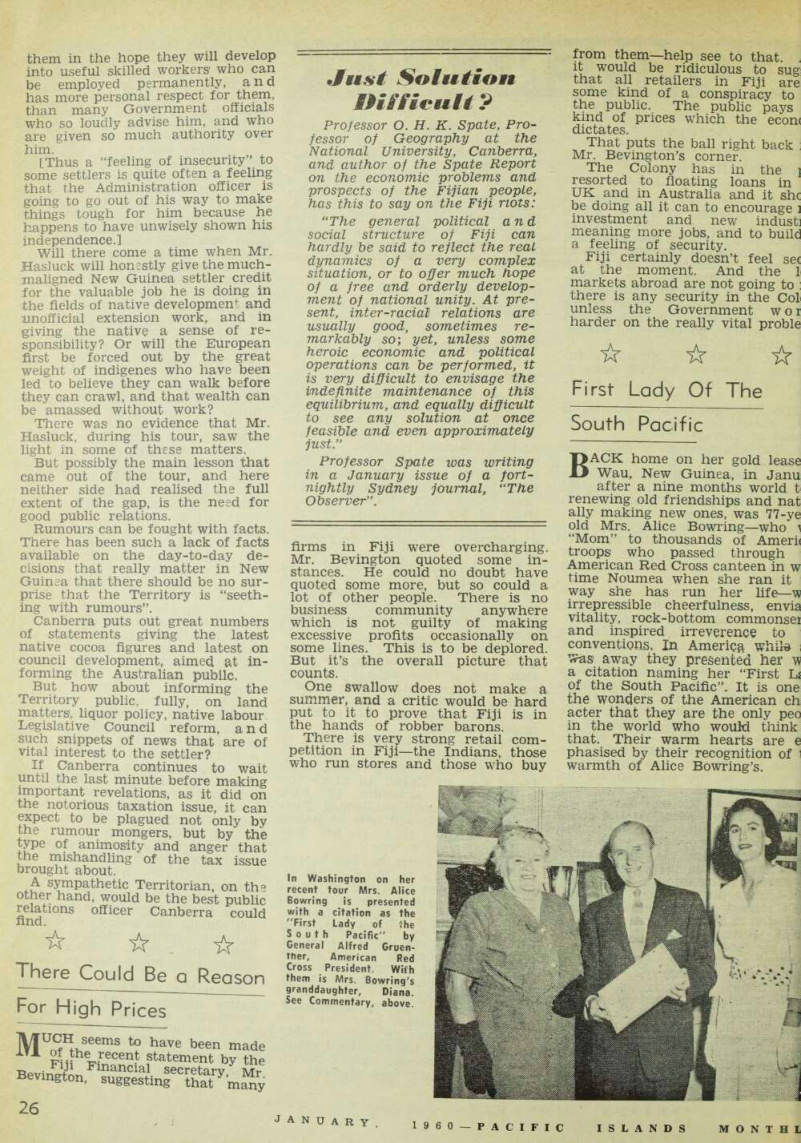
BACK home on her gold, lease Wau, New Guinea, in Janu after a nine months world t renewing old friendships and nat ally making new ones, was 77-ye old Mrs. Alice Bowring—who t “Mom” to thousands of Ameru troops who passed through American Red Cross canteen in w time Noumea when she ran it way she has run her life—w irrepressible cheerfulness, envia vitality, rock-bottom commonser and inspired irreverence to conventions. In America white i spas l away they presented her w a citation naming her “First U of the South Pacific”. It is one the wonders of the American ch acter that they are the only peo in the world who would think that. Their warm hearts are e phasised by their recognition of 1 warmth of Alice Bowring’s.
In Washington on her recent tour Mrs. Alice Bowring is presented with a citation as the "First Lady of the South Pacific" by General Alfred Gruen ther, American Red Cross President. With them is Mrs. Bowring's
granddaughter, Diana.
See Commentary, above.