sphate Survey
pp. 119-145 · Read in the full issue


Pacific Report
The month’s round-up of news and pictures of people and /ents, from PIM correspondents in the South Pacific.
/ Completed
survey of all the potentially ible phosphate and guano sits in British South Pacific tories commenced jointly by Australian and New Zealand rnments over three years ago, to all intents and purposes )leted in October when Mr.
Warin, of the Australian au of Mineral Resources, and ft. E. Fyfe, of the New Zealand ogical Survey concluded an lination on Tongan islands in chartered Suva auxiliary ketch >ro. . Warin has gradually worked way eastwards from New ea and its off-shore islands essing all the known small fits over as far as Tonga. In Mr, B. Wood and Mr. R. Hay, -he New Zealand Geological sy, examined the Cook Islands, eposits were found there. n of the deposits examined— in Tonga or Fiji—are likely to be of serious commercial est. All suffer from difficulty ccess. A few west of Fiji with the high grade sources slauru, Ocean, Makatea, the i Is., and Christmas Is. In the n Ocean worked out, be worth ond look. ptain Emile Savoie, of Noumea, has an interest in the Walpole guano depoits near New lonia, said in Auckland in mber that though no practical had been made to exploit island again, the matter was very much to the fore, ere seemed a possibility that local government might agree satisfactory contract price for supply of some of this guano ?w Caledonia, and if that was iged the shipping of the dy mined stockpile could com e almost immediately.
Caledonia May
Another Drought
November, New Caledonia was ng signs of the approach of a ; drought. Hot scorching winds sweeping the country causing
bush fires, especially on the dry west coa s t. The Government promised aid to station owners for the sinking of wells. And officialdom also reduced by one-third the kill ing of cattle for meat consumption.
The dry spell was being feit at the Yate hydro scheme. With the level of the lake falling, some people were wondering whether land marks, thought to have been lost forever by the falling of the lake in the last 12 months, might now be seen again.
Noumea does not get its water supply from Yate, and no water shortage is expected in the town.
The French Navy
In Reply
The recent report by two Ameri ca n tourist experts, criticising sections of New Caledonia’s tourist industry ( PIM , November) has apparently upset the French Navy.
The report, by Messrs. Clement and Koel, who have been com missioned by the Pacific Area Travel Association to make a study of various Pacific tourist areas, said in one section that a military base was detrimental, even dangerous, to tourist traffic anywhere because eventually the amusements created for tourists are over-run by soldiers and sailors.
The Navy in New Caledonia in November retorted that the Navy left in New Caledonia each year something in the nature of £A300,000 to £A400,000, and that that sum was the equivalent of the spending power of at least 300 tourists.
That’s what the Navy said, but even with high fares and other ex-
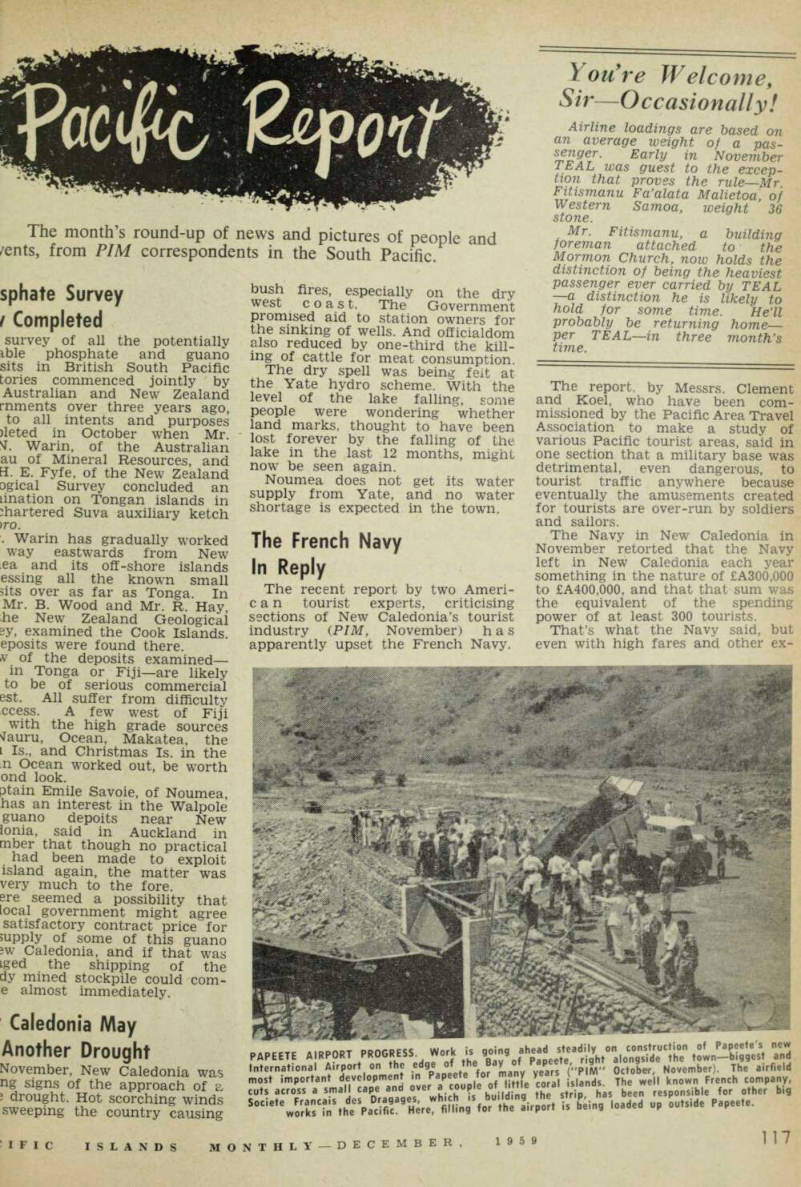
PAPEETE AIRPORT PROGRESS. Wprk is going ahead steadily on constrcution of Papeete's new International Airport on the edge of the Bay of Papee, right alingside the town-biggest and most important development in Papeete for ma ny year ( " PIM " October, November). The airfield, cuts across a small cape and over a cople of liffle coral island, The well know French company, Societe French de s Dra a ges, which is buildin g the strip, has been responsible for other big works in the Pacific, Here, filling for the airport is being loaded up outside Papeete.
;, £l,OOO per tourist sounds a igh, and what the French men spend would probably it a lot more than 300 tourists get through. But the Navy lade a good point.
\bout Time
;oms red tape surrounding the g of watches from New a to Australia for repairs, sen annoying the Horological of Australasia. At a conven n Sydney, in November, the decided to ask that control ed so that repair men would we to go through all the “un ary humbug” of opening nt of Customs men and de j them.
Guinea people couldn’t agree that it is all humbug. For Customs procedures on ss have been a source of mce to Territorians.
Vorkshop" For
en's Interests
South Pacific Commission a’s Interest Officer, Miss M. ■t, continues to stir up things moves around the Pacific, turned up recently at the Adi au school, Fiji, where 40 i —Europeans, Fijians, Indians t some of the holidays at a “workshop” to find out the ays of teaching adult educa irough leadership. r were all representatives of > women’s organisations, many m teachers, mostly married, ime even grandmothers—but •e imbued with a sense of re lility towards women in the mity who have little oppor to further their education •caching adulthood, novel workshop idea was not I by Miss Stewart but by the racial Pan Pacific and South Asia Women’s Association /omen are club minded —there
are 40 women’s organisations in Suva alone). The Pan Pacific asso ciation got the idea of the workshop when women in the rural areas complained that they were running out of ideas and wanted some help in helping themselves.
Miss Stewart, trained for women’s work in adult education, lectured and demonstrated to the workshop on the latest techniques on teaching, how to conduct campaigns for better health, better homes, better food.
Said one of- the Fijian delegates, “I learned more in four days at the workshop than I would have done through reading 50 books.”
Their Bones Dried
In The Sun
You can find criticism frequently enough of the missionary who sits down on the job in the Islands and lets the work come to him. Some times he is wrong in that approach, but sometimes, too, it might be the best way of doing things in that area, despite appearances. Yet there are plenty of missionaries, of all denominations who still do the job the hard way—and get satisfac tion out of knowing there is no other way to do it.
Mr. L. H. Barnard, Seventh Day Adventist missionary in the primitive Mount Michael area of the Eastern Highlands, in company with Mr.
Eric Were, recently walked 300 miles in six weeks on an anti-yaws cam paign in the Karimui area.
That job entailed giving an in jection to every single native and to proceed as far as the Papuan border.
Mr. Barnard had last visited Karimui 12 months previously. It took him then, as now, eight days of hard walking over range after
range of leech-infested country to reach it. But this time he was gratified to find something in the nature of a transformation in one village where he had taught a few hygienic principals on the previous visit.
The Karimui people are tree dwellers.
Their two-story houses are built high among the trees and a whole clan of 60 to 80 will live in one long hut.
Said Mr. Barnard (who for a number of years was on the staff of the Mt. Hagen Hansenide colony) : “I’ve never seen such degredation and suffering. Beneath the huts are filthy quagmires where pigs grovel.
Sanitation, of course, is nil. The young pigs live with the women in the lower half of the hut.
“Dried human bones hang near the doorway, and a revolting stench issues from high platforms where bones dry in the sun following cannibal feasts.”
The men treated large tropical ulcers that were eating away limbs, and saw many advanced cases of pneumonia. Malaria was exacting a terrible toll, and in one village they noted a 10 per cent, incidence of leprosy.
The workers gave 2,359 injections of penicillin alone to the remote tribes.
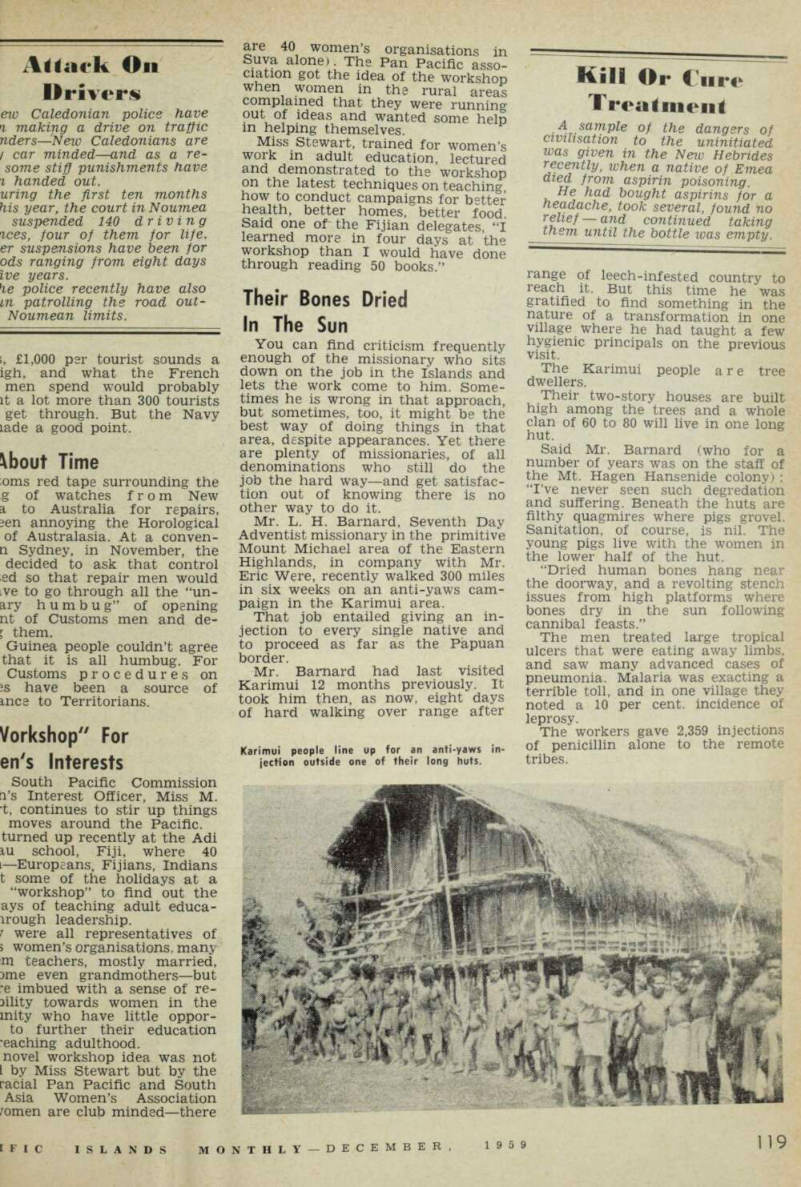
Karimui people line up for an anti-yaws in jection outside one of their long huts.
Maries' Sons Drown
young European boys, sons heran missionaries, drowned Lai River, between Wabag apenamunda, in the Western ads of New Guinea in No- The boys were Alan jr, 8, son of the Reverend [eppner, and Donald Gerber, of the Reverend Donald boys’ fathers are both on the of the Lutheran Mission, ri Synod, at Ampaiyah.
ye Banks and Churches
Fhey're In!
inks and churches are any ion of a town’s prosperity, ,ae, New Guinea, should be i the way, because there are janks and four churches in vn now, with a new bank tether new church about to t addition to the banks will 1 National Bank of Aus ,. It’s taken over premises in jorge Kui building on the of Fourth Street and Corona rive. Already established in vn are the Commonwealth Bank of New South Wales, ie Australia and New Zea ank Limited. New manager National Bank will be Mr.
Howe, of Sydney, fished churches include of England, Roman Catholic , Lutheran and Seventh Day Ist. The new church under ction is the Lutheran church, 1001 for natives.
Transmitters for
'oadcasting
Fiji Broadcasting Service is 5 two new 10 kilowatt outlets ration by the end of 1961 in ramme designed to improve lality of reception and the of its three-language s to all parts of the Colony, equipment will be installed C engineers but tenders for nufacture will soon be called vorld-wide basis. A 30-acre ir the erection of the new litting station has been i at Naveu between Suva 'Jausori (eight miles from ind near Koronivia) on the side of the main road, plan follows a careful field gation made several months r Mr, W. L. Harrison, chipf cr _the N . lasting Service, and the receipt of his report and nendations. existing equipment will be irred from Tamavua to the ite. The existing broadcast
band outlets will continue to pro vide coverage of Suva and nearby areas, and the new transmitters operating probably in the 75-metre short-wave band like the existing lower-powered station VRH4, will with their specially designed aerial systems, provide greatly improved coverage of the more distant parts of the Colony. The precise frequencies have not yet be-n decided upon.
Though these new transmitters are intended only to improve reception within Fiji it is probable that reception will also be improved in neighbouring groups like Tonga, Samoa, etc.
Tri£, an W ncm g the new plans the FBCs chairman, Mr. R. L. Munro said that his organisation was also Keeping a close eye on TV. The only problem there he said was finance.
Foods, Islanders
For The Use Of
Most Islands people haven’t much choice about the foods avail able to them—but in case they want to know whether they are likely to do them good or not, some Hawaii scientists have made a thorough
study of them, and have publish a report.
Some Tropical South Pm Islands Foods — description, hist\ use, composition and nutritive w is the title of the report prepay by Mary Murai, Florence Pen i Carey D. Miller, of the Univen of Hawaii department of foods ; nutrition. It is printed by University of Hawaii Press. I sounds like a good thing to have you if you are thinking of bee wrecked on a desert-island.
This report discusses the bre' fruit, coconut, pandanus, banu apuch, limes, taro and other stan foods, arrowroot, sweet potato, various sea foods, both fish shellfish.
Most of the material analjJ was collected in the Mars!; Caroline and Gilbert Isla* American Samoa and Hawaii, these foods are eaten througtt many Pacific islands.
The studies were made with support of the Pacific ScitJ Board of the National Reses; Council; the US Department!
Agriculture, through its Huu Nutrition Research branch; and!
Food and Nutrition Departmenr the Hawaii Agricultural Experirr Station, University of Hay Analysis of the sea foods was m in the laboratory of the Natid Institute of Nutrition, Toe Japan.
Big Islands Wedding
In Auckland
One of the largest Isis weddings to take place in Auckll where Islands weddings commonplace, was celebrated!
November when Miss Sti Tuiletufuga was married to Faaoso Tupe, both of Wes Samoa, in the Pacific Islam Congregational Church. The gu were afterwards entertained s feast in the Auckland Town I Mr. George Tuiletufuga, o clerk and accountant in Western Samoa Department: Agriculture, and Mrs. Tuiletut parents of the bride, flew to Zealand for the occasion, anr great many gifts of mats and arrived from Apia aboard Tofut also did a large quantity of Isl.J foodstuffs for the feast.
RNZAF Sunderland
Holed at Chathams
A RNZAF Sunderland flying —one especially equipped for ■ carriage of passengers on the Zealand-Chatham Islands which was instituted a year as was holed while taxiing on th*j Whanga lagoon, the seadromes Waitangi township 10 miles as on November 4.
The flying-boat was beaches
five feet of water following ilshap and its interior was 1, but passengers and crew d no injury.
Sunderland has been written d was being stripped of all tent later in the month, ihnical team sent from Auck i another Sunderland decided ie cost of salvage would not rranted as the aircraft had 1 very severe hull damage. An ■ into the mishap will be held, is believed that the level of rackish-water lagoon was than normal at the time of Dunding.
*1 Entertains
lueen
the first time in 32 years the of Niuatobutapu—also known pel Is. to the outside world — he opportunity to entertain ,ueen in October, when Queen visited this northern outlier iga aboard the Copra Board Aoniu. boat landing at this island icult and there were some s moments during this opera but the Queen was safely and taken aboard again end of the short visit. u, under command of Captain Visser, of Holland—where the iras built—also called at the 1 Group and later at Vavau Queen Salote left the ship urn to Nukualofa later, understood that Queen Salote 2 making her usual summer 0 Auckland soon.
Enterprise at
onga
Cooks’ 21-mile-round main of Rarotonga now has a ale delivery service twice 1 the Crummer family went ie vegetable business a year lyone wanting vegetables had down and grow his own, or Avarua at the crack of dawn
;urday morning to join the t the weekly roadside pro rove that a properly organ getable business can pay on and, the family now has two t vans on the road and in • was offering cabbage, carrots, pinapi, cress, beans, iro-tarua, kumara, and also s. 0 now a lot of vegetables, especially those not easily in the tropics, have been im from New Zealand and sold 1 the government freezer Phe new venture will reduce mportations and provide vho want them with fresh les at cheaper prices. The deserves success.
ane Warning Stations
ustralia
twork of hurricane warning 5 will soon be in operation Coral Sea to give Australia warning of the approach of [ storms from the north-east supply more precise infor on their movements towards ,st. new network, to augment a : along the Queensland coast, insist of French controlled stations at Chesterfield Reef •ench Cay—Ausralia already ; on Lord Howe Island. There ; another at Willis Island, a microseismic station will ; established and a similar at Cato Island, 260 miles east ivnsville. The microseismic ; detect and fix the position rricane centres from the vibrations caused by the 3d seas in the areas, hese new stations are ex to be ready by the 1960-61 ne season, in a year’s time.
Islands 7
\s Down
he first time for some years Islands’ exports showed a instead of a rise during t financial year, mainly due closure of the Manihild -of-pearl shell fishery for ation purposes, total value of exports in is £405,258 as compared with > in 1957. MOP shell exports d from £176,248 to £49,580 and intity of shell from 222 tons ms. But there were also de i tomatoes and in pineapples, weather conditions, there was no such explana )r a drop in banana pro l which Fruit Distributors if New Zealand, and the nent, have been trying to ip in recent years. After a ise in exports the output 3m 1,288 cases worth £1,359
in 1957 to only 751 cases worth £793 in 1958. As a result of this Fruit Distributors have decided to withdraw their special incentive arrangement whereby all bananas delivered to the Avarua wharf at Rarotonga were paid for whether export shipping facilities were avail able or not. The annual report says rather discreetly: “It is felt that the growers have perhaps been unwise in this respect’'.
Citrus, the Cooks’ main crop, also declined slightly from 80,082 Ih bushel cases to 78,279 cases, but the value rose slightly from £111,626 to £112,927.
South Pacific Is "Missing
Out On Banana Market"
An absolutely unlimited market for properly dried bananas from the South Pacific exists in the United States—and it will be a steadily expanding market.
This was the finding of Mr. B.
Proweller, of Suva, who returned there recently from a two-months exploratory visit to Hawaii and the United States.
Mr. Proweller said on his return that the South Pacific territories capable of producing bananas were
g out on a most valuable earner, and he could say ut hesitation” that the entire Pacific banana crop, either )r in the forseeable future, be absorbed by the American tionery market and other out lere.
Proweller said that his main was that he had not been panied by a Fiji Government I —or representatives of other a producing territories —so ley could have seen for them the great market which for this product in the United Proweller said, the dried a industry had many ad ;es for growers. Fruit that vould not meet fresh-fruit ex standards might be quite able for the driers. Problems port shipping were greatly iied and areas which cou 1 d not zed by the special cooler-ships sd in the fresh fruit trade, have their own dried-banana ry which calls for no urgency pping or for special ships.
Proweller said he wanted to isise, however, that such an ry could only succeed on the □f regular, large supplies. All merican importers sought not eds but thousands of pounds onth on a guaranteed basis of r supply. Nothing would kill idustry quicker than for the :s to fall down on their con he said.
Proweller believes that the ry can only be based on the ■hearted support of a govern- The market is there for the
exploiting—but the native growers have to be convinced by the gov ernment that such an industry is well-founded, and the growers would need constant urging and encourag ing to maintain the essential regular supplies.
As for the financial aspects, Mr.
Proweller said that it was amply clear that the American market would permit payment to the growers equal to or in excess of their present earnings. There need “be no fear at all on that score”.
Mr. Proweller said that people in the South Pacific had little con ception of the enterprise and drive of the American business man.
Confectioners who had never heard of this product were immediately ready, on viewing samples, to place huge orders on long-term contracts.
They immediately wanted sole
agencies for their States—or for the entire United States.
A few days after initial visits to some such firms, the representatives had again approached him with sample packs showing their ideas on marketing. There were attrac tiv e 1 y prepared cellophane en velopes capable of holding a single dried banana dipped in some con fection. They had invented names of their own and these were printed on the packages in eye-catching
lettering.
One big firm prepared a number of beautiful display cartons of the product, each fruit dipped in choco late and fitted with a decorative band.
Mr. Proweller added that sun dry ing was unsatisfactory because it allows the drying fruit to become infested by parasites which later hatch out. Such an infestation of weevils killed the Western Samoa industry some years ago.
A high temperature method that Mr. Proweller has destroys such parasites, and that or some similar method must be employed for the product to obtain an entry permit into the United States, he said.
Better Air Link
For American Samoa?
American Samoa might have a regular weekly direct air link with Honolulu, Nadi, and Auckland by the time this appears—if an applica tion to be made to the New Zealand Government received the favourable consideration that it was expected to receive. Applicant is PAA.
The application was for per mission to operate a weekly Boeing Stratocruiser flight into Auckland from Nadi, Fiji, instead of the pre sent DC4 service.
The existing fortnightly Boeing flight from Honolulu to Tafuna (American Samoa) and return, would then be increased to a weekly basis and would terminate at Auck land, with a direct connection with
NURSES. Sister Mele Fuka (left) and Sister Siosiane Fanua (right) in Sydney in November, ter Norma McCarthy, after their graduation from Sydney's Waverley War Memorial Hospital, [?]anua was a school pupil in Australia before she began her nurses training and will do an [?]s course before she returns to Tonga. Sister Fuka will also do her obstetrics, next year in Melbourne, before returning to Tonga.
Three jack hammers found it tough work to break up this heavy concrete wall in Suva recently—part of Fiji's defences in World War II. It sheltered a power house which provided electricity for two of Suva's main search lights, which NZ, US and Fijian troops manned at different
periods.—Fiji PRO.
American 707 jets on the San cisco-Sydney service at Nadi A u s t r a 1 i a-bound Samoan ngers and others who wished try the trans-Pacific flight by ling Samoa en route to Aus , or New Zealand, lenuapai airfield, Auckland, is ileared for a full Stratocruiser ig, and it is probable that the nger load would be limited to stead of the full 63 which the ift is capable of carrying on •oute.
i The Japanese Say There
Too Many Tuna Fishers
1 some time past the Japanese rnment has ceased to issue any licenses for tuna fishing, [y to prevent a glut and a de lon in the price of this most 'tant overseas export, as, for a new boat-owner to the business he must purchase icense of an existing owner. :il recently such licenses have selling at the rate of about fO to £BO per gross ton. Now, ise of an unfavourable result ipanese negotiations with the t Union in the matter of in fishing rights in the north, m fishing companies are seek una fishing licenses at offers 20 per gross ton or more, for ime tuna fishing licenses, t-time licenses, which permit types of fishing at certain as, are considerably higher in ; Japanese Maritime Safety 1 has been arresting an fil ing number of vessels for un ed tuna fishing—about a dozen month.
NG Missions: Drink and
;ation Problems
presentatives of all the tian miss i o ns throughout a-New Guinea —and there are there than in any other South ic territory—got together in Moresby in October-November ;heir usual Missions-Adminis »n conference, which is held two years. There were 58 onaries at this one.
Is is something of what went i ication ; P-NG Education tor Mr. G. T. Roscoe told the irence that P-NG was on the hold of unprecedented progress ie field of education, now that ,d got going with its plan for ;rsal primary education and :rsal literacy in English. An ex ed teacher training programme essential for the plan, ther James Dwyer, Catholic ion, Rabaul, said in reply that universal primary education
plan would remain but an idle dream unless there were an unprecedented grant from Canberra for education in P-NG. He said that 15,000 trained teachers were needed as a minimum.
Father Dwyer’s views got support but among the opponents were missions who stressed that the native people themselves should be the principal contributors to their own education development.
The conference voted unanim ously for the immediate introduc tion of compulsory education in urban and other areas where firmly
established schools exist in suf ficient numbers to take care of all local pupils who would come under the compulsory education regula tion. The specific areas would be indicated by the Administration.
Mission speakers said this would help eliminate one of the greatest educational problems, which was the all too irregular attendance of pupils in mission schools.
Cinemas : Rev. Percy Chatterton, of the LMS, Port Moresby, said he was increasingly concerned with the impact of the cinema on the people, some of whom were attend
ing picture shows three or t times a week.
He said that films that dealt v racial relationships between wi and coloured people could be espc ally harmful. From what he f seen, it seemed to him that censor in the past had conside only sexy films harmful. Many ff inculcated deceitfulness af treachery, cruelty and violence these were harmful. Native lead: too, he said, were fearful of effects of such harmful films their children.
Mr. Chatterton moved for ’ formation of a consultative c«; mittee of three members, least to be native, to be set up each censoring centre, so that censor could consult it.
Gambling : The conference g ported a motion by Rev. Will.
Buch (Lutheran Mission, Wab expressing grave concern over spread of gambling among nati The motion called upon the Adrr istration to prepare educate material to alert natives of perils of gambling, and also to I them to make better use of t leisure time. The growing amoun leisure time was greatly respons for the spread of gambling, speal. said.
Some delegates said some of chief violators of the gambling I were native members of the po force.
Drinking : The conference pa. a resolution calling for total ] hibition in the Territory, as the ( answer to problems caused by na drinking.
Rev. Wesley Lutton (Methc Overseas Missions, Rabaul) proposed the motion, asked that; Administrator consider having' alcoholic beverages declared illl imports unless for specific purp and that the manufacture of lit within the Territory be banned! at least five years (P-NG has breweries).
He asked that the system of ♦ trol recently introduced into Rab whereby the quantity of liquor ports had been drastically cut: introduced into as many parti the Territory as possible as am terim measure until total proli tion.
The motion was carried by votes out of 41. There were 16 v; against total prohibition and abstention. No single subject dui the conference was more hotly ♦ tested than this one and n brought more speakers to the p form.
The nine Catholic Mission c: gates consistently spoke aga total prohibition for the Territ and their votes, together with tl: of the Lutheran Mission, Anglican Mission, the LMS, and!
Australian Churches of Ch n Foreign Missions Board, made the 16 dissenting votes.
nembers of the conference ex d deep concern over the grow roblem of drink among the population and told of com villages going on drunken Albert Cuneo, Sacred Heart nary from the Catholic n, Port Moresby, had a i prepared in which he •ed part of the European ition for their excessive drink- Labits, but the conference’s :ion for total prohibition made otion inapplicable.
) Publicity. The conference
tianimous in deploring the ad publicity given missions by N Visiting Mission in its 1959 , where it speaks of the ilicity of missions in the Terri s “a situation which may have he seeds of future discord and sion”. Conference members he extent of the problem, as ited in the report, was ex .ted. Even prior to the arrival •opeans in New Guinea, native living in close proximity to nother did not have uniform us beliefs. thropologically speaking,” the ence said, “we know of no in native primitive societies >cord and dissension arising conflicting religious beliefs.”
and Balsa Could
for P-NG
fly “money-spinner” timber ts from Papua-New Guinea e future could be teak and according to Mr. W. Suttie, Director of Forests, m teak was growing well on ;one soil, near Port Moresby, id recently, and there is a lot is type of country in Papua, three years, an experimental of balsa at Keravat, near fl, had grown to a height of Seed from it could be buted along coastal areas and, tie, it would supply timber for 3 fishing rafts. Eventually, it develop into an excellent t. iPIM, November, P. 37).
If a steady supply of good quality teak and balsa can be built up, there are plenty of assured markets overseas, he added.
Fiji s World War I Flags
Placed in Museum
Flags carried by Fiji servicemen in World War I. and medals of veterans, which had until now been Medical "nen k f pin f °l the „ Fijl Medical Department, have been
handsd over to the New Suva Museum trustees Mr. H. Maurice Scott, president of the Fiji RSSA and a fighter pilot of World War 11, handed over the r ll^ 8 DerHck Meseums Curator> Ml Present at the ceremony were three First World War veterans, Mr Vivian Abrahams of the first ???>“}!,!."* ‘,° . le^ ve ‘fe Colony in Australian Im™^iai VCl pnii?=< ! 0f th s Mr - w s - Stevmson who |lined a commission in the Royal Air Force.
New Budget—A Lean
iok—ln Fiji
way it could be considered a ” year for Fiji, but the outlook e Colony with its rapidly ex ig population and its lagging pment, was less than bright, ing to the Financial Secre- Mr. E. R. Bevington, in his ary of the situation to the itive Council in November.
Bevington said that there some facts which Fiji would to face “without any vestige ishful thinking or escapist sm”. More and more people *oing to have to live on less iss, and energetic action needs taken to develop further re s and to increase production. first indication of trouble, [r. Bevington, is that the sugar ry, for the second year in
succession has reached and ex ceeded its present permissible sugar export quota—this year by 10,000 tons.
The second indication of trouble is the failure of the copra crop to show the expected recovery from the 1958 hurricane, perhaps through the age of the trees, and the failure of producers in the main to carry out any serious replanting of coco nuts to replace these ageing trees, or to get on with the job of estab lishing other crops on a large scale, Mr. Bevington said that if a million coconut palms and a million cocoa trees were planted today they would not come into bearing for seven years, and by then there will be nearly 100,000 additional mouths to feed in the Colony.
A dual programme is urgently called for, he said, firstly for cash crops with a comparatively quick yield, and secondly for an energetic planting programme. “We are all involved in this. It is a matter of urgency if our standard of living is to be maintained”.
It should be emphasised, Mr.
Bevington said, that the cost of re planting is wholly deductible as an income tax allowance, and is 50 per cent, deductible where new areas are brought in—up to £l,OOO. The actual cost of replanting coconuts does not involve any capital outlay to the smallholder, he said. All it
calls for is the setting aside of a few nuts for this purpose, and planting them.
Mr. Bevington mentioned a fact which has often been carefully scouted by those who have been over-ready to heap scorn on the Rewa Valley farmers for contem plating a continuation of the sugar industry and the establishment of a new mill.
“There is undoubtedly a difficulty that faces the primary producer in regard to the short term cash crop,” he said. “Unfortunately, he always compares any crop with sugar, but there are no crops at present known in Fiji which will give quite as high a yield per acre as sugar will.
“Unfortunately, we and the farmers yet to be born will be forced to turn to crops which give yields of a lesser order.”
Pointing out that there were no grounds for any protective tariff to ensure a higher return to primary producers, Mr. Bevington said that there is, unfortunately, “evidence that we are already over-paying ourselves.”
“A beautifully packed, battery fed chicken can be imported in cold storage and can be sold here at a
Islands Weddings
At left, married at Taurama Chapel, Port Moresby, recently. Miss Margaret Bowater and well known Port Moresby man Mr. Frank Both come from Birmingham, England Right top, Mr. and Mrs. Terence McGaffin, after their marriage at St. Andrew's Presbyterian Church, Suva. She was formerly Jill Wooley, of Suva.
Right, Mr. and Mrs. Daryl Aders on cut the cake after their marriage at the Cathedral of the Sacred Heart, Suva. Mr. Anderson is a teacher with the Suva Boys' Grammar School.
His wife was formerly Elizabeth Bucknell. Also in the picture is the bride's sister, Agnes, who was bridesmaid.
Photos: Papuan Prints; C. L. Cheng; Prasad's.
price than what I can only e as a very scrawny rooster Suva market. me can say that the chicken imerica is underpriced: it is >ster from the market which priced.’” ther example,” Mr. Beving d, “is yaqona (kava) which ;rstand can be purchased— iroduced with dollar labour — little as 1/8 per lb, whereas ice of the local product Is • lb. ther striking example is that caught off Iceland, taken to d. brought here in cold stor id yet can be sold cheaper esh fish in the Suva market.” iswer to this, he said, is not The exception can only be v a new industry to get go ld then only for a limited Fiji farmer was already pro by Fiji’s devalued pound, walls would mean that the dweller would have to pay a price for his essential food ments, and Government De denying people the equally ut cheaper, foods from over- Bevington said that he could is of inflation in the Colony, increase awards to three in 5, of not less than 17 s per iiis year, and the probability :her in the Public Works De nt “are bound to have an nary effect.”
Bevington stressed that the iswer to increased wealth was ed productivity. Rather as an lowever, he also later pointed at in his opinion, based on ;ures available to the Gov en t, some people were ntly getting more than their are of the Colony’s earnings. 3s have come to the Govern notice during the past year,” d, “in which local mark-up id above landed cost, appears excessive, and this in what lied ‘bread-and-butter’ lines, the year I collected a num examples, and there is ample le that the write-up of some irms is too high.” ;udy of the published balance and statements of assets and les show that after paying ividends large sums have been reserve, and the reserves are g each year by—in some cases substantial sums. In other they have ample room to them to cut their profit is.” irged the commercial houses ? a lead in this question of ; profit margins. The use firms make of their large :s “will be a matter of con l Government interest,” Mr. :ton said. idded that the great need at Dment was for Government to ack its own expenditure.
Though increases in most de partments will be small, there would be a substantial increase in the Education Department vote. There would be a sizeable decrease in Public Works Department expendi ture. A substantial increase —of £90,000 —would be required to pay interest on Government loans.
Mr. Beyington said that in the main it will be possible to meet the additional costs in 1960 through th Q increased amount of taxation re sulting from high earnings this year.
Capital expenditure by the Gov ernment in 1960 is set at £2 h million —mainly in the Lautoka wharf, Suva slipway, and water supply pro jects. It is estimated that the cap-
ind will be in deficit by ) at the end of 1960; £2 will be sought on the Lon irket during the year to meet ments then, but capital ex ire will have to be slowed rom its present rate in 1961 i unavailability of funds and Teasing cost of meeting in m loans.
Jevington said there are many works and many services ;he Colony would like to have m needs but they cannot be i. “The state of the economy iamentally sound,” he said, t to the provision that we thin our income.” re are still, unfortunately, people in this Colony . . . . link that somehow Govern ed some mysterious chest vhich it can produce vast a provide services. The plain feel, horrible fact is that ment can only take it out of 'son’s pocket and put it into r’s. . . . Money is made by : produce from the land and it.”
)art-Herald
In iart of a south-east Pacific >tration flight, Handley smoothly-designed Dart-
Herald passenger aircraft paid a brief visit to Papua-New Guinea in November.
Because the propellers were in the usual place forward of the engines (unlike the Piaggio now operating for Papuan Air Trans port), the uninitiated were apt to shrug their shoulders and ask what was so different, anyway?
But, as the technical boys hastened to point out, it is not so much the position of the propellors as the power supply feeding them that really matters.
And the system used to provide power is what makes the Dart- Herald unusual—as far as Papua- New Guinea is concerned, anyway.
Instead of the usual type of piston engines, it is powered by two turbine engines in which burning sprays of fuel keep rotors spinning at more than 14,000 revolutions a minute.
The rotor in each engine drives a propeller, and the thrust of the exhaust aids propulsion.
The arrangement is technically known as a turbo-prop.
The Dart-Herald can carry up to about 50 passengers at a cruising speed of 241 knots over a range of about 1,260 nautical miles, and is designed as a short haul medium sized transport.
The makers, who demonstrated it in the Territory before flying on to NNG and the Philippines, are hope ful that New Guinea might use it in place of the old Dakotas which have been doing the donkey work for so long, and would probably be replaced if there were something as good to replace them with.
Latest Moves With
The Airlines
According to Deputy Leader of •J I ®. Australian Opposition, Mr Arthur Calwell, who takes an interest in New Guinea affairs, there is little doubt that the Federal Government will let Ansett-ANA fly aircraft to New Guinea from Australia in competition with Government-owned Qantas.
In a radio broadcast in Mel bourne in November Labour’s Mr, Calwell said that Ansett chief Mr Reg Ansett had demanded “with truculent demeanor” to be allowed to fly to New Guinea.
Added Mr. Calwell: “The Minister for Civil Aviation (S enator Paltridge), who can be very tough and domineering when challenged about his failure to protect the nation’s interest against Mr.
Ansett, will ultimately surrender to yet another Ansett demand”.
“Senator Paltridge is certainly more the Minister for Ansett than he is Minister for Civil Aviation.”
Mr. Ansett had announced a few days earlier that he was still press ing the Government for licences to operate to New Guinea and throughout the Territory’s internal network. Ansett-ANA was anxious to take over the entire New Guinea service from Qantas, he said.
Other South Pacific airways developments: TEAL in December operated the first of its Electras on the Tasman service between Australia and New Zealand. It will fly the aircraft to other parts of the Pacific next year (see page 20).
Pan-American Airways in late December will compete with Qantas on the Pacific with jets—using a bigger version of the Boeing 707 that Qantas introduced with a great flourish in the middle of the year.
South Pacific Air Lines, long delayed in its efforts to go south from Hawaii, will inaugurate weekly Stratocruisers from Honolulu to Bora Bora from February 15. It will sell the Solent flying-boats
At The NG Ball
A New Guinea Cabaret Ball was a great success in Sydney in November, when 200 Territorians and their friends danced till three in the morn ing. It was, in fact, such a success that the men of the Australian School of Pacific Ad ministration, who organised it, hope it wil become a regular Christmas feature in Sydney, and they hope it might also become a terri tories' Ball, with guests from other territories besides P-NG. Among the couples who enjoyed the evening were (left) Jack Walsh and his fiancee Pauline McMullen, shortly to be married, and Mr. and Mrs. Des Murphy.
The Handley Page Herald is of great interest to the natives as it stands on the Lae Airport during its recent visit to Papua-New Guinea.
See story.
have been parked in San isco for so many years. ; service will only be first to begin with. It will be the direct air link between the nd French Polynesia, th Pacific, formed by the r family of San Francisco, an merican shipping family, had ed earlier to start service with -boats which were to refuel at tmas Island. The British
'nment peremptorily cancelled
rm’s lease for atomic test use e island area.
ed for Cutting
n Cocoa Trees
Rabaul (P-NG), in November, tive was found guilty in the me Court of destroying 187 trees belonging to a Chinese er. ; native, Togarangol, of Tin ;alip village, 10 miles from il, was sentenced to nine as’ gaol. arangol freely admitted in that in April this year he into a property belonging to Jacred Heart Mission and cut a large number of trees, said he cut down the trees se they grew on land belonging ; own Vunatarai (land owning i of natives), had intended to plant on the himself. also claimed the land did not g to the Mission because it had been paid for. dence showed the land had leased by the Mission to a ;se planter in 1955. msel for defence claimed that 'angol had a bona fide claim ?ht.
Drdered the Drinkers
iirched
; Suva monthly pay day brings wake good trade for the hotels, nerable sore heads next morn and a big list of “drunk and ierly” cases in the court a day o later. There appears to have an increase in the incidence he offence in the last few hs. s police, understandably, were
aing concerned, and public
en was that something should lone promptly. Some people t like walking past some of ’s hotels after dark, inken louts, most of them n, regrettably, have a nasty , of bumping deliberately into ;ent passers-by, and remon ice is inevitably met with a m of abuse. new magistrate, Mr. R. M. rose, who recently arrived in Uolony, apparently decided that ers had gone far enough.
When one day recently, 19 men appeared before him on liquor offenccs, Mr. Ambrose handed out terms of imprisonment to those found guilty. This was after he had warned a week previously, that in future he would treat severely those who came before him on liquor ch f'JS o s.
Mr. Ambrose ordered some of the guilty ones to be berched, but later withdrew these orders.
In addition he ordered that all of the 19 be paraded before him, while he gave them a thorough
dressing-down. He said his court would not stand for any interfer ence with the public’s exercise of its right to walk along the streets, it is now a little more than 18 months since all races in the Colony were given “open slather” as far as beer was concerned. For a start, it may have been because there was not too much money about, it appeared that the advocates of a free go for everybody were vin dicated.
Now some people in Fiji, says a correspondent, are shaking their
and wondering whether, after le move was not a little ure. The police and the now have extra work, but s a few salutary sentences >se which Mr. Ambrose handed ; month may have the desired they think. io£e: Mr. Ambrose, late in ber, when hotel licences were r renewal, called all applic efore him and gave them a and fatherly lecture, ppealed to them to do all in ower to curb drunkenness in hotels, and asked them to that liquor was not served inks”.
ppeal For
's Chinese
:ench Polynesia nowadays are ,000 Chinese —almost half of >n the main island of Tahiti to all intent and purposes mtrol the internal commerce Colony. wing a bank scandal some ago, the Kong Ah affair, : measures were taken by the authorities against the e—they are subject to special ons and they pay higher ; licences and fees than men. as not unnatural, therefore, hen Deputy French Premier s Soustelle was in Papeete y he should be “lobbied” by the local political groups who ed to him the Chinese cause. ’ pointed out it was unfair iscriminatory laws should be led against “this admirable, working population” and that hinese were no longer danger the Tahitians because the ate of the two races is similar most astute politicians, M. lie was non-committal and no definite promises on the
News For
ling Lines
5 latest budget has good news le shipping lines regularly y to the Colony. and light dues were sub illy increased as from Jan- L, 1959, after many years at 1 level. The increases were on siderable scale, and they met itrong protest.
Government has now taken a I look and has decided to 7 the charges. While the charges remain as in 1959, m January 1, 1960, no specific vill be levied port dues ex g 1/6 per ton half yearly, no r how often that ship enters ports. he case of light dues, the rate
of 6d per ton for the first port of call will be retained, but only id per ton will be charged at other ports during any one voyage. This charge * S WTiarfage 4 charges are also being modified. There will be a full day’s charge in respect of the first 24 hours, but a vessel requiring to remam alongside for perhaps only an hour or so of another day will no longer be charged for a further full day. The day will be divided into 6-hourly periods and the fee quartered accordingly.
These reductions will make a substantial difference to the cost of calls by the big liners in particular.
The Government also hopes that the reduction of charges at second and subsequent ports of call will have the effect of including more calls at such ports by overseas cargo lines, and thus avoid additional landing costs through trans-shipment at Suva.
n . f r .1
“UT bea Fares And
11
' reigniS Up
z £ a ber ° f Federation announced fares and freight ?ates earlv in SLh!f and the new up 10 per cent., and freights up by 10 per ton-came into force on November 9 The increases Will be felt in Fiji-Tonga-Samoa-Cook Islands served by Union Steam Ship Company vessels from New Zealand and from Australia. Tasman Sea rates are similarly affected.
Reasons given for the increase are a 2d per hour rise in wages of maritime workers in New Zealand last March, and a basic wage in crease of 15/- in Australia last June, plus a general wage increase in New Zealand effective from October 12.
emoves Tax From
go-derived Income
ons or companies deriving in from non-British overseas s will no longer be taxed on ncome in Fiji. is one of the concessions in 60 budget. law already provides that income derived in a British ry overseas is taxed in that ry, there will be no additional Fiji, and new concession extension of the principle.
;js Were Tough For
Womenfolk
i the policeman of W S. t, a woman’s lot is not a happy in Papua—in fact, at times ,rned tough, if not deadly. The was emphasised in November ee cases before PNG’s Supreme idi, a Southern Highlands in, told Mendi Court he fired rrows into the body of Tiviam, )ngo, because she had stared 5 father, put a spell on him, caused his death by sorcery, i she died six days later, her md, Waiya, decided to kill i’s wife in revenge—but, first, pened Tiviam’s body, in the and found that she had a ima. As any Longo villager s, a woman with a sanguma is
a proved sorceress. So Nandi’s wife was reprieved.
At Baniara, Papua, Kaigana was imprisoned for killing an old woman of a neighbouring village, in Milne Bay District. He alleged that she was a sorceress, had sent pigs to eat up his garden, and birds to ravage his bananas. Then, when she made talk of his babies to die, he clouted her over the head with a walking stick to teach her, he said, to stay good “Now she’s dead, she’s staying good”, he explained to Chief Justice A. H Mann, truthfully enough.
Elderly Injoagari, of Rondo, near Wabag, NG, killed his wife, Piazam. with a tomahawk when her relatives continually badgered him for more “bride price”. Angrily, he told how he had paid the full price but his wife’s brother and others kept ask ing for more pigs, even when he
nad handed over four in August.
They threatened that if he did not buy Piazam again with more pigs they would send her to another man.
“I had no more pigs and I did not want another man to have my wife, so I killed her,” he said.
NZ Gives W. Samoa
An Education Grant
In line with United Nations re commendations regarding the needs of Western Samoa, New Zealand is to give that territory a grant of £BO,OOO for educational purposes in the next financial year, and con sideration will be given to corre sponding grants in the following four years—despite independence.
This was announced by the New Zealand Prime Minister, Mr. Nash, late in November.
Licensing Court Blocks
Proposed Lautoka Hotel
An application by Northern Hotels Ltd. (the Ragg chain, and owners of the present Lautoka Hotel) for a liquor licence for their proposed Namoli Hotel was rejected by the Licensing Court at Lautoka in November.
Magistrate M. J. C. Saunders said h° was not satisfied that another hotel was required in Lautoka for the tourist industry, as the com pany had submitted. In addition, th nlgnned site was too close to a place of worship (Lautoka Gospel Hall) and a public school (the Jasper Williams Girls’ School).
An application by Cathay Hotels (Fiji) Ltd. (owners of the Grand Pacific Hotel, Suva) for a licence for their projected Park View Hotel, also in Lautoka, will come before the same court in D2cember.
Their site, too, is near a church and a school.
It seems, therefore, that there won’t be a hotel “war” after all in the “capital” of Fiji’s great north west as many people have thought since plans for the new hotels were announced.
At The Polynesian
Association
At a gathering of the Polynesian Association of Sydney recently were (left) these repre sentatives of a well-known Fiji family—Mr. and Mrs. Jim Ragg, and their nephew Neal Jenkins. Below, present and former residents of Noumea —Mrs. Paulette Heloin, Mr. Alec Rolland, Mrs. Marcelle Deudeute, Mrs. Therese Helein and Mrs. Blanche Lynton. Mrs. Lynton is now of Taree, NSW, but originally was from Noumea. —Tele-Photos.