Tahiti's Last Pomare Makes
pp. 55-59 · Read in the full issue


Sequel to the Drama of 1830-47 Tahiti's Last Pomare Makes Obeisance To De Gaulle
By. R. W. Robson
Seen against the background of history, the most interest incident of the visit of Deputy French Premier Jacques stelle to French Polynesia in October was his meeting with direct descendant of the royal Pomare family.
Princess Terii Nui Otahiti mare, a handsome, dignified, Idle-aged lady, lives in Tahiti, [r. Soustelle made a formal on her. significance of the meeting, the good relations developed lies in the fact that the , over one hundred years ago, ruthlessness in removing Pomare from her throne, i taking possession of the archipelagoes now called Polynesia.
Tahitians of today know little ,re less about the events re to; but some very bitter ies have lingered on in the ible families of the Society ;ess Pomare’s cordial message Soustelle and to General de in October, expressed good id friendship, and hope of )y future partnership, within mch Union, between Polynesia
and France. Therefore, it is an historic document.
Probably, although the Pomares now have no official standing, it marks really the last formal act in the union of France and Eastern Polynesia.
LMS and the Pomares
The history of the relationship between Tahiti (and the surround ing groups) and France, during the first half of last century is not a pretty one. It shows French Im perialism, and the Protestant and Catholic missionary organisations, at their arrogant and intolerant worst.
English navigators—Wallis and Cook especially—were the first Euro peans to find and wax lyrical over lovely Tahiti; and so much was written about the islands’ desirable ness, and their people’s “sinfulness”, that the London Missionary Society was formed to go forth and deal with this Polynesian situation.
The LMS ship Duff reached Tahiti on August 10, 1796; and a party of very earnest gentlemen and wives, mostly top-hatted and frock-coated and crinolined in the absurd fashion of those days, pro ceeded to “Christianise” the happy, care-free folk of the eastern islands.
Among their first converts was Pomare 11.
Within the next 30 or 40 years, unchallenged and unchecked, the
LMS missionaries virtually had taken possession of the country.
Nominally, they ruled through a succession of Pomares, who did their bidding in most things.
A Line of Pomares
The Pomare line was not a long one. When Cook was there, the Arii Rahii (Ariki Tahiti), or over lord, was Amo; and he and his at tractive spouse, Purea, became the navigator’s warm friends.
But Amo was supplanted by what was virtually a nominee of the licentious Areoi society—an enter prising young man who, because he coughed a lot, was named Pomare
(“po”—night; “mare”—cough).
By the time the missionaries got there in 1796, Pomare was boss. He lived in accordance with Tahiti’s age-old customs. They called him Pomare I, but they did not like him much. Accordingly to their standards, he was shockingly im moral. (Over)
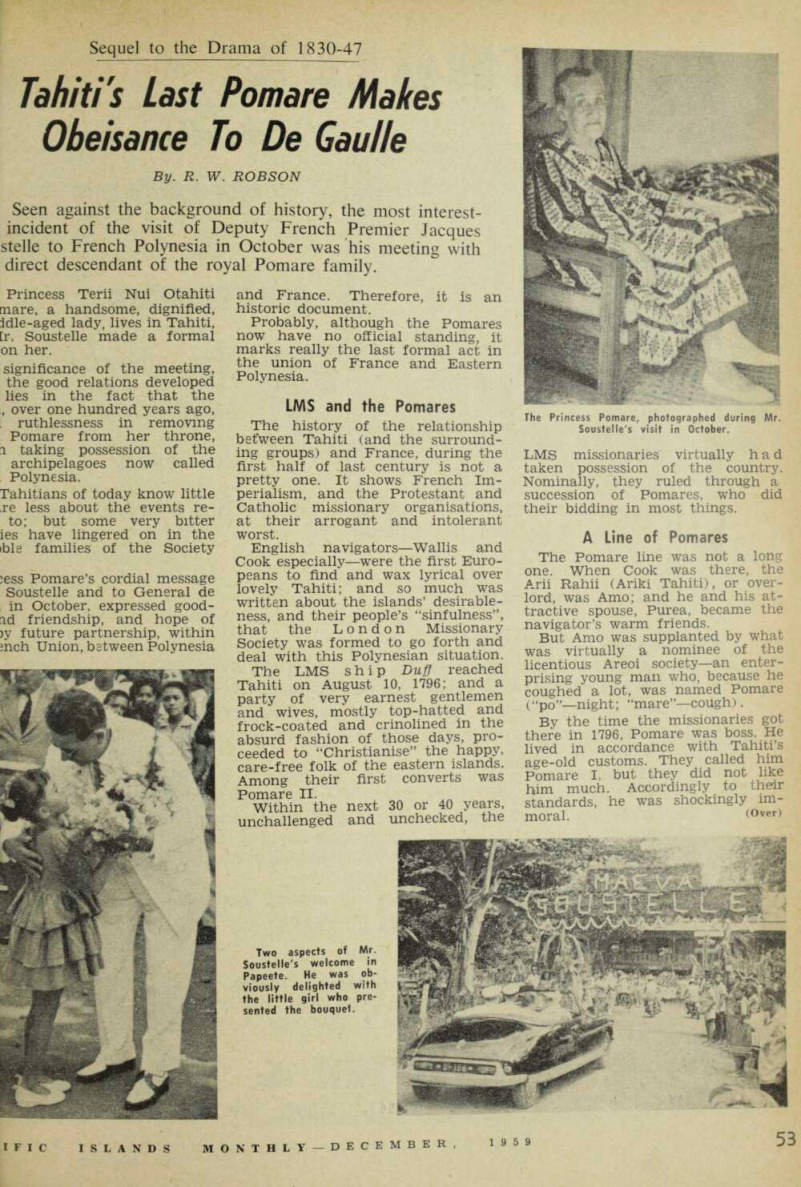
Two aspects of Mr.
Soustelle's welcome in Papeete. He was ob viously delighted with the little girl who pre sented the bouquet.
The Princess Pomare, photographed during Mr.
Soustelle's visit in October.
i son, Tu, became Pomare 11. ad a multiplicity of wives, and ved the grog of the white man. he accepted Christianity, and ved LMS directions in social ms; so LMS records call him great” and “the reformer”, s son died while being groomed ie missionaries for the king as Pomare 111. His sister, ta became Pomare IV—she was n to fame as “Queen Pomare” [) years. s little LMS-Tahitian paradise wrecked by religious strife, i opened the way to French for colonies. ■ly in the century, missionary ;s of a French Roman Catholic were established in the fier Islands; and in 1838 some hem crossed to Tahiti, on ;elisation bent. mrally, the long-entrenched generally arrogant men of the very much resented this in »n. Queen Pomare was wholly be LMS, and very friendly to in; and, under her influence, rahitians bared their teeth at Tench Roman Catholics, nchmen were handled pretty ily, and departed and pro l strongly to France. ,nce, proud and imperialistic, >rted the RC missionaries. The men appealed passionately to in for aid. Britain flatly re to interfere.
Guns of Du Petit Thouars August, 1838, French Admiral >etit Thouars arrived off ;te with the frigate Venus. He ie would bombard Tahiti unless Pomare administration paid dollars to compensate the RC maries for the thrashing they ■eceived. litians and LMS literally yelled protests—but paid up.
France was not finished. In Captain La Place arrived in ■igate Artemise. He said that if i Pomare did not sign an taking that Frenchmen would owed to visit Tahiti freely and d their religion there, he would ard Papeete. ) Queen’s chief adviser was the George Pritchard, head of the and by this time British il. Queen and missionary de the French —but the French t business. The Queen signed, iks have been written about lard in Tahiti. Copies of his ring reports to St. James on incidents may be read therein.
Britain still refused to inter ; RC missionaries came in. i they were roughly handled, im the French acted. Again, 142, Du Petit Thouars came a menacing warship. Again
the LMS cursed (or whatever good missionaries do when they want to curse) and again Pritchard wrote furiously to London.
With cannon pointing at them, Pomare’s Ministers (Pomare was away) signed something that gave France a “Protectorate” over Tahiti and adjoining islands.
The Queen came raging back to Tahiti. Pritchard raged with her.
It was all to no purpose. The French, by now, were moving in.
France Takes Over Pomare, reminded that she now was under the protection of France, did not give the answer that turns
away wrath. Out in the field, the LMS missionaries fought the de tested RC missionaries with every thing they had. There was Christian organisation a-plenty, but little of the Christian spirit.
In 1843, the übiquitous Du Petit Thouars was back—with three war ships. He declared Queen Pomare’s throne forfeited, and he took formal possession of her territories in the name of France. This started a five years’ minor war between the French and the Tahitians.
Rev. George Pritchard was in it, up to his neck. He fought the French with such spirit that in 1844 he was arrested, and sent to Eng land on a British warship. (Over)
hard got a hearing in Lon ,nd the British Government slowly and ponderously.
Louis Philippe sacked the rial Du Petit Thouars, and 3 ritchard compensation and es totalling 100,000 francs.
Pritchard did not return to (he was afterwards British in Samoa and made some there); France clung to her orate over Tahiti; and Queen e (who had gone to Raiatea ) finally and formally sub to France in 1847. was French Polynesia n Pomare IV was a really ; woman. Wild, clever and an aited lover in her youth, she down to a very proper royal in her later years. But she forgot her dethronement, or ; the French. closest friend was Princess ihau (Taimai), who married Alexander Salmon, son of a i banker; and Monsieur and le Salmon later supported the Administration, and had influence there. It actually idame Salmon who persuaded e IV to submit.
Salmons’ daughter, Marau, d the last Pomare (Queen e’s son). Some historians call )mare V, but he never actually descendants of M. and ie Salmon and of the Pomare e are well known and in al people in Polynesia, and hly pro-French.