Territories Talk-Talk
pp. 31-37 · Read in the full issue


By TolaU
Minister Paul Hasluck Papa belong all Papuans and w Guineans (in the political sense at least) gave a most cresting talk on a TV programme at the beginning of last nth in which he stressed the fact that Australia would rec lise claims by NG natives to determine their own future.
a casual observer it would ipear that the Minister’s ilicy has undergone a change e last year or so—could be us make a few quotations: I he more slowly we change i [the native people ], the e soundly the change will be blished.” i a statement, with UN seship Committees on his certainly supports opinions sed for these many years by der residents of the Territory ired, in no uncertain manner, M columns. )ne of the Government’s big • lems is to create a healthier onalism in New Guinea. . . . worst kind of nationalism we d get in the Territory is one d on resentment of the es. The feeling that the k man is being exploited Id be the wickedest and worst g that could happen to the )le of New Guinea.” true! But who, in the post ears, has inferred that such tation existed more than nment officials themselves? ing the effort of the establish of native co-operatives how has this very subject been the foundation to build a economy at the expense of ig markets? t in recent months has the attitude towards private Tise taken a kindlier and appreciative tone, as ex d by Administrator Cleland at Goroka and Lae Shows, isising the fact it was not nment policy to retard ex »n by private enterprise.
'vsryone who lives in New nea should conduct himself in i a way that the indigenous lie trust and respect him.” n very much afraid that this irint on European conduct a bit late in the piece. The lappy screening system (if enforced by post-war Govern ■ especially, has left a lot to be d if one can judge by some
3 temporary residents allowed
the Territory, mostly as icians and artisans. And the un used by the Minister
should also include the female of the species.
As is well known, some of these temporary residents come under the category of “poor whites”. Not necessarily based on their financial status, as their moral suitability to live in a black country. It is from the “poor whites” we often glean our illicit liquor traffickers, who invariably become an embarrassment to the white popu lation.
That is one reason why the Germans in their time employed only Asiatic artisans, and most of them conducted themselves in an orderly manner amongst the indigenes.
Well do I remember the advice of an old German official given when I first arrived in the colony: “Always keep your word with a native; always maintain the dignity of your race. Never strike a native.
If he deserves punishment get your Boss-Boy to deliver it. If you’ve promised a boy a present, always give it to him; if you’ve promised
him punishment for an offence— and he commits it, give it to him.”
It was good advice nearly 50 years ago. It is still good advice and makes for trust and respect—two qualities which the Minister ad vocates.
“One way to unify the people is through the Christian religion which is something good they can hold in common.”
Precisely. But unfortunately, the modus operandi adopted by the “multiplicity of sects” is so dis united, and so competitive, much of the Christian unity is bogged down in sectarian strife and denomin ational difference which confuse and bewilder even the most sophisticated native people.
The Minister ends up with a plug for the English language: “Another unifying force can be the use of English instead of the present 500 languages. They will absorb English ideas as they le&rn the language.”
The Good Book tells us of that idyllic time when the lion will lie down with the lamb, and it will be about this same time when the New Guineans will attain nationalism if they are going to depend first on speaking English throughout the Territory. Such a target is a pipe dream in an ivory tower.
Our goal should be to create first class New Guineans with their own national culture and languages, rather than second-class Australians with an adopted culture, economic and social conditions which leave a great deal to be desired.
In fact, I often wonder if native cultures, together with their own economic and social set-ups, in all their simplicity are not more to be desired than our present-day plan ning towards a perfection which we never seem to reach.
“They [the natives ] despise pidgin because of its weaknesses and because it is the language of people at a lower social level.” (Over)
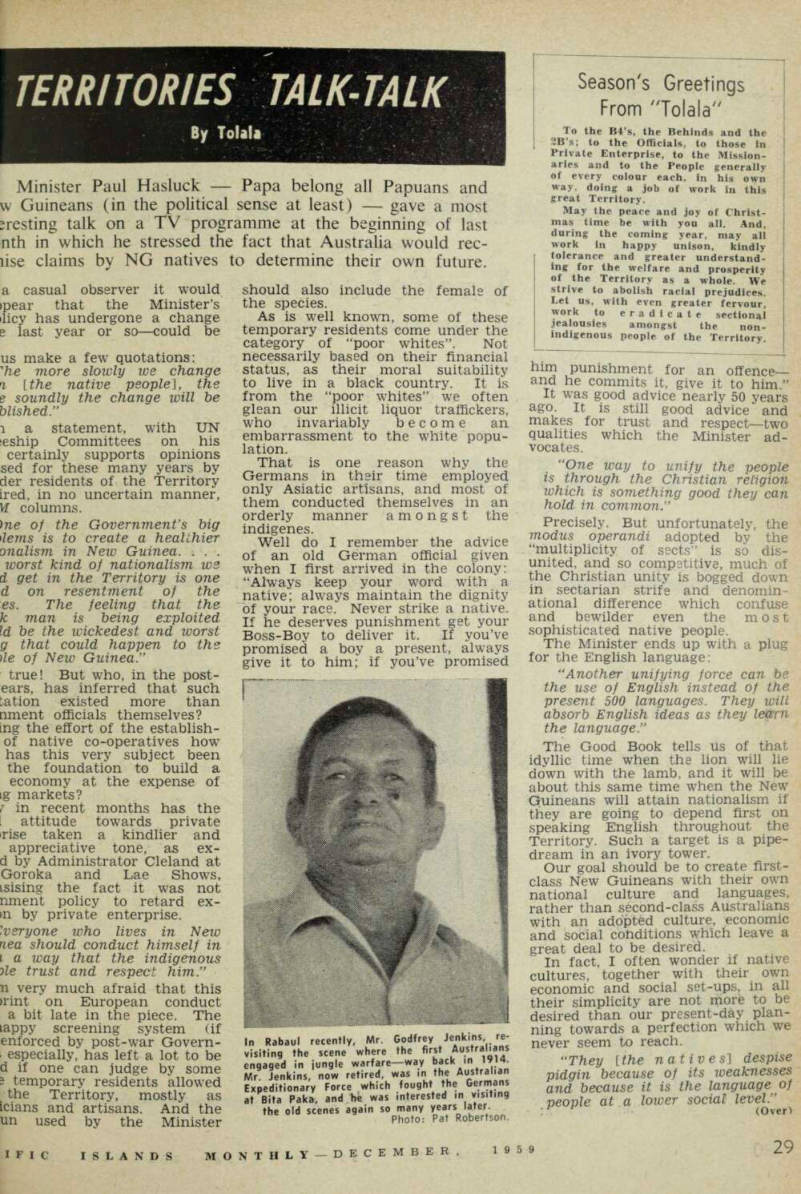
In Rabaul recently, Mr. Godfrey Jenkins re visiting the scene where the first Australians engaged in jungle warfare—way back in 1914.
Mr. Jenkins, now retired, was in the Australian
Expeditionary Force which fought the Germans
at Bita Paka, and he was interested in visiting the old scenes again so many years later.
Photo: Pat Robertson.
“they” referred to by the er are possible .001 per cent, dgin speakers; the super states in some Government ment who are telling the er what he wants to hear, or pidgin generally being de by the native, that is just so hooey, a mild term to be used 3 connection. It only shows ealistic approach, plus wishful ig on the part of the Min md those who servilely take :ue from him.
erman Eagle
return of the German flag to °IM, Nov., p. 31) was men in Times Courier (28/10/59) le notation that “some people f the opinion it could be the flag of the old German New i Company. . . .” The “some ’ can rest assured the flag as in the photo was not the flag of the old NGC, but that German Imperial Govern ed only flown by Government ns.
German days nearly every tion and trading station had pole from which fluttered the white and red colours of ny as a simple matter to get a r so of calico of those three ; out of the trade store, sew together, and there was the lone of the intricacies of try make a Union Jack! ve boats-crews always got a ut of “dipping” the flag as ships passed some coastal or plantation where excited boys lowered their own flag, muted “Sailoo!” It was sur how much information was iged between the two parties 1 gesticulations.
Peter Hensen, who at one had the trading rights hout the Witu Group and whom Peter Harbour was , used to tell of the days when id Queen Emma were at s drawn. in Emma Forsayth schooner pass Peter s station at Meto kipper would break out a flag with a rude design em ed thereon, which would im ;ely be answered by Peter’s
Master Yeoman” hauling to the masthead another rudely designed piece of bunting.
But flags, with their attendant protocol and courtesies, gradually died out as the Australian occupa tion settled down; the average Aussie, with his inherent distaste for anything savouring of ceremonial, just couldn’t care less about dipping the Jack or ensign to a passing vessel.
A Forgotten
Character
Mention of old Peter Hansen re calls many a story of this old blown-away Danish sailor who swallowed the anchor and started trading for the old Neu Guinea Kompagnie and for many years had the sole rights in the French Islands, as the Witu Group was called at one time.
Only for the timely aid of his native lass he would have been
murdered in that Group several times. Eventually he married this woman, was properly “churched” in the early ’Thirties when legislation was introduced providing for such marriages—or else, In the late ’9o’s and early 1900’s Peter was one of the richest traders in the colony; he owned h s own steamer, and used to make periodical extravagant trips to Sydney where
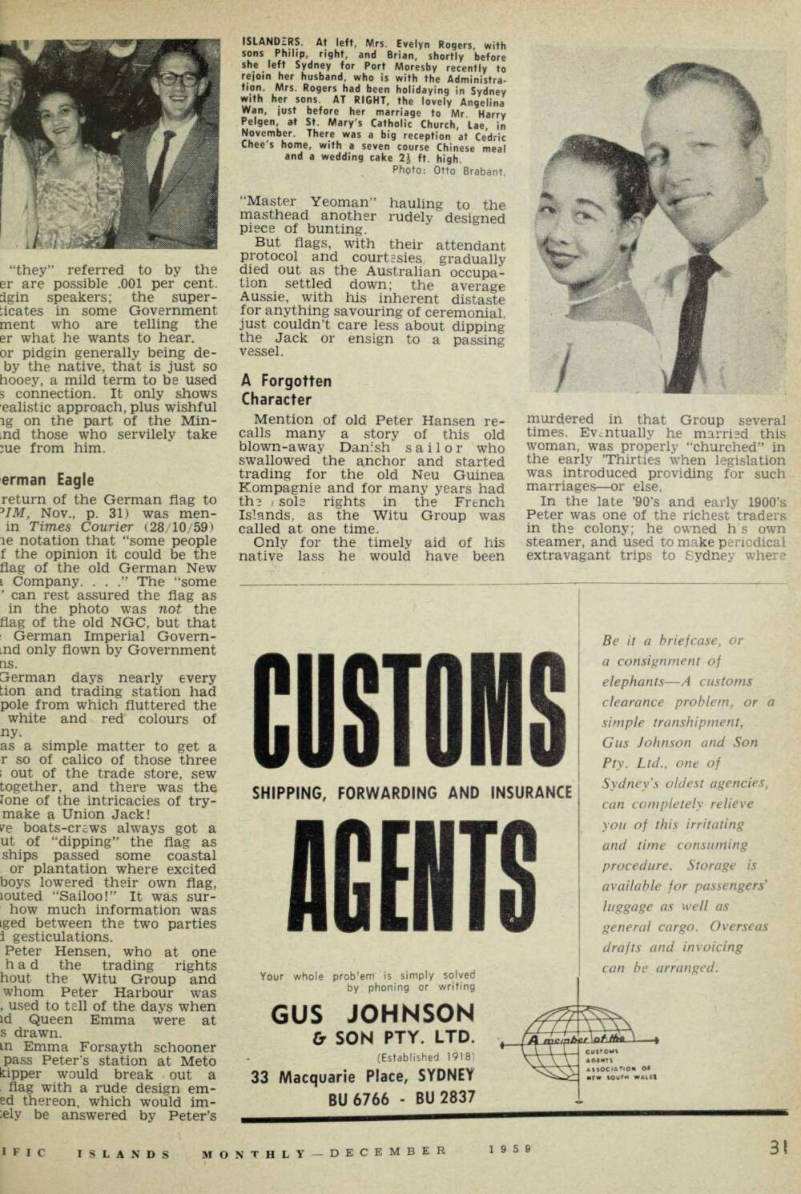
ISLANDIRS. At left, Mrs. Evelyn Rogers, with sons Philip, right, and Brian, shortly before she left Sydney for Port Moresby recently to rejoin her husband, who is with the Administra tion. Mrs. Rogers had been holidaying in Sydney with her sons. AT RIGHT, the lovely Angelina Wan, just before her marriage to Mr Harry Pelgen, at St. Mary's Catholic Church, Lae, in November. There was a big reception at Cedric Chee's home, with a seven course Chinese meal and a wedding cake ft. high.
Photo: Otto Brabant.
dulged in the gentle art of aining chorus girls en masse lidnight banquets with >agne. 912 he was planting up Kekere ainville) plantation for him tnd it was in Kieta that I net him as a guest at my ig there in 1912; even then d lost much of his glamour, (ht up to the time of his death middle ’Thirties he was ever teresting character and one life-story would equal almost ng that has been published South Seas identities.
Maclean
» November 24, Colin Howell in passed on to his rest after ng illness which had lasted months.
Macleans were a well-known ir Rabaul family, arriving i the late ’Twenties when the , C.H., was appointed an ive on the WRC staff; his soon became popular in 1 circles and the four up ng sons (lan, Alistair, Donald olin) were the envy of many her. And now only one of this ir family remains—Donald, a r in the Baining district, father and son, lan, who was tist in Rabaul, were both lost ? Montevideo Maru tragedy; r, who served with the vatchers during ’43 and ’44, n Rabaul a few years ago, as lid the mother a couple of later while on a visit to Colin, t that time was District Coro ner at Sohano, Bougainville, later retired from the District es and took up planting in the reland area. n Trend item in a New Guinea news recording the urge, expressed ) native members of the New i Advisory Council, that the ;ed radio station for native in the Gazelle Peninsula [ serve all people, seems to te that even the native people ealising that non-indigenous re getting a rough spin from ildom. And this is a change look. so long ago the Rabaul Health Department issued a ennaire amongst the non nous residents of the town g their opinion and sugges regarding hospital facilities, ry services, mosquito-control vhat-have-you. Surely a de *e from the usual official at towards the non-indigenous of “take it or leave it —or But a very welcome change i; in fact the PHD seems to dulging in a publicity cam generally, with the Educa- Department running a very second.
Its all very good to see and has a good psychological effect upon the residents generally. But it’s taken them a long time to get started on a Tell It To The Public gesture.
Even the local Press makes men tion of a “softening attitude” of Officialdom towards the public fol lowing the John Howse tour.
Nothing could be more conducive towards good-will and Territorial progress than the elimination of official arrogance and intolerance which have been bred in Canberra and reared in Port Moresby.
Those Uprising
Rumours The P-NG Press certainly did a
service to the Territory in virtually ignoring the furphies that ran riot in October concerning the contem plated Rabaul “uprising,” (as men tioned in Nov. PIM, p. 67). Happily, southern papers (if they did know about it) refrained from their usual sensational stories and that obviated inquiries into the cause of the whole business which (from what I hear) could have been embarrassing for certain Church dignitaries.
Once again a case of a “little knowledge being a dangerous thing.”
Our Gallant "Few"
Referring to the paragraph last month concerning the lack of re cognition of our “Gallant Few” who
id off to meet up with the Japs ,nuary, 1942, over Rabaul in antiquated Wirraways, Dudley , of Rabaul, writes: ealised this some time ago and the honour to move in the il Town Advisory Council that road leading from Mango ie to Central Avenue, opposite ommonwealth Bank be named away Avenue”, This was *d by the Administration, and is now its official name, priately, it leads to the aph, unveiled last Anzac Day. present it is dusty and un d but plans for a fine dual geway avenue, with rows of have been adopted.” s good to know “they” have een forgotten, and all credit dley Jones for his action. But Posterity know exactly what ord “Wirraway” implies? Is it
h? Will future generations
just exactly what these “Few” >n when they were left out on d by the Top Brass? . . . And at why there is no official lition made of these “Gallant md Pieces r South Wales Director-Gen af Public Health, Dr. H. G. ce, who retired last month, een with the Health Depart since 1924. For some years he MO with the TNG Adminis a, and a son of Mrs. Jane T. ce, a well-known Territory ty; a brother T.V., was lost e Montevideo Maru. ... A :al party has been formed *st the P-NG natives, incor ng the best [sic] of Australian il and Labour Party policies, said to have the backing of influential parties in P-NG.
Big increases have been an :ed for Mission Grants in . Last year £203,000 was the at granted, but from next ,ry teachers’ grants would rise r cent, and other additional 3 would be made.
ng Terntorians
eir Place on’t profess to be an authority plomatic protocol, but it does somewhat strange that the ries of the world (or some of , anyway) have no consular sentation in P-NG. Possibly to our Aussie down-to-earth, ut-the-trimmings attitude i we adopt (when it suits us), ie idea that consular agents ustralia are “near enough”, the old German days, New ea had its international liar representatives, officially nised in the Colony’s political social world. Fred Jolley (one ueen Emma’s executives) was 5h Consul; H. R. Wahlen repre d Sweden, while Capt. Isadore
Kommi was Consul for Japan, and Ah Tam was Chinese representative, There could have been others as well, but I have forgotten them.
The lead for the appointment of consular officers would, presumably, come from Canberra officialdom, but this coterie seems to have a rooted objection for any private citizen holding any position which might even suggest quasi-official standing, Public servants must monopolise every office, whereas there are many footling jobs that could be done by Mr. Citizen and thus ease the burden on the overworked Official.
Incidentally, I notice where John Hohnen at the Wau TAC meeting asked why private citizens were not appointed as Commissioners for
Taking Affidavits and Justices of the Peace. He was informed that one private citizen had been ap pointed a C for A. In pre-war days there was a long list of private citizens who held this office, but nai T a JP. Is it because Bureaucracy is so jealous of its brief authority?
And when, oh when, is the position of Administrator to be raised to gubernatorial level?
Canberra seems loath to ’ allow
the Terr a^!v ofthaolpithS
$ civilised (aIS
surelv P-NG is “civihsed’’ bv now)? nor, j U dgi ng by Honour’s lists, much appreciation of good citizenship. Is all this studied evasion a sly dig at the non-native peoples, lest they become too self-assertive?