Sydneysider
p. 24 · Read in the full issue
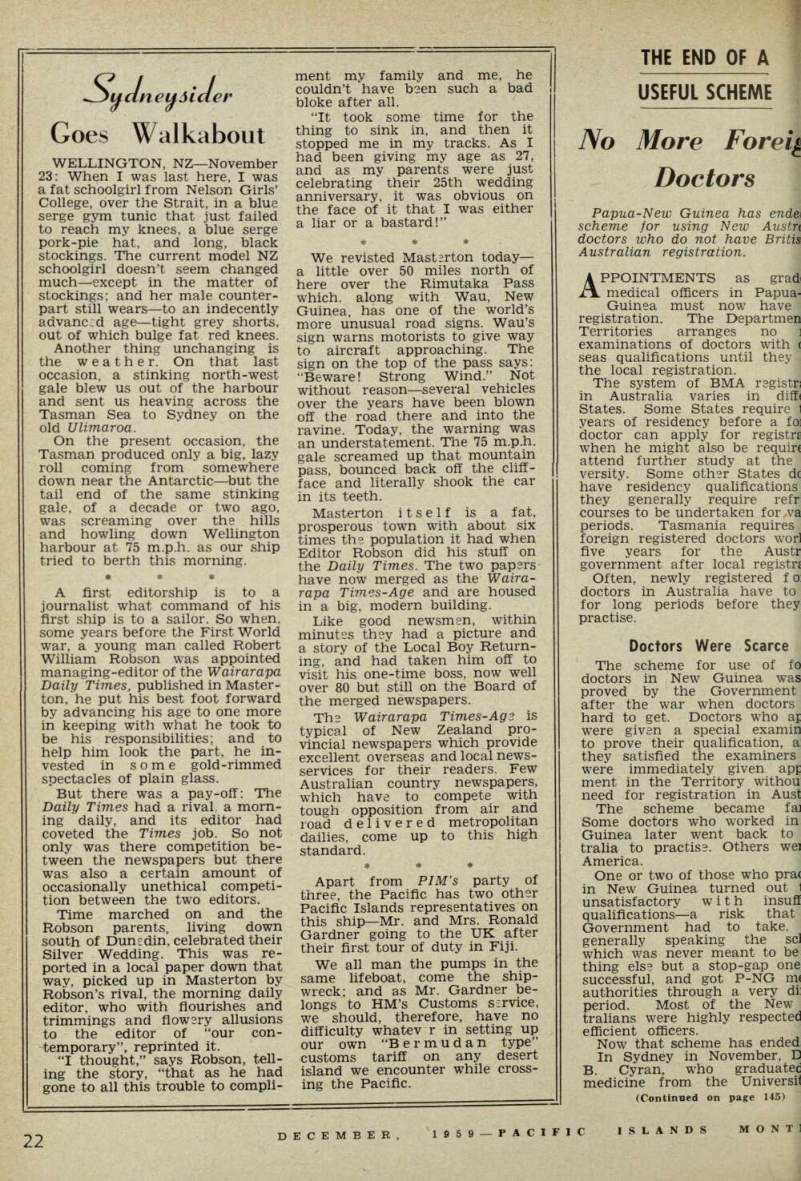
Goes Walkabout
WELLINGTON, NZ—November 23: When I was last here, I was a fat schoolgirl from Nelson Girls’
College, over the Strait, in a blue serge gym tunic that just failed to reach my knees, a blue serge pork-pie hat, and long, black stockings. The current model NZ schoolgirl doesn’t seem changed much—except in the matter of stockings: and her male counter part still wears—to an indecently advanced age—tight grey shorts, out of which bulge fat red knees.
Another thing unchanging is the weather. On that last occasion, a stinking north-west gale blew us out of the harbour and sent us heaving across the Tasman Sea to Sydney on the old Ulimaroa.
On the present occasion, the Tasman produced only a big, lazy roll coming from somewhere down near the Antarctic —but the tail end of the same stinking gale, of a decade or two ago, was screaming over the hills and howling down Wellington harbour at 75 m.p.h. as our ship tried to berth this morning. ♦ * » A first editorship is to a journalist what command of his first ship is to a sailor. So when, some years before the First World war, a young man called Robert William Robson was appointed managing-editor of the Wairarapa Daily Times, published in Master ton, he put his best foot forward by advancing his age to one more in keeping with what he took to be his responsibilities; and to help him look the part, he in vested in some gold-rimmed spectacles of plain glass.
But there was a pay-off: The Daily Times had a rival, a morn ing daily, and its editor had coveted the Times job. So not only was there competition be tween the newspapers but there was also a certain amount of occasionally unethical competi tion between the two editors.
Time marched on and the Robson parents, living down south of Dunedin, celebrated their Silver Wedding. This was re ported in a local paper down that way, picked up in Masterton by Robson’s rival, the morning daily editor, who with flourishes and trimmings and flowery allusions to the editor of “our con temporary”, reprinted it.
“I thought,” says Robson, tell ing the story, “that as he had gone to all this trouble to compli
ment my family and me. he couldn’t have been such a bad bloke after all.
“It took some time for the thing to sink in, and then it stopped me in my tracks. As I had been giving my age as 27, and as my parents were just celebrating their 25th wedding anniversary, it was obvious on the face of it that I was either a liar or a bastard!” * * * We revisted Masterton today— a little over 50 miles north of here over the Rimutaka Pass which, along with Wau, New Guinea, has one of the world’s more unusual road signs. Wau’s sign warns motorists to give way to aircraft approaching. The sign on the top of the pass says: "Beware! Strong Wind.” Not without reason—several vehicles over the years have been blown off the road there and into the ravine. Today, the warning was an understatement. The 75 m.p.h. gale screamed up that mountain pass, bounced back off the cliff face and literally shook the car in its teeth.
Masterton itself is a fat, prosperous town with about six times the population it had when Editor Robson did his stuff on the Daily Times. The two papers have now merged as the Waira rapa Times-Age and are housed in a big, modern building.
Like good newsmen, within minutes they had a picture and a story of the Local Boy Return ing, and had taken him off to visit his one-time boss, now well over 80 but still on the Board of the merged newspapers.
The Wairarapa Times-Age is typical of New Zealand pro vincial newspapers which provide excellent overseas and local news services for their readers. Few Australian country newspapers, which have to compete with tough opposition from air and road delivered metropolitan dailies, come up to this high standard. ♦ * * Apart from PI M’s party of three, the Pacific has two other Pacific Islands representatives on this ship—Mr. and Mrs. Ronald Gardner going to the UK after their first tour of duty in Fiji.
We all man the pumps in the same lifeboat, come the ship wreck; and as Mr. Gardner be longs to HM’s Customs service, we should, therefore, have no difficulty whatev r in setting up our own “B ermu d a n type” customs tariff on any desert island we encounter while cross ing the Pacific.