Not Independence
pp. 19-20 · Read in the full issue
American Samoa Speaks Out They Want Home Rule—But Not Independence
It was time for talking in American Samoa when, in late ober and November, three waves of distinguished visitors sd on the Territory. They heard some fairly straight talk n the Samoans, Samoans who are conscious of what is hap ing in the neighbouring Territory of West Samoa.
TOR Oren Long, of the new ite of Hawaii, was first to 1, followed by Secretary of terior, Fred Seaton, with the )r of the Office of Territories, ithony Lausi, then Congress 5. F. Sisk (California) Jack land (Washington), and [ McGinley (Nebraska). Be he usual receptions and the mal kava ceremonies, the ; met the Samoan Legislature,
■ior Secretary Seaton probably
e fullest brunt of what the ns had to say. The gist of it iat the Samoans are not en- , happy because they feel that ave been neglected, f spokesmen for the Samoan □f view were Speaker of the >a n House, Aifili Lauvao, enate President Rapi Sotoa, lewly returned from a trip to 3, where they began a cam for a number of goals, in l full US citizenship for ,ns, greater assistance from 5 Government in Samoan de lent, home rule, and an end dual pay system operating in
Not Good Government
two men between them, at nt times told th Q visitors that 3 had not established a good nment in American Samoa, was inadequate to provide needs, and to formulate pro e policies. It was a Govern “for” the people as dis shed from a Government “by” ople, and even “of” the people. ioa knew the road to self-gov nt was long and hard, but it ow walked on it for 60 years ; was too long. The time had for changes. fas too dangerous to leave the ion in charge of a Chief tive with too great a dis tiary power (in this case nor Peter Coleman). •etary Seaton in particular was that th° Samoan Fonos had i in 1948 to establish their iture as an advisory body for irs. That period was over and a now needed a further step, erican Samoa wanted an end
to the ill-defined status of “nationals”, which was a label of inferiority, and which was causing unfair discrimination against Samoans moving to Hawaii and the American mainland.
The people were distressed by the salary system which gave higher salaries to non-Samoan Government employees—with college educated Samoans returning home only to be faced with a salary system “with colour and place of birth as the de termining factor”.
Better Education
They wanted bitter education. A request for scholarships for bright high school students had been cut from the budget.
Noting that many Cook Islanders were now in New Zealand on scholarships, and that Western Samoans were studying in New Zzaland, Hawaii and the US con tinent, High Chief Sotoa said: (Over)
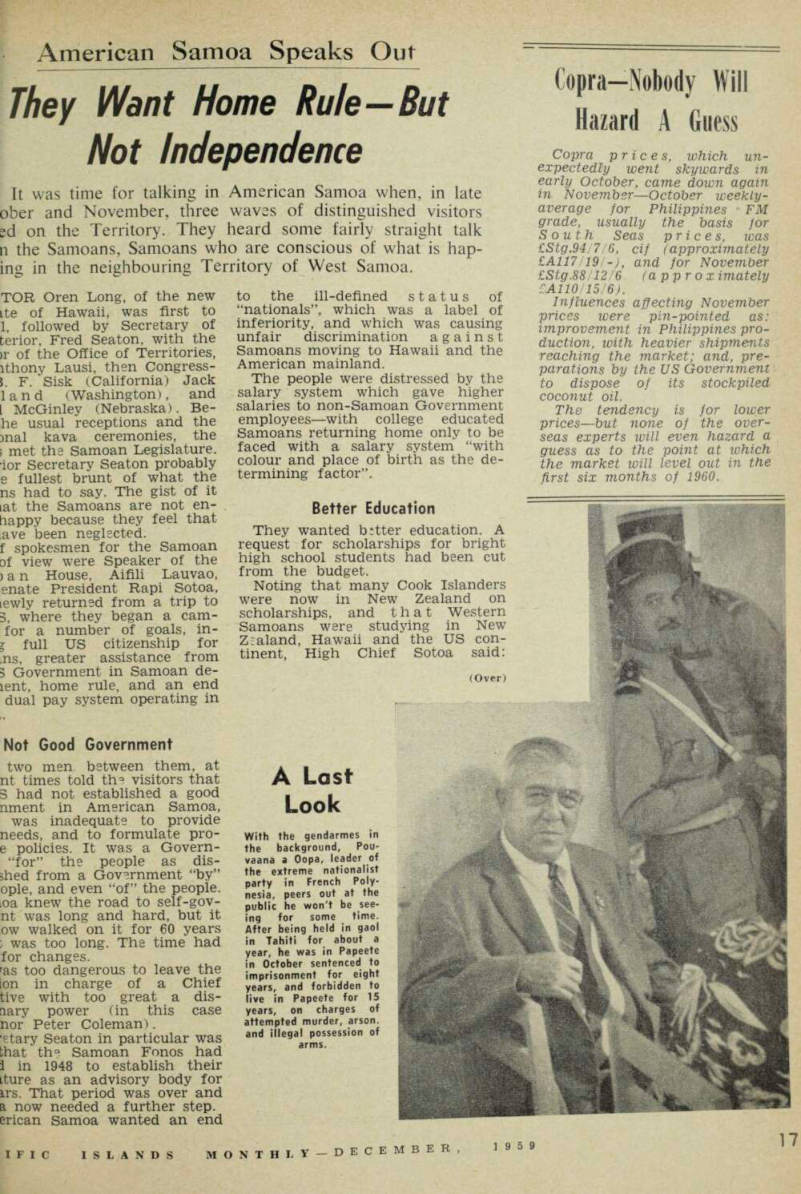
A Last
Look
With the gendarmes in the background, Pou vaana a Oopa, leader of the extreme nationalist party in French Poly nesia, peers out at the public he won't be see ing for some time.
After being held in gaol in Tahiti for about a year, he was in Papeete in October sentenced to imprisonment for eight years, and forbidden to live in Papeete for 15 years, on charges of attempted murder, arson, and illegal possession of arms.
“Such news arouses in us a feeling of inadequacy and inferiority. How long are we to be slighted, ignored and treated as unwanted? We are surroynded by the British and the French. We represent the wealth power and prestige of the greatest nation in recorded history and by the policy laid down, we the national Americans are kept ignorant, un tutored, poor and unwanted”.
The visitors also heard com plaints about the poor state of the roads and other facilities, the Samoans always being told there was “no money”. The people wanted new industries and better utilities.
No Roads
Mr. Seaton was told, “The De partment of the Interior must face the horrific truth that not a single inch of roadway has been paved since the transfer of the Ad ministration in 1951 from the Navy —a deplorable and highly unspec tacular record for so great a de partment of Government.”
Mr. Seaton also heard some words of criticism of Governor Coleman, who he was told, allowed importa tion of hard liquor for the exclusive Goat Island Club, although it was prohibited for sale in American Samoa.
High Chief Sotoa concluded that a joint resolution of the both houses of the Fono had demanded that Samoa be given home rule, with the Fono empowered to make laws; that the people be granted full US citizenship; that Secretary Seaton assure the President and Congress of the US that the people of Ameri can Samoa had no intention for independence; and that the Secre tary make it clear to the President and Congress that American Samoa had no desire for a union with Western Samoa; and that the Secretary make it clear that Samoa had no desire for Statehood.
Senator Oren Long later went on to NZ and P-NG, and talked about the American Samoan situation along the way.
In Wellington, he said the people of American Samoa were happy and there were at present plenty of occupational opportunities there.
However, if the Territory were to run into a period of economic dif ficulties the people might change their attitude and seek independ ence. If most wanted it, they could have it.
In Port Moresby, he said American Samoa would rather remain poor under the American flag than join New Zealand and be rich.