Pacific Report
pp. 119-136 · Read in the full issue


The month’s round-up of news and pictures of people and its, from PIM correspondents in the South Pacific.
Big Wharf Job
I Swing
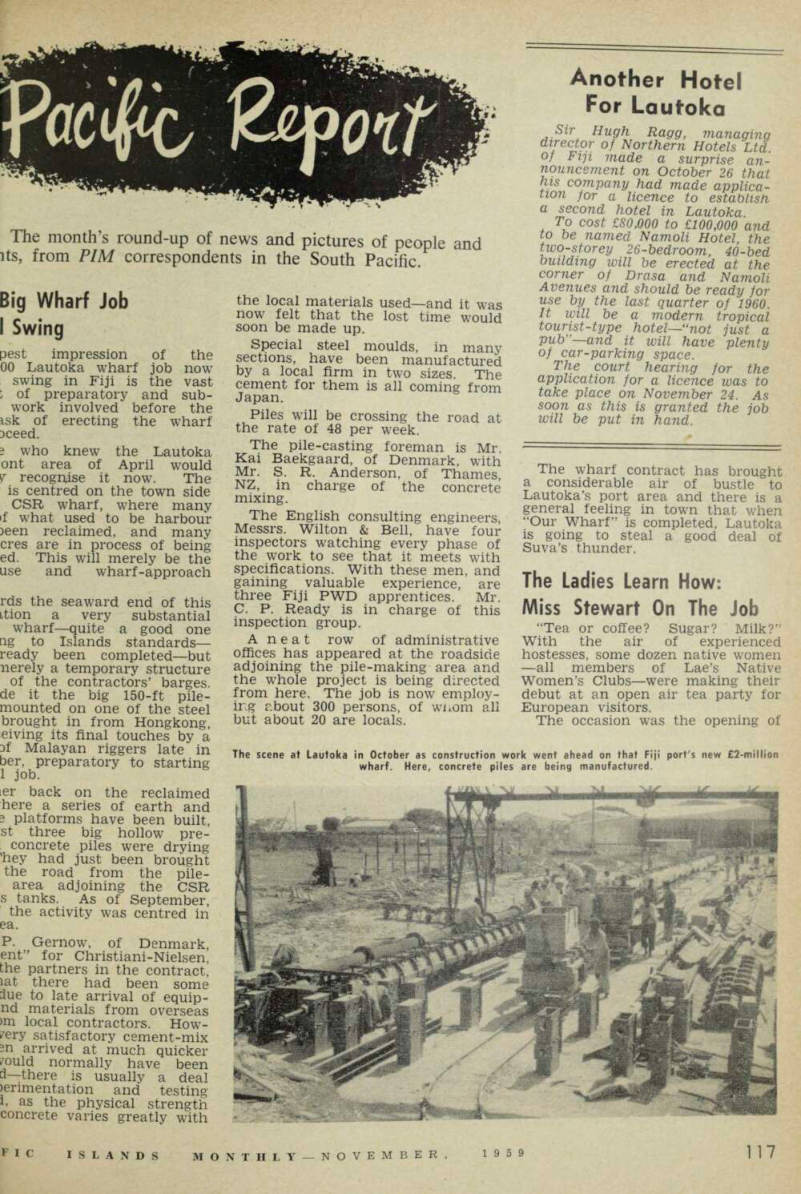
pest impression of the 00 Lautoka wharf job now T swing in Fiji is the vast : of preparatory and sub work involved before the isk of erecting the wharf Dceed. 5 who knew the Lautoka ont area of April would V recognise it now. The is centred on the town side CSR wharf, where many if what used to be harbour ieen reclaimed, and many cres are in process of being ed. This will merely be the use and wharf-approach rds the seaward end of this ition a very substantial wharf—quite a good one og to Islands standards— ready been completed—but nerely a temporary structure of the contractors’ barges, de it the big 150-ft pile mounted on one of the steel brought in from Hongkong, eiving its final touches by a Df Malayan riggers late in ber, preparatory to starting 1 job. ier back on the reclaimed here a series of earth and 3 platforms have been built, st three big hollow pre concrete piles were drying 'hey had just been brought the road from the pile area adjoining the CSR s tanks. As of September, the activity was centred in ea.
P. Gernow, of Denmark, ent” for Christiani-Nielsen, the partners in the contract, lat there had been some Sue to late arrival of equip nd materials from overseas >m local contractors. How /ery satisfactory cement-mix m arrived at much quicker /ould normally have been d—there is usually a deal )enmentation and testing 1, as the physical strength concrete varies greatly with
the local materials used—and it was now felt that the lost time would soon be made up.
Special steel moulds, in many sections, have been manufactured by a local firm in two sizes. The cement for them is all coming from Japan.
Piles will be crossing the road at the rate of 48 per week.
The pile-casting foreman is Mr.
Kai Baekgaard, of Denmark, with Mr. S. R. Anderson, of Thames, NZ, in charge of the concrete mixing.
The English consulting engineers, Messrs. Wilton & Bell, have four inspectors watching every phase of the work to see that it meets with specifications. With these men, and gaining valuable experience, are three Fiji PWD apprentices. Mr.
C. P. Ready is in charge of this inspection group.
A ne a t row of administrative offices has appeared at the roadside adjoining the pile-making area and the whole project is being directed from here. The job is now employ ing about 300 persons, of wnom all but about 20 are locals.
The wharf contract has brought a considerable air of bustle to Lautoka’s port area and there is a general feeling in town that when “Our Wharf” is completed, Lautoka is going to steal a good deal of Suva’s thunder.
The Ladies Learn How:
Miss Stewart On The Job
“Tea or coffee? Sugar? Milk?”
With the air of experienced hostesses, some dozen native women —all members of Lae’s Native Women’s Clubs—were making their debut at an open air tea party for European visitors.
The occasion was the opening of
The scene at Lautoka in October as construction work went ahead on that Fiji port's new £2-million wharf. Here, concrete piles are being manufactured.
i grass basketball court at m Village, and one of the ;hts of a four day Welfare ig course organised by Miss i Stewart, of the South Commission, ors included Morobe’s District ssioner, Mr. H. L. R. Niall, let Office personnel, two e Officers —Misses Lois Niall, at Ure from Port Moresby, crested native and European ier welfare workers from Lae, Finschhafen, Dregerhafen, and Kaiapit. le basketball opening visitors irst “danced” into a large louse. Here they were treated :s, dances and games by the clubs. Many of the club rs wore smart uniforms they learned to make on es in the nine months since bs came into being. the entertainments, two women’s teams played off irst basketball match with md more especially with a. There were no longer icas that often ended in isticuffs when the game was troduced.
Stewart’s course embraced on village hygiene, house gardening, child welfare, health and cleanliness, songs and rounds.
Stewart’s method of teaching gely by use of a flannel and by play acting. The raph comprised a series of backed pictures which when ) a flannel sheet remained ion and could be easily re md replaced again by more le play acting, Miss Stewart d how the women members flubs should be divided into ups. To get home the idea ?e cleanliness for instance, □up would act “a dirty and the other group “a .lage and its consequences”, ethod not only gave the something to think about ent for self expression and 'ought out hidden talents.
Stewart has not long been :d to the SPC, but she and k will soon be better known DUt the South Pacific.
ings They
of Doing
l a census of the number s and turtles inhabiting Frigate Shoals, recording its and squeaks of a variety sea marine life, and record- TV and movie camera the labits of commercially use -sea fish were some of the tasks undertaken in a 3-day research cruise by the i & Wildlife vessel Charles -rt from Honolulu, essel, which was under the a of Captain William
Tanaka, made a wide circuit round the Hawaiian Is.
A close study of the feeding habits of tuna and similar fish and their reaction to various kinds of bait fish, to agitation of the sea surface in the fishing area with a high-pressure water hose (simulat ing the activity of a school of small fish on the surface), and to various sounds, was made possible through . use of a P la stic observation “blister” fitted to the bottom of the research vessel 7-ft below the water line.
Modern electronic submarine detecting equipment depends upon the recognition of sounds peculiar
to not only undersea craft but to fishes and whales, and some work on this cruise was sponsored by the US Navy which had two representatives aboard. The US Navy is compiling a llbra *7 of the sounds of the m L a f n d f S° me rec °rdings were made in this connection, in co operation with the submarine Carp.
In addition to this special work the routine work of an oceano graphic survey vessel was also conducted—the sampling of the ocean at various depths for salinity
temperature, zooplankton, etc.
A number of the Department’s shore staff were taken along to
•ise themselves with the 3ing undertaken. Some of vie films will probably be for public interest.
Average Losing
1 Tokelaus
dng the enormous scientific s made over the past 20 l the field of soil improve le can scarcely doubt that Ac’s infertile atolls will one made to produce many new it for the present about the nmercially interesting crop aces like New Zealand’s okelau atolls can produce ow profitable that crop can ch territories is seen in the annual report just pub which shows that in an y good year of output and :here was a nett loss in is of £1,087. eason for this is seen in > that to get their copra r orld’s markets the Tokelau there are no outside traders all—have to charter a ship the produce in Apia. Three voyages of the 297-ton Jssel Kurimarav. during the t them £3,975 of which only s recoverable in the form nger fares and freight on ?oods. Other handling sacks, lighterage at Apia, to £2,325. ’alue of the 230 tons of t the Tokelaus, was £5,374, is already stated, was less - costs involved by £1,087.
On top of this problem, the report points out that up to 40 per cent of the coconuts are devoured bv rats on some of the islets of the three atolls. To meet this problem some 9,000 palms were fitted with alu i n i mum bands at Atafu in 1957 and further banding is to be carried' out at Fakaofo this year. Other works projects interrupted that programme during 1958.
To overcome the adverse expense receipt ratio a drive is being mad* by the Administration and the New Zealand Government—who sub he.Group to the extent of £24,858 last year—to improve both quantity and quality of copra.
As a result of three men being sent to Apia to study copra pro
duction there has been a striking unprovement in the matter of quality since 1955, but until the quantity can also be substantially increased the cost of getting it to proportion" 8 * C ° n * lnUe t 0 be out o£ A copra stabilisation fund is being gradually built up from a iToL£ n -f n . C 0 ? ra ex P° r ted and last aich it stood at £5,085, of which £5,000 is invested in New Zealand securities.
These atolls are subject to con siderable variations in rainfall most of which is in heavy down pours from thunder-showers. Some years a lot of such showers score hits on these very small atolls as they drift past, and in other years
re many hits. The copra fluctuates a good deal in 'h o the e outlo V ok lt for mother
’ shelf and trorhns
ticularly bright at present! n industry does offer a long-range alternative to nd the report says that Mr Pel, Fisheries Officer for th Pacific Commission, re- ’avourably on the possibility ilishing shell beds in two three lagoons, Fakaofo and 3 not possible for Mr. Van make an investigation of no, but there is no reason to that it would not be. equally
r llnhannu Auor
r unnappy uver
rw 7 c Arrrvimtf i y a MLtUUmS Vustralian Auditor-General 3er, having studied the acof the Papua-New Guinea tration for the year 1958-9, ome very harsh criticism ! of the things he found mple, he said the Adminihad: sted money on contracts for )f timber. •wed privately owned boats y • ied to account properly for items of furniture and nt at hospitals and other mients. ight electrical equipment
for a technical training centre and never used it. •Generally kept unsatisfactory control over tools and equipment an f I 6 training centres, * Failed to keep reliable records of the cost of bricks manufactured administration works for Terri tory building projects, He also expressed sharp dissatis faction with the way in which the accounts of the Port Moresby electrical supply undertaking, the water supply undertaking and the town’s Government-owned bus services had been kept, Every so often, Government auditors rise up in wrath, in this way, and show that there is some thing seriously wrong with Govern mental handling of public money; it is not the first time it has happened in P-NG. But one never hears of either a bumbling Politician or an arrogant bureau- S rat ’ a ? a re !V lt ’ b £ mg booted downstairs, as they often deserve to J*®- . . .. .
What chance is there of any remedial action being taken in the Territory of Papua and New Guinea?
New P-NG Director of
Agriculture Appointed
It was announced on October 23 that Mr. F. C. Henderson had been promoted to the post of Director of Agriculture in Papua and New Guinea, rendered vacant on October 3 by the death of Mr. Larry Dwyer.
Mr. Henderson has been a leading man in the Department for many years—latterly as chief of the Division of Plant Industry. He joined the service in New Guinea in the ’Thirties, and was an Agri cultural Inspector and Instructor under the late Mr. George Murray before World War 11.
After the war, when the Depart ment was reconstituted for the two Territories, Mr. Henderson became Economic Botanist and, later, took charge of the Division of Plant Industry under Mr. Dwyer. He has acted as Director on occasion.
Some Good Advice
From The Governor
This year’s Cession Day address by the Governor of Fiji, Sir Kenneth Maddocks, was something in the way of a “softening up’’ process to prepare the people for the report of the Burns Commission, which finished its work in October. Sir Kenneth’s address was broadcast on October 12 to mark the anniversary, on October 10, 1874, when King Cakobau and the high chiefs of Fiji ceded the country to Queen Vic toria.
But most were in agreement that Sir Kenneth’s address was both frank and sane.
Sir Kenneth said, among other things: “If we are to comply with the spirit of the Deed of Cession we too must be ready to adapt ourselves to new ideas and changing conditions. There is a tendency in all countries for people to cling to the past and to be apprehensive of change. . . . During the coming year we shall be studying the recommendations of the Burns Commission and the Spate report and we shall have to do some vitally important stocktaking.
“If as a result of this, some changes are suggested in ways and habits to which you are accustomed, I would say to you—keep your minds open and do not assume
Fiji's Governor Sir Kenneth Maddocks . . .
He had some good advice to give in his Cession Day address.
e old ways must always be ;han the new. us look into the future with me spirit of courage and ition that was shown by u and let us avoid that mis hich is so commonly made ig to leisurely and so too
a Another
to Tonga's Bow
it unawares, Tonga seems ion to become an important i the Pacific vanilla trade— ent almost entirely in the )f French Polynesia. 3 Tungi, Tonga’s Prime ", said in September that now has some thriving plantations and that reports )les of the Tongan product, erseas, gave promise of a iluable alternative industry island. ; Tungi was en route to n search of a vanilla-curing ■a field in which a number tese have specialised there.
Polynesia has a long history iction of high-grade vanilla. ; Tungi said that about 1953, npt was made to introduce from Tahiti to Vavau. This ut as a result of the interest it was then recalled that h priest had introduced the Tonga at about the turn century. For one reason or this plantation had been led and was long since for tnd overgrown with weeds, igation showed that those had propagated themselves ead wild through the bush, lese plants, new plantations en established and overseas indicate a vanilla content of ns equal to the best in the uld be, said Prince Tungi, thin a few years the rhino etle infested coconut planta : Vavau make take second o this promising industry.
The crop is now approaching maturity, at a time when vanilla prices are very high.
Pollination of the plants is done by hand—bees cannot do the job satisfactorily. The commercial suc cess of the industry then depends on the correct curing of the beans and the early establishment of a high reputation for the Tongan product on the overseas market.
The Bush Hasn't
Changed Much
With a twinkle in his eye Dr. E W. Brandes said in Lae in October that New Guinea was no different
now to what it was when he last visited it in 1928.
Nobody believed him, of course but he explained himself.
“The country is the same now irom the air as it was 30 years ago —-but your town—ah! now that’s a different matter!” •.r>^ h , en Dr - Bran des were here in 1928 he was with the US Depart ment of Agriculture, and he was collecting sugar cane.
He hew about then in what was the latest type of amphibian air craft, which frequently set down on unknown rivers. “Your boys were then hying some very antiquated little planes and looked with envy at the very modern air
e brought with us”, said the this visit Dr. Brandes is a collection of bananas. b of a serious banana disease deal America he is looking ive bananas for hybridising 3 create disease resistant s. 11 take two years to collect s in 11 Far East countries, ext port of call for Dr. s will be Netherlands New and then Borneo. tie will make arrangements eral field parties to operate r Guinea after him. whole programme is a co /e one between Govern and private enterprise, ed by the United Fruit ly, of Boston.
Home Truths
jstralian Liberals
ely debate on political con and public feeling in Papua ew Guinea took place in at the Fourteenth Annual tion of the New South Wales of the Australian Liberal in mid-October.
Lane Cove branch of the submitted a motion to the that Territories Minister : be congratulated on sub g direct for indirect taxation ma and New Guinea, and le Government should keep in mind the need for ig the democratic rule that who had to pay taxation be represented in Parlia nately, there was a delegate Mrs. Millard Hagon, of e Hill—who had lived re in New Guinea, and who something of the conditions
and the strength of publilc feeling there She moved an amendment that the Convention urge that New Guinea be given a direct repre sentation in the Federal Parliament by a man whose domicile and interests are in New Guinea; and she told the Convention some home truths about P-NG’s attitude towards the Australian Government.
There was a long discussion and opposition to Mrs. Hagon’s amend ment was led by Mr. C. C M Usher, who is known as an industrious writer of letters to newspapers.
A very large majority of the 500 delegates present carried Mrs.
Millard Hagon’s amendment, and congratulated her on the forthright
way in which she had presented the views of the now unrepresented non-official people of New Guinea.
Niue Is Better
Than We Said
In the new edition of the Pacific Islands Year Book, there is a libel upon the port of Niue, the small NZ Territory east of Tonga.
The book, at page 61, says the boat passage is shallow and even dangerous. This may have been so once—it is not now. The NZ De partment of Island Territories re ports: The boat passage at Niue now is
deep, and easy to work, ex i a heavy swell. Niue wharf t suitable —it has been ex and can accommodate trucks. The hand crane Is > of a 10 tons lift, and the stration also uses a “Hyster” loading. The cargo lighters to 27 feet long. There are zer supplies available in that
-Or Else! Councils
ative Vagrants
mt natives, detribalised and sophisticated that they will lour labour contracts and so employable, are becoming a :e around some New Guinea Two local government coun ative) in the Rabaul area issed laws to combat growing :y and prostitution, councils are trying to force -bodied men and unmarried to either seek employment k regularly in the villages’ rdens. If they refuse, there e a fine of £5, or a month calaboose. e Affairs officers are co ig. They say that these young natives are respon r much of the petty crime the towns.
Break Their Labour
icts—And Go Free
failure of the Papua and Guinea Administration to natives to observe the la contracts (see above) was r criticised by Mr. J. L. •, of Rabaul, when he for resigned from the Legisla uncil (to which he had just ected) on September 30. ieclared that the Minister led the Territorians in many ;, so that the Legco had be aeffective and useless; and hasised the difficulties being for private enterprise gen by native indifference to labour contracts, ng in South Pacific Post on 17, Mr. Michael J. Leahy, New Guinea’s oldest and lown settlers, said; ■w Guinea native has no economic )n to work. He only does so to ook around the country or to get >m trouble in his village—unlike man, who does not eat if he does law stands now, native labour is impossible to work. They are threatening and ridicule the ! the law. ne is much too afraid of Mr. > pro-native phobia to attempt ! to control them. They can de ore an employer and an Adminis official that they will work for a t their issue of blankets, clothing, n without striking a blow, they with the lot.
Try and imagine what they are going to develop into in a generation.
The punitive clauses were re moved in 1947 from the Native La bour Ordinance by Socialist Minis ter Eddie Ward. In this, he since has had the endorsement of “Liberal” Ministers.
In fact, Mr. Hasluck goes fur ther, describes Territorian traders as “locusts”, and in Australia’s Parliament on September 30 “warned Australians not to look on New Guinea people as a mass of cheap labour for exploitation”
He was heartily cheered by the Socialist Opposition.
Under the Hasluck dictatorship, private enterprise in New Guinea —without which there can be no
sound progress, either economic or
discouraged 8 being systematically
Ambitious Housing
Scheme for Lautoka
It s expected work will commence on a large housing scheme adjoin ing Dravuni Street, Lautoka, by the end of the year, as the result of a recent meeting between the Fiji Housing Authority and the Lautoka Town Council.
The scheme involves an attractive layout of more than 100 houses of several designs and of a type within the means of the £6-£l2-per-week wage earner, similar to the scheme at Raiwaqa, near Suva. (Over)
Lautoka building will be I round tht e e landscaped >aces with footpath access to ses. There will be provision Dping and community centres ler amenities. nts will be given a pro ry period of two years and are found satisfactory will 5 given the opportunity to e the houses over a period o 20 years. first 28 tenants for houses Raiwaqa scheme will in- II Fijian and 10 Indian of the Raiwaqa low-cost, torey houses are already ed and the first of the duplex two-storey buldings seted to be finished in early er. Each duplex will accom nine persons. Overseeing of the project now is Mr. adams, who resigned recently th Officer of the Suva City to take up the post of re Secretary of the Housing by.
American Samoa Shelves
Liquor Rationing
American Samoa is one of the few Islands Territories where there is no system of beer rationing, and it is apparently going to remain that way for some time yet.
As a result of certain Samoans being admitted to the Goat Island Club, which has in the past been reserved to overseas membership,
there have been negotiations be tween legislature and governor re garding the extension of the spirit rationing system to include spirits consumed in the Goat Island Club.
However, it is believed that on the governor’s insistence that any rationing system must include also beer, which is at present available to all, the matter has been dropped.
It appears likely, too, that Goat Island Club membership may be restricted as in past to avoid ill feeling.
Colonial Development Will
Help Fiji Build Roads
It may safely be assumed that one of the recommendations of the Burns Commission will be for a major programme of road building in Fiji especially feeder roads to inland agricultural areas.
Apparently in anticipation of this —though its need has been clear enough—the Fiji Government has announced plans for the setting up of a feeder road construction unit, to begin work next year in the Western Division of Viti Levu. Some 75 per cent, of the initial fund of £33,000 required for road building equipment will be provided through the Colonial Development and Welfare Fund by the United King dom.
Such CD & W funds could not previously be used for feeder road building, though a grant of £280,000 was made to the Colony for major development roads. Approval has now been given for the use of some of this fund for feeder roads.
Because of lack of funds for feeder
i the past it has been neces i build many sub-standard Either than lesser lengths of eder roads. The first move 11 be to bring the low-grade ip to standard by proper ;, drainage, etc.
, Tonga, Stage a
\\ Invasion of Fiji
ige band from Savaii Island, Samoa, in bright uniforms, Suva in October by parad ugh the city completely un l, and a week later a Tongan opped in for a brief visit. »and was from Lelepa and aded by one of Western leading musicians, Suva imoan Sauni liga Kuresa, bound for Tonga on a visit il weeks. The 46-piece band in the Islands’ vessel Tofua lained in Suva for a week the Tongan vessel Aoniu. confusion was caused dur band’s initial march from arf to Albert Park. The 5 were very similar to those iji Military Force band and eople did not realise that 5 another band. However, ng amusing evolutions, le FMF Band, this one did 1 steps, and about faces, as i on its way, and there was aare-chested gentleman out ■aring a tapa lavalava. ; next appearance, however, had changed its red jackets s and was also sporting aps just made in Suva, onstration game of Samoan cket was a major feature isit (see Sport Review). lelepeku Club choir from ame up to Suva to record ns in the FBC studios. This doir that sang during the sit and has impressed with singing on other important ;. At the end of October,
lents were looking forward
ig the choir over the air.
arotonga
I Coming
Minister of Island Terri- Jr. J. Mathison, said in ;a during his recent visit te had now been approved ew hospital at Rarotonga ce the present outmoded The building will be n stages.
ie Crop (And
) Higher
iimate of the current Fiji >P made in June—2so,ooo s raised by the CSR to an of 282,000 tons in October )mpany believed that this
amount would be reached if the crushing went ahead smoothly and the weather held good, but it would take until the end of January to complete the harvest. Only 123 000 tons can be exported in the 1959 calendar year, and some of that amount would be taken up bv carry-over from the 1958 year The free-market price has risen slightly since the middle of the year and the price after the end of 1959 is estimated at about £Stg.24/l/6. price average for ~i2 59 <l uota export is estimated at £37/16/-, which will permit an actual sugar-cane price to farmers of about £F3/1/- per ton, except for the Rewa Valley cane which is of lower sugar content.
In a further CSR statement the company summarises the situation and outlook for Fiji sugar pro duction and exports.
This shows that the International bugar Agreement export quota for 1959 is 179,000 tons of sugar and for 1960 will be 184,000 tons To these figures may be added local consumption and sugar sold to nearby Island territories which does not come within the quota limita tion. This amounts to about 15,000 tons annually. Thus the total amount of disposable sugar in 1959 is 194,000 tons and in 1960 will be 199.000 tons.
It is also considered good busi ness to maintain a reserve stock of 50.000 tons at the year’s end in case of a free-market demand. (Over)
For 1959 the sugar producer that carried over from 195S< amount to 306,000 tons. Then; thus be 62,000 tons in excess normal reserve of 50,000 to;c hand at the end of this year., 35.000 tons of this will have stacked in the open uj tarpaulins.
Because of this big surpliu CSR mills will not purchase 200.000 tons of standing can© the farmers next year.
The Sugar Agreement specifies that Fiji may not more than 40,000 tons of suj stock in May each year—tl immediately prior to the comn ment of the cutting season this year overlaps intot calendar years).
The reduction in the quan cane which farmers may gro< year will be offset to some apparently by the estimated price.
Prison Sentence For
Club Treasurer
Otto Louis Wendt, of Suvs ployed as treasurer of the Club, Nukualofa, Tonga, was guilty in September of the ulent conversion of £BO2 in funds and was sentenced Chief Justice of Fiji, Mr.
Lowe, to three years imprisc Because the accused is Tongan, the case fell with jurisdiction of the Court High Commissioner for the Pacific, and Judge Lowe w Nukualofa especially to he case. Wendt was represented] Moti Tikeram, and Mr. P. 1 of Suva, conducted the case prosecution. It was expecte an appeal would be lodged.
Training Course Urged
For Migrating Islanders
Islanders should be requ undergo a course of train adapt them to the impact oF pletely different way of life being permitted to migrate Zealand.
This was the substance address given by Mr. M. G. headmaster of Reparoa Distn School, NZ, and formerly a to the LMS Mission at Niue when he spoke at a Rotoru Club gathering in October.
Mr. Check noted that h of Islanders were arriving Zealand each year and prepared for the completely < society there. He said thi arrived in Auckland and down six families in a hou first person they meet on tH is some old friend “who hr on the booze for six years”..