Pacific Shipping And Cruising Yachts
pp. 103-113 · Read in the full issue
Recommendations at a recent marine court of inquiry in t Moresby regarding the operation of shipping radio net •ks just echo a long-expressed opinion among responsible rators.
Marine Board recommenda ns covered two main points— -3 need for at least one shore l to maintain a 24-hour radio and the need to require to indicate their arrivals in inquiry that led up to these nendations was into the loss s Papuan coast last July of istal ship MV Muniara. (See r PIM ). All hands were lost European master, Captain E. and 14 native crewmen.
Marine Board, which con the inquiry, found: miara probably capsized roaching-to in the prevailing e ship was seaworthy at the f its voyage, but was under i in that it did not carry a 3 engineer. ?al action should be taken the owners, Steamships I Company Ltd., in respect undermanning. ; points represent the out )f a specific case, but the interest in New Guinea is on the board’s remarks ing radio contacts. w Guinea shipping man put tter neatly earlier when he Jnder the present system, if answers a scheduled radio J know that the ship is it; but if it doesn’t answer i, we don’t necessarily know is not all right”.
His summing up of the situation is very true. If an aircraft fails to make a scheduled contact a first-stage alarm is declared. The alarm increases in seriousness as subsequent contacts fail.
With coastal shipping, however, failure to answer a call could mean a number of things—the skipper of the ship may be doing something else; or the ship may have reached port without bothering to notify coastal radio.
In most cases, therefore, the mere fact that a ship has not answered a call is no cause for alarm. Responsible shipping opera tors feel that the weakness of the system lies in this fact.
They say that radio sets should be rigidly and regularly surveyed to minimise breakdowns, and that the law should demand that the sets be used regularly during voyages. Most operators attend to these requirements already, but there is no compulsion and so some don’t.
If the requirements were legally enforced, it would provide greater protection for all shipping, and could be implemented with little trouble at this stage. The obliga tion would include notification of entry into ports as envisaged in the recent marine court finding.
Several masters and operators have been suggesting a scheme of this nature for some years, and the scheme was urged in a section of the Territory Press a little over a year ago.
• New Master For Coral
QUEEN : Following the Commission of Enquiry held into the grounding of the BSIP Government vessel Coral Queen off New Guinea earlier in the year, the Government has relieved Captain Wilder of his duties. His successor, Captain Fahlanger, is not new to BSIP waters having previously served on the Australia-West Pacific line vessels as Chief Officer and Relieving Captain and later as Master of the Aros and Delos.
Captain Fahlanger has also served with the Swedish Navy.
It is expected that he will arrive in Honiara towards the end of this year.
A new Superintendent of Marine has been appointed for Honiara.
He is a Mr. Campbell and apart from the fact that he spent some time in Cyprus before being ap
pointed, no other details are avail able. • ONE LESS NG SHIP; A 60-ft patrol vessel owned by the Papua- New Guinea Administration ran aground on the north coast of New Guinea early in October and broke up.
The vessel was MV Ela, which was carrying about 12 natives, including the skipper. There was no loss of life.
The wreck occurred in the Wewak area. Some equipment and possessions in the vessel were salvaged.
• Tenders For Patrol
CRAFT: BP’s, as agents for the British Administration in the New
5, are calling tenders for a 68-ft patrol craft for gov ; use in those islands, ed by twin 5L3 Gardners i a speed of about 10 knots, jper sheathed vessel has ;signed by Mr. Arthur N. 1, AMINA, of Sydney, who gned other Island craft in those recently built for the ian Mission, and the Con m Government’s four-year ; Rocinante, built by Wynne m of Newcastle, NSW.
Dresent craft will have a ‘ 18- ft and a draught of i will have two, two-berth o four-berth cabins for passengers, and a cargo of four tons. She will be vessel owned by the British tration since the 120-ft acht Euphrosyne was dis in 1928.
Lose Rubber Rafts;
the rubber dinghy and life ; been the means of very ially reducing loss of life world’s fishing fleets, and almost all modern vessels ig fitted with such rafts, 3 still some distance from approved by maritime es as replacements for rigid f the difficulties is the fact ost of them cannot be with the passengers and it is not easy for old or in some circumstances mg people, to board them vater. Another difficulty is y must be examined by the turers and repacked every months. No accredited turers’ representative cap performing this function is anywhere in the South slands area at present. The e also expensive, people were wondering why government patrol launch
Ra Marama had to be specially fitted with wooden lifeboats when she recently made a voyage to Tonga, though she is fully equipped with rubber rafts. The above are the reasons why British, and Fiji, maritime law still does not permit such rafts as sole equipment on foreign-going voyages.
• All Under Control: The
lamb-liner Delfino, on her second voyage from Sydney to San Diego, USA, with 25,277 lambs aboard — less an insignificant few which had died of blood-poisoning after sailing—passed through Suva on October 22.
Captain A. Lucas told a PIM rep resentative —who was kept off at a distance by a strict quarantine— that the experience gained on the first voyage was now paying off.
The losses that had occurred were through shearing wounds —the lambs had been shorn on New Eng land, NSW, sheep stations imme diately prior to being sent to the ship by road trucks. There are always some deaths from this cause following shearing.
Delfino took aboard 554 tons of fresh water from four hose-lines at Suva during an 8-hour period.
• It Can Happen To You:
Some time ago it was mentioned in this column that many areas in the Islands are still classed as po tentially dangerous due to mines.
What was reported by local vil lagers to be such a mine was washed up on Na Viti Island in the Yasawa Group of Fiji in early October. Up to late October, ar rangements were still in progress to send a qualified person out from Lautoka to confirm that the object was in fact a mine.
• Getting Down To Busi
NESS: The Cook Islands at last have a proper machine for deepen ing those dangerous shallow reef
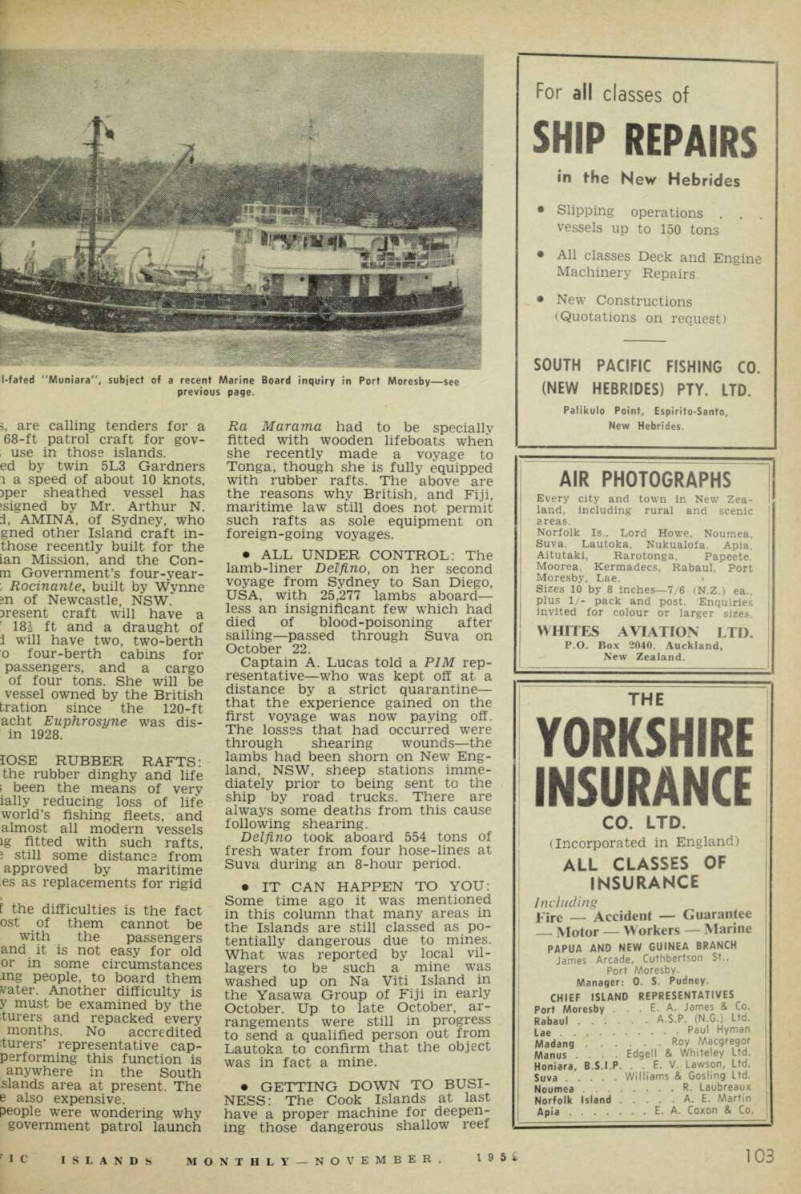
l-fated "Muniara", subject of a recent Marine Board inquiry in Port Moresby—see previous page.
js. It is a Hydromaster drill : capable of drilling 12-inch er holes in coral at “a fair machine, now in use at Atiu cost £6,000. The holes it vlll be filled with explosives series of charges will be lectrically in a single blast.
French Visitors: The
a-based French patrol vessel vas again in Suva for dry j in October, under command itenant Y. H. Cerbelaud and i total complement of 31. tant Cerbelaud said on that slow progress is still made on the new Noumea slipway, hence it is still ry for his vessel to come to
Quiry Coming: A Marine
preliminary inquiry into the f the small Fiji vessel )ou as the result of a colli ith the government vessel I on the night of September ided in Suva on October 23 formal inquiry was “both ;e and expedient” Mean the certificates of both i have been returned.
Guarding The Sea
: A big maritime reconnai and communications exercise ace throughout the ANZAM area of the Pacific between • 12 and October 24. Not mblicity was given the exer t it involved the location by •econnaissance and the plot the exact positions of all 1 merchant ships, and the J of the positions of all non- I merchant ship positions the radio reports received hem and from other infor exercise—in effect a war - —was controlled from Can- The British section of it led Operation Sea Lanes and nerican section was called '■on Rex. Military aircraft in the Islands were en
gaged. It was a practice run in the diversion and protection of mer chant shipping.
• Operation Sayonara:
While the above exercise was in progress another exercise, reminis cent of the secret wartime German raider operations, was in progress west and south of Fiji—except that there was no secrecy about these October manoeuvres, which repre sented the closing moves in the Japanese mother-ship tuna fishing operations in the South Pacific for 1959. Other fishing boats might be sighted after mid-November, but they will be longliners sailing in dependently from Japan and not as units of a mother-ship fleet.
The mother-ships Tenyo Maru No. 3 and Nojima Maru had com menced 1959 operations in waters adjacent to the Gilberts at the end of May. As the season progressed the fleets moved slowly south to about 30 degrees latitude —with the longliners operating to 40 degrees
south. Tenyo Maru No. 3 was re £sS ec L to . Japan earl y September, and the other, early October, and they were replaced by Koyo Maru and Jmyo Maru. The Jinyo Maru fleet remained at about 20 degrees latitude seeking—with disappoint ing results—the most valuable alba core which is the mainstay of the Japanese export trade to the United States, while Koyo Maru tried her luck, with success, further south m harvesting of the less valuable Australian blue-fin tuna east and west of New Zealand.
By mid-October the mother-ships were getting low in bunkers, which they feed out to their fleet vessels as they come alongside to discharge their fish and to load ice—which is brought from Japan and not manufactured aboard. To meet this situation the small Nitto Line mo lasses tanker Juyo Maru was jointly engaged to deliver a thousand tons of oil to each mother-ship on the high seas. While awaiting her first rendezvous with Koyo Maru this vessel lay in Suva harbour for several days carrying out routine engine maintenance. Captain Kazuo Yagi, 38, in command, served his time in the petrol tanker trade be tween Indonesia and Japan during the war years, and was one of the few to survive.
As a postscript to the 1959 season it is interesting to note that Japan’s first atomic powered vessel, soon to be laid down, may be a 3,000 to 4,000-ton fishing mother-ship, with an American-type reactor supply ing heat for an 8,000 shp steam turbine motor, and with a 120 hp
For Tonga
The new 35 ft, pilot boat " Unga" which has been built by A. and G. Price, Ltd., of Auck land. She is now on the job in Tonga.
ANOTHER FOR TONGA: "Lolo Maana'ia", Tonga's new oil barge, with Auckland's nearly-new harbour bridge in the background. Built by A. and G. Price, Ltd., Auckland shipbuilders, the tanker is 112 ft. long and is designed to be towed behind "Hifofua".
for emergency use. The re and its heavy shielding will 1,100 tons. The atomic id vessel, disregarding the t cost factor, would seem to rticularly applicable to this
Tshing—And Talking:
Japan catches fish, and moves towards a tuna fish iustry, the outlook for any r iji-based industry does not bright. The overseas half capital is available, but the substantial half required for >le venture does not appear forthcoming. is interesting to note, during mth, that a spokesman for ia’s chief tuna cannery said was useless trying to com i world markets for canned rapan and the US had the y sewn-up.
J. Vinnecombe of Australia, eturned there as super ry mate in the tug Shell-40 )ber, said that he would be Fiji waters in a few months fishing vessel. He would not i fishing, however, □-incidence a fishing vessel might have been ideal for 'pose, passed through Suva te to Australia in October.
Isahel-May, this ruggedly ttle 47-ft by 14-ft by 6-ft yas bearing Welshman R. ; and his 20-year-old ir Ann to Sydney to settle.
Bssel, fully equipped with dectronic fish-shoal locator, it coiling winch, and trawl ipment, was for sale. Some hes were made to possible in Fiji while the County uilt craft lay in Suva. aboard was a young i. A Mauritius navigator, ined at Papeete, flew back ) rejoin his yacht Eve, and expected that a member of ZAF, on short leave, would navigator to Brisbane—if a nth the hard cash was not ning in Fiji.
ULA BLUES; Moving at i a somewhat erratic course, : Shell-40 was finally de to Brisbane in October. She rlier been towed back to ith fuel-line blockages, after leaving on her second trouble developed in the ic steering gear and this ed across towards Noumea epairs were made. En route ► cruised for several miles Japanese buoyed tuna-line, in Henry Simpson and his ;w back to Suva from Bris-
Jsiness Is Brisk: Pago
new $BO,OOO marine slipway, came into use on June 10, mdled about 30 vessels to tober, mostly Japanese tuna irs based there. Mr. James
sHtsa
" e ve o ie“up e fo ucT ft" and
llssL g understood 5 f"SS
Plus *,zu per aay.
® Now They Have A ‘Rannv-
When «:ejT^ g ? A^ E p4 B^a?d E s Aomw made her monthly visit to nffWre « he end f° f Se P tember the nm l i? er^rJf ore s P° r^ an attractive n .f w .. um or ”J cap-badge m place of the standard British merchant marine cap badge. Produced by a leading overseas badge maker, the new badge consists of a green palm
s&vjsut -
Ton Ea G CoD?a „ GOI ri NG ', GONE '
tl°\ “ S ry
sold in October to an Auckland syndicate understood to be headed
oLefof
Hind (later lost in French Poly nesia as Artemise, March, 1953) and the Fairmile passenger ’launch Philante II (later lost in the Loyalties), and more recently asso dated with toe motor-cruiser Manawanui.
To late October PIM had no in-
ion on the new owners’ ’or Aoniu, but it is assumed to be used for pleasure.
Further Safety
JRES: The New Zealand Territories are steadily towards a stricter control operation and safety stan )f small trading craft. The is Committee of Parliament lington recommended at the September that government be taken on a petition seek islation to control the man md seaworthiness of such lore particularly in the Cook problem is partly tied up le absence of servicing faci or ships in those islands— ily a slipway—and with the i of qualified deck and en ig surveyors. The latter i could be overcome to a xtent by making use of the i of such qualified officers government’s own fruit ship calls at monthly intervals, is suggested by the peti that the slipway problem be solved by a co-operative to establish this facility at iga and thus save the local from having to journey all ty to Papeete, Pago Pago, r Auckland for dry-docking, s a costly and time-consum ration. The government will y now fully investigate the problem. iME SELECTED: The new n fruit vessel, due to be id from a UK shipyard for and Territories Department ugust as a replacement for 2-year-old 1,215-ton Maui will be named Moana Roa e Sea”. Cabinet announced il of this Polynesian name las been applied to the Paci ian in mid-September. a Roa will have twice the capacity of her predecessor, third more speed, and she rry 40 one-class passengers two-berth and three four
berth cabins. Dimensions are 296 ft 9 in. x 46 ft x 16 ft 9 in. dr.
• Finished Her Time •
Stripped of all fittings W. R. Car penter & Co.’s 140-ton wooden Fiji vessel Komaiwai was offered for sale in Suva, in October. Tenders closed October 14 but the hull had not changed hands to late in the month.
Komaiwai was built by A. W.
Settree of Huskisson, Jervis Bay, NSW, in 1947, who also built the same owners pre-war vessels Duranbah (No. 2), Desikoko, and John Bolton in the New Guinea and Gilberts trade, and possibly
other vessels for the Islands trade too.
• That Rabaul Ship
WHARF: Probably many seamen and other visitors to Rabaul wonder about that wharf formed by the hull of a Japanese ship. Sunk at her berth by air attack during the war, the 8,525-ton Komaki Maru, then about ten years old, was owned by one of Japan’s larger shipping companies, Kokusai Kisen KK—a company which seems to have gone out of existence or perhaps has been amalgamated or re-formed under another name since the war The company then owned 21 vessels.
[?]. Bradshaw (right) and Gene Bledsoe [?]ngeles who went south to Tahiti to [?]ake over the yacht "Baboon".
New Ship For P-Ng
EY SERVICE: A ngw vessel New Guinea trade will have her first appearance there by me this appears. She is zth Boye, and will replace recently sold to Australian ts. \heth Boye is a Norwegian red vessel of larger capacity Slevik. She was built three igo and has come to her new via Singapore and will 3 under the flag of the Kar (NG) Line. F. H. Stephens -td., will be Sydney agents, vessel has three sets of cargo me capable of a heavy lift, ls a speed of Hi knots. Calls made at Port Moresby, Lae abaul and it is expected that yages ex-Sydney will be at imately one monthly inter ne will carry general cargo.
SRSONAL: Mr. Bjarne Hal well-known Sydney ship will make a quick business ;o Port Moresby between ber 10 and 14.
MOTHER LOSS: A Japanese er of the Jinyo Maru fleet ashore on Ono-i-lau island southern Lau Group of Fiji is abandoned on the night of r 23. The vessel, of about >, was Kamome Maru No. 26. 3s were lost. lission was obtained from for the captain and radio )r to speak directly with the ■ship from the government elephone station on the to explain the situation, nothership despatched two vessels to attempt salvage, were unsuccessful, and on r 26 the mothership took off bw and departed.
"Shell-40's" officers and crew. Captain [?]mpson is standing second from right.