The Month's New Reading
pp. 90-99 · Read in the full issue

With Judy Tudor
The essential thing that separates man from the beasts is the former’s inability to leave well alone. Civilised man has organised his own society to the point where the whole con struction creaks badly at the hinges; but primitive man, with fewer natural advances, hasn’t been far behind in artificially providing the breeding ground for his own tensions.
THAT seems to be the conclusion to be deduced from anthro pologist Marie Reay’s investi gation into a section of the people who live just north of Minj, in the middle Wahgi Valley of the New Guinea Highlands.
The report of her investigations made during 15 months fieldwork in the area was the basis for a Ph.D thesis, and the work has now been published in book form, under the title of The Kuma.
The Kuma (an arbitrary name that Dr. Reay has chosen, as this group has no name for itself), live on the lower ridges and terraces of the Kubor Range. Land is plentiful and no problem: the soil is reason ably fertile and grows abundant crops; the climate is temperate and healthy. But the Kuma, in spite of these natural advantages, and in spite of the fact that they are de scribed as extroverts, have many built-in emotional tensions.
Why they have these tensions — when on the face of it they should be living a lotus existence —is the theme of Dr. Reay’s book. In essence, tensions exist in Kuma society for much the same reason they exist in ours: The men want to “get on”; the older women resent the men’s assumption of superiority.
Kuma men “get on” by acquiring wealth in the form of pigs and wives—the wives’ purpose being to tend the pigs and bear children; and to a secondary degree, in ac quiring other valuables such as plumes, shells, etc.
The material ideal of abundance is the dominant factor; “A man is a ‘rubbish man’ of no consequence if he has not enough food to offer many friends and relatives as well as meet his personal requirements,” says Reay. “The ideal is to produce more food than people can ever eat and to possess so many valuables that the owners come to think of them as useless.”
Kuma men have two overwhelm ing interests —women and pigs. . . They set great store by
material valuables. . . . Disputes
within the clan are concerned mainly with the damage pigs do to gardens, but litigation between clans is nearly always concerned
with women—with women, that is, not as sexually desirable persons who can confer prestige by demon strating the choice of partners, but as brides whom particular men can claim on behalf of their clans.”
The Kuma are ambitious as clans, but also as individuals, the acquisition of wealth being for ostentatious display at ceremonial exchanges or other clan, family or social occasions. The culmination of clan existence is the Pig Cere monial which occurs at intervals of about 15 years. This Ceremonial is the ritualistic means of ensuring the increase in the clan’s pig-herds —although, paradoxically, during it, virtually all of the clan’s herd is wantonly slaughtered, and must thereafter be rebuilt painstakingly.
No Wine Beneath the Bough
A Kuma, clan or individual, does not acquire “wealth” without effort.
Those who would succeed have to work themselves, employ judicious exploitation of others, and keep the women in sufficient subjection to tend the gardens and the pigs and to produce children for marriage exchanges.
In his efforts to “get on”, the
Kuma can be likened, in a wayy the successful businessman v could afford to sit back and tf things easily, but instead goes 8 accepting more directorates 3; responsibilities until he has quired a high-powered tensiona his own—if not an ulcer or H blood pressure.
So the Kuma, with no land prc lems, fertile soil and an excels climate, and with all the paraptri alia for being, in fact, a child)] nature, instead spends his ti scheming how to acquire more n more wives, more valuables thus achieves (according to Re. more tension.
Our own society has, of com produced numerous philosoplc who have been content to let : world go hang, but if the K\Z have yet produced an (X Khayyam who is content with 1 Highland equivalent of a flasHi wine, book of verse and thou,, Reay doesn’t mention it.
The Kuma women are tensedb another reason. In the three or : years before marriage, the girll the clan are given complete scb and physical freedom; they havro obligations of any sort.
During this period, they haves privilege of choosing their t porary partners, bachelor married man, and generally cak the tune.
At marriage all this chan.
Their permanent partner already been fixed through usual custom of bride-exchangee from there on the woman beco: the chattel of the husband. SM expected to tend his pigs, bean, children, work in his garden, pare his food. Her periodfc amatory adventure is over—shf expected to have sex relations with her husband, although!
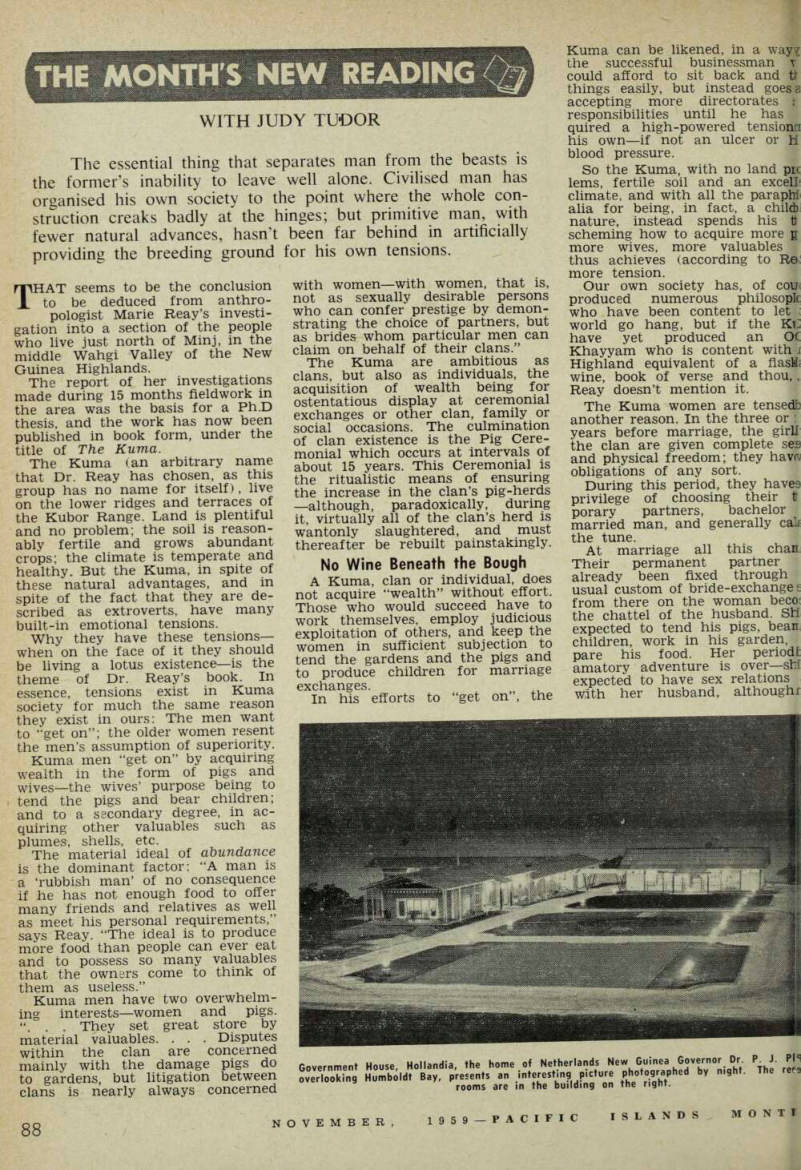
Government House, Hollandia, the home of Netherlands New Guinea Governor Dr. P. J. Pl[?] overlooking Humboldt Bay, presents an interesting picture P hot og ra phed by night. The re[?] rooms are in the building on the right.
prohibition is placed upon her 5, says Dr. Reay, produces ten in the female of the Kuma s. Adult women then collec regard the male as “no mutter other dark things him and generally behave cranky and frustrating man i their husbands —if they can ray with it. In this regard the women, too, have their coun ts in some strata of our own Reay’s book is completely nic, filled with anthropolo terminology and vast detail clan relationships—cross s, father’s-mother’s-daugh lother’s-brothers and all the complicated variations which pologists love but which are ited to drive the average round the bend. However, inlikely that it was ever in fer “popular” reading and aid be of considerable value sionaries and administration nel working in the area, aould be of interest also to nds Europeans outside those fies who like to know more :he native people in their area mgh whether everything to rned about these people can luced to a 200-page, Ph.D is a matter of opinion.
KUMA. Published by Melbourne ty Press on behalf of the Aus- National University. Australian >/-•) « .
; That Need
ch of Salt
J CAILLOU is one of that Teasing band of writers ich bob around all over the in search of exotic back against which to drape their s. », North Africa, Ethiopia, and in Mindanao Pearl, lilippines, so far as Alan is led. plot in Mindanao Pearl is a iread of improbability upon is suspended a series of bash >eatings, shootings and as skullduggery in the jungles nail island called Pangalau. i, an unimportant clerk in i, steals some of his em > money and bolts half ac e world, to of all unusual for a London clerk to bolt :he Philippines. David Calib by his father to find Smith thalf of his lamenting ex ers) and have him extra- However, by the time Calib i Manila, Smith is already in pearl-diving deal with two •s, who with their beautiful Andree (the sex interest), broken-down hemp planta i Pangalau. i’s reception to Pangalau is :ated by the fact that Smith >t skipped out with the pearls
and Calib is held by the brothers to be responsible although just why this was so you have to read to the end of the book to find out Most of the story consists of Calib who is not the outdoor type being severely walloped and beaten up by one of the brothers,* being menaced by shrews (entertaining little creatures peculiar to those parts who can strip all the flesh from a man while he sleeps) or being dragged through the bush by the beautiful Andree.
All turns out happy like a mar riage-bell, in the end. (THE MINDANAO PEARL. Published by Peter Davies, Ltd. Australian price, 18/9.1
Red Cross and
International Peace
TO mark the 100th anniversary of the Red Cross organisation, Dr.
James Avery Joyce, English born international lawyer, has set out the story of International Red Cross from its origin in Geneva in 1859 until the present day.
But as the title of the book indi cates (Red Cross International and the Strategy of Peace ) it is more than a history in it he resurrects Dunant’s original conception of the organisation as an instrument of war-prevention, and thus a new controversial aspect is permitted to raise its head.
It is usual to look at International Red Cross as a neutral, non-parti san instrument whose specific pur pose is to pick up the pieces and comfort the victims when the battle has passed. It, of course, is known that Red Cross has a role in peace —blood-banks, devoted field workers following floods, famines and disas ters—but as Dr. Joyce says “. . . it
18 war the brutal, ugly fact of war which has given Red Cross Its sta tus, its raiscm d’etre, its frame of reference”.
But that is not how Henri Dunant saw it he did not regard his chief mission in life as one of mitigating the horrors of war but in finding the means of ending war.
At the 1957 international confer ence of Red Cross at New Delhi, this aspect of the founder’s aims was discussed by representatives of over 60 governments and 70 Na tional Red Cross societies against a background of the knowledge that although Red Cross has existed on a principle of non-involvement in international politics, Red Cross could no longer evade the politics of the H-bomb. It was a question of abolition of war, or abolition of man.
It was because of this aspect of the New Delhi conference that “the world’s Press which lives on disaster and thrives on conflicts found it so embarrassingly difficult to report either intelligently or ade quately the most significant con ference the Red Cross ever held”.
Henri Dunant was already a con vinced pacifist on the day in June, 1859, when the Battle of Solferino began in Northern Italy between the army of Napoleon 111 and the Austrians. The casualties of that one day’s battle were more than 40,000 in killed and wounded, and although Dunant had travelled all the way from Geneva to try to see the French Emperor he found him self, instead, organising a handful of Italian peasant women in a des perate bid to ease the lot of some of the wounded and dying. Before he finally returned to Geneva, Du nant visited Napoleon 111 at his camp on the Plains of Lombardy
uccessfully pleaded with him ease the doctors and surgeons Austrian army who had been prisoner. t he had returned to Geneva, it began to write his Souvenir Iferino, from which stems the of service of modern Red International, consisting of tional Societies and 125 mil idividual members, book is illustrated with 100 graphs and drawings, some of not previously published, and ;es the history of the move from Solferino through 100 Df war, tragedies and conflicts present day with its biggest n of all: Can we deal with ; War?
Joyce feels that neither we id Cross can except by pre- Z war altogether,
Cross International. Pub
by Hodder and Stoughton, Ltd. an price, 37/6.)
iese Water-Colour
chancy business of translat : a novel from one language 0 another depends for success 3 translator more than the 1 author. And in this sense a say that Edward G. Seiden has succeeded reasonably translating Japanese novelist iri Kawabata’s Thousand , in that the book in its Eng rm, appears more as a sty- Japanese print and not like ;1 at all. On Western stan the story is plotless, even ss; it is a posturing of words erbal dance for the purpose lucing a pattern rather than sloping a theme, story concerns a man and )men in his immediate life of them former mistresses father, now dead, and al of modern Japan it is en with the ancient Japanes3 emony. is a book for connoisseurs of and styles and not for the y reader of stories. If it has essage it is an unconscious lowing the huge gulf that between Japanese and Wes linking about life and death.
JSAND CRANES. Published by and Warburg, Ltd. Australian V-.)
irothers Cobb
istralia
tIRD edition of the late Will wson’s When Cobb and Co. s King, was published during »nth the first edition hav jpeared in the mid-thirties second a couple of years ;he war. A third edition of iok in the restricted Austra irket is unusual although this
•oyes nothing, probably, ex
lat Australian pioneer stories perennial local appeal.
Law r son (no relation to Henry) turned his hand to anything in the writing line verse, fiction, fac tual reporting but was never a literary giant. His work covered the whole pioneering period in Aus tralia and New Zealand and what he has left behind is likely to be come more valuable as time goes on.
His Cobh and Co. is a novel and although the story is a slim enough account of a youngster growing up in mid-century, gold-mining Vic toria and finally realising his am bition to be a coach-driver, its real merit lies in its account of the coaching business that made the words “Cobb and Co.” part of the Australian language.
The two American brothers Cobb remained in Australia only seven years after they arrived in 1852, and then returned to the United States, each with a fortune. Thereafter the control of the company that con tinued to operate as Cobb and Co. came under James Rutherford who also had arrived in Australia in 1852.
Under his direction, the com pany’s operations extended into New South Wales and Queensland “following the gold”. Rutherford made Bathurst, NSW, his head quarters and lived there for 50 years until his death in 1911, a year be fore the last Cobb coach made its last journey (in Queensland).
The Cobb and Co. era, from first to last, lasted 60 years, Lawson’s novel covers the years immediately following the return of the Cobb brothers to America years when the huge, swaying, American-built coaches were part of the Australian scene on outback roads and tracks.
(When Cobb And Co. Was King-
Published by Angus and Robertson, Ltd.
Australian price, 17/6.)
Take a Gun, and
A Big Piece of Bush
A GENERATION ago it was pos sible to get good shooting in Australia no more than an hour’s drive from any big city. To day, with city sprawl, water-conser vation schemes, and the urbanisa tion of areas once regarded as “the bush”, this is no longer possible and the majority of Australian men now never shoot at all.
You have to go a long way out of the cities these days before it is safe to loose off a rifle or gun without the possibility of shooting something human and as it has now acquired some of the distinctions of a spe cialised sport it’s probably fair enough that a “How to Do It” book should be provided. S. H. (Barney) Edwards, himself a crack shot, pro vides it, with a small book called Shooting and Shooting Bushcraft.
Like a certain Mrs. Beeton of culinary fame who assumed that her
amateur cooks had a poultry farm ai H, on ‘take two dozen eggs”) author Edwards assumes you have a good, uninhabited piece of bush handy. He takes it from there, ex plaining about guns, rifles, stalking decoys, how to skin things like birds’ foxes and rabbits, what to wear what to do and even how to get through a barbed wire fence with a gun without shooting your pal in the back.
He does it all with good humour and commonsense and what he has to say about shooting as an enter tainment applies, of course, not only to Australia.
(Shooting And Shooting Bush
CRAFT. Published by Angus and Robert son, Ltd. Australian price, 15/-.)
Emily Rocks
Another Boat
PRESUMABLY there are people (no doubt American), who en joy the dilly, middle-aged travel monologues of Emily Kimbrough, but your reviewer just doesn’t hap pen to be one of them.
It is hard to believe that anyone so self-confessed witless, ham handed, vague and casual could manage to get through all the for malities and difficulties of travel in 47 different countries, much less persuade hard-headed publishers to produce 10 of her epic accounts of her wanderings.
Miss Kimbrough, we fear, makes a gimmick of dishing herself up as an addle-pated American matron without one practical thought. No doubt it is all supposed to be cosy and poor-helpless-girls-together and in so far as it seems to get her a living, good luck to her but for our money, it all seems so much corn.
In her latest adventure (A Right Good Crew), she and four other Americans go cruising the canals of the United Kingdom a form of holiday that has increased in popu larity in inverse ratio to the pro gressive decrepitude of the canals themselves.
The inland waterways of Britain date back to about the mid-18th century. For about 100 years after that they were the chief means of moving freight particularly coal.
Then came steam trains to put a crimp in their usefulness, and, fi nally, a modern system of roads and motor transportation to sound their death knell. The Inland Waterways Association formed af ter World War II (plus, of course, the British fetish about sacred tra dition) , is about the only thing that now stands between the remaining canals and complete disintegration.
Anyone who has seen one of these weed-fringed ditches that passes for a British canal, and knows Miss Kimbrough’s peculiar style of delivering a perfectly kill
idventure story, can imagine est for themselves, pever, those who actually like may be assured that she is no about canals than she is Greek architecture or New ns wrought iron, and in the under review delivers the in 240 pages plus sundry black irhite sketches by a character Mircea Vasiliu. iIGHT GOOD CREW. Published by leinemann. Ltd. Australian price,
in a Maze
ST GILBERT has used a little everything in his recipe for zag, his second novel. There and psychology: the romance inge places (Cairo and North ); war-time adventure at nd matrimonial problems, e Chappell is a war-neurosis shell-shock they called it in iss scientific days of World ), in the charge of a psychia n a North African military il. The psychiatrist is trying nek the mystery of why Mike it coffee came down his nose hy his legs wouldn’t obey his or why his hands would no pick things up. Mike finally s his own mystery when ms the door of the mental ,rd and takes a good look at dden skeleton within. is a story in retrospect, out between the coffee com wn the nose and the skeleton I, that allows the author scope for excellent charac [on and racy incident against ground of war in thq Middle AG. Published by Peter Davies, an price, 18/9.)
ing a
)oder
author with a name like ne Meredith should be pre itined by Fate to write serials ■ ladies’ own paper; and the titles of her works The nt Bride, Impetuous Heart hing to dispel the illusion, wer, if the latest of this > novels (A Man in the ) is a fair sample, it is only le that is deceptively simple, ie story showing a great deal f sophistication than the out rappings indicate, j, Cyril Laureller was the ac family do-gooder who had irnt that the people he did ) would have frequently been for a good swift kick in the and heart and sense of obli and duty made him a sitting
or helpless, elderly relatives
icidal female friends, but the ie is that they lead him in
£i“ ?e times 6 S n aV S po^ h I thl story itself could be a great deal worse, considering what one is led to expect by exterior appearances (A MAN IN THE family Pnhii C h«H by Hodder and Stoughton, Ltd. Austraiian price, 18/9.) Kl f
No Distress for
n . .
The Spaniards
1 HE expedition, led by Captain Anson (afterwards Admiral Lord Nelson) in the Centunan, that left England in 1740 to “annoy and distress the Spaniards in the Pacific, returned four years later
* mone?- but "oTJZ „ ot re turn was Wager, an ex-Indiaman, wn i cl T got separated from the T est °i T her squadron after rounding Ca P e Horn and was finally wrecked COast ° f southern Chile, The Unknown Shore Patrick ©’Brian’s second novel based on the Anson expedition—tells something ?. f the stor y of Wager up to the time she stuck herself permanently between two rocks on that unhappy coast; but even more of the story of two young men and their survival.
Like all stories of this period it is one of incredible hardshin both on board ship and after the s T yivors found themselves cast away in a land designed by nature to
nothing more substantial a few penguins and peri author O’Brian has a gim n his two characters—Jack the young midshipman of ratic connections who re the imperturbable gentleman when trailing through the )aked woods of southern America looking for the cap nislaid piece of seal-blubber; young Tobias, the surgeon’s
mate who can cause an argument ative diversion (in Greek, Latin or even Spanish) on every subject from politics to religion, and pursues his single-minded zeal for zoology even when reduced to the last extremity.
Under this treatment, the novel becomes less another sea adventure —although there is plenty of this in it—and more the story of two personalities who refuse to become daunted even when up against the longest odds.
When the survivors of the wreck are reduced by desertions, mutiny and death, a half-dozen men, in cluding Toby and Jack, are led by an unsavoury Indian character to a Spanish outpost at Chiloe. From here they are taken to Santiago to become prisoners-of-war—but find this experience by far the most pleasant of their adventures. (THE UNKNOWN SHORE. Published by Rupert Hart-Davis. Australian price. 18/9.)