Seven Went, But
p. 71 · Read in the full issue
The Real Story of the Laughlan Island Castaways
Seven Went, But Five Came Back
How much does a native tell a European? Usually only as much he native wishes. About six months ago , a canoe party of ■jhlan Islanders of Papua were blown away from home waters and ly reached the Solomon Islands. They were returned eventually apua in MV “Tulagi” and Captain Brett Hilder, of “Tulagi”, told thing of their adventures in June “PIM”.
story the castaways told in g Solomons, to Brett Hilder, d in New Guinea, to some was a much abridged version it really happened, and Mrs.
Neate, of Woodlark Island, a ;r of a family which has been irs amongst these people, now ;he full story.
Laughlan Island people were illy of Woodlark Island stock ;o be more explicit, Murua as they came from the i end of the island. The rs of the Madau area, at the te end of Woodlark, have a itely different name although itive name for the whole of ark Island is Murua.
Becalmed
break-away Laughlan grs have now evolved a ge of their own and no longer gr themselves to be Muruas gh there is much inter ige between the two areas anoes make the trip across frequently. canoe that drifted to the ms was one of six, and they iot on their way to Woodlark, ed, but back to the Laughlans. with home in sight, they were ted. The terrific tide-rip nakes that stretch of water f the best fishing grounds 1 Woodlark, caught them mid-day when, Murua i, they were completely dis ited in bestirring themselves, to the extent of paddling gives into the shelter of the As darkness settled that with still no wind to aid Budi-Budi lay low on the n and that was the last they :o see of it for a couple of s. Two of them never saw in. ge weeks later, Gladstone, a -Bogga boy who is captain r launch, brought the news ne of the canoes that had set o the Laughlans was still g, with seven passengers on is in Samarai at the time and usband asked me to inform istrict Officer. I did so and
he contacted Port Moresby. A few days later he was able to tell me that the canoe has been cast ashore in the Solomons and that all five on board were alive. When I re turned to Woodlark I questioned Gladstone, but he could not be shaken from his original statement that there had been seven on board.
Second to Die In May the wanderers returned.
With them came the Samarai Sub- Inspector of Police under whose care they had been placed when the Tulagi dropped them at Samarai. One of our first questions was who were the two who had died, but the Sub-Inspector replied that the natives were adamant that there had never been more than five on board. He was completely astounded, therefore, when the wanderers about-faced and told my husband and Gladstone full details of the drift and the two who had died.
Old Ted, as we knew him, had
lasted to within four or five days of their reaching the Protectorate.
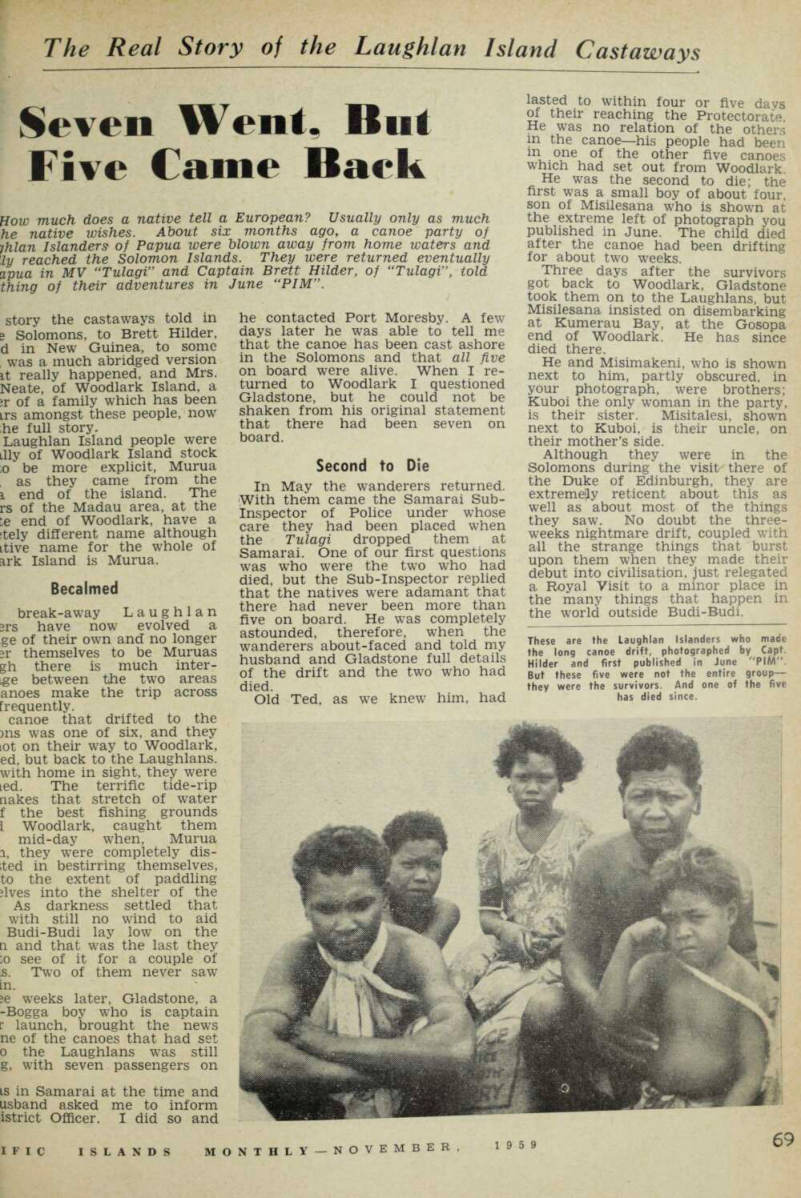
He was no relation of the others in the canoe—his people had been in one of the other five canoes which had set out from Woodlark He was the second to die; the first was a small boy of about four, son of Misilesana who is shown at the extreme left of photograph you published in June. The child died after the canoe had been drifting for about two weeks.
Three days after the survivors got back to Woodlark, Gladstone took them on to the Laughlans, but Misilesana insisted on disembarking at Kumerau Bay, at the Gosopa end of Woodlark. He has since died there.
He and Misimakeni, who is shown next to him, partly obscured, in your photograph, were brothers: Kuboi the only woman in the party, is their sister. Misitalesi, shown next to Kuboi, is their uncle, on their mother’s side.
Although they were in the Solomons during the visit there of the Duke of Edinburgh, they are extremely reticent about this as well as about most of the things they saw. No doubt the three weeks nightmare drift, coupled with all the strange things that burst upon them when they made their debut into civilisation, just relegated a Royal Visit to a minor place in the many things that happen in the world outside Budi-Budi.
These are the Laughlan Islanders who made the long canoe drift, photographed by Capt Hilder and first published in June "PIM"
But these five were not the entire group— they were the survivors. And one of the five has died since.