Coffee Costs Need
pp. 63-65 · Read in the full issue

To Be Lower
New Guinea Highland coffee plantations are equal to the best in America, according to Professor Y. Baron Goto, Hawaiian and coffee expert who concluded a three weeks visit to NG coffee areas on October 18.
By a Staff Writer
This was Dr. Goto’s second visit to the Territory to ad e coffee-producers. The first was in early 1956 when the jority of plantations were new-planted and not then in iring. That visit was sponsored by Colyer Watson (NG) 1., the Bank of New South Wales, Mr. R. F. Bunting, the mmonwealth Bank and the Highland Farmers’ and Settlers’ sociation.
October visit was arranged id financed by Colyer Watson terests and the Bank of NSW was designed, primarily, to planters on processing for market, most of the itions, in the 3i years between oto’s visits, having come into g. overall coffee picture in New a today had some agreeable ses for Dr. Goto but he also ed some of the problems ar to the NG industry and sed them with planters.
Most Urgent Need Goto thinks that a uniform g system for processed beans 5 most urgent need of the at. He feels that standardised > should be established at while the industry is in its y. This could be done by all ig being done with screens iform size, and the various ■ of beans being called by irdised grade-marks—A, B, C, (In order to get his message a groups of planters, Dr. Goto yed a peculiarly Australian ■a can of VB beer. The ler didn’t have to open the ind try the beer, he told rs; he knew what it was to be like before he tasted d NG coffee planters should t the same thing—merchants ;hout the world should know they were getting simply by g at the NG grading marks).
Bush Kanaka Labour
re is more in good coffee, of . than the size of the bean Dr. Goto advocated uniform sing methods for good liquor les.
Dr. Goto sees it, the New
Guinea planters’ biggest problem is untrained and inefficient labour— either local casual labour or raw labour recruited from the bush to work for 18 months to two years.
In South America, generations of coffee-plantation workers live on the same estate, just as in India and Ceylon the workers are closely identified with tea estates. In this way, with whole families living and growing up on plantations there is a continuity of skilled labour that regards coffee picking and process ing as a life-time work.
Although there is not the same close identification with estates in Hawaii, labour on coffee plantations
there is far in advance of anything in New Guinea, As one example of this, Dr. Goto said that a Hawaiian worker picked an average 300 lbs of coffee in a day. In New Guinea, the average was from 40 lbs to 100 lbs, with 100 lbs considered very good. Although NG native wages are only a fraction of Hawaiian wages, Dr. Goto thinks the idea of “cheap, black labour” will be eventually exploded as a myth so far as NG coffee is concerned.
He thinks that a NG worker’s picking capacity could be stepped up simply by providing receptacles that fasten round the waist so that he could use both hands for pick ing. (Over)
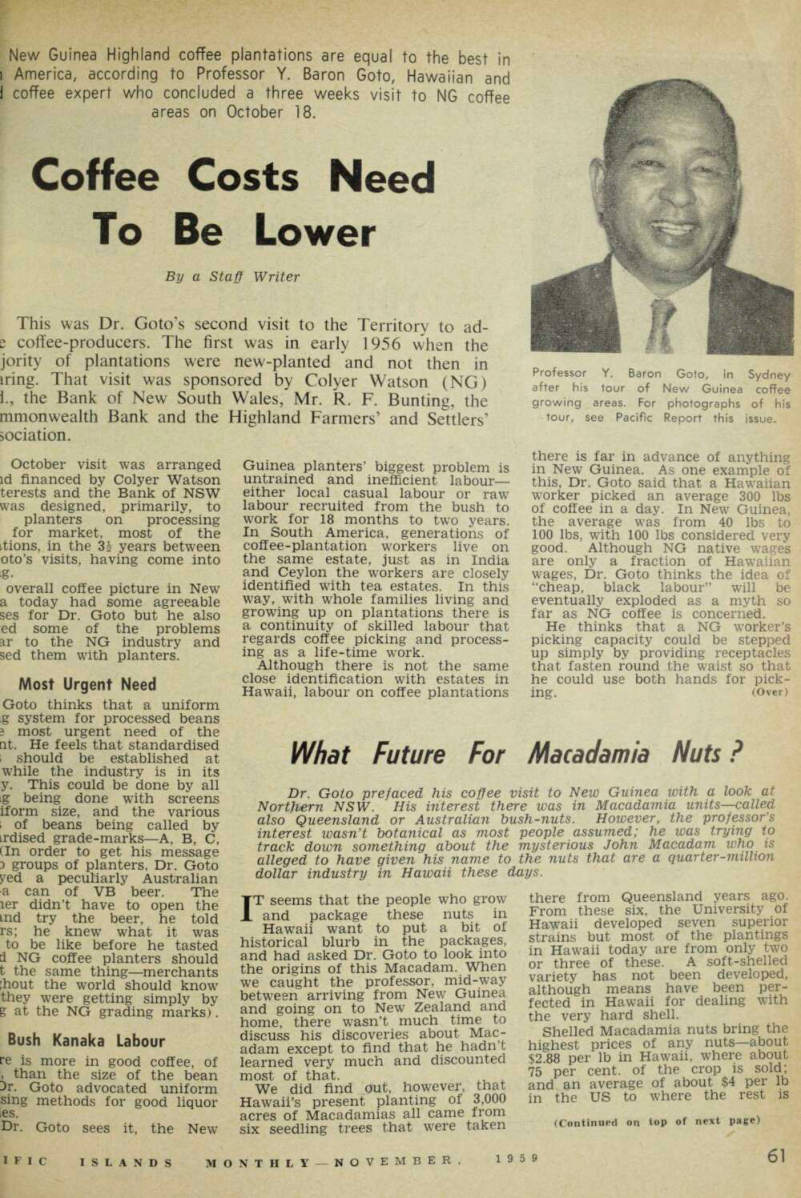
Professor Y. Baron Goto, in Sydney after his tour of New Guinea coffee growing areas. For photographs of his tour, see Pacific Report this issue.
l transportation cost was ir problem peculiar to the nds coffee areas (coffee areas ,u have an all-weather road outlet to a sea port). ough the Highlands will have sonable road to the coast the next few years, it is un for some time to come that ng road-haul will be any r than present air transporta- Both means are expensive dd considerably to the cost luction of coffee —not in get he processed coffee - out for but in bringing in basic dities, including fertiliser.
Goto believes that coffee •s in New Guinea will some ave to achieve a lower cost iduction which basically more efficient production Is —in order to meet probably tver prices for coffee than at ; ruling. aid that in New Guinea, a :ss f u 1 coffee plantation ed on the efforts of the in ,l planter. Where the planter adopted good farming les, had provided the right conditions, had drained his nd was a hard worker him s coffee plantation was equal best in the world, of his greatest surprises on md visit, he said, was to find ime areas which he had, in msidered doubtful for coffee I, had been turned, by the methods adopted by the into excellent coffee planta-
Dear Fertiliser
all planters were using sr—which cost about £lOO landed at Goroka —but they ne at it eventually, Dr. Goto as the natural fertility of 1 diminishes with continued g. Overseas experience has that there is a distinct re lip between fertiliser ap n and yield. ig his three weeks in New , Dr. Goto visited the whole ids coffee growing area, from f Mt. Hagen to Kainantu; so coffee areas in Morobe at Wau and the Markham farmers in the Markham who have been growing rice, ; and other crops, are hing anything up to 30 or is of Robusta coffee. Dr. sgan and ended his entirely ■ul New Guinea visit, in the im lowland coffee areas to vice to growers there whose is not yet in bearing. al colour and black and 6 mm films on Netherlands luinea have recently been X) the library of the Nether- Information Service in and may be borrowed on tion.