Don't Send Misfits Into
pp. 47-49 · Read in the full issue

Critical Comment on Island Missionaries Don't Send Misfits Into The Mission Field
One of the most forthright and challenging addresses ever given to mission organisations interested in the Pacific Islands was heard on October 20, in Perth, when the Austra lian Minister for Territories (Mr. Paul Hasluck) spoke to a public meeting in the Wesley Church, Perth.
HE spoke of the numbers of mission workers in North Aus tralia, and Papua and New Guinea, and quoted some interest ing figures to show what had been done in the fields of education and medicine.
And then Mr. Hasluck went on to discuss certaip aspects of mission work in a way that is sometimes seen in secular newspapers, but rarely heard from one so highly authoritatively placed as the Min ister in charge of Papua and New Guinea. Here are some of the points he made, taken from a verbatim re port:
Material for 'United' Nation?
In the Australian Territory there are close on two million people.
They are of many different racial types. They talk about 500 different languages. They used to be at enmity with one another.
They have nothing that even faintly resembles national unity.
They are certainly not homo geneous, nor are they yet conscious of any identity among themselves, or of any common future.
Yet we talk of their advancement towards self-government. If self government is to become a reality they will need to become conscious of themselves as one people.
They will also have to advance in civilisation. Any unity they have as a people will have to be acquired.
Any advance in civilisation will have to be based on new principles and new values that have been firmly grasped by them, and which have really replaced the principles and standards by which they previ ously lived. . . .
Why Do They Become Christians?
“The question we have to ask— and the politician asks it, too, just as sincerely as anyone else —is whether Christian missionary work is bringing about any fundamental and deeply-rooted change in the people,” said Mr. Hasluck.
“To put the challenge in the harshest way: Is Christianity just another white man’s custom which the native people imitate because, like a number of other white men’s customs, it appears to be an entrance ticket to a more pleasant life on earth? Or is it something which they receive into their own lives to become a vital part of their own living and being?
“In Papua and New Guinea there has been an intensive Christian missionary effort for nearly three quarters of a century.
“It is easy enough to add up figures about people who have been better fed; people who have been taught to read and write and wear clothes and to sing hymns; and people who have passed through hospital.
“But you will agree that the sum will not give the final answer to the question whether the work has been successful. . . .
“As I have moved around the Territory, seeing a good deal of the native people at various stages of their advancement, in all districts, I have been struck forcibly by the fact that their interests, as they become civilised, are often highly materialistic.
“Is that because, being a material istic people ourselves, we have been unable to give them any better standard to live by than the standard by which we live ourselves?
“Or, is it because, having lived as primitive men, sometimes in hunger and often in fear of nature and their neighbours, they value
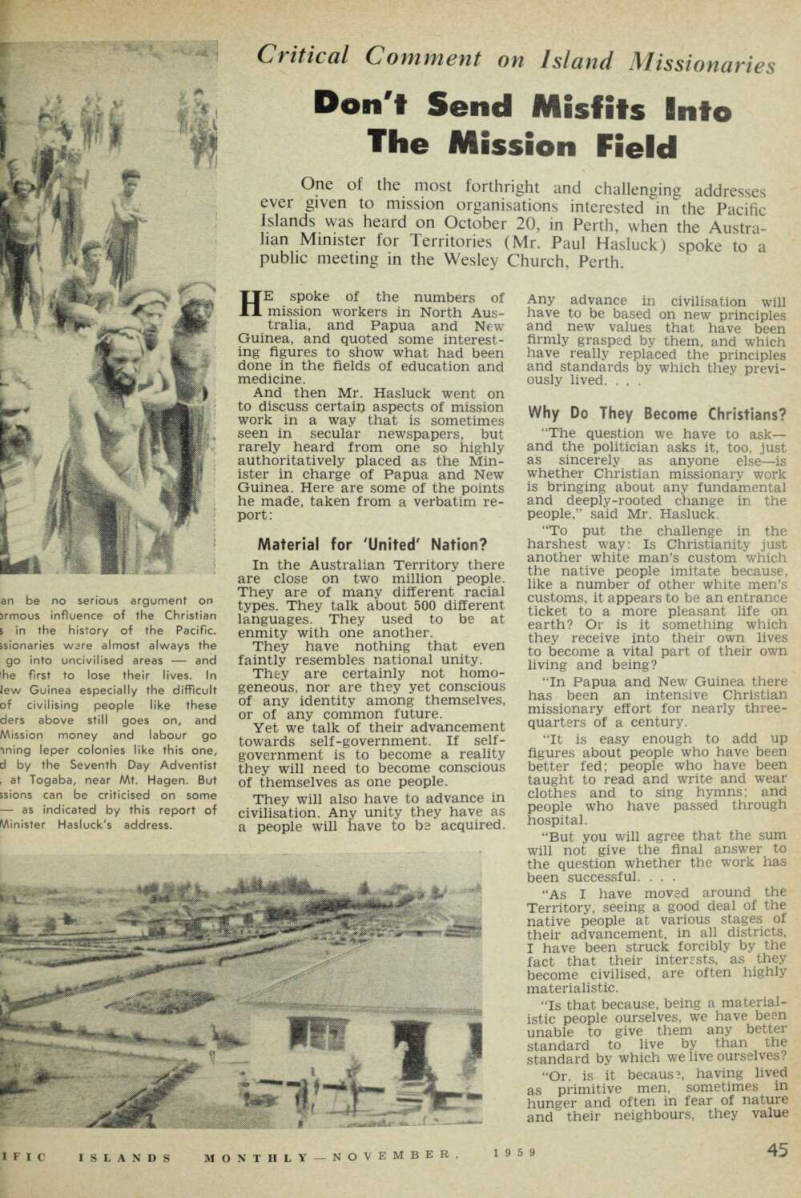
[?]an be no serious argument on [?]rmous influence of the Christian [?]s in the history of the Pacific. [?]ssionaries were almost always the
go into uncivilised areas - and
[?]he first to lose their lives. In [?]ew Guinea especially the difficult of civilising people like these ders above still goes on, and Mission money and labour go [?]ning leper colonies like this one, [?]d by the Seventh Day Adventist [?], at Togaba, near Mt. Hagen. But [?]ssions can be criticised on some - as indicated by this report of Minister Hasluck's address.
ihysical security and material lions? atever the cause, many of today are an acquisitive atever the cause, if the ims I have described are truly ed, they suggest that the a may be dangerous. . . .
►ions Are 'Swarming' In
it are the missions doing it the challenge? 5 I am going to speak critic id perhaps harshly. missions are certainly ng in—all sorts and sizes of The six or seven major lary bodies of pre-war days een joined by literally scores ;r missionary organisations, heory it is a competition for souls, yet so often it takes appearance of a competition ssion leases, and for men’s to build a thriving station, it worries me is the possible on that this causes in the of the people. ou may have gathered, speak a politician, I should like to 3 people become Christians. :actly the same thing if they members of various sects ‘nominations and are more us from ths beginning of ‘parates Christians from one : than of the few simple that make all Christians of ad? i while the Government gives il aid for mission schools and Is, what concerns me more le work done in these schools spitals is the question whether ssions are giving to all the a faith by which they can d a faith they will pass on r children, not as a white faith, but as something of wn. se are questions for church , I hope they tackle them on't Send Your Misfits' ’t send your misfits into the i field. Don’t send the sort pie to whom the chairman meeting (Dr. Mortimer) re when he told the story of the Dposite a name on a church Difficult to place; try the l field.’ :areful about sending people ‘merely looking for a change, link that the heathen they mow may be easier to get with than the heathen that a know down here. ’t send missionaries who hat a practical task can cover )ss of faith. d your best. And, having sent support them.”