At Last—Perhaps—Cheaper
pp. 41-43 · Read in the full issue

Air Fares Are On The Way
It looks as though that long-promised reduction in inter national air fares is coming closer in which event it is going to be a case of it being a poor dilemma that doesn’t do some one some good.
DIRECTOR General of the International Air Transport Association, Sir William Hildred, had a lot to say about “basic dilemmas” in the aircraft industry at the 15th annual general meeting of lATA which concluded in Tokyo in October—the dilemma, of course, being how to keep the big jets that are becoming standard international flying equipment, filled with paying customers.
By the end of this year, there will be 300 jet aircraft operating, capable in total of uplifting something like 30,000 people if eachi is filled to capacity. T ?^ ci il}pH or fS of the pure jets are designed for long distance flights—even though oniy 19 per cent of the traffic offering wants to fly on . of over 1,000 miles-so rt can be seen at once that Sir William is probably right when he said: ...
We shall have to feedffl£ o^Jf S these capital ana an .
But Sir William is not without hope, and went on to say. 11 an attractive product is priced low enough, there is no limit to the amount of it which can be sold .
Airlinps need bigger markets, he said and in order to get them there must be lower tares
the first time that anyone con nected with the airline business has come out in the open and said it.
Pacific residents, who use air travel a great deal will know the high cost of travel,
Jet-Travel Novelty
In the j ast 12 months, as the j et services began to operate on international routes, operators who we re fortunate enough to be first-in, were lyrical about the boost jet travel was giving them. Speed, they sa j dj was the thing, It is perfectly true that the fact that one can now comfortably week-end in Paris from Sydney Qr gan Francisco or Johannesburg, attract the odd customer to wh £ m £1 000 means litt i e , but the airllnes are a i rea dy finding that it does not attract the 30,000 odd cus t o mers that the new jets are capable of carrying. tata meeting concluded without oyer , r'nrrpnt agreement will stand The current * hich th€ > air n nes will decide future policy, me amine* w f It is obvious that if the airlines do not do something to attract more customers, many of them are going
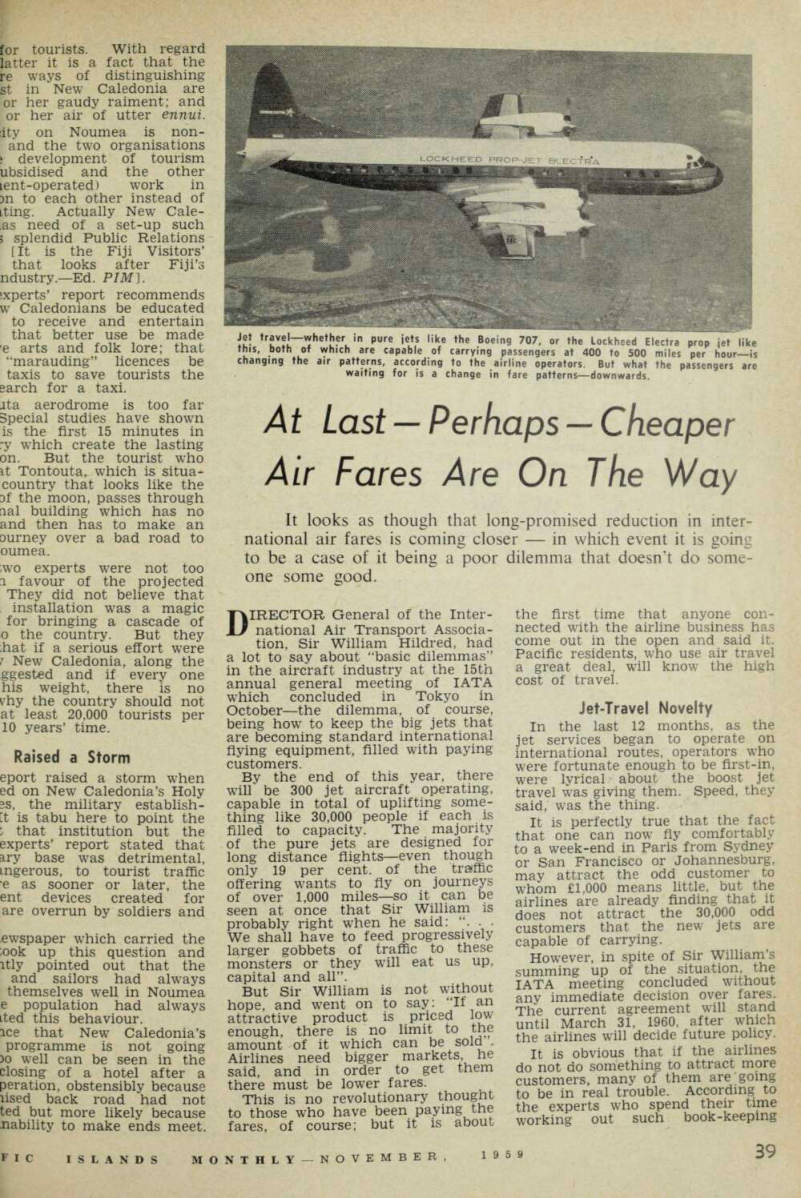
Jet travel—whether in pure jets like the Boeing 707, or the Lockheed Electra prop jet like this, both of which are capable of carrying passengers at 400 to 500 miles per hour—is changing the air patterns, according to the airline operators. But what the passengers are waiting for is a change in fare patterns—downwards.
world airlines lost, in total, t?. million in 1957; and in 1958, 7 millions. In 1959, those who i early with jets will show balance sheets, but those who )t will be a great deal worse an in 1958. [Jet operators ted customers from airlines inverted, but by end of 1959 cme of this jet novelty was g off]. Next year, with air eats available in quantities le airlines have never before ailed upon to fill, it is going necessary for airlines to 3 a new line of thinking.
Bun-and-Tea Flights
as significant, however, that lATA meeting, not even Sir i Hildred thought of giving stomer something more, for rhe stress was on the intro i of third-class or “economy”
To this extent airline think las already changed, the ;is no longer being on bigger etter champagne breakfasts i getting more people there on a bun and a mug of tea. her flight has already altered feeding habits on short In the old days when it Dver three hours between and Melbourne a full menu istomary. These days, with ght taking not much over r, and the Electra turbo-prop t carrying twice as many jers, there is not sufficient o serve all the passengers, msiderable menu simplifica not complete elimination of it meals, is already in opera- At the same time it is in ig to note that Australian ic fares rose during the and airlines began to charge msport to and from city ils and the airport, le forefront of the fight for fares are the two British nent-owned airline com- British Overseas Airways ation and British European s. BOAC lost no less than millions in its last account ir—a sum that few privately companies could sustain— directors maintain that they o better if they were allowed er fares from lATA levels ;tract more customers.
D agitation in this direction en going on for at least six i, and it is reasonably certain r en if the majority of lATA rs stick to their old fares larch, 1960, BOAC and BEA it on their own. This could trouble for a lot of airlines, e-cutting war and perhaps d of lATA—but it is hard how the paying customer 3se in the long run. Air fares leen too high for too long, the jet age does not bring m this direction, its main r> as far as the travelling is concerned, will have failed.
America is still leading in the production of the big jets. But these cannot operate economically on short range routes; their airfield requirements moreover, limit their operation to the larger aerodromes Short-Haul Airrraft snorr naui Aircraft It is already obvious that the British and Continental aircraft industries are ahead of the Americans in designing aircraft to meet this short-haul need which still represents about 65 per cent, of all air traffic. rp, , , , , RrT£fr^ UtC Tr Fokk ! r Friendship and Viscount have already established themselves in this field,