Worth A Fortune—In 50 Years
p. 39 · Read in the full issue
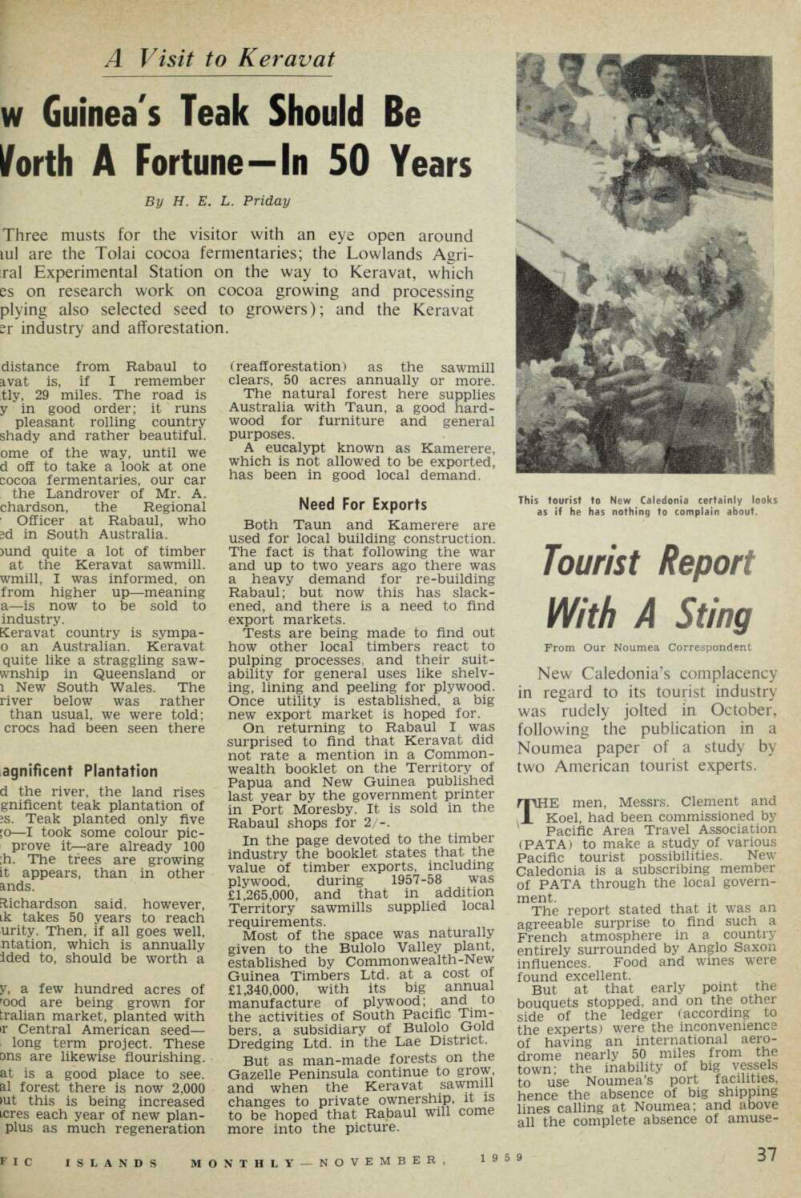
A Visit to Keravat worth Guinea's Teak Should Be Worth A Fortune—In 50 Years
By H. E. L. Friday
Three musts for the visitor with an eye open around ml are the Tolai cocoa fermentaries; the Lowlands Agri ral Experimental Station on the way to Keravat, which es on research work on cocoa growing and processing plying also selected seed to growers); and the Keravat sr industry and afforestation.
distance from Rabaul to avat is, if I remember tly, 29 miles. The road is y in good order; it runs pleasant rolling country shady and rather beautiful, ome of the way, until we d off to take a look at one cocoa fermentaries, our car the Landrover of Mr. A. chardson, the Regional Officer at Rabaul, who sd in South Australia. >und quite a lot of timber at the Keravat sawmill, wmill, I was informed, on from higher up—meaning a—is now to be sold to industry.
Keravat country is sympa -0 an Australian. Keravat quite like a straggling saw wnship in Queensland or 1 New South Wales. The river below was rather than usual, we were told; crocs had been seen there
agnificent Plantation
d the river, the land rises gnificent teak plantation of is. Teak planted only five fo —I took some colour pic prove it—are already 100 ;h. The trees are growing it appears, than in other ands.
Richardson said, however, ik takes 50 years to reach urity. Then, if all goes well, ntation, which is annually ided to, should be worth a y, a few hundred acres of r ood are being grown for tralian market, planted with ir Central American seed — long term project. These ons are likewise flourishing, at is a good place to see. al forest there is now 2,000 lut this is being increased i-cres each year of new plan plus as much regeneration
(reafforestation) as the sawmill clears, 50 acres annually or more.
The natural forest here supplies Australia with Taun, a good hard wood for furniture and general purposes.
A eucalypt known as Kamerere, which is not allowed to be exported, has been in good local demand.
Need For Exports Both Taun and Kamerere are used for local building construction.
The fact is that following the war and up to two years ago there was a heavy demand for re-building Rabaul; but now this has slack ened, and there is a need to find export markets.
Tests are being made to find out how other local timbers react to pulping processes, and their suit ability for general uses like shelv ing, lining and peeling for plywood.
Once utility is established, a big new export market is hoped for.
On returning to Rabaul I was surprised to find that Keravat did not rate a mention in a Common wealth booklet on the Territory of Papua and New Guinea published last year by the government printer in Port Moresby. It is sold in the Rabaul shops for 2/-.
In the page devoted to the timber industry the booklet states that the value of timber exports, including plywood, during 1957-58 was £1,265,000, and that in addition Territory sawmills supplied local requirements.
Most of the space was naturally given to the Bulolo Valley plant, established by Commonwealth-New Guinea Timbers Ltd. at a cost of £1,340,000, with its big annual manufacture of plywood; and to the activities of South Pacific Tim bers, a subsidiary of BUIOI9 Gold Dredging Ltd. in the Lae District.
But as man-made forests on the Gazelle Peninsula continue to grow, and when the Keravat sawmill changes to private ownership, it is to be hoped that Rabaul will come more into the picture.