cific Commerce and Produce
pp. 167-168 · Read in the full issue
'earch For
i's Gold:
oated
about three years of effort, it appears that th Waterhouse (one of
terhouse family which
n identified with New n past years) has floated ; company for the de nt of what are believed
irge gold deposits (reef)
sima Island, Eastern
EN 1888 (when gold was jvered there) and 1942 m the Jap invasion forced n), three active companies [i n g Freddie Cuthbert’s lonanza) and innumerable , took about £3 millions of of the heavily forested, lous, 100-s quare-m i 1 e s ; interests tried to return 3 war; but the available sre not high-grade, the g system had collapsed, and icreased costs prevented a search for the re-discovery de. for Mr. H. Gladstone, still there, the field has been >d since 1951.
G. Palmer, a competent mgineer, after lengthy in ms in 1956 and 1958, said •e are three very promising ring areas on the island, >f investigation. >ert view is that, under de it, this could become one lost extensive goldfields in i and the South Seas, ue of 5,000 ordinary shares
of £5 each by Pacific Islands Mines Ltd. has been underwritten by Leslie D. Phillips and Kitchen, Sydney sharebrokers; and the money will be used for investigation and preliminary development.
The Australian Government’s Bureau of Mineral Resources has been conducting a geological survey on Misima since May, 1959; and Pacific Islands Mines will carry on from there.
If the preliminary operations show that the mass of ore is rich enough for profitable operation, the Co. will go back to the public for funds for large-scale development and mining.
The directors are George Willard Noe, an American civil engineer: N. A. K. Wallis, a timber and forestry expert; R. V. Brierley, a management consultant, and E. R.
Hudson and Keith Waterhouse, company directors.
The Co. has the goodwill and co operation of the Administration, which is anxious to re-establish big scale gold-mining in Papua.
Bigger Profit For The
W. R. Carpenter Group
Nowadays, the numerous interests of the W. R. Carpenter companies lead into W.
R. Carpenter Holdings Ltd., registered in Canberra and regarded as a first-class investment stock.
This company, representing the whole group of Australian and Islands com panies, showed a profit of £738,586 in the year ended June 30 last. As this repre sents an increase of over £200,000 over the 1958 profit (£517,907), it may be as sumed that the group is doing very well The dividend goes up from IDA to 12/ 2 per cent.
That profit was shown after providing no less than £459,666 for taxation.
The Carpenter activities cover a very wide range—trading, planting, shipping, air transport, copra crushing, brewing, insurance —in fact, there are few in dustrial fields which the big organisation does not touch at, some point or other.
Enterprise Production
The mine manager of Enterprise of New Guinea Gold and Petroleum Development, NL, reported at end of September that the batteries of the company’s mine in the Wau-Bulolo area had crushed 90 tons of
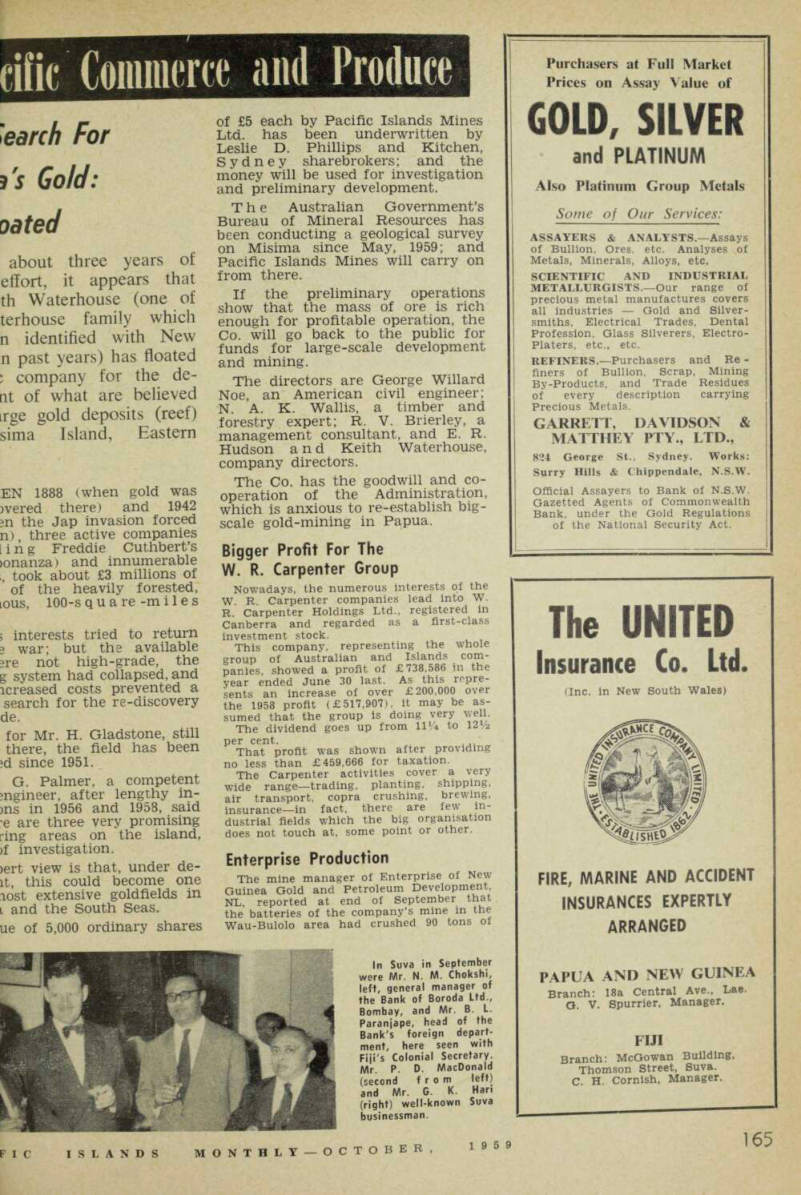
In Suva in September were Mr. N. M. Chokshi, left, general manager of the Bank of Boroda Ltd., Bombay, and Mr. B. L.
Paranjape, head of the Bank's foreign depart ment, here seen with Fiji's Colonial Secretary.
Mr. p. D. MacDonald (second from left) and Mr. G. K. Han (right) well-known Suva businessman.
ore for a recovery of 50 oz of retorted gold. Five working days had been lost when a battery had to be repaired.
During the month, work on drives from Nos. 1, la and 2 levels continued. Re timbering to 35 ft. in No. 2 level was accomplished, reef in this latter section showing good values.
NG Twist Tobacco
To Earn 10 Per Cent.
Pacific Tobacco and Development, Ltd., of Madang, New Guinea, is making an issue of 131,096 ordinary 5/- shares to the public. If they are all taken up, issued capital of the company will be £50,000.
The issue will be underwritten by Lionel A. McFadyen and Co. of the Sydney Stock Exchange. According to the prospectus, an annual 10 per cent, dividend is ex pected from now on, in spite of the fact that since the company began operations in 1956 trading losses amounting to over £15,000 have been sustained.
The company makes black twist “trade” tobacco and some of ready-rubbed type for the native trade. Like all new in dustries, it had its teething troubles.
Production did not begin until mid-1957 and for the first 12 months the factory at Madang was equipped with only two twisting machines, natives had to be trained to work them and there was con tinuing experimentation to obtain the right mixture for the made-up twist.
Proceeds of the present issue of shares will be used to lift production to 70 tons of twist tobacco per annum.
About 190 tons of trade tobacco are im ported into Papua-New Guinea in a year —which means that if local production were boosted to 70 tons per annum that would represent a fair share of the busi ness.
In the past, several attempts have been made to manufacture trade tobacco in the Territory but all failed because they were unable to produce a tobacco that appealed to the palate of native customers who are as fussy about their twist as Australians are about their beer.
The Madang factory product, however, seems to have overcome most of the pre judice. Its difficulties have been through insufficient capital.
Most of the tobacco used is imported from America but part of the original plan of the company was to eventually grow at least a portion of the leaf locally.
Koitaki Pays Even
Bigger Dividend
Koitaki Para Rubber Estates, Ltd., profit for the year ending June 30, 1959, was at £28,986, £B,OOO more than in the previous year. Dividend has been raised from 22 V 2 per cent, in 1957-58 to 35 per cent, which will require all but £2,600 of the year’s net profit.
Koitaki’s profit for the year under re view is tax free. If the company makes the same profit next year, something like £5,600 will be swallowed up in company taxation; Territory shareholders will also be taxed on their dividends.
Burns Philp Bonus
Shares This Month
The Burns Philp one-for-five bonus issue of 1,000,000 20/- shares, announced some months ago in chairman James Burns’s report to the annual general meeting, will be made to shareholders on October 31.
This will bring BP issued capital to £6,000,000 —with about £9,000,000 of re serves also working in the business.
Shareholders of the company will meet in an extraordinary general meeting on October 22 to authorise the doubling of the nominal capital to £lO million; and to approve the issue of the bonus shares.
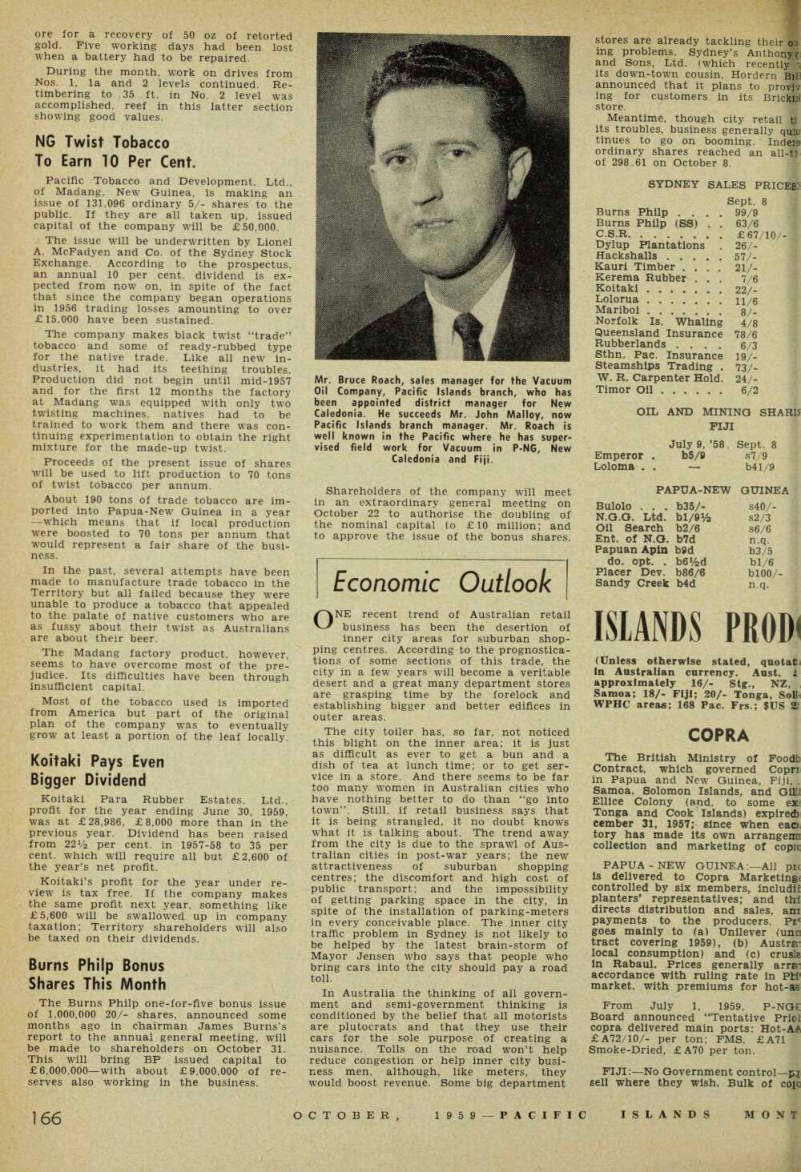
Mr. Bruce Roach, sales manager for the Vacuum Oil Company, Pacific Islands branch, who has been appointed district manager for New Caledonia. He succeeds Mr. John Malloy, now Pacific Islands branch manager. Mr. Roach is well known in the Pacific where he has super vised field work for Vacuum in P-NG, New Caledonia and Fiji.