Deaths Of Islands People
pp. 154-155 · Read in the full issue
Captain A. C. Bird
A distinguished old-timer, Cap tain A. C. Bird, died at Munda.
BSIP, on September 5, from black water fever. “Charlie”, as he was affectionately known, had been in the Protectorate for over 40 years, mostly as master of small ships.
During the war, he served with the American Small Ships’ Fleet: then, in peace time, when the BSI Trade Scheme was formed, he was appointed master of MV Biliki.
After many years in this capacity, he settled ashore and became chief storeman in the Government ser vice.
In later years, with his eye-sight failing, he started a chicken farm ing venture near Honiara. Then he was in charge of Mr. O. J. Symes’ scrap metal interests in the Western Solomons.
Only a month before his death, Captain Bird was appointed Gov ernment air-p ort supervisor at Munda airstrip, New Georgia Island.
Chief Molio’O Pouli Setu
A well known and respected Samoan, Chief Molio’o Pouli Setu, died on September 8 at the age of 70.
A former member of the Legis lative Assembly and the Fono of Faipule, and at one time a Samoan District Judge, he represented Western Samoa at the first South Pacific Conference in 1950. A widow and six children, one of whom is the wife of the Hon. Malietoa, MLC, survive him.
Mr. P. R. Best
The death occurred suddenly in Sydney on September 25 of Mr.
Paul Raymond Best, relieving Chief Engineer on Burns Philp ships. He was 70 but looked a great deal younger, and was still serving at sea at the time of his death.
He was born in Tasmania and joined Burns Philp in 1926; he left them in 1928 and had a shore job for 10 years, when he rejoined the company serving thereafter on all of the ships in the company’s fleet.
He is survived by his wife and two married daughters.
Mr. A. W. Esson
One of New Guinea’s well-known pioneers, Mr. Archibald Wallace Esson—usually known as Jock —died in Concord Repatriation Hospital, Sydney, on September 16 after a short illness. He had been flown down from Rabaul a few days previously.
Mr. Esson was chief inspector for Coconut Products Ltd. at the time of his death and had been in the Territory for over 30 years—he had gone there originally to work for his brother-in-law, Mr. Vic Penne father.
He served with the Gordon High
landers in World War I, migrated to Australia after it, and went on to the Territory. He served in ANGAU during the Second World War.
Mr. Esson was twice married. He is survived by his second wife; a daughter, Mary, who is nursing in Canada, and a young son who is at school in Sydney.
He was born in Scotland and was 66 at the time of his death.
Mr. R. E. P. (Larry) Dwyer
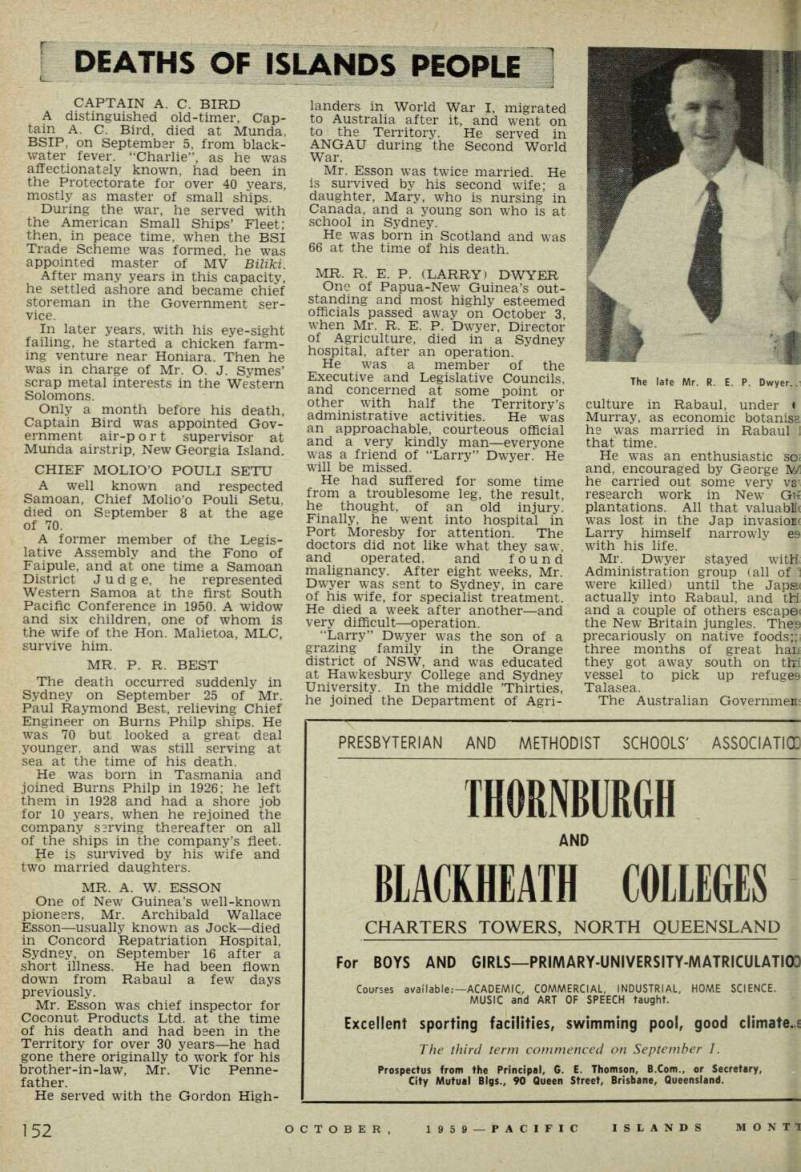
One of Papua-New Guinea’s out standing and most highly esteemed officials passed away on October 3. when Mr. R. E. P. Dwyer, Director of Agriculture, died in a Sydney hospital, after an operation.
He was a member of the Executive and Legislative Councils, and concerned at some point or other with half the Territory’s administrative activities. He was an approachable, courteous official and a very kindly man—everyone was a friend of “Larry” Dwyer. He will be missed.
He had suffered for some time from a troublesome leg, the result, he thought, of an old injury.
Finally, he went into hospital in Port Moresby for attention. The doctors did not like what they saw, and operated, and found malignancy. After eight weeks, Mr.
Dwyer was sent to Sydney, in care of his wife, for specialist treatment.
He died a week after another—and very difficult—operation.
“Larry” Dwyer was the son of a grazing family in the Orange district of NSW, and was educated at Hawkesbury College and Sydney University. In the middle ’Thirties, he joined the Department of Agri-
culture in Rabaul, under ♦ Murray, as economic botaniss he was married in Rabaul I that time.
He was an enthusiastic so< and, encouraged by George W. he carried out some very vs T research work in New Gix plantations. All that valuable was lost in the Jap invasion Larry himself narrowly ee with his life.
Mr. Dwyer stayed with Administration group (all of 1 were killed) until the Japs* actually into Rabaul, and tH and a couple of others escape* the New Britain jungles. The;e precariously on native foods;';; three months of great haii they got away south on thi vessel to pick up refugee Talasea.
The Australian Governmenj
The late Mr. R. E. P. Dwyer.
er in charge of urgently
•ubber production. After
;ions in North Queensland •them Territory, he was 3 apua, and spent the rest war organising rubber in the Sogeri area, he war, he returned to the ;nt of Agriculture, and was r in charge of Agriculture i, immediately under Mr.
Dormer. When the latter the Directorship in 1951, ertook other duties, Mr. icame Director of the De . Under Mr. Dwyer, the and the activities of the »nt have grown very much, as the result of the policy of encouraging :riculture and extending it possible way. tsluck, on October 3, paid 3 Mr. Dwyer’s service. ryer is survived by his wife, :y Dwyer, and their two 3, both of whom are teen ents in Sydney.
Robert Melrose
i long illness, Mr. Robert a former high official of aa and New Guinea Ad ion, died in hospital in n September 18. He retired service in 1951, and had resident of Sydney for ears. He was 68.
Melrose went first to New with the Australian ex ,ry force, and by 1916 he lay£d so much aptitude for rative work that he re there when civil govern is introduced in 1921. He le important posts in the d Territory between the the Japanese invaded in 1942, Mr. Melrose was a cial—Director of District and Native Affairs. Fortun him, he was over on the i, assisting in the proposed of the capital from -ridden Rabaul to Lae. ; bombers came over Lae lys later. elrose showed resource and ; in leading a small party y civilians from Salamaua, mall boats, along the coast, northeast coast of Papua, they somehow travelled to Port Moresby, elrose undertook many tasks the war; and, at its con he carried out many ardu ies connected with the re iment of civil administration, new basis, and he then be- Dvernment Secretary in Port '. He filled that post, with on, until his retirement in he Minister for Territories isluck), on learning of the f Mr. Melrose, paid a special to the services he had 3 to the Territory in 35 years . Mr. Melrose is survived by ; and one son.
Mr. W. E. Hardaker
The death occured in Brisbane, in early August, of Mr. Walter Edwin Hardaker, one of the New Guinea Ex-Pro Board’s early pioneers.
He was badly wounded in World War I, but took over Modilon Plantation, Madang, from the Board.
However, ill-health eventually forced him to give up and he returned to Queensland.
He had been in poor health for some years. He was in his late 60’s when he died. He is survived by his widow, a son and a daughter.
Mr. Norman Saggers
Mr. Norman Saggers, who was
appointed Director of Broadcasting in Western Samoa in 1956, follow ing several years service there, died at Napier, NZ, recently.
Mr. Hung Lee-Lo
One of Western Samoa’s oldest Chinese residents, Mr. Hung Lee- Lo, who came from Singapore in 1904 and pioneered the early de velopment of Lafi and Togo planta tions, died at Vailima village on August 26. He left his Samoan wife and eight children.
Mr. J. Twycross
The death of ex-Territorian, Mr, J. Twycross, is covered by Tolala, in Talk-Talk, this issue.