Tropicalities
pp. 83-84 · Read in the full issue
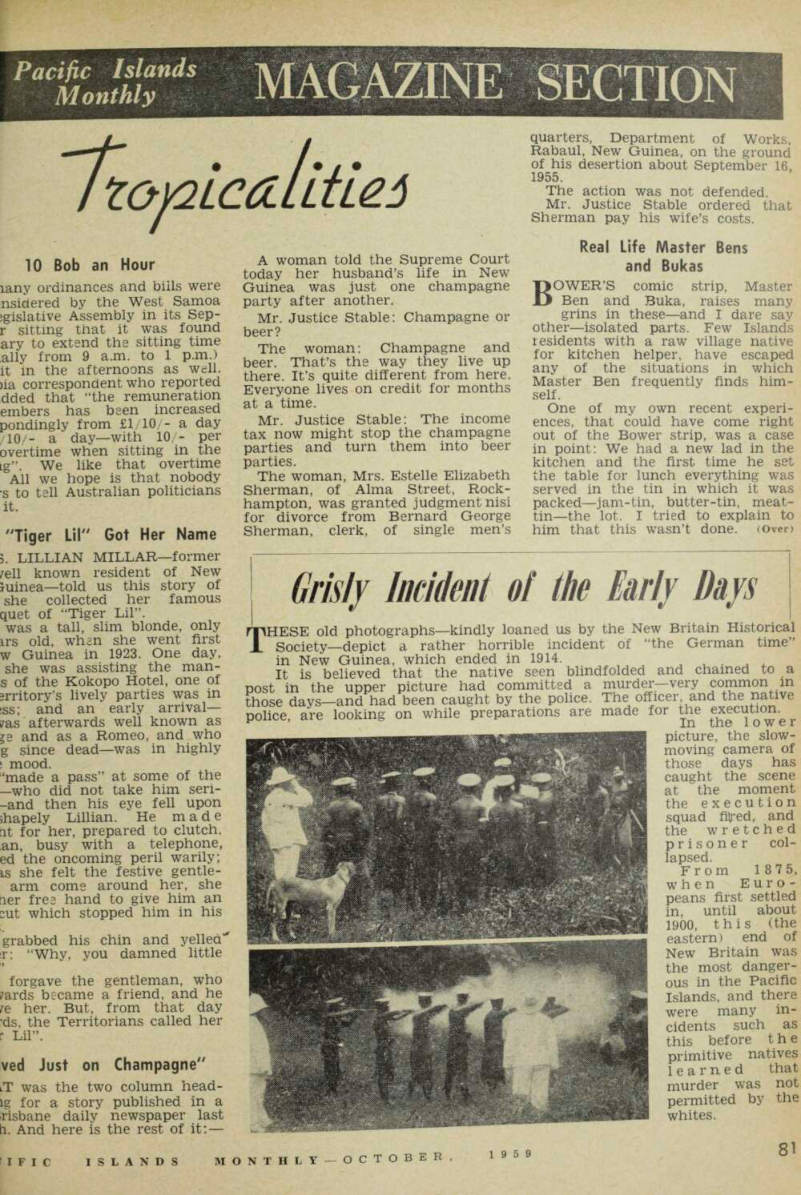
Pacific Islands Monthly
Magazine Section
10 Bob an Hour iany ordinances and bills were nsidered by the West Samoa ■gislative Assembly in its Sep r sitting that it was found ary to extend the sitting time ally from 9 a.m. to 1 p.m.) it in the afternoons as well. )ia correspondent who reported dded that “the remuneration embers has been increased pondingly from £l/10/- a day /10/- a day—with 10/- per overtime when sitting in the ig”. We like that overtime All we hope is that nobody ■s to tell Australian politicians it.
"Tiger Lil" Got Her Name 5. LILLIAN MlLLAR—former fell known resident of New xuinea—told us this story of she collected her famous quet of “Tiger Lil”. was a tall, slim blonde, only its old, when she went first w Guinea in 1923. One day, she was assisting the man s of the Kokopo Hotel, one of srritory’s lively parties was in !ss; and an early arrival fas afterwards well known as ;e and as a Romeo, and who g since dead —was in highly ; mood. ‘made a pass” at some of the —who did not take him seri -and then his eye fell upon shapely Lillian. He made nt for her, prepared to clutch, an, busy with a telephone, ed the oncoming peril warily; is she felt the festive gentle arm come around her, she ner free hand to give him an cut which stopped him in his grabbed his chin and yelled - ' r: “Why, you damned little forgave the gentleman, who fards became a friend, and he fe her. But, from that day 'ds, the Territorians called her r Lil”. ved Just on Champagne" iT was the two column head ig for a story published in a risbane daily newspaper last h. And here is the rest of it; —
A woman told the Supreme Court today her husband’s life in New Guinea was just one champagne party after another.
Mr. Justice Stable; Champagne or beer?
The woman: Champagne and beer. That’s the way they live up there. It’s quite different from here.
Everyone lives on credit for months at a time.
Mr. Justice Stable: The income tax now might stop the champagne parties and turn them into beer
parties.
The woman, Mrs. Estelle Elizabeth Sherman, of Alma Street, Rock hampton, was granted judgment nisi for divorce from Bernard George Sherman, clerk, of single men’s
quarters, Department of Works, Rabaul, New Guinea, on the ground of his desertion about September 16, 1955.
The action was not defended.
Mr. Justice Stable ordered that Sherman pay his wife’s costs.
Real Life Master Bens and Bukas BOWER’S comic strip, Master Ben and Buka, raises many grins in these—and I dare say other—isolated parts. Few Islands residents with a raw village native for kitchen helper, have escaped any of the situations in which Master Ben frequently finds him self.
One of my own recent experi ences, that could have come right out of the Bower strip, was a case in point: We had a new lad in the kitchen and the first time he set the table for lunch everything was served in the tin in which it was packed—jam-tin, butter-tin, meat tin—the lot. I tried to explain to him that this wasn’t done. (Over)
Next time, I told him, “put everything into glass dishes.”
Later that day I went to the refrigerator and there found ample proof that my own particular Buka was trying to carry out instructions to the letter. The frig, was full of tins—each sitting gaily in its own glass dish or on a glass saucer, It was my omission to tell the boy to capsize the contents from the tin into the dish that had caused the trouble.—HFO, Rossel Is A Memorable Trek in ' °, 16 ° New Guinea, 1942 Even now, almost 18 years after , T 7. the outbreak of thw Pacific War, ar JE! rJf 6 Yi 1 etafi nfS parties of Australians escaped from
Mri^ a ?n°iQd9 rUn
by masses of Japs early in 1942.
Old-timer Harold Hindwood, who retired from air transport management at Lae to his coffee estate near Kainantu, not long ago, supplies the latest chapter,
When the Japs arrived, Mr, Hind wood was one of several Australians who suddenly were isolated in the Sepik area. All boats and planes were gone, the enemy was getting close—so eight of them, with 80 Sepik carriers, decided to cross the mountainous centre of New Guinea, to the South Coast of Papua. They were Harold Hindw o o d, Jack Thurston, Theo Mason, James Maliski, Ron Pickwell, Keith Atkin son, Len Odgers and Eric Pederson —and they made it.
They went up the Fly River to the May River by launch from Ango ram; then struck across the moun tains to Telefomin; got onto the top of the Fly and made their way slowly down the river to navigable water; and then, in two weeks, they constructed sufficient canoes to float them all safely down to Daru. From there, an American Small Ships de tachment carried them to Port Moresby.
That is the bare outline of one of the toughest and most adventur ous treks of the war.