Mariner's Cave
pp. 63-69 · Read in the full issue


Visited
By Rob Wright
Except for a very vague knowledge of the existence of Mariner’s Cave in Vavau Harbour, I confess to having been in com plete ignorance of the somewhat exciting manner in which one gained entrance to it.
I HAD previously visited nearby Swallows Cave by rowing into it in a small boat, and when Que Weston, the British Consul in Tonga, broached the subject while we were en route to the island, I assumed that Mariner’s would be something like the latter cave, with the exception that one would have to swim to it instead of visiting it in a boat. Que was all for trying it out, but I reserved my decision until we were on the spot.
I believe the island is named Hunga—a small one with fairly steep sides of volcanic rock. It was similar to many in this beautiful harbour.
As the launch approached I looked over into the clear water—seem ingly fathomless—but there was no indication of the entrance until we got closer. Then deep-down a dark blue chasm appeared which seemed to melt into the side of the island.
Rope First
The three Tongan boys who were to act as guides were soon into the water, followed by Que Weston.
The guides had taken with them a length of rope, one end J* was to be taken inside the cave and the other end held outside. By following the rope underwater, it would be possible to negotiate the entrance and the subterranean channel until arrival in the cave.
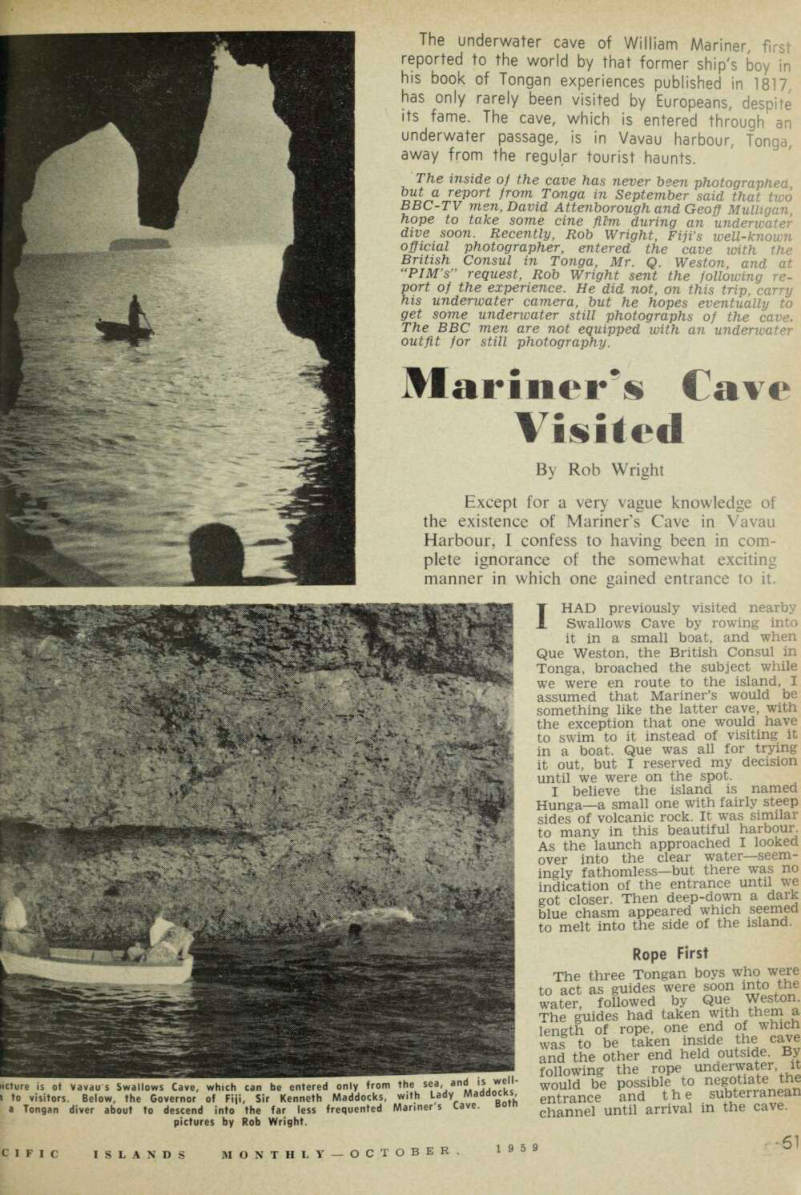
licture is of vavau s Swallows Cave, which can be entered only from the sea, an d is well [?] to visitors. Below, the Governor of Fiji, Sir Kenneth Maddocks, with Lady Maddocks , a Tongan diver about to descend into the far less frequented Mariner's cave. pictures by Rob Wright.
The underwater cave of William Mariner, first reported to the world by that former ship's boy in his book of Tongan experiences published in 1817, has only rarely been visited by Europeans, despite its fame. The cave, which is entered through an underwater passage, is in Vavau harbour, Tonga, away from the regular tourist haunts.
The inside of the cave has never been ’photographed out a report from Tonga in September said that two BBC-TV men, David Attenborough and Geoff Mulligan, hope to take some cine film during an underwater dive soon. Recently, Rob Wright, Fiji’s well-known official photographer, entered the cave with the British Consul in Tonga, Mr. Q. Weston, and at “PlM’s” request, Rob Wright sent the following re port of the experience. He did not, on this trip, carry his underwater camera, but he hopes eventually to get some underwater still photographs of the cave .
The BBC men are not equipped with an underwater outfit for still photography.
itched as one of the Tongans eared under the surface and reappeared after a lapse of 1 minutes. That seemed easy i. Que meanwhile was pre fer his dive. I lingered long i to take a photograph and swam over to the spot. Que, fides, and the rope had dis *ed. I floated around on the e looking down into the water what confronted me. 3 beneath appeared to be a left in the rocky side of the which gradually widened to th of perhaps ten feet at a of six feet below the surface, w of rock obscured the en from view. obvious thing was to dive than this overhang and then i out and swim horizontally the interior of the cave was d. i I did, swimming into the and coming to the surface when one of the Tongans d me on the back, re appeared to be a slight out current. I estimated the ce as a possible 12 or 15 feet, i thinking it over afterwards mowing that I can swim at i clip underwater, perhaps it lore like 20 feet. One doesn’t in situations like this. More ny main concern was to get tie cave as soon as possible as , getting darker and darker.
Eerie Light
de, I found a cavern perhaps more feet in height and maybe t across. Que and the Tongans treading water close by. first and lasting impression he light. This was an eerie ire blue and came only from ibterranean entrance. My im ,te thought was how wonderful vimmers would look on colour They appeared to be on a y stage with blue-green foot shining up into their faces, i second thing which struck me he haze or fog which com y blanked out the cave every linutes and then cleared again iy after. The haze was accom d by a considerable amount of ire on the ear-drums.
It wasn’t a pleasant sensation and I certainly would not have cared to stay in there for an indefinite period.
The sides of the cave appeared to be fairly steep, but at the back, the rock sloped downwards at a gentle angle and it was possible to gain a foothold here and stand for awhile, although there were spas modic surges of current which kept sweeping me to one side, and which led me to believe that there may have been additional fissures or clefts leading off from this cave, deeper into the island.
I was not prepared to follow this up, however.
Swimming out of the cave pre
sented no problems, although from literature I have subsequently read, this appears to have caused dif ficulty with other divers.
Que Weston surfaced too early and scratched his shoulder.
I was not aware of any current except that mentioned previously.
But perhaps we had ideal weather conditions. I could imagine it being very different with a heavy swell beating against the island. Never theless I would like to try it again sometime —equipped with a mask, swim-fins, camera—and a tape measure.
On returning to Fiji, I had a note from Que Weston: “I read your account in the Fiji Times of our
1 Mariner’s Cave with great ; although, in comparison he following extract from Thomson’s book, Savage it as too modest and rei:
Thomson's Version
... remamder of our visit was d sight-seemg. I was anxious the Hunga cave, twiceby Mariner a,nd Byron. In westerly swell had prevented m diving into it, but this man had promised to proides from the best divers on ,nd, and to put no obstacles vay if the weather made the ire possible. But to my dismerit a westeriy swell again and the guides backed h s tion by refusing to risk their Mi 18 - , , ... ... d to admit to myself that d have been a poor end to • to be sent home in bandages, iefymg the advice of the especially as I had been by Mr. H. J. Marshall, RN, as a midshipman on HMS 2 when Captain Aylen exhe cave in 1852, that the feat ficult even in calm weather, ain Sir J, Everard Home bedous to have the cave exin order to test William :’s story, selected Mr. J. F. R. then a Master’s Assistant, Post-Captain retired, as bebest diver on the ship. He ken to the indicated posif the cave’s mouth and sd with a lead line and two guides. e was no sea on, but the a long one—one fathom ,nd five fathoms along the
passage before it is possible to rise into the cave. Aylen was, I believe, the first white man to enter the cave since Mariner and, being some what of a draughtsman, he made a sketch of the interior, which was afterwards turned into a picture by an artist in Sydney. ‘The return dive was not so suc cessful. The great difficulty in div ing OU £ these submarine caves is that, your face being downwards, y OU are d ece i vec i by the reflected light into coming up too soon, captain Aylen scratched his back so severe iy with the stalactites that t hc wounds did not heal for two mo nths.’ So said Thomson, “Compare your estimate that the i en gth of the passage is 12 feet it £ Thomson’s estimate that it is 30 feet As one who nearly suc . cum bed during the dive, I agree with Thomson.”
From Thomson’s book, The Scene changes, I have found a further reference to the cave:
Colourful Legend
“We visited also the Hunga sub marine cave, famed both by Mariner and Byron, in the harbour channel. During the disturbances of a hundred years ago a young chief heard that the village of the girl he loved was doomed tc massacre.
“He had discovered this cave dur ing a fish excursion, and he de termined to carry off his bride and hide her until they could set sail for Fiji. He led the way in the dive; she followed him, and for three weeks she stayed there on a narrow sloping ledge while he dived out for food for them both. In the end, his friends brought a canoe,
in which they set sail for Fiji. A heavy surf was rolling at the time of our visit.
“There was a dive for 20 yards to swim, and the last European who had attempted it —a captain in the Navy—had been wounded so badly by stalactites that he had to be invalided out of the service. Finau was strongly against my going, and it appeared that the guides them selves did not care to attempt the dive.
"Interminable"
“I had already made such a dive in Yasawa-i-lau, in Western Fiji.
There the opening was only a few yards under water into a limpid pool. A native led the way, warning me to follow the soles of his feet, which are pink like those of a European.
“I felt the want of eyes on the back of my head to know when I had dived far enough to come up.
It seemed interminable, but I sup pose it was not more than four or five yards. When I saw his feet treading water I came up in a sort of vaulted chamber in which there was) a flat rock.
“The light was sapphire blue be cause every ray had to penetrate through water. It was a place in which one might easily have con cealed a person for weeks together if food were carried in at intervals.
Alas, during my journey outwards a signet ring which I valued slipped from my finger into the mud, and the rest of the afternoon was spent by my boat’s crew diving for it, Without SUCCeSS.” (Over)
Mr. Rob Wright, author of this article, is well known in the South Pacific as official photographer of Fiji's extensive Public Rela tions Office.
This old cannon muzzle, set up at Haapai, Tonga, is reputed to have come from the "Port au Prince", the sailing ship captured by the Tongans when she called there in 1806. Most of the crew were massacred, but among those who survived was young William Mariner, who lived to return to England and report on his adventures, including his visit to "Mariner's Cave". In the last few years, however, there has been some argument as to whether this cannon really did come from Mariner's ship.
d asked the British Con-
Tonga, Quentin Weston,
s impressions after swim into Mariner’s Cave with Wright, and received this
fling letter:
only difference of opinion flween Rob Wright and my f] is over the difficulty of ing into the cave. Rob, who s to spend almost as much i and under the water as he ut of it, found the exercise while I, who swim but nally, found it formidable, the average man, my opinion probably prevail over Rob’s, ovice wants an indication of le is up against if he makes ;tempt. Rob [thought] that igth of the underwater swim Dout 10 ft. I consider 30 ft more accurate, and my view ported by Basil Thomson in 3k. am guided by a rope which ieen placed there by some is who accompanied us. I recommend that any person niliar with underwater swim and especially swimming st rocks and caverns, to make tempt only with the aid of "You Swim Into Dark" n you swim in, you are swim into the dark and, so it •s at the time, into the un . It is therefore a comfort, j rate it was to me, to have e to hold on to with one and to half swim and half neself in. followed after me without pe, arriving about two minutes He shot up from the water le cave like a cork and some out of breath. le, the cave is circular and , domed roof. It was quite I should say not more than •ds in diameter and about 25 h. se are rather confused recoi ls and may be inaccurate but give an impression of the size and appearance. The was dim, green and eerie, be imited to the light reflected outside through the passage.
An interesting feature was that, when the water level in the cave was raised a few feet by the in coming surge from outside, the atmosphere was clear, but when the water level fell with the out going surge, a vacuum was created, and the atmosphere became misty and one had a feeling of tension in the ears.
This process was continuous at intervals of a few seconds, and in dicated the cave had no outlets above water level. The air inside, though somewhat musty, was suf ficiently fresh to make breathing comfortable.
No Signs of Life
There were no signs of anything having lived in the cave and neither were there any marks left by human beings recording their visits. The fiancee of the Tongan chief who traditionally discovered the cave must have had an uncomfortable time, because there is only one small uneven, limestone shelf to sit on.
To my mind, swimming out of the cave is easier than going in be cause of the guide of the reflected light outside, but, as Thomson says, there is in consequence a temptation to surface too soon.
I don’t imagine that many people have entered the cave, especially visitors from overseas. Its situation is remote and the attempt can only be made if conditions are suitable.
The tide has to be low, the sea reasonably calm, and the wind from the right quarter. I don t know how many Europeans have the cave since 1900, but I imagine the number to be very small.
Mr. Q. Weston, British Consul in Tonga.