[?]n Unhappy R ecord, But
pp. 55-57 · Read in the full issue

The Future of Fiji Forestry
There's Still Promise
From a Staff Writer in Suva.
Despite the fact that the Fiji timber industry has an un ipy record of commercial failures, with the Agricultural Industrial Loans Board “in the red” as backers, forestry •ears to hold promise as at least one valuable alternative ustry of the future for this Colony.
riCULARLY important is the ict that certain exotic acalypts and a Caribbean sem to thrive on Fiji’s burnt “talasiga” lands, of which are many thousands of acres. ;e lands, the result of indis ate burning-off over many have often been described as is”. future could lie in exotic than native timbers, if the nental work so far carried ■ the Department of Forestry ue. i result of these experiments, commenced since the war, je of perhaps greatest promise large Mahogany, a native of i Honduras, first introduced i in 1911.
Good Possibilities
> is a fast grower of attractive ranee and excellent timber y. It seems to thrive under b all but the driest conditions i Colony, and is to date free diseases and pest problems, logany is not the only pos y, however, Pinus elliotti,
known as slash pine in the Southern States of the USA, where it is native, is now thriving in the higher levels of Fiji—notably in the vicinity of Nadarivatu—and Pinus cari baea, another Honduras timber, gives great promise as a commercial timber for the lower levels and the talasiga lands.
While the fast-growing Albizzia varieties, introduced into various Pacific territories in recent years, also thrive, especially on soap-stone lands, they are very subject to wind damage and, following experimental work, are now considered to be un suitable for commercial develop ment in this hurricane-zone terri tory, except in the most sheltered areas. . .
Another highly promising can didate is New Guinea’s Eucalypt deglupta, which is thriving in some
small experimental plantations.
The principal problem with this —as with native timber varieties, such as dakua and kauvula—is the difficulty of obtaining seed.
Mahogany growing at ucuo-i -suva forestry station a few miles from Suva at an altitude of about
Big Trees
Small leaf or Spanish Mahogany is also growing there bu L while timber is generally considered of higher quality it does not give such promise** as the large ieaf variety, as its rate of growth is much slower.
The first two large-leaf trees, established at the Nasinu Arboretum, rfear Nausori, in 1911 are now over 100 ft in height and 12 ft 2 in ana 14 ft 1 in. in girth respectively.
About 1 000 acres of this timber has been established and it is clear it ran stand up to hurricane conditions "remarkatafy well, where Alhizzia suffers heavily. Some
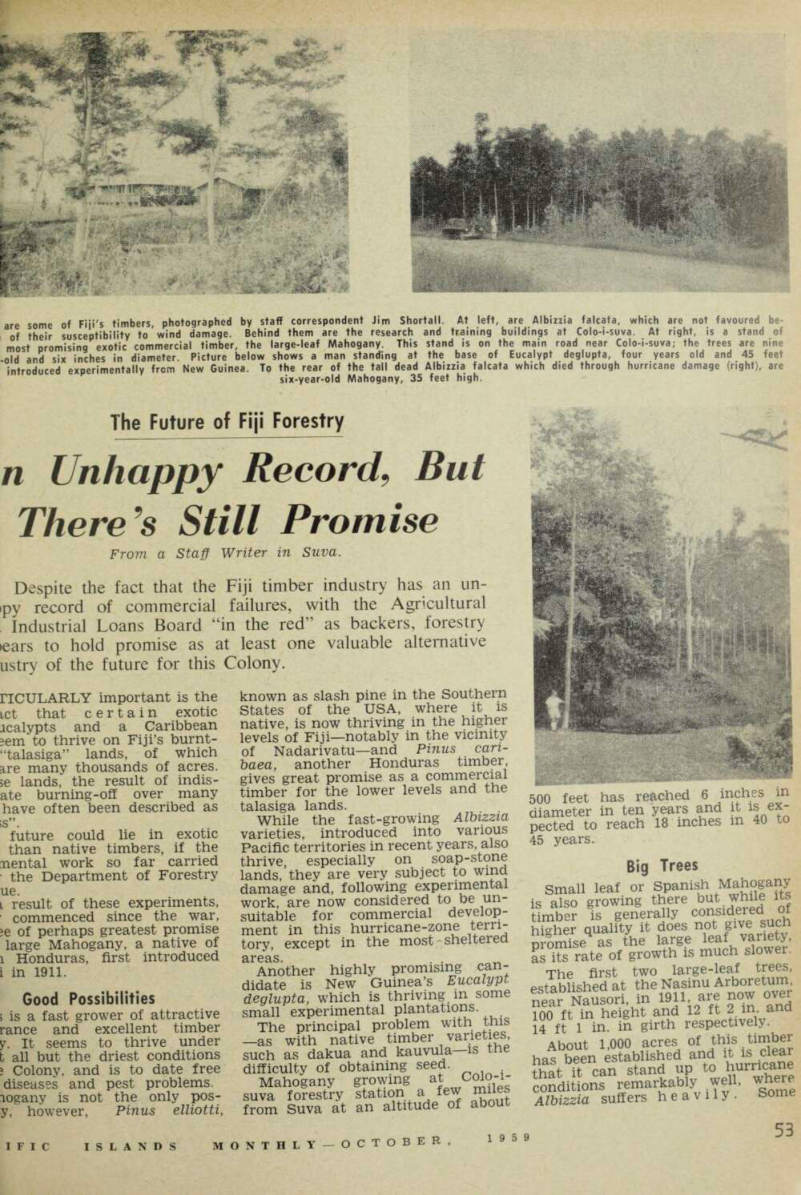
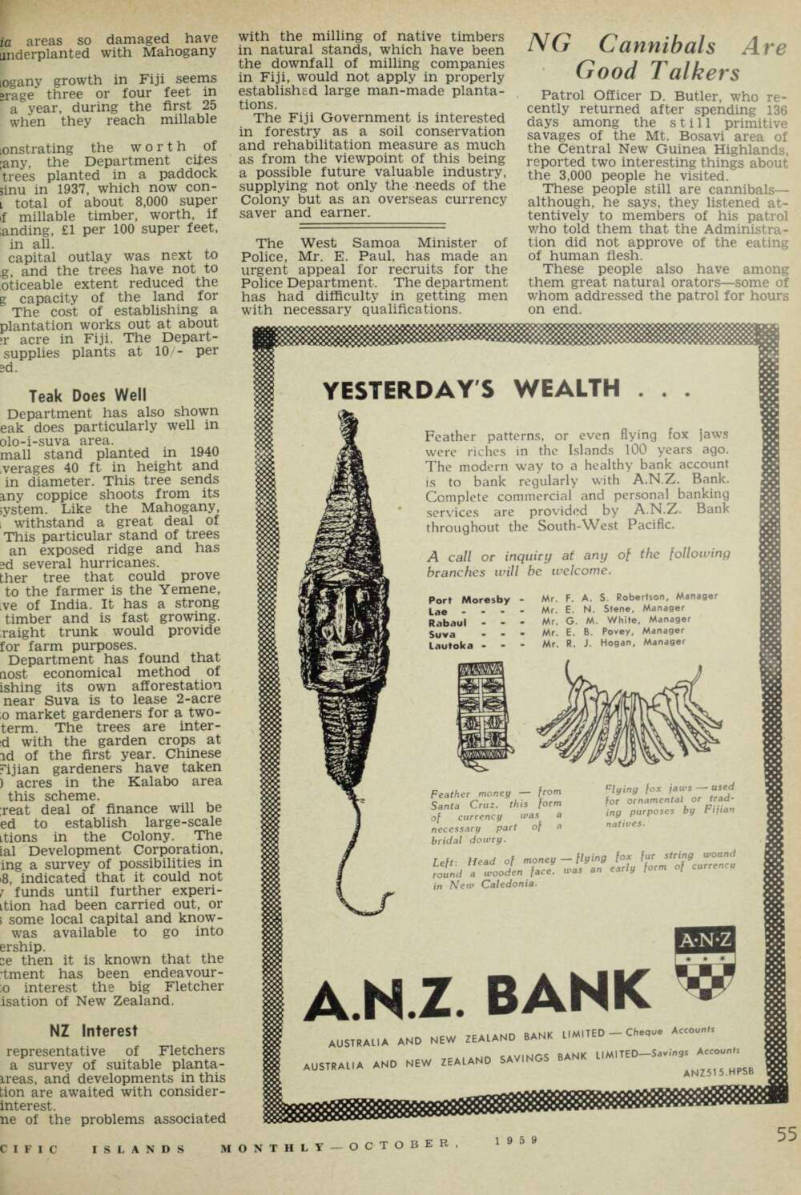
[?] are some of Fiji's timbers, photographed by staff correspondent Jim Shortall. At left, are Albizzia falcata, which are not favoured be -of their susceptibility to wind damage. Behind them are the research and training buildings at Colo-i-suva. At right, is a stand of most oromising exotic commercial timber, the large-leaf Mahogany. This stand is on the main road near Colo-i-suva; the trees are nine -old and six inches in diameter. Picture below shows a man standing at the base of Eucalypt deglupta, four years old and 45 feet introduced experimentally from New Guinea. To the rear of the tall dead Albizzia falcata which died through hurricane damage (right), are six-year-old Mahogany, 35 feet high.
500 feet has reached 6 inches in diameter in ten years and it is ex pected to reach 18 inches in 40 to 45 years.
ia areas so damaged have underplanted with Mahogany logany growth in Fiji seems srage three or four feet in a year, during the first 25 when they reach millable lonstrating the worth of ;any, the Department cites trees planted in a paddock ;inu in 1937, which now con l total of about 8,000 super f millable timber, worth, if ;anding, £1 per 100 super feet, in all. . capital outlay was next to g, and the trees have not to oticeable extent reduced the g capacity of the land for The cost of establishing a plantation works out at about ;r acre in Fiji. The Depart supplies plants at 10/- per “d.
Teak Does Well Department has also shown eak does particularly well in 010-i-suva area, mall stand planted in 1940 ,verages 40 ft in height and in diameter. This tree sends any coppice shoots from its system. Like the Mahogany, i withstand a great deal of This particular stand of trees an exposed ridge and has “d several hurricanes, ther tree that could prove to the farmer is the Yemene, ,ve of India. It has a strong timber and is fast growing. ;raight trunk would provide for farm purposes.
Department has found that aost economical method of ishing its own afforestation near Suva is to lease 2-acre o market gardeners for a two term. The trees are inter id with the garden crops at id of the first year. Chinese Fijian gardeners have taken ) acres in the Kalabo area this scheme. :reat deal of finance will be ed to establish large-scale itions in the Colony. The ial Development Corporation, ing a survey of possibilities in 8, indicated that it could not j funds until further experi ition had been carried out, or ! some local capital and know was available to go into ership. ze then it is known that the ’tment has been endeavour ;o interest the big Fletcher isation of New Zealand.
NZ Interest representative of Fletchers a survey of suitable planta rreas, and developments in this tion are awaited with consider interest. ne of the problems associated
with the milling of native timbers in natural stands, which have been the downfall of milling companies in Fiji, would not apply in properly established large man-made planta tions.
The Fiji Government is interested in forestry as a soil conservation and rehabilitation measure as much as from the viewpoint of this being a possible future valuable industry, supplying not only the needs of the Colony but as an overseas currency saver and earner.
The West Samoa Minister of Police, Mr. E. Paul, has made an urgent appeal for recruits for the Police Department. The department has had difficulty in getting men with necessary qualifications.