Cheaper Electricity
pp. 49-51 · Read in the full issue


y're Shocked By Their Power Charges
Ew Guinea In Search Of
The high cost of electricity is fast displacing the merits various beers as the most popular topic of conversation in lua-New Guinea these days.
j the fussiest NG drinker nits that any beer is better in none at all, but thousands ritory householders are not i that kerosene, or plain, old ied candle power, wouldn’t be than electricity at the present : that product in the Terri r normal power bill is about £l3 a month, compared—as requently remind themselves about £l2 or £l3 for three s in Sydney and most other lian capitals. e was a special upsurge of m recently following an an ;ment that the electricity aking in the Port Moresby ast year made a profit of Local citizens demanded a ion in their electricity bills, lis was refused. Electricity n other towns applauded the .—not because they don’t be n cheaper electricity, but be they don’t believe one area get it cheaper than another. understand the P-NG elec problem, one has to know ie Territory uses diesel power at Port Moresby, Goroka, and Aiyura. These centres lydro-electric schemes. How- Bulolo is a “company town” 3 hydro scheme is private and lot affect the Administration It also serves Wau. Aiyura is
i small agricultural station.
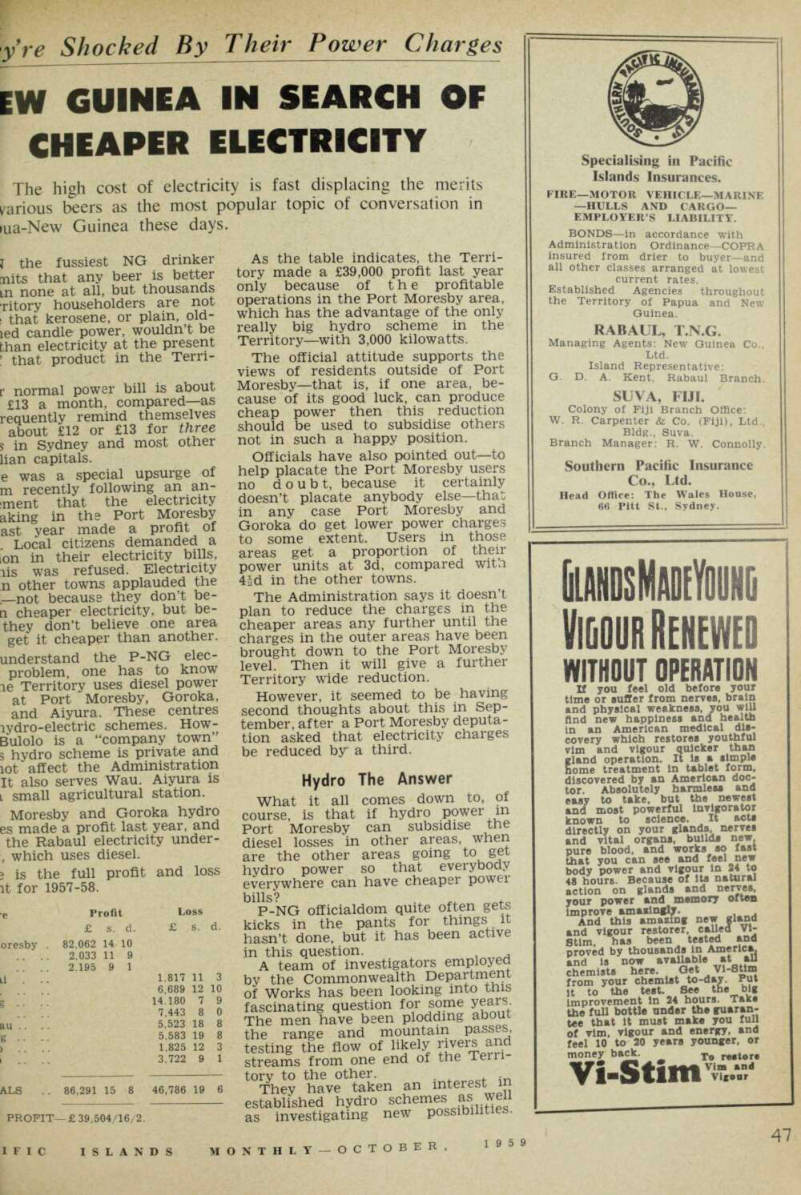
Moresby and Goroka hydro es made a profit last year, and the Rabaul electricity under - , which uses diesel. 3 is the full profit and loss it for 1957-58.
As the table indicates, the Terri tory made a £39,000 profit last year only because of the profitable operations in the Port Moresby area, which has the advantage of the only really big hydro scheme in the Territory—with 3,000 kilowatts.
The official attitude supports the views of residents outside of Port Moresby—that is, if one area, be cause of its good luck, can produce cheap power then this reduction should be used to subsidise others not in such a happy position.
Officials have also pointed out—to help placate the Port Moresby users no doubt, because it certainly doesn’t placate anybody else—tha: in any case Port Moresby and Goroka do get lower power charges to some extent. Users in those areas get a proportion of their power units at 3d, compared with 45d in the other towns.
The Administration says it doesn’t plan to reduce the charges in the cheaper areas any further until the charges in the outer areas have been brought down to the Port Moresby level. Then it will give a further Territory wide reduction.
However, it seemed to be having second thoughts about this in Sep tember, after a Port Moresby deputa tion asked that electricity charges be reduced by* a third.
Hydro The Answer
What it all comes down to, of course, is that if hydro power in Port Moresby can subsidise the diesel losses in other areas, when are the other areas going to get hydro power so that everybody everywhere can have cheaper power bl p S -NG officialdom quite often gets kicks in the pants for things it hasn’t done, but it has been active in this question.
A team of investigators employed by the Commonwealth Department of Works has been looking into this fascinating question for some years The men have been plodding about the range and mountain passes, testing the flow of likely rivers and streams from one end of the ierr torv to the other.
They have taken an interest in established hydro schemes as well as investigating new possibilities.
e Profit Loss £ s. d. £ s. d. oresby . 82,062 14 10 2,033 11 9 2,195 9 1 ii 1.817 11 3 6,689 12 10 i .. 14.180 7 9 7,443 8 0 au .. .. 5,523 18 8 g .. 5,583 19 8 > 1.825 12 3 3,722 9 1
Als
86,291 15 8 46,786 19 6
Profit-
-£39,504/16/2.
Some of their work has gottc stage where decisions shouu made soon.
The men have found thasi Goroka scheme, at 200 kilowatif practically reached its limn might be able to develop 300 that wouldn’t be enough for expansion. This means Gorotal eventually need another scherrn . A nd the Rouna scheme, whi in fact the profitable Port Mil undertaking, will eventually its problems, too. There is ee water to provide for the futunj a dam will have to be built i it can be properly exploited.
At present a pond has ; almost completed to provide c power but this is only a temni measure.
Another difficulty in the S scheme, is that a cliff could po< fall on the water race (whiclo happened in Goroka a cour. times). This could be prevents burying the race but it is consie too expensive to do this a\e moment.
Rabaul Area
To supply Rabaul the inn gators have had a look atr Batonga River, in the Bai, area. It could work. Bothri Warangoi and Kavavas Rivee that area would not be suitaW the Batonga were chosen the i would have to be transmitted miles.
For Wewak the Brandi Rives been looked at, but it is doui if this river will do. The Gum I at Madang, would have em water to supply Madang with h but there would be no room fco pansion.
At Manus, the Lorengau wouu quite suitable as a hydro scM-.
There is such a small populatM the area, however, that it isa likely one will be built for time.
Probably the major work o;c vestigation has gone on the Mil district. Schemes have been loi at there in the hope that one w be found that would supply ■ Madang and possibly Goroka £ towns on the way to Goroka, s one king hit.
The possibilities for such a m scheme look pretty bright althrl it has taken a lot of to get this far.
The Oomsis and Gabensis RS= were looked at and abandoned) cause although they were econora there was not enough water to s Lae’s future requirements.
Lae Schemes
The Sankwep River, which side river from the Busu, 100 very good to the experts for a w# It has the capacity to serve
required a mile long tunnel ; of its development. Every the tunnel would have had upported, which meant that t of building the tunnel may >en a million pounds accord ine estimate, thus the scheme andoned.
Busu itself was a possibility also was abandoned because high cost. A diversion would een necessary to provide the water needed. nes that would have in- Lake Wanum and the Timne tlso abandoned because of nail capacity. most popular scheme, and s that might pay off, is one ig the big Ramu River and i River, somewhere about the n of the Ramu and Markham ; on the valley floor below e is enough water in the River alone for large in -1 development, and a power somewhere around the end Markham Valley could pro ower for Madang, Lae and ghlands, making use of both imu and Wanton Rivers, e would have to be a power i run the 100 miles from the ) Lae and about the same ;e to Madang. line to Lae could follow the
road easily enough, and probably cost about £3,000 a mile.
The line to Madang would be more expensive, because there is no fjprpss road there access roaa mere. r Serve Goroka, Too Power sent up the ranges towards Goroka from a power station at the head of the Markham would have the advantage of opening Highlands areas on the way.
The possibilities of such a com-
bined scheme have been advocated by one or two private persons in New Guinea for some years , The supporters of hydro-electricitv are aware that thg inltial cost Q - f any hydro scheme is expensive. Bu: they point out that once the cost can be raised the scheme soon pays for itself.
The Port Moresby scheme cost about £600,000, but with a profit o £82,000 a year this will be worked out soon.