A "Population
pp. 43-45 · Read in the full issue
Spray Teams At Work In New Guinea Malarial Control May Mean A "Population
By Lew Priday
Dogs barked as our truck turned into the village com pound. Smartly the Malaria Control unit got down with their portable sprayers from the USA and strode to the first of many houses-on-stilts.
THE scene was a village on the road, today kept in excellent condition, which joins two former German administrative centres, Namatanai and Kavieng, still known as the Bulominski Road after the administrator who had it built long ago. The story goes that if the road was not to his liking, he had his carriage carried by the natives across the bad bits —and the horses as well.
A meri, babe in arms, got up with a smile from the threshold and joined her two other children, who at the sight of so many strangers ran howling to the beach.
Yet another New Ireland village, Manuwai, was to be sprayed m the fight to stamp out the Territory s greatest scourge.
So important has the campaign to give Papua-New Guinea a healthier record become, that tne Administrator, Brig. D. M. Cleland, declared only the other day that
control could cause a virtual popu lation “explosion”.
Europeans look forward to this “explosion” with a mixture of approval and dread, yet malaria control is a step that must be taken now if the good name of Australia is to survive.
Big Job Ahead
In the New Guinea Islands, spray ing started in February, in New Hanover: it was extended to Tabar, Lihir, Anir and Tanga off the New Ireland coast; and when I left there recently they were completing the first six months spray on that 2UU mile long island itself.
Spraying of the Bougainville dis trict will start on the same scale in October; in the New Britain dis trict in January next; then the turn of the Manus district will come.
Before the unit arrives m an area, a notice is sent round in pidgin, with simple pictures, show
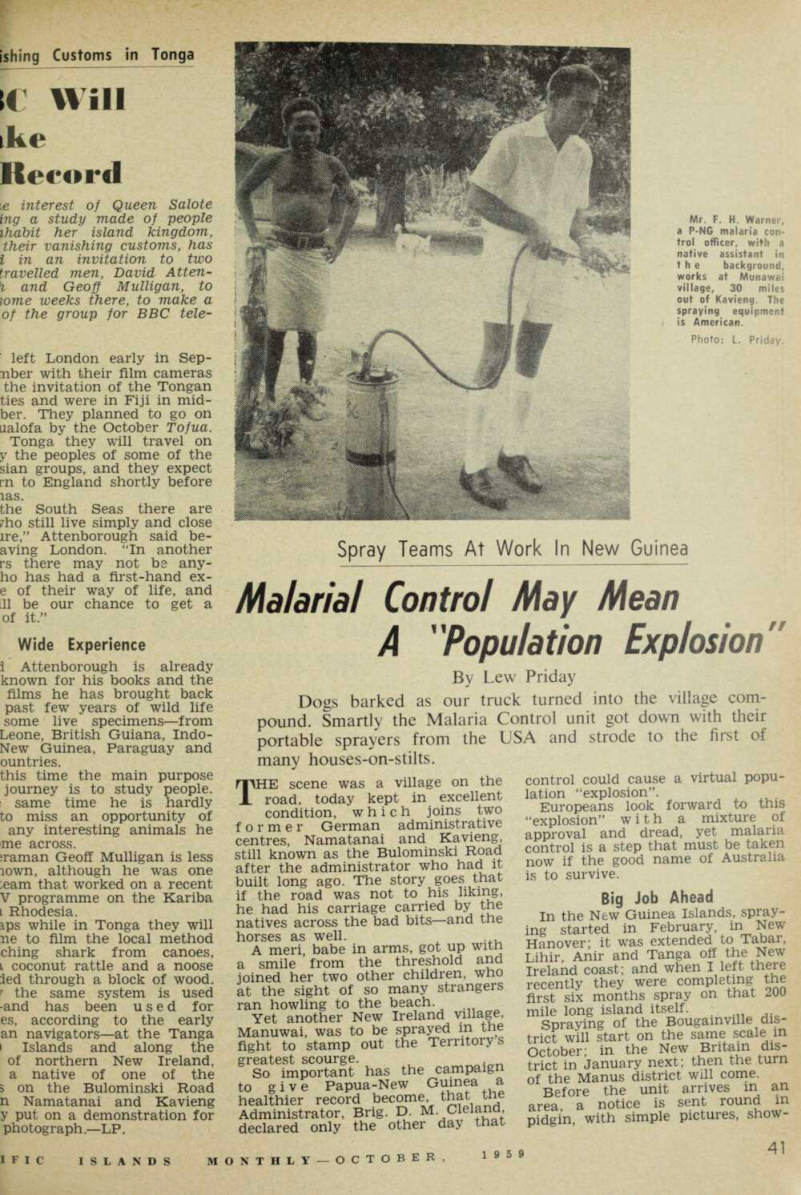
Mr. F. H. Warner, a P-NG malaria con trol officer, with a native assistant in the background, works at Munawal village, 30 miles out of Kavieng. The spraying equipment is American.
Photo: L. Friday.
i natives how they can help, re asked to pile their belong the middle of the bedroom so that the sprays can get walls. travel with as few personal ags as possible. Where there i roads, they hump their s on foot. They must climb y tiny garden house up in s, no matter how steep, high ny. Where trails don’t exist, ust take to the sea. scheme calls for the spray h 50 per cent, dieldrin of all ;s used as sleeping quarters, opheles mosquito, after tak uman blood meal, invariably a a wall, somewhere below ;et from the floor. If it is ed at this stage, the cycle smission is broken.
I you can see dieldrin crystals ng on the walls of every New hut you enter. This means or every fly or mosquito that on them for six months, it may take a few hours for o come. rings are painted on all ;s that have been sprayed, ;er each periodic spraying is :ed, a spoke is added, until ial design will look like a Goes On Three Years dng will be done every six for three years, after which ime a further three-year of surveillance, during which ckets of malaria still found : will be eliminated, few Ireland, where I accom the unit, the complete team ; of two Europeans, four id Papuans, and 14 foremen rs who are local natives. villages volunteer sprayers oiled. times the unit has to split ► two parties, to cover road retches on foot, and where 3 no track at all, as between and Lemusmus, which are rs apart on the north-west hey hired a big sailing canoe attled through very rough r indeed. took nine hours to get up r er to an inland village be heir canoe had a mast, and ad to clear branches out of ty to make progress at all. nad a better trip to Djaul on the hospital ship Mercy.
“Most Efficient"
the Chinese-owned ship o, whose master, David t (his brother Xavier is of Capricornia ), I visited Lihir Island, 30 miles off the eland coast. There we found ilaria unit had walked corn round the island, a matter miles, spraying the dwellings ; 3,600 inhabitants and not g one.
“The most efficient team the administration has ever sent us,”
Mr, Jim Sciortmo, the well known Lihir planter at Londolovit Plantation, said to me over a glass of beer. “It was unusual to see the Europeans in charge really working alongside their native assistants.
“This war on malaria,” he went on, “is the biggest thing that ever happened in the Territory. Already on Lihir there is an advance in domestic cleanliness and physical health. Mark my word, the gain in stature and vitality and the release of physical energy will transform native life. Those who now
criticise natives as supine and lazy will find them more ready to work and co-operate in their own development ”
But it is still difficult to persuade the natives that one mosquito differs from another; and food taboos mental attitudes and traditional prejudices that have contributed to population decline ars difficult to overcome.
There is no use minimising the size of the task New Guinea has undertaken to better the lot of the native inhabitants, whose life an ticipation at present is no more than 37 years.