£78 Millions, Plu[?]
pp. 24-31 · Read in the full issue
The P-Ng Budge
Australia's Gift to P-NG Now Is £78 Millions, Plu[?]
• According to Australia’s . \ presented in Canberra in and the Territory’s Budget sented in Port Moresby mo tember 29 by Treasurer H. .' the following has been the O ment expenditure in Papm ( New Guinea since World IT up to June 30, 1959: Provided by Australia
—a free gift .. .. £78,5,i
Provided from P-NG’s own revenue .. .. 35,2,> Total 113,7.
WITHIN the same period,,! various headings (sui subsidies of shipping and as vices, maintenance of lighth various special grants) Avi has contributed many more irn not included above.
To those totals Australia pq add, in 1959-60, £l3 millions being the grant for “Admiix tion expenses” in budget.
Budget examination shows' in addition to the £l3 nm Australia in this financial t giving Papua and New Guinn following amounts: New Guinea civilian war pen sions, education benefits, medical treatment Subsidy to shipping service Australian School of Pacific Ad ministration For former P-NG superannuation funds Maintaining lighthouse services • Interest on pre-war loans Loans to ex-servicemen for agri cultural enterprises For new lighthouse and equip ment * Out of £25 million earmarked b for the purpose. £250,000 budgeteoo 1958-59, but only £62,000 used.
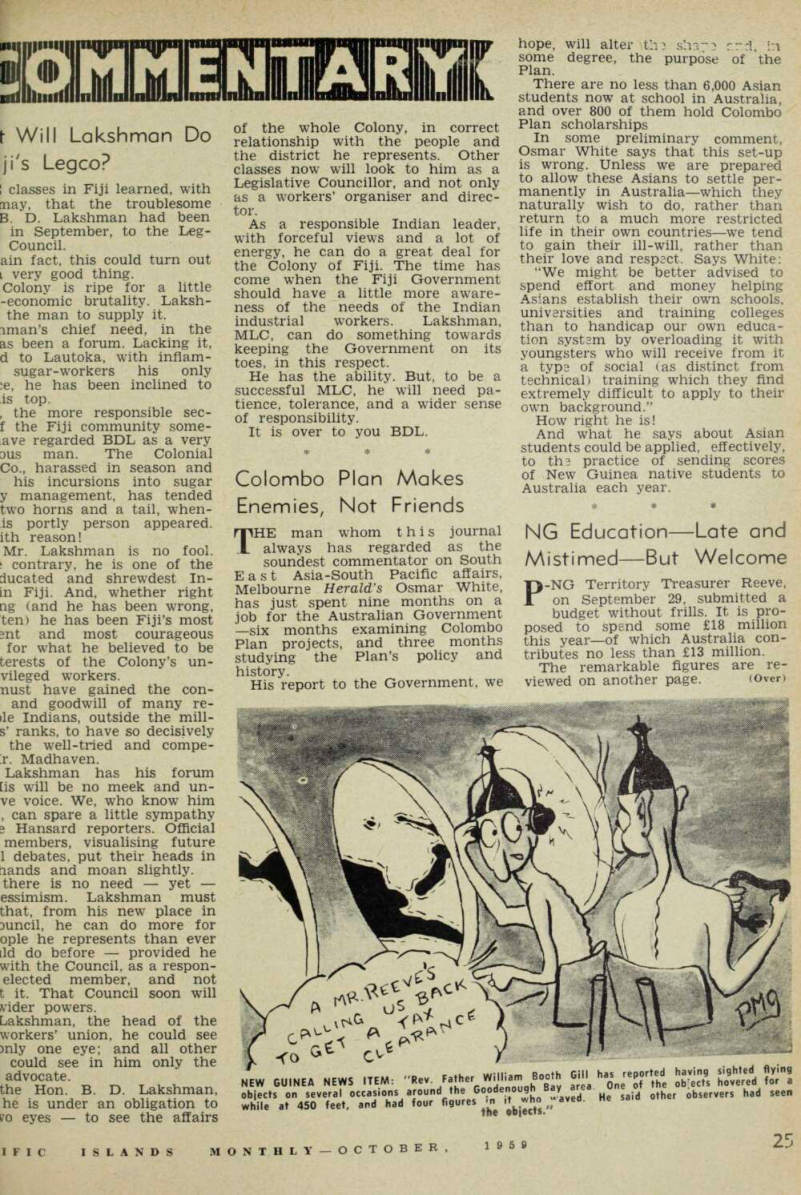
There is a total there o;o £700,000 —and there Is, in acfo expenditure for P-NG autMJ under Army training, public a staffs, maintenance of airfieldb ities, care of wartime cermr and many other things, not ; separately in the Australian tf £l9 m. in P-NG This Ye\ In his budget speech onn tember 29, Treasurer Reeves that he spent £17,077,000 in 111 of which 28i per cent, wes’ salaries, 21.69 per cent, on <
(Continued on page 29)
10 per cent, on maintenance, e balance on "m.scellaneous” ontingencies”. t one-third of that money from P-NG s own revenues, ie balance from Australia’s proposed to spend £18,961,300 i-60 (£l3 million from Aus une 30, P-NG had a staff of ersons. i of Mr. Reeve’s speech was [ to a description of the stration’s activities and ments in advancing native , where the record appeared /ery creditable. hat "Extension" Means expenditures planned cover Taxation Branch (of which srritorians and outsiders now , good deal), and something “Extension Service Branch”. latter is big, new and ic.
'here in this journal, we re a statement by Minister wherein he repudiates— surances amounting to smug plan attributed to him which he was supposed to > in P-NG a newspaper for nental purposes, ppeared that his Territory ; advocated the plan, but he it down. It was not Gov t policy (he said) to interfere eedom of the Press, even to ent of competing with it.
Extension Services Branch is f the same thing. Minister c has planned a large, new ation and printing office, i which films, posters, leaf- Doklets, gramophone records s, radio services, and every i means of encouraging literacy and thought, will be ivailable to the native corn 's. ! of these facilities already rhese and a lot of new things be brought together into iv Administration section, the on Services Branch.
Moresby officials —logically —wanted to include a news service within this planned lation. The Minister turned n.
usurer Coy About Costs
ie plan is to be linked with lore necessary thing—namely, dended effort to increase 7 among the Territory’s 11 . people—it is worthy of sup y all classes.
Treasurer Reeve was coy on esti mates of its cost. The cost is likely to be heavy. A special building, to house the new Branch, is to be built at Port Moresby—one guess is that it will cost £40,000 —without print ing-presses !
The Treasurer similarly was coy about the cost of the new Taxation Branch, now functioning actively, and with the ruthless efficiency of its true parent, the Australian Tax ation Commission.
Effects of The New Tax
He made a guess at what the Territory may gain in direct tax ation, and what it will lose by abandoning export and import
taxes. All figures, as yet, are vague and unimpressive.
The most noticeable result, up to date, are the confusion and em barrassment of the small traders who now are being taxed, and the bitter resentment of the 3,500 public servants, who are losing a slice of their monthly income, without any compensatory benefit whatever.
The Budget naturally came under non-official fire, but was adopted, practically in toto.
Some of the non-official critics were earnest and well-informed; but they were beating empty air. It is now generally recognised that Canberra ignores all the more im portant recommendations of the Council.