ational Airport at iti Takes Shape
pp. 23-150 · Read in the full issue
iti Takes Shape
Special Correspondent mg last, after years of on and delay, the Tahiti
ional Airport is taking
ti the edge of the Bay of
, right alongside the town.
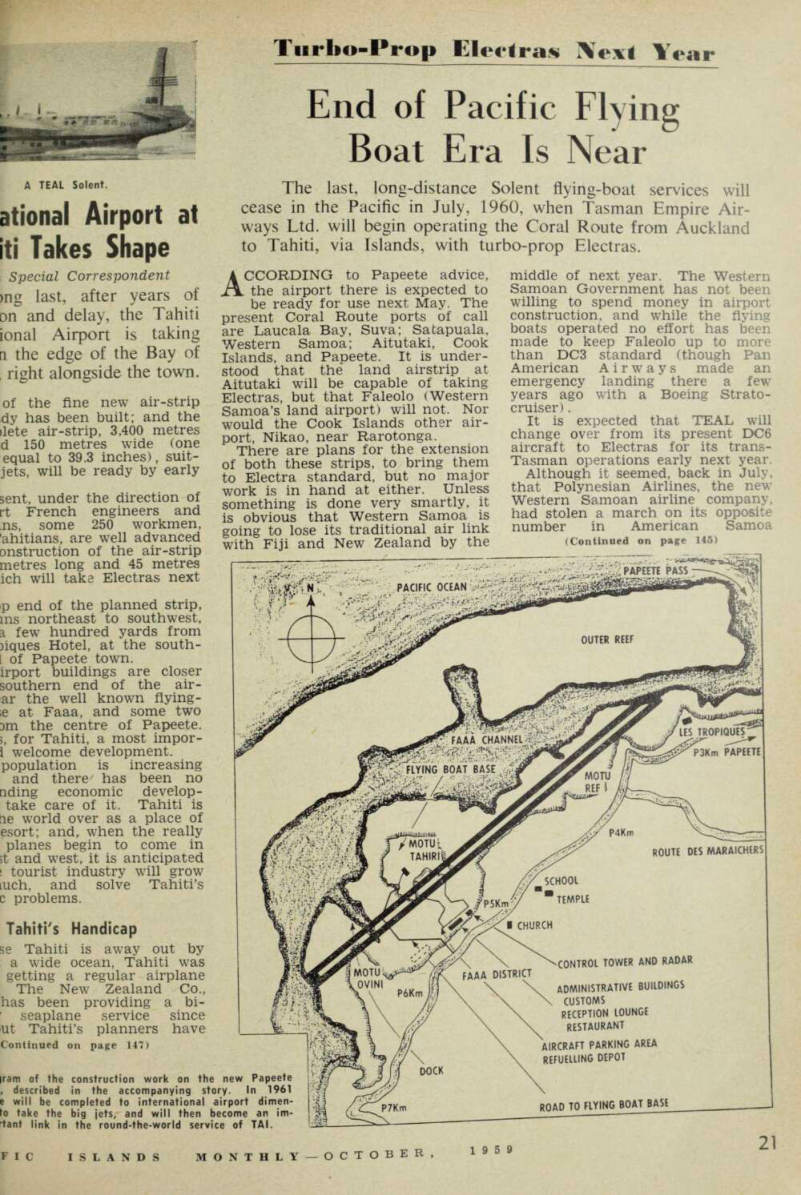
of the fine new air-strip dy has been built; and the ilete air-strip, 3,400 metres d 150 metres wide (one equal to 39.3 inches), suit jets, will be ready by early sent, under the direction of rt French engineers and ,ns, some 250 workmen, 'ahitians, are well advanced [instruction of the air-strip metres long and 45 metres ich will take Electras next p end of the planned strip, ms northeast to southwest, a few hundred yards from jiques Hotel, at the south [ of Papeete town, irport buildings are closer southern end of the air ar the well known flying e at Faaa, and some two im the centre of Papeete. for Tahiti, a most impor l welcome development, population is increasing and there has been no nding economic develop take care of it. Tahiti is tie world over as a place of esort; and, when the really planes begin to come in >t and west, it is anticipated ! tourist industry will grow luch, and solve Tahiti’s c problems.
Tahiti's Handicap
se Tahiti is away out by a wide ocean, Tahiti was getting a regular airplane The New Zealand Co., has been providing a bi seaplane service since ut Tahiti’s planners have
Continued on page 147)
A TEAL Solent.
toking for something bigger might reach deep into the ravel-conscious communities h America, Europe and Aus-
Tahiti was further handicapped because the nearest air-strip for land planes was at Bora Bora, built by the Americans in World War 11, and seaplanes or little ships had to carry passengers from Bora Bora to Papeete.
TEAL’S big seaplanes landed on Papeete harbour, of course; but big seaplanes are no longer economic, and are on their way out.
The leading French airline, TAI, in 1958, began to run a service from Paris, via Middle East and New Caledonia, to Bora Bora—the world’s longest air route. When it appeared that TAI was determined to maintain and extend this service, the Government of France finally decided to proceed with the long projected but very expensive job
of building an international airport on the coral along the edge of th lagoon, near Papeete.
Skilled Staff and Heavy Plant The job was given to the web known French Company, Societe Francais des Dragages, which built the international airport at Hong kong, the new harbour at Bluff (New Zealand), and the great nev dam at Yate, New Caledonia.
The Societe has brought in not only a fine corps of skilled and experienced technicians, but also a large quantity of very heavy machinery bulldozers, stone crushers, power-generators, motor shovels and draglines, and scores of large trucks.
The speed, size and thoroughness
of the job that is being done is a matter of constant wonder to the
pe ? ple^of ahitl -
TeelflutMn ?c°rols
a smill cane Ind ove? a connle of fittle coral P islets nv JnntiS; Pl f It 6 provided e^ie 01 e ngineers with many difficulties. One of the most serious was the discovery that formed at a spot where'l little stream had come down out of the hills—the muck and sand had to be scooped up out of this place, and a solid filling put in.
The problem called for special research and study of coral formations—but it was successfully solved by the young French engineer, M. de la Gardette, and the gap was bridged. fo^d\tton n oT'tan g V S tS d , r nh k sSrfacl cmal for their strm went out 10 miles to the bed of a small river and got hard gravel and rocks: put them through crushers; and thus got a stone base. On top of that went prepared coral rock, and the final airstrip surface is called “coral soup”—a mixture with a base of pulverised coral.
The edge of the strip, which rises slightly towards the centre, is only a few feet above high-water mark.
The present strip is near completion and will represent 18 months of hard work and clever planning.
Good P r °S ress has been made with the airport’s terminal buildings ’ the number and character of which are “
TAI-Air France
It is understood that the French privately owned air operator, Trans- Pr£* r T % s Intercontmentaux (TAI I and the wholly Government- °i^ company, Air France, will shortly pool their names as well as their operational facilities.
The airline will be known as Air- France-TAI or TAI-Air France, or some other combination—exactly what is not yet decided.
At the present time, TAI operates services from Paris through the aK y, S oW J? a p eet ?| iamtl - ,^ ne A , riance s E^ vl 9 e , 1S acrosa At lan tic from Pans to wew YorK - For some time the two companies have been pooling operational facilities, offices, booking agents, etc. The combination of names when it comes, will be a logical development.
It is hoped by the French autL ities that the present Paris-8 York service by Air France s ultimately extend to San Franc.' “><s that the present TAI ses th at terminates at Papeete wir
fxplrte kll this i?ltm in a
state of negotiation and somes from becoming an accompli!, When the French compani©! extend their existing services iti be under the combined Air Frs~ TAI set-up. The only place w the two companies will then opc separately will be in Paris h quarters, where TAI will ultima be responsible to its sharehoh and Air France to the Governnr ~r „
'Complex"
At Present TAI is subsidise, the French Government andb apparently complex situation i 1 scribed as being “something ■ TAA and Ansett-ANA in Austn The Commonwealth Governn owns TAA, but in various assists the privately owned An.
ANA and also has some say in rationalisation of both compq operations.